When facing divorce, many people picture a courtroom drama—lawyers battling it out in front of a judge who holds the final say over their lives. This traditional litigation path can be public, expensive, and emotionally exhausting, turning deeply personal family matters into a public record.
Fortunately, there’s another way. Divorce mediation in North Carolina provides a confidential and structured alternative designed for collaboration over conflict. It offers a faster, less costly, and more private way to resolve your separation.
What Is Divorce Mediation in North Carolina?
Think of traditional divorce litigation like two opposing teams in a stadium. Lawyers argue your case, and a judge, who knows very little about your family, acts as the referee and decides the outcome.
Mediation flips that script entirely. Instead of a public fight, it’s a private, guided negotiation. You and your spouse sit down with a neutral third-party mediator whose only job is to help you find common ground. The mediator doesn't take sides or make decisions for you; they facilitate a productive conversation so you can make the decisions yourselves.
The Power of Self-Determination
The most important principle in mediation is self-determination. Rather than having a judge dictate how your property will be divided or when you’ll see your children, you and your spouse retain control. You become the architects of your own future.
This approach allows for far more creative and practical solutions that fit your family’s unique circumstances.
- Practical Example (Financial): A judge might simply order the family home sold. In mediation, you could agree for one spouse to buy out the other’s interest over several years, keeping the children in their home and community.
- Practical Example (Parenting): Instead of a generic, court-ordered visitation schedule, you can create a detailed parenting plan that accommodates your children's specific activities, your unique work schedules, and your family's holiday traditions.
This control over the outcome is one of the most significant advantages of choosing mediation over a courtroom battle.
How Does Mediation Differ from Court Litigation in NC?
The two paths to resolving a divorce in North Carolina offer very different experiences and outcomes. Understanding these differences is key to making an informed decision about how you want to move forward.
The table below provides a clear, side-by-side comparison of how mediation and traditional court litigation stack up on the issues that matter most to families.
| Aspect | Divorce Mediation | Court Litigation |
|---|---|---|
| Control | You and your spouse make the final decisions together. | A judge makes the final, binding decisions. |
| Cost | Generally far less expensive than going to court. | Can be very expensive due to legal fees, court costs, and expert witnesses. |
| Timeline | Can be resolved in a matter of weeks or months. | Can take a year or more to reach a final resolution. |
| Privacy | Completely confidential and private. | Proceedings and records are part of the public domain. |
| Tone | Collaborative and focused on finding mutual agreement. | Adversarial, with a "winner" and a "loser." |
| Outcome | Creates a customized agreement tailored to your family's needs. | Results in a standardized court order that may not fit your situation. |
As you can see, mediation gives you the power to craft a solution that works for your family, on your own timeline, and without the public scrutiny and high cost of a court fight.
This visual shows the two distinct roads you can take when finalizing your divorce in North Carolina.
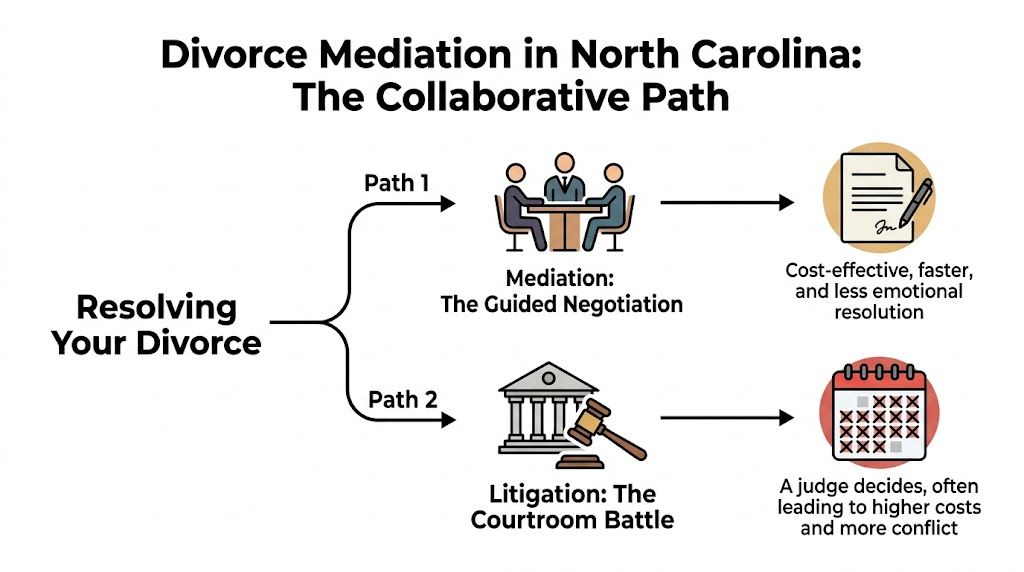
The path you choose has a major impact on your finances, your stress levels, and your ability to co-parent effectively in the future. The guided negotiation of mediation helps preserve family relationships and resources in a way that courtroom conflict rarely does.
Mediation Is a Process, Not a Single Event
It’s important to know that mediation isn't a magic wand. It requires both spouses to engage in good-faith negotiations, prepare financial documents, and be willing to compromise. It takes real work.
But for countless North Carolina families, the effort is well worth it. Mediation provides a clear path to a more peaceful, private, and financially sound resolution, allowing everyone to move forward with their lives on their own terms.
How Does the NC Mediation Process Work?
Thinking about divorce mediation in North Carolina can feel like staring at a huge, tangled knot. But if you break it down, the process is really just a series of clear, manageable steps. This guide will walk you through the entire journey, from finding the right mediator to finalizing an agreement that works for you.

Let's start with the most important decision you'll make at the outset: choosing the right professional to guide you and your spouse.
Step 1: Selecting a Qualified Mediator
In North Carolina, you and your spouse will need to agree on and hire a neutral third-party mediator. This person’s job is to facilitate your negotiations—they don't represent either of you or give legal advice. The best mediators are certified as Family Financial Mediators by the North Carolina Dispute Resolution Commission, which means they’ve met strict training and experience standards.
So, how do you find one?
- Attorney Recommendations: Your own lawyer is a fantastic resource. They can provide a list of respected mediators they trust and have worked with before.
- NC Judicial Branch Roster: The state provides a public roster of certified mediators, which you can easily search by judicial district.
- Professional Organizations: Groups focused on alternative dispute resolution in North Carolina are another great place to look for qualified professionals.
It's absolutely essential that both you and your spouse feel comfortable with the mediator you choose. Their role is to create a balanced and safe environment where you can both negotiate openly to reach a fair outcome.
Step 2: Preparing for Your First Session
Once you’ve hired a mediator, the preparation phase begins. The mediator will usually schedule an initial call to walk you through the process, establish ground rules for communication, and get the first meeting on the calendar.
This is where your attorney becomes invaluable. They’ll help you clarify your goals, understand your legal rights regarding property and support, and develop a clear opening position. This isn't about being aggressive; it’s about starting the conversation from an informed and confident place.
Common Misconception: Many people believe they shouldn't form an opinion on what they want before mediation starts. The opposite is true. The goal of preparation is not to "win," but to be ready for a productive conversation. Coming to the table with a clear understanding of your finances and priorities will make the process smoother and more efficient for everyone involved.
Before you can get down to negotiating, you have to complete one of the most critical tasks: gathering your financial documents.
Step 3: Gathering Your Financial Documents
Successful mediation depends on complete financial transparency from both sides. This is the only way to achieve a fair and legally enforceable division of your marital assets and debts under North Carolina's equitable distribution laws.
Your mediator or attorney will give you a detailed checklist. It will almost always include:
- Income Information: Recent pay stubs, W-2s, and several years of tax returns.
- Property Documents: Deeds for your home, vehicle titles, and up-to-date mortgage statements.
- Bank and Investment Accounts: Statements for all checking, savings, retirement (401k, IRA), and brokerage accounts, typically from the date of separation.
- Debt Statements: All records for credit cards, personal loans, car loans, and any other liabilities.
- Business Records: If a business is involved, you'll need profit and loss statements, balance sheets, and potentially a business valuation.
This financial disclosure isn't optional—it's the bedrock of a fair settlement. Trying to hide assets will not only derail the mediation but can also invalidate the final agreement and lead to serious legal penalties.
Step 4: Negotiating Key Issues and Finalizing the Agreement
With all the financial cards on the table, the real work of negotiation begins. The mediator will guide you and your spouse through the major issues that need to be resolved.
- Equitable Distribution: Dividing all marital property and debts in a way that is fair, though not always a 50/50 split.
- Child Custody and Support: Creating a detailed parenting plan and calculating child support based on North Carolina's guidelines.
- Spousal Support: Deciding if post-separation support or alimony is appropriate based on the facts of your case.
To help you work through sticking points, the mediator might use a combination of joint sessions and private meetings, called caucuses. Once you’ve reached a resolution on every issue, the mediator or one of the attorneys will draft a "Memorandum of Understanding" or a formal Separation Agreement.
Before you sign anything, your own attorney will review the document thoroughly to make sure it protects your rights and reflects the terms you agreed to. Once signed, this agreement becomes a legally binding contract.
How to Resolve Custody and Property in NC Mediation
When you're facing a divorce in North Carolina, the two issues that often cause the most stress are child custody and the division of your property. Taking these disputes to court can turn a private family matter into a public, high-conflict battle.
Mediation offers a different path. It’s a confidential, structured process where you and your spouse work together to create solutions that actually fit your family's needs, rather than leaving your future in a judge’s hands.

Ultimately, this process gives you control over the outcome, guided by an expert who helps you find common ground.
How to Create a Parenting Plan in Mediation
In North Carolina, any custody decision a judge makes must follow one rule: the best interests of the child. In mediation, you and your co-parent get to define what "best interests" means for your children, based on your firsthand knowledge of their personalities, needs, and routines.
Instead of a court-ordered, generic visitation schedule, mediation helps you build a detailed Parenting Agreement. This document can address the real-life details that a court order often misses:
- Holiday and Vacation Schedules: How will you split summer breaks, school holidays, and birthdays in a way that feels fair?
- Decision-Making: Who makes the final call on major issues like education, non-emergency healthcare, and religious upbringing?
- Communication: What are the ground rules for how you and your co-parent will communicate about the kids to keep conflict low?
- Future Changes: What’s the plan if one parent wants to move or a child’s schedule changes dramatically?
A skilled mediator keeps the conversation focused on practical solutions, helping you build a stable co-parenting relationship that will support your children long after the divorce is final.
How to Divide Marital Property Fairly
Trying to divide assets and debts accumulated over a marriage is a huge task. North Carolina law operates on the principle of equitable distribution, which requires a fair division of marital property—not necessarily an exact 50/50 split. Mediation is an ideal setting for this complex negotiation.
Real-World Scenario: Consider a couple where one spouse runs a small local business. In court, a judge might order a costly and time-consuming business valuation, then require the business-owning spouse to pay the other spouse a lump sum, potentially forcing them to sell the business. In mediation, they could agree to a structured payout over several years, preserving the business and the income it generates for the family.
The process works because it requires both parties to provide full financial disclosure, from retirement accounts and investments to credit card debt and car loans. A mediator ensures every asset and debt is on the table, valued correctly, and divided in a way both of you agree is fair. You can learn more about the specifics in our guide on what equitable distribution means in North Carolina.
This collaborative approach isn't just a nice idea—it's incredibly effective. It’s particularly good at untangling the toughest issues, helping families avoid the massive emotional and financial toll of a court battle.
How Much Does Divorce Mediation Cost in NC?
One of the first questions on anyone’s mind when considering divorce mediation is simple: what’s this going to cost me? While the emotional benefits of a calmer process are easy to see, you need a clear picture of the financial side to plan effectively. The good news is that mediation is almost always far more cost-effective than battling it out in court.
In private mediation, the primary expense is the mediator’s fee, which is billed at an hourly rate. These rates vary across North Carolina depending on the mediator’s experience and location, but the cost is almost always split between you and your spouse. This shared expense creates a natural incentive for efficiency—the more you cooperate to find common ground, the less you both spend.
What Is the Difference Between Private and Court-Mandated Mediation?
It’s important to know that North Carolina has two very different types of mediation. When parents can’t agree on child custody, the state requires them to attend custody mediation, which is offered free of charge through the court system.
But this mandatory, free service only covers parenting issues. Every other financial aspect of your divorce has to be settled separately.
- Free Custody Mediation: This state-funded program, mandated by N.C. Gen. Stat. § 50-13.1, is designed to help parents create a child custody and visitation schedule. It’s a required first step before you can take a custody disagreement to trial.
- Private Financial Mediation: This is a voluntary process for untangling finances—things like equitable distribution (dividing property and debt), alimony, and calculating child support. This is where you hire and pay for a private mediator to guide you.
Why Is Mediation Cheaper Than Going to Court?
To see the true financial value of mediation, you have to compare it to the alternative: litigation. A contested divorce that goes to trial is unpredictably expensive. Costs can quickly skyrocket into the tens of thousands of dollars for each person.

Think about all the costs involved in a court battle:
- Large attorney retainers to even get started
- Constant hourly billing from your lawyer
- Fees for expensive expert witnesses, like property appraisers or forensic accountants
- Court filing fees and other administrative expenses
Mediation isn’t just an expense; it’s an investment in a more peaceful, private, and financially predictable outcome. By sidestepping the open-ended costs of a court fight, you and your spouse get to keep more of your hard-earned assets for your own futures.
By choosing divorce mediation for your financial matters in North Carolina, you’re choosing a process that puts you in control of the timeline—and by extension, the total cost. For a closer look at the numbers, you can explore our guide on the overall cost of divorce in North Carolina. This predictable, structured path is why so many couples find it’s the smartest financial decision they can make.
When Is NC Mediation Not the Right Choice?
While divorce mediation in North Carolina is a powerful tool for many couples, it simply isn’t designed for every situation. The process is built entirely on good-faith negotiation, transparency, and safety. If those core elements are missing, mediation can be ineffective at best and deeply unfair—or even dangerous—at worst.
In certain circumstances, the formal structure and protections of the court system are not just a preference; they are a necessity. Your safety and your right to a just outcome must always come first.
Cases Involving Significant Power Imbalances
Mediation works when both spouses can advocate for themselves on relatively equal footing. If one spouse has a history of controlling the other—emotionally, financially, or psychologically—a fair negotiation becomes nearly impossible.
This kind of power dynamic can silence the less dominant spouse, preventing them from voicing their true needs or concerns. The result is often a one-sided agreement. In these cases, having a dedicated attorney to speak for you in a formal court setting is the only way to level the playing field.
Cases Involving Domestic Violence and Abuse
The biggest red flag for mediation is any history of domestic violence or abuse. The process demands open and honest dialogue in a safe space, which is fundamentally impossible when one person is afraid of the other.
North Carolina law explicitly acknowledges this danger. If a court determines a party has been the victim of domestic violence, it has the authority to waive the mandatory custody mediation requirement. Your safety is the priority, and you should never be forced to negotiate directly with an abuser.
Cases Involving Dishonesty and Hidden Assets
Successful mediation of financial matters depends on complete transparency. Both parties must be willing to lay all their cards on the table—disclosing all income, assets, and debts honestly. If you suspect your spouse is hiding money, underreporting business income, or being deceptive about their finances, mediation is not the right path.
The traditional litigation process includes a powerful tool called "discovery," which allows your attorney to use subpoenas and depositions to uncover hidden assets. Mediation has no such power. When one party won't be honest, going to court is often the only way to ensure a truly equitable distribution. For those seeking alternative but structured negotiation methods, exploring a collaborative divorce attorney in North Carolina may offer a suitable middle ground.
In these difficult scenarios, turning to the court system isn’t a sign of failure. It is a smart and necessary step to protect yourself, your children, and your financial future.
North Carolina Divorce Mediation: Frequently Asked Questions
Considering divorce mediation in North Carolina? It’s a smart move for many couples, but you’re bound to have questions. We’ve put together straightforward answers to the questions we hear most often from clients about the mediation process.
Is Mediation Required for a Divorce in North Carolina?
The answer is yes and no, because North Carolina law treats child custody differently from financial matters.
When it comes to child custody, the law is crystal clear. North Carolina General Statute § 50-13.1 states that if parents can’t agree on their own, they must go through a mandatory mediation session before a judge will hear their case. The state court system even offers this program at no cost.
For financial issues like property division (equitable distribution) and spousal support, mediation is typically voluntary. However, judges and attorneys strongly encourage it as a faster, more collaborative alternative to a lengthy court battle. Most couples who choose private financial mediation find it saves them a great deal of money, time, and stress.
Do I Still Need a Lawyer if We Have a Mediator?
Yes. Having your own independent attorney isn't just a good idea—it's essential for protecting your rights. It's a common misunderstanding that the mediator can give legal advice to both spouses, but that’s not their role at all.
What is a mediator's role? A mediator’s job is to be a neutral third party. They facilitate the conversation and guide negotiations, but they cannot legally or ethically provide advice or advocate for either side. To do so would be a clear conflict of interest.
Your attorney has a completely different and vital role. They are your personal advocate, responsible for:
- Explaining Your Legal Rights: Making sure you fully understand your rights and obligations under North Carolina’s specific family laws.
- Analyzing Settlement Offers: Helping you evaluate proposals from your spouse to decide if they are fair, sustainable, and in your long-term best interest.
- Drafting and Reviewing Agreements: Ensuring the final agreement is worded correctly and provides the legal protection you need for the future.
Going into mediation without your own lawyer is like negotiating blind. You could unknowingly agree to an unfair or unbalanced settlement that you can’t easily undo.
What Happens if We Cannot Reach an Agreement in Mediation?
If you can’t resolve every single issue, the mediation wasn’t a waste of time. Any progress you make is a win. When you hit a wall on a particular issue, it’s known as an impasse.
For mandatory custody mediation, the mediator simply reports to the court that you reached an impasse. Your case will then move forward to a custody hearing, where a judge will hear from both sides and issue a ruling based on the child's best interests.
For voluntary financial mediation, any topics you couldn't agree on will proceed toward a traditional court resolution. Even reaching a partial agreement is a huge victory. For instance, if you settle how to divide all your assets except the family business, you’ve just dramatically narrowed the scope of what you have to fight about in court. That directly translates to lower legal fees and less time spent in litigation.
Start Your Path to a Peaceful Resolution in North Carolina
This guide has shown that divorce mediation in North Carolina offers a path forward defined by control, confidentiality, and civility. It’s a process designed to empower you and your spouse to make your own decisions, rather than handing that power over to a judge in a public courtroom.
By focusing on collaboration, you can protect your assets, create a stable co-parenting future, and close this chapter with dignity. If you are feeling overwhelmed by the prospect of divorce, you don’t have to navigate it alone. Choosing the right legal partner is the most important step you can take to secure a fair outcome.
Take Control of Your Future Today in North Carolina
Our firm is dedicated to guiding North Carolina residents through the complexities of divorce. We believe in empowering our clients with the knowledge and strategy needed to build a stable, secure future for themselves and their children. We work to protect your rights while minimizing the conflict that can make this process so difficult.
Mediation provides a constructive alternative to a contentious court battle, but it's crucial to have an experienced advocate in your corner. An attorney ensures you understand the full implications of every decision, from dividing retirement accounts to crafting a parenting plan. They will also review the final agreement to make sure it is legally sound and truly protects your long-term interests.
Taking the first step is often the hardest part, but it is also the most critical. A productive resolution starts with understanding your rights and options under North Carolina law.
Don't leave your future to chance. We are here to provide the clarity and strategic representation you need.
Take the first step toward a constructive resolution. Contact the Law Office of Bryan Fagan for a consultation to discuss whether mediation is the right choice for you and your family. Schedule your appointment at https://bryanfaganlaw-nc.com.