
You may be sitting at your kitchen table with a notebook, a stack of mail, and a phone full of unanswered questions. You may not even be sure whether you're ready to file. Individuals scheduling a first divorce consultation in North Carolina are often not calm and organized when they start. They're worried about the house, the children, the bank accounts, and what happens next.
That uncertainty is exactly why preparation matters.
A first meeting with a divorce lawyer can feel like a fact-finding exercise if you walk in with only a general story. It becomes much more useful when you arrive with dates, documents, and a clear sense of your priorities. Instead of spending the entire meeting reconstructing basic facts, you and the attorney can use the time to identify pressure points, talk through likely legal issues, and decide whether immediate action makes sense.
I've seen the difference many times. One person comes in saying, "My spouse handled everything." Another comes in with a short timeline, recent financial statements, and copies of prior agreements. The second client usually leaves with more clarity, not because the case is easier, but because the information allows for a more strategic conversation from the start.
Your First Step Toward a Clearer Future
Seeking information on how to prepare for a divorce consultation in NC often indicates a desire to regain some control. That's a good instinct. Divorce is personal, but your first consultation works best when you treat it like preparation for an important business and legal meeting.
A common situation looks like this. A spouse has recently separated, or is seriously considering it, and wants answers fast. They want to know who stays in the home, what happens with the children, whether support may be an issue, and how long the process could take. Those are reasonable questions, but the attorney's answer depends on facts, not just fears.
The strongest first consultations usually happen when the client has already gathered the basics and can explain the timeline clearly. That means knowing key dates, identifying major assets and debts, and bringing any documents that might change the legal picture. Even if you don't have everything yet, partial organization is far better than none.
Preparation doesn't remove the stress of divorce. It gives that stress a structure, which makes legal advice far more useful.
If you're still deciding whether to meet with counsel, reviewing what a North Carolina divorce lawyer needs to evaluate can make the process feel less intimidating. The first meeting isn't about having every answer. It's about bringing enough reliable information to start making informed decisions.
A productive consultation should leave you with more than general reassurance. It should leave you with a clearer understanding of what matters now, what can wait, and what you need to protect moving forward.
Understanding What Your NC Attorney Will Evaluate
North Carolina divorce cases usually turn on a small set of legal questions, even when the personal history feels far more complicated. The North Carolina State Bar explains that the process is built around five core issues: property division, alimony, child support, custody or visitation, and divorce itself. It also notes that these issues may be resolved by consent or contested in court, and that negotiation or mediation is often less expensive and less time-consuming than trial, as outlined in the State Bar's overview of the North Carolina divorce process.
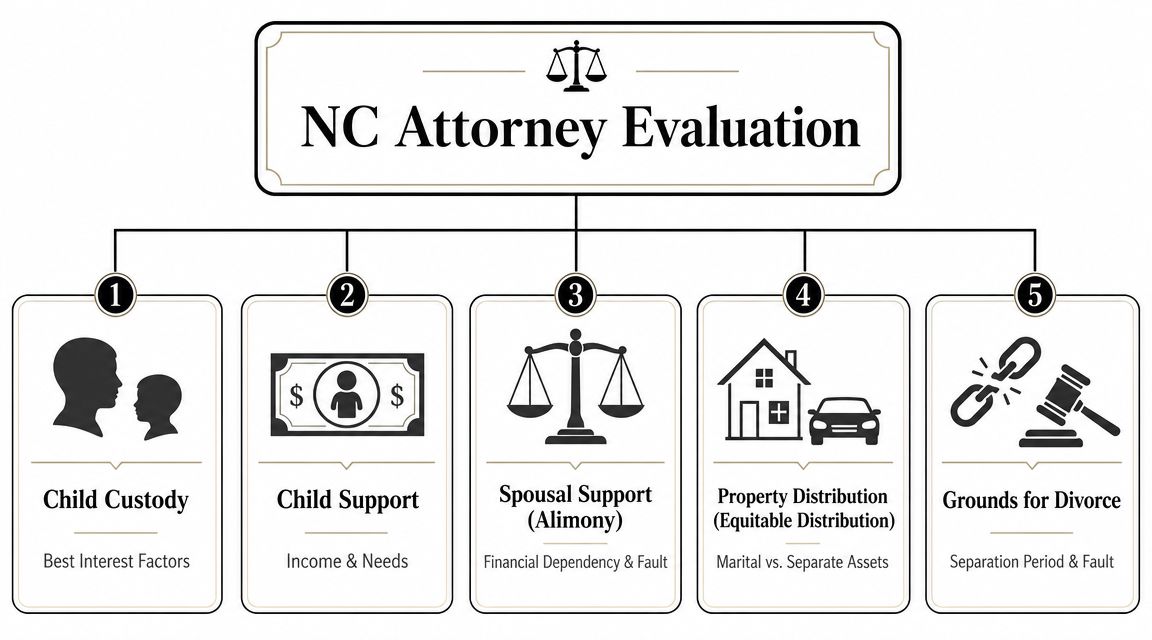
Divorce itself
In plain English, this is the legal end of the marriage. In North Carolina, the attorney will immediately want to know the date of marriage and the date of separation. Those dates are basic, but they shape almost everything else.
If a client says, "We split up sometime last year," that's not very helpful. If the client says, "We began living separate and apart on this specific date," the attorney has a firmer starting point for evaluating the case.
Property division
North Carolina uses the term equitable distribution for property division. That means the court looks at marital property and marital debt, then addresses how it should be divided under North Carolina law. If you want a deeper look at that concept, this explanation of equitable distribution in North Carolina is a useful companion.
For consultation purposes, the question isn't just "What do you own?" It's also "When was it acquired?" Homes, vehicles, retirement accounts, business interests, and debt all need context.
Alimony and post-separation support
Support questions usually require a close look at income, expenses, and the financial relationship between the spouses. An attorney will also want to know whether one spouse has been financially dependent on the other and whether there are facts that may affect support claims.
Custody and visitation
When children are involved, the consultation often becomes urgent. The attorney will want children's birthdays, current living arrangements, school schedules, caregiving roles, and whether there are already any informal or written parenting arrangements in place.
Child support
Child support depends heavily on reliable financial information and the children's needs. A vague answer such as "I pay for most things" doesn't help much. Specific records and actual expenses do.
Practical rule: If a fact could affect one of these five issues, bring it in writing if you can.
Your Essential Document Gathering Checklist
Before a consultation, a common error is either providing almost no documents, or presenting a box of unsorted papers and expecting the attorney to organize them immediately. Neither strategy is effective.
A better method is to group your information into categories. That keeps the meeting focused and helps the lawyer spot missing pieces quickly.
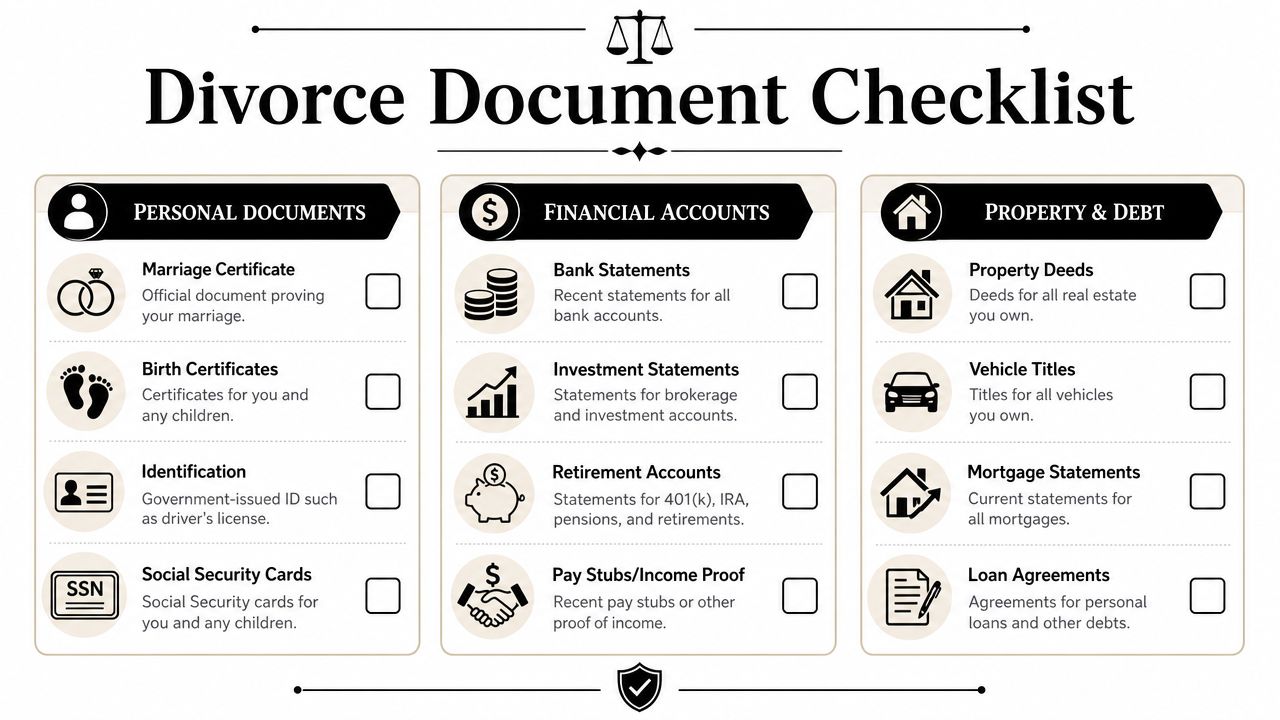
Personal and marital information
Start with the facts that frame the marriage and separation.
- Key dates: Write down the date of marriage and the date of separation. Don't rely on memory in the meeting.
- Addresses: Include current addresses for both spouses and recent shared addresses if relevant.
- Basic identity documents: Government-issued identification and any document that confirms names used during the marriage can help avoid confusion in filings or account records.
- A short timeline: List major milestones such as marriage, move-outs, reconciliations if any, and when children began living in the present arrangement.
This information sounds simple, but it often saves a surprising amount of consultation time.
Child-related records
If children are involved, organize this section separately. Don't bury it inside your financial folder.
- Birth information: Children's names and birthdays.
- School or daycare information: Enrollment details, schedules, and records that show who handles transportation or care.
- Child-related expenses: Bring documents that show recurring costs such as daycare, school-related expenses, medical costs, or activity expenses if those are already a point of disagreement.
- Existing agreements or orders: If a court has already entered an order, or if you've signed any custody-related agreement, bring it.
A parent who says, "We usually just figure it out," may still need immediate guidance if conflict has started or communication has broken down.
Here is a quick overview of how to think about the paperwork:
| Category | What to gather | Why it matters |
|---|---|---|
| Personal facts | Marriage date, separation date, addresses, timeline | Gives the attorney a legal and practical starting point |
| Children | Birthdays, school records, expense records, existing arrangements | Helps assess custody, visitation, and support issues |
| Agreements and filings | Court papers, separation agreement, prenup or postnup | These documents can change strategy quickly |
| Property records | Deeds, titles, loan statements, account summaries | Helps identify what needs review for division |
For a practical overview of forms and filings, many clients also benefit from reviewing common divorce papers used in North Carolina.
Legal papers that can change the conversation
Some documents matter more than clients realize.
- Court filings: Complaints, motions, notices, or signed orders from any related case.
- Separation agreements: These may already address property, support, or parenting.
- Prenuptial or postnuptial agreements: If one exists, the attorney needs to see the full document.
- Property documents: Deeds, vehicle titles, mortgage statements, or loan papers.
Bring the actual document if possible, not your memory of what it says.
A short video can also help you think through what to gather before the meeting.
Organizing Your Financial Picture for NC Law
For many clients, finances are the hardest part of the consultation. That's normal. One spouse may have managed the banking, taxes, investments, or debt payments for years. Even in that situation, you can still prepare well enough to make the first meeting productive.
North Carolina practice guidance recommends bringing tax returns for the last 3–5 years, along with pay stubs, bank statements, and a list of assets and debts. That documentation helps the attorney evaluate marital property, potential support issues, and whether expert valuation may be needed for assets such as homes or businesses, as described in this North Carolina divorce consultation preparation guide.

What to gather before the meeting
Think in terms of income, accounts, property, and debt.
- Income records: Recent pay stubs, bonus information if available, and other proof of regular income.
- Tax records: Tax returns for the period noted above, plus any schedules that show business income, rental income, or investment income.
- Bank account statements: Individual and joint accounts.
- Retirement and investment records: Statements for retirement accounts, brokerage accounts, and similar holdings.
- Debt records: Credit card statements, personal loans, vehicle loans, and mortgage statements.
- Property list: A written summary of major property owned by either spouse, including real estate, vehicles, business interests, and valuable personal items.
The goal isn't to create a perfect accounting before the consultation. The goal is to give the attorney a workable snapshot.
What helps and what doesn't
Clients often ask whether screenshots from a phone banking app are enough. Sometimes they're useful as a placeholder. They usually aren't a substitute for organized statements that show account names, balances, and time periods.
What helps:
- A simple spreadsheet or written summary of assets and debts
- Documents arranged by category
- Recent statements plus older records when the history matters
- A monthly budget draft, even if you aren't sure it's complete
What doesn't:
- Guessing at balances
- Saying your spouse "probably" has an account
- Bringing only totals without supporting documents
- Leaving out debt because it's in the other spouse's name
If you're unsure whether a financial record matters, bring it. It's easier to set a document aside than to build strategy around missing information.
Why this level of detail matters
Financial organization does two things in a first meeting. First, it helps the attorney identify the likely scope of property and support issues. Second, it helps uncover hidden complications early, such as missing account history, business valuation questions, or unclear debt responsibility.
A client who can explain income, monthly expenses, major assets, and known debts with documents will usually get a more concrete early assessment than a client working from memory alone. If you're comparing options for counsel, firms such as the Law Office of Bryan Fagan often ask prospective clients to gather financial records, property information, and custody-related documents before the first meeting because those materials make the consultation far more useful.
Preparing Your Questions and Personal Story
A consultation isn't only for the lawyer to evaluate you. It's also your chance to decide whether that lawyer is a fit for your case, your communication style, and your goals.
Many people waste this part of the meeting by telling an unstructured story for most of the appointment, then leaving without asking the practical questions that matter. A better approach is to prepare both a concise narrative and a short question list.

How to tell your story clearly
Keep your summary chronological and focused on facts that affect legal decisions.
A useful outline might include:
- when the relationship began and when you married
- when problems became serious
- when separation occurred or is expected
- where the children are living now
- what financial arrangements exist at the moment
- whether there has been any prior court involvement
- what outcome matters most to you
This doesn't need to be polished. It does need to be organized. If the attorney has to interrupt repeatedly to find out basic dates or correct the timeline, the meeting loses momentum.
Questions worth asking
Ask questions that help you evaluate process, judgment, and communication.
- How do you usually approach cases like mine in North Carolina?
- What facts do you need from me before you can give more specific advice?
- Do you see any issue that may need immediate attention?
- How do you communicate with clients during the case?
- How are fees billed, and what work is included in that billing structure?
- What can I do now to avoid making the case harder or more expensive?
These questions often reveal more than broad inquiries like "Can I win?" Family law is rarely that simple.
The best first meetings don't produce certainty. They produce direction.
Common misconceptions to leave behind
Some clients think they need to prove every allegation at the first consultation. You don't. The first meeting is about assessment and planning.
Others think they should hide embarrassing or difficult facts until later. That's a mistake. A lawyer can usually work with a hard fact. Surprise is much harder to manage than a problem disclosed early.
Common Questions About the First Consultation
| Question | Answer |
|---|---|
| Is the consultation confidential? | In general, conversations with a divorce attorney during a consultation are treated as confidential. If you have concerns about who may have access to your email, phone, or shared accounts, mention that at the start of the meeting. |
| Should I bring my spouse to the consultation? | Usually, no. A divorce consultation is typically a private meeting where you can speak openly about your concerns, goals, and questions. |
| What if I don't have every document yet? | You can still meet with an attorney. Bring what you have, plus a list of what you know exists but haven't gathered yet. Partial preparation is still useful. |
| How long will the consultation last? | That varies by firm and by the complexity of the issues involved. Ask when scheduling so you know how much time you'll have and whether the firm wants documents sent in advance. |
| How much will the first meeting cost? | Consultation fees vary by attorney and office policy. The best approach is to ask directly when you schedule. You should also ask how ongoing fees are billed if you decide to hire counsel. |
One more practical point. If there are safety concerns, urgent parenting issues, or immediate financial problems, say that early when you call. The office may want specific records before the meeting or may need to schedule you differently.
Schedule Your North Carolina Divorce Consultation Today
Preparing for a divorce consultation doesn't solve the case. It does something almost as important. It turns your first meeting into a strategy session instead of a rushed attempt to piece together missing facts.
If you've gathered your dates, organized your financial records, collected key agreements, and written down your questions, you've already taken an important step. You're no longer reacting blindly. You're preparing to make decisions with better information.
That's the value in learning how to prepare for a divorce consultation in NC. You walk into the meeting ready to discuss your future, not just your stress.
If you live in North Carolina and you're considering separation or divorce, schedule a confidential consultation and bring the facts that matter most. A careful first meeting can help you understand your options, protect your position, and move forward with a clearer plan.
If you're ready to talk through your situation, the Law Office of Bryan Fagan can review your concerns, discuss the North Carolina issues affecting your case, and help you take the next informed step.