If you're searching what if my ex refuses to pay child support nc, you're probably already feeling the effect in real time. The payment was supposed to cover groceries, daycare, school costs, gas, or rent. Instead, you're left deciding which bill gets paid first while the other parent ignores a court order.
That frustration is justified. Child support isn't a favor. It's a legal obligation ordered for your child's benefit.
This problem is also far more common than many parents realize. The average amount of child support due in 2013 was $5,774 annually, but only 68.5% of that was paid, which left custodial parents short by about $1,824 per year according to this North Carolina child support discussion citing U.S. Census Bureau data. When support stops, the gap doesn't stay on paper. Parents and children feel it immediately.
North Carolina gives you real enforcement tools. Some cases are best handled through the state agency. Others need direct court action, fast. If you want a broader overview of how support obligations work, this guide on child support in NC laws is a useful starting point.
Your Ex Missed a Child Support Payment Now What
The first missed payment matters.
A lot of parents make the same mistake here. They wait, hoping the other parent will catch up next week, or after the next paycheck, or after one more promise. Sometimes that happens. Often it doesn't, and the arrears keep growing while your proof gets weaker.
Treat the missed payment like a legal issue, not a personal argument
In North Carolina, unpaid child support is not just bad co-parenting. It's noncompliance with a court order. That distinction matters because your best remedy usually isn't another emotional text message. It's documentation, enforcement, and a strategy that fits the facts.
Some parents worry they'll look aggressive if they act quickly. In practice, prompt action usually protects you. It also protects your child from a pattern that becomes harder to unwind later.
Practical rule: The longer you rely on verbal promises, the harder enforcement becomes.
You are not powerless, but you do need a plan
The right response depends on what kind of nonpayment you're dealing with. If your ex has a regular job and is failing to send the money, administrative enforcement may be very effective. If your ex is self-employed, hiding income, working for cash, or openly ignoring the order, court action may be the stronger option.
That strategic choice is where many parents get stuck. They know support is owed. They don't know whether to call Child Support Services, file in court, or do both.
Here is the immediate takeaway:
- Don't assume one missed payment is too small to address
- Don't rely on memory alone
- Don't confuse excuses with legal defenses
- Do start building the record right away
North Carolina gives courts and agencies serious enforcement authority. The key is using the right tool early, before missed support becomes an entrenched pattern.
Immediate Steps to Protect Your Rights
Before you file anything, get organized.
Parents often come into my office with a phone full of messages and a rough idea of what's missing. That is understandable, but it isn't enough. Enforcement works better when you can show exactly what was ordered, what was paid, what wasn't paid, and when the default began.
Start a clean payment record
Create a simple ledger. It can be a notebook, spreadsheet, or organized file, but it needs to be consistent.
Track:
- Due date: The date each payment was supposed to be made
- Amount ordered: Use the amount from the court order, not what the other parent says they can pay
- Amount received: Note partial payments clearly
- Method of payment: Direct deposit, check, cash app, money order, or no payment
- Related messages: Save texts or emails where the other parent admits missing payment or explains why
If support has been paid informally, document that too. Informal payment history can matter, but courts and agencies still want a reliable record.
Be careful how you communicate
You don't need to start a fight to protect your case.
A short written message is often enough: confirm that the payment was due, state that it hasn't been received, and ask when it will be paid. Keep it calm. Avoid threats, insults, or long arguments about the past. Written communication can become evidence later, and clear messages usually help more than angry ones.
Put important communication in writing. A verbal promise is easy to deny. A text or email is much harder to explain away.
Figure out whether this is can't pay or won't pay
This is one of the most important distinctions in North Carolina child support enforcement. Existing legal guides often fail to distinguish between a parent who "won't pay" and one who "can't pay," yet that difference is critical because a court must typically find the parent had the ability to pay before imposing sanctions like jail time, as discussed in this North Carolina enforcement analysis.
That doesn't mean a parent can avoid support just by saying money is tight. It means the enforcement strategy should match reality.
A few examples:
- Won't pay: Your ex is employed, taking trips, buying nonessentials, or changing jobs without reporting income, but still ignores support.
- May not be able to pay: Your ex lost a job, had a major medical event, or has a documented reduction in earnings.
- Mixed case: Your ex claims hardship but provides no proof and still has access to income or assets.
If you're not sure how to classify the situation, speaking with a North Carolina child support lawyer can help you decide whether to push for enforcement, modification, or both.
Don't assume the court updates support automatically
It doesn't.
If the paying parent had a genuine change in circumstances, the order still remains in effect until it is changed properly. Missed support can continue to accrue even while that parent says they plan to file something later. That is why you should document the nonpayment now, not after months have passed.
Using North Carolina Child Support Services for Enforcement
A missed payment does not always call for an immediate contempt filing. In many North Carolina cases, Child Support Services, or CSS, is the smarter first move.
CSS is the state's enforcement system for child support. It is often the best fit when the other parent has a regular job, files taxes, and keeps money in accounts that can be found. If your goal is to get payments restarted with less upfront cost than private litigation, CSS deserves serious consideration.
Why CSS works in many cases
CSS can use administrative collection tools without requiring you to file a new court action every time support falls behind. According to this overview of enforcing child support orders in North Carolina, those tools can include wage withholding, tax refund interception, and liens, and opening a case is typically far less expensive than hiring counsel to start with court enforcement.
That practical difference matters. If the other parent is a W-2 employee and the problem is nonpayment, not concealment, CSS can be efficient.
CSS tends to work best when the paying parent:
- Has regular wages through payroll
- Files tax returns
- Uses bank accounts in their own name
- Has a stable address or employer
- Is behind on support but easy to locate
This is the first triage question I would ask. Is this a collection case or a concealment case? CSS is usually stronger in collection cases.
What CSS Can Do
Parents often assume CSS just sends letters. It can do much more than that.
Common enforcement tools include:
- Income withholding
- Tax refund interception
- Credit reporting
- Liens
- Bank account seizure
Those tools are most effective when income is visible and documented. A parent paid through payroll is generally much easier to reach than a parent paid in cash, paid through apps, or running everything through a closely held business.
Where CSS is less effective
CSS is often slower and less effective when the other parent is self-employed, works for cash, changes jobs often, or hides income through someone else's account or business structure. In those cases, the agency may still help, but it may not create enough pressure on its own.
That is the overlooked strategic point. CSS is not weak. It is just built for certain kinds of cases.
If your ex owns a business, understates income, or lives well while claiming little or no earnings, direct court action may produce faster answers because subpoenas, testimony, and judicial pressure are sometimes what move the case.
CSS is usually strongest against visible income and ordinary financial records.
How to make CSS more useful
CSS works better when you give it organized information from the start. Do not assume the agency will fill in every gap for you.
Prepare:
- Your current child support order
- A payment history or ledger
- The other parent's employer information, if known
- Records showing missed, partial, or irregular payments
- Texts, emails, or other statements about work, pay, or refusal to pay
The application process also has timing requirements, and the filing fee must usually be paid before services begin. Some applicants may qualify for a reduced fee, as noted in the same source above.
When CSS is the right first move
A common example is simple and frustrating. Your ex has a regular paycheck, you know where they work, and support suddenly stops. That is often a good CSS case.
By contrast, if your ex is self-employed, paid in cash, or appears to be hiding income, waiting too long for administrative enforcement can cost time. In that situation, CSS may still be part of the plan, but it may not be the first or strongest step.
Filing a Motion for Contempt in Court
When CSS isn't enough, or when the facts show the other parent is deliberately refusing to comply, court enforcement may be the stronger route.
In North Carolina, this usually means filing for contempt. In practical terms, you ask the court to require the other parent to appear and explain why they have not followed the existing support order. If the judge finds a willful violation, the court can impose serious consequences.
What you have to prove
Contempt is powerful, but it is not automatic.
The core issue is usually willful failure to pay. That generally means there was a valid order, the other parent knew about it, and the other parent had the ability to comply but still did not pay. The ability-to-pay issue is where many cases turn.
A court will look closely at facts such as:
- Employment status
- Recent job changes
- Access to savings or assets
- Spending patterns
- Whether the parent made partial payments or none at all
- Whether the parent sought modification instead of stopping payment
If the paying parent lacks present ability to pay, contempt may be harder to win. If the parent is employed, underreporting income, or making choices that show access to money while support goes unpaid, contempt becomes much more effective.
What the judge can do
Under N.C.G.S. 50-13.4, a judge can hold a non-paying parent in civil contempt, with penalties including fines, driver's license suspension, and imprisonment for up to 30 days, or up to 120 days if suspended on condition of payment, according to this North Carolina discussion of child support enforcement remedies.
That is only part of the picture. North Carolina enforcement can also involve wage garnishment, tax refund interception, passport denial, property liens, and credit reporting. A driver's license can be suspended if a parent becomes one month behind in support, and federal criminal consequences may apply if arrears are due for longer than one year or exceed $5,000, with more serious federal penalties when arrears exceed $10,000 or remain unpaid for two years, as described in the same source.
Why contempt is often the right move
Contempt has an advantage that CSS does not always have.
A parent who ignores agency notices may still respond when ordered into court. A judge can set purge conditions, meaning the parent may have to pay a specified amount to avoid further sanctions. That changes the conversation from excuses to compliance.
Here is when contempt often makes practical sense:
| Situation | Why court may be stronger |
|---|---|
| The parent is self-employed | Income is harder for CSS to capture administratively |
| The parent works for cash | Wage withholding may be ineffective |
| The parent keeps changing jobs | Agency collection tools may lag behind the pattern |
| The parent disputes what is owed | A judge can resolve the dispute directly |
| The parent has assets but no regular paycheck | Court pressure can focus on available resources |
What weakens a contempt case
Some cases are filed too early or too loosely.
Common mistakes include:
- Incomplete payment history: If you can't show what was due and what was unpaid, the case gets harder
- Overreliance on verbal promises: Judges prefer records
- Ignoring the ability-to-pay issue: Contempt is not just about missed payments
- Assuming one hearing fixes everything: Sometimes enforcement takes more than one step
The strongest contempt cases usually pair missed-payment records with proof of income, assets, or changed employment.
A practical example
Suppose your ex is a contractor who tells you business is slow. At the same time, he posts photos from out-of-state trips, buys a vehicle, and ignores every request for support records. That is not automatic proof, but it is the kind of fact pattern that often justifies looking hard at contempt rather than relying only on administrative collection.
By contrast, if your ex was recently laid off, has little savings, and can show active efforts to find work, a contempt hearing may produce less than a targeted modification or withholding approach. The remedy has to fit the facts.
Choosing Your Strategy CSS vs Direct Court Action
This is the decision most parents really want answered. Should you open a CSS case, go straight to court, or use both?
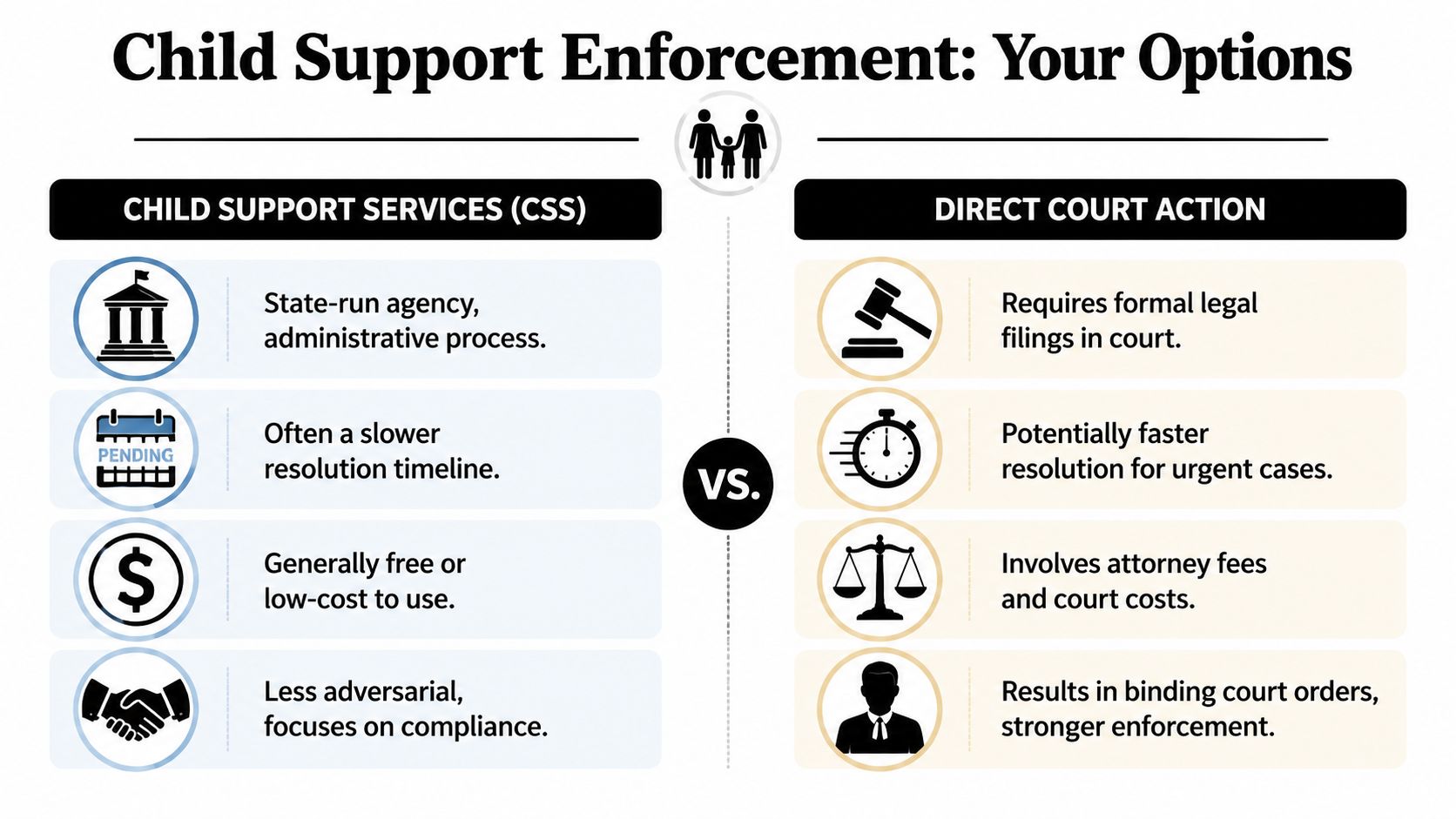
Many legal guides don't help much with that choice, even though it is often the most important one. North Carolina's own framework makes clear that this is a practical strategy question because the agency route may be faster and cheaper for some families, while private enforcement is more effective in others, as reflected in North Carolina Child Support Services information.
A simple way to decide
If the other parent is easier to track financially, CSS is often the sensible first step. If the other parent is evasive, defiant, or financially opaque, direct court action may be more productive.
Use this framework:
- Choose CSS first if your ex has a regular paycheck, your budget is tight, and you need low-cost enforcement tools working in the background.
- Lean toward court first if your ex is self-employed, hiding income, disputing the order, or ignoring agency efforts.
- Consider both if you want administrative collection running while also preparing a stronger court response.
Real trade-offs parents should understand
CSS is often less adversarial. That can help when communication is tense but still workable. It also helps parents who cannot afford to start with a private enforcement action.
Court action is more intensive. It usually requires more preparation and often more legal expense, but the judge's authority can create pressure that an administrative file alone won't create.
A practical comparison looks like this:
| Path | Often works best when | Main weakness |
|---|---|---|
| CSS | The parent has visible wages or tax filings | Harder cases involving hidden or cash income |
| Direct court action | The parent is willfully noncompliant or evasive | Stronger proof is needed, especially on ability to pay |
| Both together | You need collection pressure and court leverage | Requires tighter coordination and better records |
Don't overlook modification issues
Sometimes the question isn't only enforcement. It's whether the current order still fits the actual facts. If the paying parent had a legitimate, substantial change in circumstances, modification may become part of the strategy, especially in mixed cases where the issue is not simple refusal. This overview of NC child support modification can help you understand when that issue may be in play.
The best enforcement plan is usually the one that matches how the other parent earns, hides, or moves money.
NC Child Support Enforcement FAQ
How long does child support enforcement take in North Carolina
It depends on the path you choose and how easy the paying parent is to locate financially. CSS may move efficiently when there is a known employer and traceable income. Court enforcement may move faster in some urgent situations, but only if your documentation is ready and the case is properly presented.
Can the court order my ex to pay my attorney's fees
North Carolina courts can sometimes award attorney's fees in family law enforcement matters, but it is not automatic. Whether that is realistic depends on the posture of the case, the conduct involved, and the evidence presented to the court.
What if my ex moved out of North Carolina
North Carolina uses the Uniform Interstate Family Support Act, or UIFSA. An NC order can be registered in another state, which gives that state's court authority to enforce it, including through wage withholding or contempt proceedings, as explained in this overview of enforcing a North Carolina child support order.
Do I have to choose only CSS or only court
No. In some cases, using both makes sense. CSS can continue administrative collection efforts while your attorney evaluates whether contempt or another court remedy is necessary. The right mix depends on the other parent's income pattern, the amount of arrears evidence you have, and whether ability to pay can be shown.
What if my ex says they lost their job
That matters, but it does not erase the existing order by itself. A job loss may affect whether contempt is the right immediate remedy, because ability to pay is a key issue. It may also raise a modification question. The important point is this: the order remains in place unless and until it is changed properly.
Take Control and Protect Your Child's Financial Future
If your ex has stopped paying support, waiting usually makes the problem worse. North Carolina gives you meaningful options, but the right path depends on the facts. Some cases respond well to CSS. Others need the pressure of contempt, financial records, and a focused court strategy.
The most important step is to stop treating the nonpayment as a private dispute and start treating it like the enforcement issue it is. Your child has a right to support. You have the right to use the legal tools available to collect it.
A careful case review can help you decide whether to document, file, enforce, modify, or combine those approaches for the strongest result under North Carolina law.
If you're dealing with unpaid child support in North Carolina, the Law Office of Bryan Fagan can help you evaluate your options, build a practical enforcement strategy, and determine whether CSS, direct court action, or a combined approach makes the most sense in your case. Schedule a consultation to discuss your order, your documentation, and the next step for protecting your child's financial stability.