Losing a job is hard enough. When you also have a child support order in place, the panic usually sets in fast. You may be wondering whether the payment drops automatically, whether unemployment benefits change anything, and whether the court will understand that you cannot pay the same amount right now.
A common North Carolina scenario looks like this: a parent is laid off on Friday, spends the weekend updating a resume, and assumes the support amount will be adjusted because the income is gone. Then the next due date arrives, the full payment is still due, and the fear shifts from job loss to contempt, arrears, and wage withholding.
Yes, child support can sometimes be lowered after a job loss in North Carolina. However, it does not happen automatically, and the timing of your response matters almost as much as the reason for the income loss. North Carolina requires a formal request to change an existing order, and the court will look closely at what changed, why it changed, and what you've done since.
That means there is a path forward, but it has to be handled strategically. The right move usually isn't to stop paying and hope the court sorts it out later. The right move is to act quickly, document everything, and present the change in a way a judge can utilize.
Introduction Navigating the Shock of Job Loss and Child Support
The first days after a job loss are messy. You're trying to figure out severance, unemployment, health insurance, and how to keep the mortgage or rent current. Child support can feel like one more pressure point you can't control.
North Carolina law gives you options, but it also imposes responsibilities. The existing order stays in place unless the court changes it. That surprises many parents, especially those who assumed a layoff would trigger an automatic reduction.
Immediate reality: Your child support order remains a court order until a judge signs a new one.
Consider two parents in the same week. One gets laid off, calls counsel, gathers records, and files promptly. The other assumes the loss of income speaks for itself, misses payments, and waits until savings are gone before taking legal action. Both lost jobs. Only one put themselves in a better position to manage the legal fallout.
That difference matters because family court often turns on practical details. Judges want to see whether the income drop is real, whether it was outside your control, and whether you're responding responsibly. In plain English, the court wants proof, not just a difficult story.
If you're dealing with this now, the most useful mindset is simple. Don't freeze. Don't assume. Don't make side agreements and trust they'll hold up without court approval. Start building your case while you still have time to control the timeline.
The Legal Threshold for Modifying Child Support in North Carolina
In North Carolina, the court modifies child support only if you prove a substantial change in circumstances under N.C. Gen. Stat. § 50-13.7(a). A job loss may meet that standard, but the court will look closely at how serious the income drop is, how long it is likely to last, and whether the current order still reflects reality.

What substantial change in circumstances means
The phrase sounds formal. The court's analysis is practical.
The judge compares today's facts to the facts in place when the current support order was entered. If your income has dropped in a meaningful way, your expenses or the child's needs have changed materially, or the financial picture behind the old order no longer exists, modification may be appropriate.
A short gap between jobs may not carry much weight. A layoff with no immediate replacement income often does. Context matters, and so does timing. If you wait months to file, the old amount usually keeps accruing while your case is pending. That is one of the costliest mistakes I see after a job loss.
The guideline calculation matters, but it does not decide the case by itself
North Carolina courts often use the child support guidelines as the starting point for deciding whether the existing amount still fits the parties' incomes. If updated numbers would produce a significantly different support figure, that can help support a request to modify. But the worksheet is only part of the case.
Judges still want to know why the numbers changed, whether the change is real, and whether it is likely to continue long enough to justify a new order. For a practical overview of how those calculations work, review the North Carolina child support guidelines.
What the court wants to see
A strong modification request usually comes down to three things:
A real change, not a temporary setback
The court needs proof that the existing amount no longer matches current circumstances.Current, reliable documentation
Termination notices, pay stubs, unemployment records, tax returns, and financial affidavits carry far more weight than broad statements about hardship.A filed motion, not an informal understanding
Even if the other parent agrees to accept less for now, that does not change the order unless a judge signs off.
The amount in your current order keeps running until the court enters a new one.
That point deserves attention because it affects strategy. Parents often focus on whether they will eventually qualify for a reduction. The more immediate problem is arrears. If support is $1,200 per month and you cannot pay that amount after losing your job, the unpaid balance can grow while you are waiting for a hearing. Filing promptly does not guarantee relief, but delaying almost always makes the arrears problem worse.
The legal threshold is high enough that preparation matters, and practical enough that good records matter just as much. A parent who files quickly, documents the income loss, and presents a clean timeline usually stands in a much better position than a parent who waits and hopes the court will sort out missed payments later.
Was Your Job Loss Involuntary Why It Matters to the Court
You lose your job on Friday, spend the weekend trying to figure out rent, groceries, and health insurance, and then remember the child support order is still sitting there at the same monthly amount. At that point, one question drives the case. Did this happen to you, or did you choose it?
North Carolina courts look closely at that distinction. A parent who was laid off, whose position was eliminated, or whose employer shut down starts from a stronger place than a parent who quit without another job lined up or accepted a lower-paying position for personal reasons. Judges are not only measuring your current income. They are deciding whether the drop in income was outside your control and whether you responded reasonably once it happened.
Timing and facts matter together here. If you wait months to file because you expect to find work soon, the support order usually keeps running at the old amount while arrears build. If the court later decides your unemployment was voluntary or poorly documented, you may face both a denied modification and a balance that did not stop growing.
How judges usually sort these cases
A layoff after downsizing is usually easier to prove than a resignation. A termination can fall somewhere in the middle, depending on why it happened and what you did next. In practice, the court is asking whether you acted in good faith to maintain your earning ability.
| Scenario | How a judge may view it |
|---|---|
| Employer closes, position eliminated, or workforce reduced | More likely to be treated as involuntary |
| Termination not tied to intentional misconduct, followed by an active job search | Often viewed more favorably than a bare claim of unemployment |
| Parent quits without another job lined up | May be treated as voluntary unemployment |
| Parent accepts a much lower-paying job by choice | Court may question whether the income drop was avoidable |
| Parent claims jobs are scarce but cannot show applications or interviews | Weakens credibility |
The strongest cases usually show two things at once. The job loss was real, and the parent got to work trying to replace that income.
The court may use earning capacity instead of actual pay
Many parents get blindsided here. A lower paycheck does not automatically mean lower support. If a judge finds that you are voluntarily unemployed or underemployed, the court may calculate support based on what you are capable of earning instead of what you are earning today.
That issue comes up often enough that it deserves close attention. A fuller explanation appears in this guide to imputed income in North Carolina child support cases.
The practical problem is obvious. A parent may walk into court saying, "I am making less now." The court may answer, "You should be making more, and I am setting support from that number instead." That result can make a bad month much worse.
Facts that help, and facts that hurt
Good facts are concrete. A termination letter. Severance paperwork. Unemployment records. A job-search log with dates, employers, positions, and interview activity. Applications for work that fits your training and prior pay range. Honest disclosure of contract work, gig income, or side jobs.
Bad facts usually have the same pattern. The parent has an explanation, but no paper trail. Or the parent made a career change, started a speculative business, went back to school without a clear plan, or decided to hold out for an ideal job while support kept accruing.
I often tell clients that the court does not expect perfection after a job loss. It does expect seriousness. If you were a warehouse manager and got laid off, applying for comparable operations or logistics jobs supports your position. If you quit, put money into a new venture with uncertain income, and ask the court to lower support before the business has any track record, expect hard questions.
Credibility matters here more than people think. A clean timeline, consistent records, and prompt action can make an involuntary job loss look exactly like what it is. A delayed filing, vague testimony, or missing documents can make a legitimate setback harder to prove.
Your Step-by-Step Guide to Filing a Motion to Modify in NC
The most important strategic point is simple. File quickly. North Carolina sources focused on unemployment and support stress that job loss does not automatically modify support, that a parent must petition the court, and that delay can leave a person owing the full amount until filing, with arrears exposure that may not be recoverable later, as explained in this article on modifying child support due to unemployment in North Carolina.
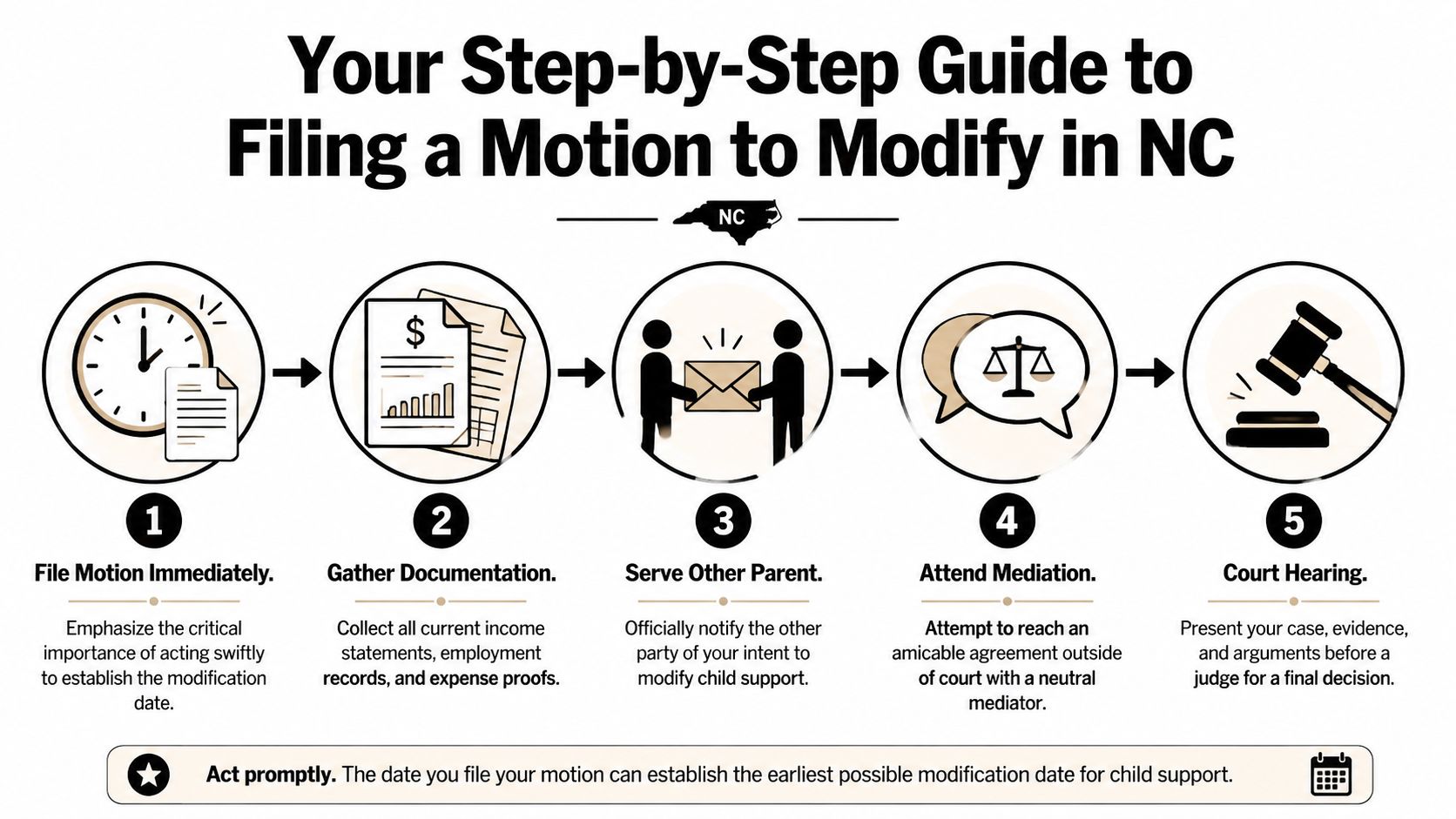
Step one file before the problem gets bigger
Many parents wait because they hope they'll find a new job soon. That instinct is understandable, but it can be costly. If the income drop happened months ago and you still haven't filed, the old order may continue to control during that period.
That is the trap. People focus on whether they'll eventually qualify for a reduction and overlook the separate question of what happens while they wait.
Practical rule: If your income has materially changed and the order no longer fits, talk to counsel and evaluate filing right away.
A parent asking can child support be lowered after job loss nc usually needs this answer more than anything else. The risk isn't only denial. The risk is falling behind while doing nothing.
Step two gather the core paperwork
Before or immediately after filing, start collecting documents that show what changed. You do not need a perfect file to begin the process, but you do need enough to present a real claim.
Useful records often include:
- Employment separation records such as termination notices, layoff emails, or severance paperwork.
- Income history including recent pay stubs from before the loss and any current earnings information.
- Benefits records if you're receiving unemployment or other replacement income.
- Job search proof like applications, emails, interview confirmations, and recruiter communications.
- Current expense information especially if your household obligations have shifted alongside the job loss.
For a practical discussion of income changes and support issues, see this resource on North Carolina child support when income changes.
Step three file the motion in the proper court
The formal request is typically a motion to modify child support filed with the clerk in the court handling the existing case. The filing needs to clearly identify the prior order and explain the alleged substantial change in circumstances.
This is one place where precision matters. A vague filing can make the other side's response easier. A well-prepared motion gives the court a cleaner path to evaluate your claim.
If you're represented, your lawyer will draft and file the motion, arrange service, and track deadlines. The Law Office of Bryan Fagan is one example of a North Carolina firm that handles support modification matters tied to changed income and unemployment.
Step four make sure the other parent is served
Filing isn't enough. The other parent must be formally served according to the rules. Proper service matters because support cases can stall if notice isn't handled correctly.
Service also sets the tone. Once the paperwork is in hand, the other parent may decide to negotiate, oppose the request, or begin gathering evidence of their own. That is normal.
Step five prepare for mediation or hearing
Some cases narrow through discussion. Others go to a hearing where both sides present evidence and testimony. Either way, preparation is what separates a credible modification request from a weak one.
Focus on what a judge needs to decide:
- What changed
- Why it changed
- Whether the change was outside your control
- What your current income is
- What efforts you've made to return to work
Short, organized proof beats emotional explanations. Judges hear stress every day. They need records they can rely on.
Gathering the Right Evidence to Prove Your Case
A good modification case is built on documents that answer the judge's likely questions before the judge asks them. If the issue is job loss, your evidence should prove both the loss itself and your response to it.
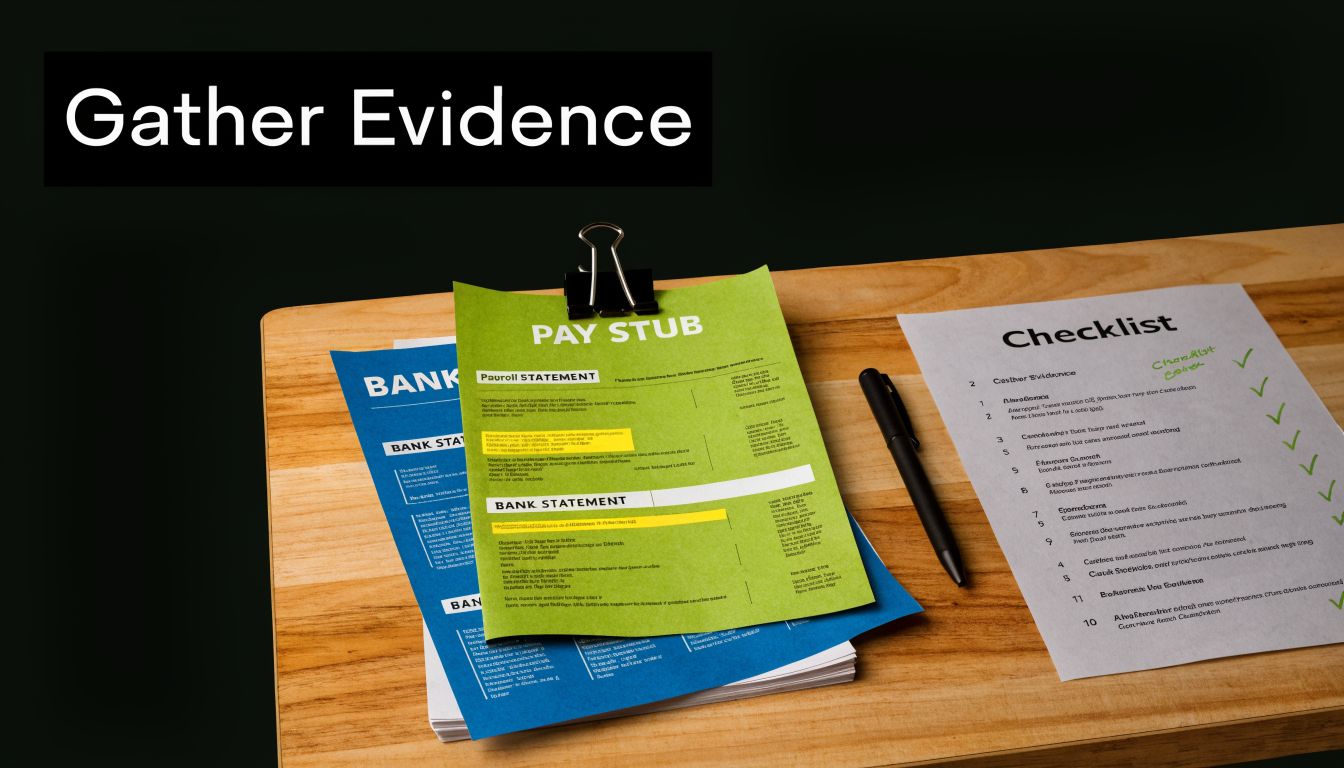
Documents that prove the income change
Start with the event that triggered the problem. If you were laid off, the strongest document is usually the employer's written notice. If the company sent an email, keep the full message. If HR gave you a separation packet, preserve all of it.
Then gather your pre-loss and post-loss income records. The court needs to see the difference between what you were earning and what you have now. That can include pay stubs, benefit statements, and records of any temporary or part-time earnings.
Documents that prove good faith
This part is often overlooked. Many parents prove unemployment but fail to prove effort. A judge may be more persuaded by a careful log of applications and interviews than by a general statement that you've been "looking everywhere."
A useful job-search file may include:
- Application confirmations from online job boards or employer websites
- Recruiter emails showing outreach and follow-up
- Interview records including dates, times, and positions discussed
- Resume updates if you revised credentials to seek comparable work
- Networking evidence such as professional contacts or referral emails
Keep your evidence in date order. That makes it easier for the judge to see momentum rather than excuses.
Financial records people forget
Some evidence problems aren't about employment at all. They come from incomplete financial disclosure. If you have freelance income, contract work, cash work, or help from family, discuss that openly with your lawyer. Hidden or half-explained income can damage credibility fast.
It also helps to gather records tied to the current order, such as the last child support order, payment history, and any wage withholding documents. Those records help frame what you're asking the court to change.
Below is a simple checklist you can use:
| Record | Why it matters |
|---|---|
| Termination or layoff notice | Shows the job loss happened and may show it was involuntary |
| Prior pay stubs | Establish prior earnings |
| Unemployment records | Shows current income source, if any |
| Job application log | Supports good-faith efforts to find work |
| Current bank and income records | Helps the court evaluate actual financial circumstances |
| Existing support order | Identifies what is currently enforceable |
A clean, complete file won't guarantee a result. But it does give the court something solid to work with, and that matters in nearly every modification hearing.
Potential Outcomes and Common Defenses You Might Face
Parents often assume the court will either grant the request or deny it. In practice, the outcome can be more nuanced. A judge may lower support, leave it unchanged, or set an amount different from what either side proposed.

What the court may do
Some outcomes are straightforward. If the evidence clearly shows an involuntary loss of income and a valid basis for modification, the court may reduce the support obligation. In other cases, the court may conclude that the change is too temporary, too poorly documented, or too tied to voluntary choices.
The court may also accept part of your position and reject the rest. For example, a judge might find the job loss real but disagree with your view of current earning capacity. That can lead to a support amount that is lower than before, but not as low as you requested.
Defenses the other parent may raise
Expect the other side to test your facts. Common arguments include:
The job loss was voluntary
They may claim you quit, caused the termination, or accepted lower pay by choice.You aren't making serious efforts to find new work
A weak application history gives this argument traction.You have access to other income
This may include side work, family support, or business revenue.Your earning capacity is higher than you admit
This is often tied to imputed income arguments.
Court hearings often turn on credibility. If your documents and testimony line up, your position is stronger. If they don't, the other side will notice.
Keep your expectations grounded
A modification case is not just about hardship. It is about proving a legally sufficient change with evidence the court trusts. You should also be prepared for the other parent's concerns. They may depend on the support order for the child's daily needs, and that reality shapes how these cases are argued.
The strongest approach is usually calm, documented, and realistic. Ask for what the law supports. Be ready to explain the timeline clearly. Avoid overstatements that the paper record can't back up.
Frequently Asked Questions About NC Child Support Modification
Common questions on NC child support modification
| Question | Answer |
|---|---|
| Can child support be lowered after job loss in NC? | Yes, it can be lowered if you can show a substantial change in circumstances and the court approves a modification. Job loss alone does not automatically change the order. |
| Do I still have to pay while I wait for court? | Usually yes. The existing order remains enforceable until the court signs a new one. That is why filing quickly matters. |
| What if I was laid off but expect another job soon? | You should still evaluate filing promptly. Waiting can create arrears if the order stays in effect during the gap. |
| Will the judge care whether I quit or was laid off? | Yes. The reason for the income drop matters. Involuntary loss is generally easier to support than voluntary unemployment or underemployment. |
| What if the other parent agrees to reduce the payment? | An informal agreement is risky unless it is turned into a court-approved modification. The written order still controls until changed by the court. |
How far back can a modification go
The practical issue is usually not how far back you wish the court would go. It is whether you filed soon enough to protect yourself from mounting debt under the current order. If you wait, you may still owe the full amount that came due before the court acted.
That is why early filing is often the most important move in the entire case.
How long does it take to get a hearing
The timeline varies by county, court calendar, service issues, and whether the other side contests the request. Some cases move faster than others. You should plan for a process, not an instant result.
While waiting, keep updating your records. New applications, interviews, and income changes may matter by the time the hearing occurs.
Should I pay something if I can't pay the full amount
That depends on the facts and your broader legal strategy, so it is best addressed with specific advice. What you should not do is assume that paying nothing is harmless. Support obligations are court orders, and nonpayment can create separate enforcement problems.
What if I was fired instead of laid off
Being fired does not automatically defeat a modification request. The court will still look at causation, good faith, and your current efforts to become re-employed. The facts around the termination matter.
Take Control of Your Situation Today and Protect Your Future
A job loss doesn't mean you're out of options. It does mean you need to move quickly, think strategically, and treat the existing child support order as a live legal obligation until the court changes it.
The biggest mistake I see is delay. Parents wait because they're overwhelmed, embarrassed, or convinced a new job is just around the corner. Then the missed payments stack up, the other parent files enforcement, and a manageable problem becomes much harder to fix.
North Carolina courts can modify support in the right case, but they expect proof and proper procedure. If your income dropped, the strongest next step is usually to get clear advice on whether your facts support a motion, what documents you need, and how to reduce the risk of arrears while the case is pending.
If you live in North Carolina and you're facing this now, get answers specific to your county, your order, and the way your job loss happened. A short consultation can help you avoid expensive mistakes and give you a realistic plan for what to do next.
If you need guidance on a child support modification after job loss in North Carolina, schedule a consultation with the Law Office of Bryan Fagan. The firm works with North Carolina clients on family law issues including child support, modification requests, and enforcement concerns, and can help you evaluate your options based on your actual court order and current income situation.