A lot of families start looking into guardianship of a minor in North Carolina during a crisis. A grandparent has been caring for a child for months. An aunt needs authority to enroll a niece in school. A family friend is helping after a parent's illness, incarceration, or death and keeps hearing, "You need something from the court."
That instinct is usually right. Caring for a child in practice and having legal authority to act for that child are not the same thing. Schools, doctors, insurers, and financial institutions often need court-backed authority before they'll accept important decisions from a non-parent.
North Carolina law gives families a way to create that authority, but the process is more formal than many people expect. It involves the clerk of superior court, a sworn application, a guardian ad litem, and in many cases a bond. It also raises hard questions about whether guardianship is the right tool, or whether custody, a temporary arrangement, or kinship-based options would fit better.
When Your Family Needs a Guardian for a Child
A common situation looks like this. A grandmother has been doing school pickups, medical appointments, and bedtime for her grandson for months. The parents are alive, but they aren't functioning as day-to-day caregivers. She isn't trying to "take over" anyone's role. She just needs the legal ability to protect the child and keep life stable.
That is where guardianship often enters the conversation.
In plain English, guardianship is a court-created legal relationship that allows an adult to act for a child in specific ways, depending on the type of guardianship the court grants. It can help when a child needs a dependable adult to make decisions, manage money, or both.
The problem families run into first
Most relatives assume that if the child already lives with them, that should be enough. It usually isn't. Informal caregiving works until a school asks for legal authority, a hospital wants formal consent, or inherited funds need to be handled for the child.
A practical example helps. If a child receives insurance proceeds after a parent's death, the person raising that child may still have no authority to manage those funds without a court appointment. On the other hand, if the child needs daily care and both parents' legal status is part of the issue, guardianship may or may not be available depending on the facts.
Families usually aren't asking for paperwork for its own sake. They're asking for stability, access, and the ability to say yes when a child needs help.
Grandparents often reach this point after trying less formal solutions first. If you're already dealing with broader third-party caregiving issues, it may also help to understand how grandparents' rights in NC fit into the bigger picture.
What works and what doesn't
Some approaches help immediately:
- Document the child's living situation: Keep records showing where the child lives, who provides care, and why court authority is needed.
- Identify the legal problem: Is the need about school and medical decisions, money, or both?
- Be honest about the parents' status: Whether parents are living, involved, absent, or legally terminated matters in North Carolina.
Other approaches tend to stall a case:
- Relying on verbal family agreements: Courts need sworn facts, not family understandings.
- Filing before gathering financial information: If the child owns assets, the court will want details.
- Treating guardianship like emergency custody: It isn't automatic and it isn't just a formality.
Understanding Guardianship vs Custody in North Carolina
Families mix up guardianship and custody all the time. That's understandable because both involve adults making decisions for children. But in North Carolina, they are not interchangeable.
A useful way to think about it is this. Custody usually answers, "Who has the right to care for and make decisions for the child under family law?" Guardianship answers, "Who has court-authorized legal authority to act for a child who is legally unable to act for themselves?"
Why the distinction matters
North Carolina treats minors differently from adults in guardianship law. In North Carolina, children under 18 are legally presumed incompetent, meaning no separate incompetency proceeding is needed. A guardian of the estate can be appointed even if parents are living, but a guardian of the person requires that the minor has no living parents or parental rights have been terminated, as codified in Article 6 of Chapter 35A of the NC General Statutes under the North Carolina courts' minor guardianship materials.
That legal presumption streamlines part of the process for minors. It also creates a major practical limit that surprises many families. A relative may have strong caregiving reasons to seek authority, but if the request is for a guardian of the person and a parent is still living with intact parental rights, that request may run into a legal barrier.
Custody is often the better fit when parents are still in the picture
Many non-parents need a careful case assessment. In some cases, a custody action under Chapter 50 is the better route because custody law focuses on who should care for the child and what arrangement serves the child's best interests. If you want a broader overview of that framework, Child Custody in North Carolina explains how NC courts decide custody under the best interests standard.
Here is the practical comparison:
| Issue | Custody | Guardianship |
|---|---|---|
| Typical use | Parent and non-parent care disputes | Court authority for a non-parent to act for a minor |
| Court system focus | Best interests and caregiving rights | Legal appointment and defined powers |
| Parental rights | Can be limited by court orders | Not automatically terminated |
| Money management | Not designed to manage inherited assets | Estate guardianship directly addresses assets |
Common misconceptions
People often assume one of three things that aren't quite right:
- "Guardianship ends the parents' rights." It doesn't automatically do that.
- "If the child lives with me, I can just file for any type of guardianship." Not necessarily. The type of guardianship available depends on the parents' legal status and the child's needs.
- "Custody and guardianship do the same job." They overlap in real life, but the legal standards and court procedures differ.
The right legal tool depends less on who loves the child most, and more on what authority is needed and what North Carolina law allows on these facts.
Types of Guardianship for Minors in NC
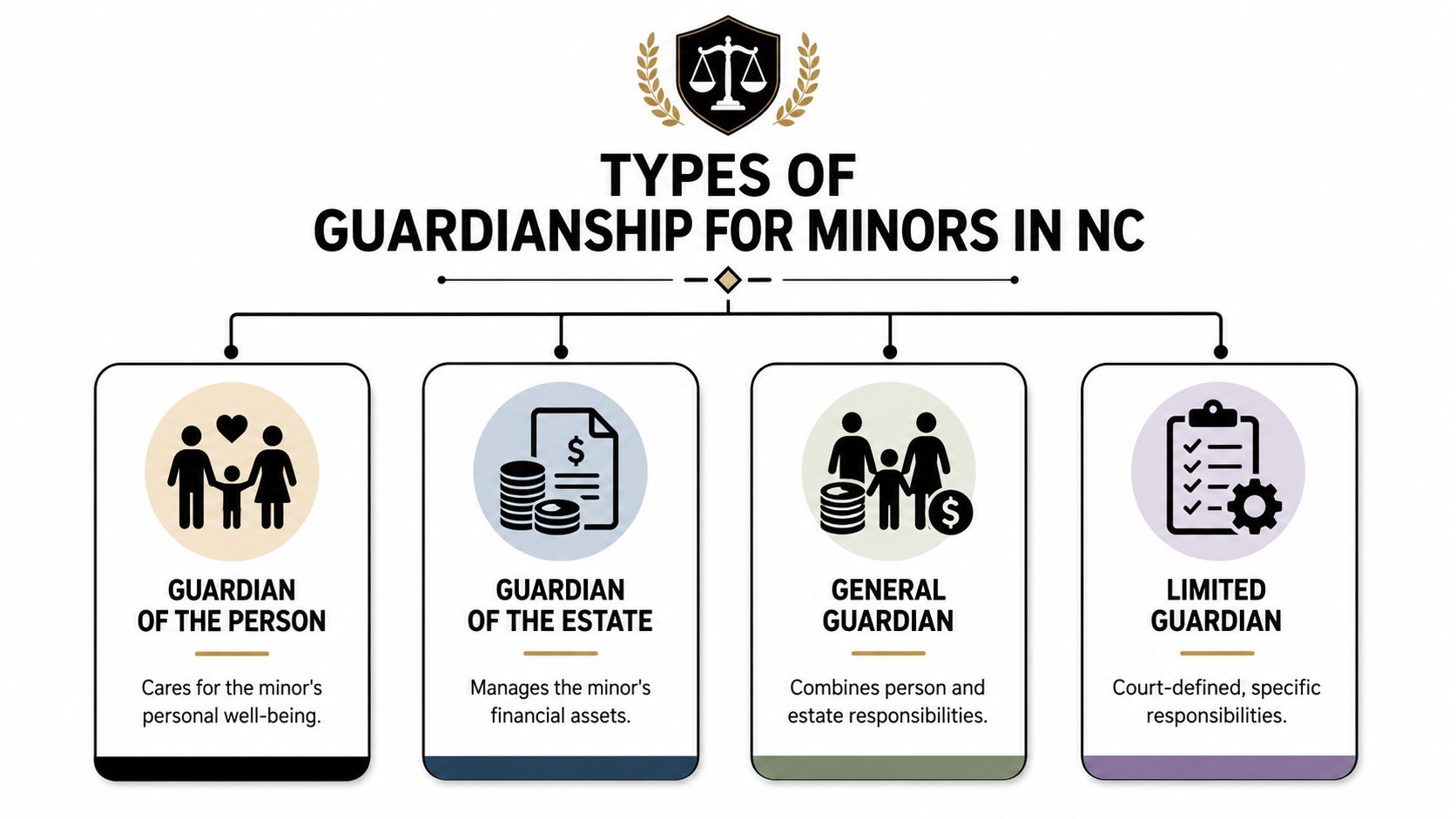
North Carolina recognizes three specific types of guardianship for minors. The application has to state which type you're asking for, as explained in this North Carolina guardianship overview from Pierce Law. Choosing the wrong one can delay the case or send you into the wrong court process.
Guardian of the person
A guardian of the person handles the child's care and daily decisions. This is the role people usually imagine first.
That can include matters like:
- School decisions: Enrollment, school records, and routine educational issues
- Medical care: Consenting to treatment and coordinating ongoing care
- Daily welfare: Housing, supervision, and practical support
A typical example is a child whose parents have died, and an aunt is stepping in to provide a permanent home. In that situation, the court may need to appoint someone with authority over the child's personal care.
Guardian of the estate
A guardian of the estate manages the child's money or property. This is common when a child owns something of value but doesn't necessarily need a change in day-to-day caregiver.
Examples include a child who:
- inherited real estate,
- received settlement funds,
- has bank accounts or investment assets,
- has debts or financial obligations that need administration.
This type can exist even when parents are living. That point is important because many families don't realize they may need estate authority without changing physical caregiving arrangements.
General guardian
A general guardian combines both roles. This person manages the child's personal care and the child's financial affairs.
A real-world example would be a child whose parents are no longer legally able to act and who has also inherited money or property. One appointment may cover both categories of responsibility if the facts support it.
The practical choice
The best question isn't "Which guardianship sounds strongest?" It's "What decisions need to be made, and what property needs to be protected?"
A court expects precision. If the problem is financial, ask for financial authority. If the problem is care and legal status, the analysis is different.
Families sometimes ask about "limited" arrangements because they only need authority for one narrow issue. In practice, the clerk will look at the actual powers requested and whether guardianship is the right fit under North Carolina law. That is one reason the application needs to be drafted carefully.
The Step by Step NC Guardianship Court Process
A common pattern looks like this. A child is living with a grandparent or aunt, school starts asking for legal paperwork, a doctor wants consent from someone with authority, and the family assumes they can get an order in a week. In many North Carolina cases, the process is doable, but it is rarely fast if the paperwork is thin or the facts are unclear.
The clerk is not there to build the case for the family. The clerk decides the case based on the filing, the supporting facts, the child's circumstances, and the legal authority requested.

File the application with the clerk
Guardianship for a minor is filed with the Clerk of Superior Court in the county where the child lives. The application is sworn. It needs specific facts, not general statements that the child would be “better off” with a relative.
According to North Carolina courts guardianship guidance, the filing may include information about the child, the proposed guardian, interested parties, and a preliminary inventory if the child has assets or debts. In many minor guardianship cases, the financial piece is what catches families off guard. If the child inherited money, received settlement funds, or owns property, the court will expect details.
Before filing, gather the records that answer the clerk's practical questions:
- Who is the child and where does the child live
- Who are the parents and other interested relatives
- Why is guardianship needed now
- What authority does the proposed guardian need
- Whether the child owns money, real estate, or other assets
Urgency often creates confusion here. Families use the word “emergency” loosely, but guardianship is not a substitute for every immediate placement problem. If the issue is short-term care or immediate control over where a child stays, compare guardianship with temporary custody options in North Carolina before filing the wrong case.
Expect a guardian ad litem review
After the case is opened, the clerk may appoint a guardian ad litem for the child. That person investigates and reports to the court about the child's interests.
This part matters. A guardian ad litem usually notices gaps that families miss, such as inconsistent timelines, missing financial records, or a request for powers that go beyond what the facts support. If one relative says the child has lived with her for two years and school records show a different address, that inconsistency can hurt the case.
Keep the presentation child-focused. The strongest filings explain the child's needs, the living arrangement, the proposed guardian's plan, and any property that needs protection.
Prepare for the hearing
The hearing is usually straightforward when the file is organized and the requested guardianship fits the facts. It gets harder when a family walks in expecting the clerk to sort out unresolved disputes, missing records, or conflicting stories.
Be ready to explain, in plain language:
- Why the child needs a guardian
- Why this proposed guardian is suitable
- What decisions must be made for the child
- Whether any money or property must be managed
- Why the requested type of guardianship matches the situation
Trade-offs matter here. A caregiver may be the right person to raise the child day to day, but if the child also has inherited funds, the court will still want proof that the proposed guardian can manage money carefully. In some families, that leads to a hard but sensible conversation about whether one person should handle care and another should handle assets.
If the clerk grants the application, the court will issue letters of guardianship once the required steps are completed. Those letters are what schools, doctors, banks, and other institutions usually want to see.
A short overview may help if you want to hear another explanation of how these cases move through court:
Oath, bond, and acting as guardian
Appointment is not always the last step. The proposed guardian may need to qualify by taking an oath, and in estate-related cases the clerk may require a bond before authority becomes active.
That requirement frustrates some families, especially when they believed the hearing itself finished everything. It did not. Until the qualification steps are complete and the letters are issued, third parties may refuse to honor the guardian's authority.
Once appointed, the guardian has ongoing duties. A guardian handling money for a child must keep records, separate the child's funds from personal funds, and follow any reporting requirements set by the clerk. Poor recordkeeping creates avoidable problems, even in otherwise strong family cases.
The Law Office of Bryan Fagan handles North Carolina family law matters, and families often benefit from legal help before filing so the requested authority, the facts, and the supporting documents match from the start.
Common Issues and Terminating a Guardianship
The most stressful guardianship cases usually involve one of three problems. Another relative objects. The child's situation is urgent. Or the family needs to know how the arrangement ends.

When another family member contests the case
Contested cases are rarely about one dramatic hearing. More often, they turn on credibility, consistency, and whether the requested form of guardianship fits North Carolina law.
For example, two relatives may both say they can provide a stable home. The court won't automatically pick the person who appears first at the clerk's office. The clerk will look at the legal basis for the request, the child's circumstances, the proposed guardian's suitability, and any report filed for the child.
What doesn't work in contested cases is making the hearing a referendum on who is morally better. What helps is concrete proof. School records. Medical needs. Financial documents. A stable plan.
When the situation feels urgent
Families often use the word "emergency" to mean the situation is serious, and they may be right. But serious and legally urgent are not always the same thing procedurally.
If the child needs immediate placement authority, school access, or protection from instability, it may be necessary to examine whether temporary custody or another filing route addresses the immediate danger more directly than a standard guardianship filing. That decision turns on facts, not labels.
A frequent mistake is waiting too long because everyone hopes the parents will recover quickly. Sometimes they do. Sometimes they don't. Delay can complicate schooling, medical treatment, and financial management.
How guardianship ends
North Carolina requires closure, not assumptions. According to this North Carolina guardianship discussion from the Breeden Law Office, all minor guardians in North Carolina must post a bond with the Clerk of Superior Court. The guardianship automatically terminates when the minor reaches age 18 but can also end via court order if the child is emancipated or the guardian resigns, which requires a formal motion and hearing.
That creates a few practical takeaways:
- Turning 18 ends the guardianship automatically: Families should prepare for that transition ahead of time.
- Early termination still requires court action: If the child is emancipated or the guardian needs to step down, paperwork and a hearing may be required.
- Bond isn't optional in minor cases: The clerk determines how to handle it, and families should plan for that requirement.
Guardianship is a legal status. It starts by court order, and it usually ends by operation of law or by court action, not by private agreement.
Exploring Alternatives to Guardianship in North Carolina
Guardianship isn't always the right answer. Sometimes it is exactly the right tool. Other times it creates more burden than the family needs, or it doesn't fit because of the parents' legal status.

Power of attorney and custody
A power of attorney for a minor child can be useful when a parent is cooperative and the arrangement is expected to be temporary. It tends to involve less court involvement and can help with limited decision-making. The weakness is that it does not create the same court-backed authority as guardianship, and it may not solve more permanent or contested problems.
A formal custody order is often stronger when the core dispute concerns caregiving authority and parents are still legally in the picture. That route can provide a clearer framework for who has decision-making rights and where the child will live.
Here is the practical side-by-side view:
Power of attorney
- Best for: Cooperative, temporary family arrangements
- Weak point: Limited scope and less durable authority
Custody
- Best for: Ongoing caregiving disputes or structured parenting authority
- Weak point: Different court process and different legal standards
The overlooked option of kinship guardianship
One option families often miss is kinship guardianship as a permanency option. As described by Child Welfare Information Gateway's North Carolina kinship guardianship resource, children may receive state-supported payments while living with relatives, and relatives may become permanent guardians without terminating parental rights. That same resource notes this model reduces foster care placements.
This matters in practice because many relatives want permanence for the child without pushing toward termination of parental rights. In the right case, kinship-based arrangements can support stability while preserving a different legal relationship with the parents than adoption would.
That is where families should compare it carefully with adoption. Adoption may still be the best long-term plan in some homes, especially where a full legal parent-child relationship is the goal. In other families, a kinship permanency option offers enough stability without requiring that final step. For a broader look at that path, review adoption laws in North Carolina.
Choosing the right tool
The practical question is not "Which option sounds most official?" It is "Which option gives this child the right amount of protection with the least mismatch to the facts?"
If parents are cooperative and the problem is short term, a less formal tool may work. If the child has assets, guardianship of the estate may be necessary. If relatives are seeking permanency without ending parental rights, kinship guardianship may deserve serious attention.
NC Guardianship FAQ and Next Steps for Your Family
Families usually reach the end of this process with a few blunt questions. Those questions are the right ones.
FAQ
How much does it cost to get guardianship in NC
Court costs, bond issues, and attorney's fees vary by county and by the complexity of the case. If the child owns money or property, the work is usually more involved. The best way to get a reliable estimate is to have the facts reviewed before filing.
Does guardianship of a minor in NC terminate parental rights
No. Guardianship does not automatically terminate parental rights. The exact effect depends on the type of guardianship and the family's legal posture.
What paperwork do I need to start
Expect to provide identifying information about the child, information about parents and interested relatives, the reason guardianship is needed, and financial information if the child has assets or debts. In practice, organized records make a major difference.
Can I get guardianship if the child has living parents
Sometimes yes, sometimes no. It depends on the type of guardianship requested. That is one of the most common points where families need legal advice before filing.
What happens after I am appointed
You don't just walk out of court and forget about the case. Guardians often have continuing duties, especially if the child has property or funds that must be managed carefully.
Guardianship cases are intensely personal, but the court still expects technical accuracy. The strongest filings usually come from families who can explain the child's needs clearly, choose the right legal tool, and present a realistic plan for care or financial management.
If you're weighing guardianship of a minor in NC, don't rely on internet summaries alone. A short consultation can clarify whether you need guardianship, custody, a kinship option, or a different strategy entirely.
If your family is caring for a child and needs clear legal direction, schedule a consultation with the Law Office of Bryan Fagan. The firm works with North Carolina families on custody and related family law matters, and a case review can help you determine whether guardianship is the right path, what type of filing fits your situation, and what steps to take next.