A court notice about supervised visitation can feel like the floor just dropped out from under you. One parent reads it and assumes, “The judge already thinks I'm dangerous.” The other reads it and worries, “What if the court still lets my child spend time in an unsafe situation?” Both reactions are common, and both usually come from the same problem. Parents rarely get a clear explanation of what supervised visitation in North Carolina means.
In plain English, supervised visitation means parenting time happens with another approved adult present to monitor the visit. In North Carolina, that isn't supposed to be a casual restriction or a punishment. It's a protective measure the court can use when unsupervised contact would put a child's safety, emotional well-being, or stability at risk. The law tries to balance two goals at once: protecting the child and preserving the parent-child relationship.
That balance matters because these cases are emotional, fact-specific, and easy to misunderstand. Nationally, supervised visitation programs have become more common over the past two decades, and more recent clinical data shows that approximately 40% of clients entering these programs had substance abuse as their primary issue according to the clinical data discussed in the Supervised Visitation Network literature. That lines up with what North Carolina courts often see when supervision is requested.
An Introduction to Supervised Visitation in North Carolina
A typical North Carolina case starts with a hard moment. A parent is served with custody papers that ask for supervised visits only. Sometimes the request follows a DUI charge, a domestic violence allegation, a recent relapse, or a mental health crisis. Sometimes it appears in a high-conflict custody fight where exchanges have become so volatile that the child is caught in the middle.
The first thing to understand is this. Supervised visitation in NC is usually temporary. Courts use it to reduce immediate risk while keeping contact between parent and child in place. The goal is often to create a safer structure now and revisit the arrangement later if the parent shows stability, treatment compliance, or other meaningful progress.
What supervision usually looks like
In practice, supervision can happen in a visitation center, a social-service setting, or another controlled environment. The supervisor might be a professional monitor, a social worker, or in some cases a trusted family member approved by the court. The details matter because the order should spell out who supervises, where visits happen, how exchanges work, and what rules apply.
A common misconception is that any accusation can lead to supervised contact. That isn't how North Carolina law is supposed to work. Courts are looking for credible evidence of harm or imminent danger, not just suspicion or anger between parents.
Practical rule: If supervised visitation is on the table, focus less on labels and more on facts. Judges respond to documented behavior, not broad claims that a parent is “bad” or “unstable.”
Why parents need clarity early
Many parents also confuse supervised visitation with supervised exchanges. They are not the same. A supervised exchange means someone oversees pickup and drop-off to prevent conflict between the adults, while the actual parenting time remains unsupervised. Supervised visitation means the monitoring continues during the visit itself.
That distinction changes strategy. If the problem is conflict at the handoff, a full supervision order may be broader than necessary. If the concern is intoxication, violence, or unsafe conduct during the visit, supervision may be what the court considers.
The Legal Standard for Supervised Visitation in NC
North Carolina judges have broad authority in custody cases, but they don't have unlimited freedom to restrict a parent's contact. G.S. § 50-13.5 matters here because supervised visitation isn't supposed to be imposed on instinct, caution alone, or a vague sense that it might be better.
Under North Carolina law, a judge must make written findings of fact showing either that the parent is unfit or that unsupervised visitation is not in the child's best interest. Without those findings, the order can be challenged. A concise summary of that rule appears in this discussion of North Carolina supervised visitation under G.S. § 50-13.5.

What written findings of fact actually mean
This phrase sounds technical, but the idea is simple. The judge has to put the reasons in writing. Not just the conclusion. The reasons.
That means an order should identify the facts that support the restriction, such as substance abuse evidence, domestic violence history, or conduct showing a real risk to the child. If the order only says supervision is “appropriate” or “safer,” that may not be enough.
Here is the practical significance for parents:
- For the parent requesting supervision: you need evidence that supports a specific safety concern.
- For the parent contesting supervision: you should read the written order carefully, because weak or missing findings can become a legal issue.
- For both sides: the order must connect the facts to the restriction. Courts aren't supposed to skip that step.
What the best-interest standard means in real life
North Carolina custody law centers on the child's best interests. If you want a broader overview of that standard, this explanation of the best interest of the child in NC is useful background.
In supervised visitation cases, “best interest” usually comes down to questions like these:
| Court concern | What the judge is really asking |
|---|---|
| Safety | Is the child physically safe during visits? |
| Emotional well-being | Do visits expose the child to fear, trauma, or severe instability? |
| Stability | Is the parent functioning consistently enough to handle parenting time without monitoring? |
| Parenting judgment | Does the parent make safe decisions in the child's presence? |
North Carolina courts also distinguish between a diagnosis and an actual parenting risk. Mental health issues alone don't automatically justify supervision. The concern is whether the condition is untreated or severe enough to impair parenting judgment or create danger.
The strongest custody arguments are usually narrow and fact-driven. The weakest ones rely on broad character attacks.
Why this legal standard is so important
Many online articles end their explanation prematurely. They tell parents supervision is ordered for “safety” and leave it there. In North Carolina, the legal validity of the order itself can turn on whether the court documented enough facts to justify the restriction.
That matters because a supervised visitation order can function as a major limit on a parent's constitutional relationship with a child. If the court is going to impose that limit, it has to do the work on the record.
Common Reasons NC Courts Order Supervision
Parents often ask, “What makes a judge order this?” In North Carolina, the most common triggers include credible allegations or evidence of physical or sexual abuse, ongoing substance abuse, severe and untreated mental health conditions, a history of domestic violence, or extreme high-conflict dynamics that endanger the child's emotional well-being as discussed in this overview of when supervised visitation is ordered in North Carolina.
Substance abuse and recent instability
Substance abuse is one of the clearest examples because it creates immediate questions about judgment, sobriety, transportation, and supervision of the child. If a parent has recent failed drug tests, repeated intoxication around the child, or a fresh DUI-related incident, the other parent may ask the court for monitored visits.
A common scenario looks like this. A father hasn't been accused of hurting the child, but he recently relapsed and was charged with impaired driving. The court may decide the parent-child relationship should continue, but only with a sober adult present until the father can show reliable stability.
Domestic violence and child exposure
Domestic violence cases often lead to supervision requests, especially where the child witnessed abuse or was present during violent incidents. The court isn't only looking at the risk of direct harm to the child. It also considers whether visitation creates fear, coercion, or an unsafe emotional environment.
That can be true even if the violence was aimed at the other parent rather than the child. Judges know children absorb what they see and hear.
If the exchange itself is the danger point, ask whether supervised exchanges would address the problem better than supervised visitation. The remedy should fit the risk.
Mental health concerns and high-conflict cases
Mental health becomes relevant when it affects parenting capacity. A diagnosis alone usually isn't enough. What moves the court is evidence that the condition is untreated or severe and that it interferes with safe decision-making.
High-conflict cases can also lead to supervision, but not just because the parents argue a lot. Courts are more likely to intervene when exchanges repeatedly escalate, the child is pulled into adult conflict, or one parent's conduct during visits causes emotional harm.
In some families, the custody fight is happening alongside divorce. If that's your situation, How to File for Absolute Divorce in North Carolina can help you understand the residency rule, filing steps, and procedural requirements for the divorce side of the case. Custody and visitation often move on a different track, but the timelines can overlap in a way that affects strategy.
How to Request or Contest a Supervised Visitation Order
If you're asking the court to impose supervision, or trying to stop it, your case will usually rise or fall on evidence. Opinions don't carry much weight unless they are backed by documents, testimony, or a clear pattern of conduct.
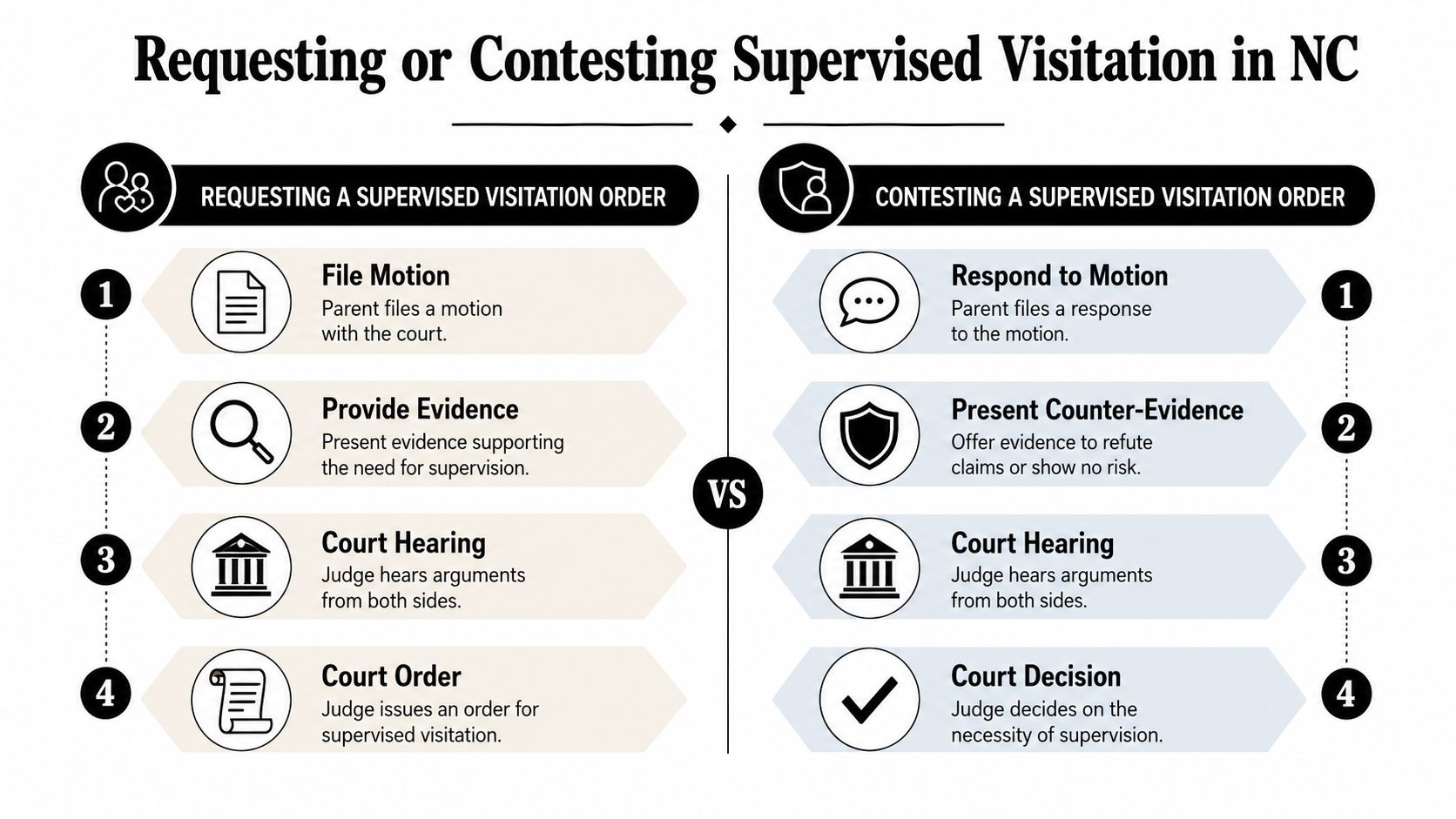
Start with the basics. A parent seeking supervision typically raises the issue in a custody complaint, a motion in an existing case, or as part of a request for temporary relief. The parent opposing supervision responds in writing and prepares to present contrary evidence at hearing.
If you're requesting supervision
The strongest requests are focused and documented. Instead of telling the judge the other parent is irresponsible, show the court why unsupervised visits create a specific risk.
Useful evidence often includes:
- Police or incident reports: especially where there was domestic violence, a disturbance, or child-endangering conduct.
- Medical or treatment records: if they directly relate to parenting impairment and are properly presented.
- Drug test results or DUI-related records: when substance abuse is part of the concern.
- Photos, messages, or recordings: only if lawfully obtained and directly relevant.
- Witness testimony: teachers, relatives, counselors, or others with firsthand knowledge.
A parent requesting supervision should also think through logistics before court. Who would supervise? Where would visits happen? What structure would reduce risk without cutting off contact more than necessary? Judges respond better when the request is practical, not just punitive.
Later in the process, parents often run into disputes over compliance and missed visits. This discussion of whether a parent can deny visitation in North Carolina is relevant because many families confuse a safety concern with a unilateral right to stop contact.
A short video can also help you visualize how contested visitation issues develop in custody litigation.
If you're contesting supervision
A parent fighting supervision needs more than denial. The goal is to rebut the claimed risk with concrete proof.
That may include:
- Clean drug screens if substance abuse is the issue.
- Proof of treatment or counseling attendance when mental health or relapse concerns are raised.
- Completion records for anger management, substance treatment, or parenting programs.
- Supervisor or third-party observations showing prior contact has been safe and appropriate.
- A narrower proposal such as supervised exchanges instead of monitored visits.
Some parents make the mistake of attacking the other parent's motives and ignoring the evidence. That rarely helps. Courts care less about who is more offended and more about whether the child can be safe without supervision.
The procedural challenge many parents miss
North Carolina case law adds an important protection here. Under cases such as Cox v. Cox, a supervised visitation order can be legally invalid if the court doesn't clearly document in writing why the parent is unfit or why unrestricted access would be detrimental, as explained in this analysis from the UNC School of Government on denying or significantly limiting a parent's visitation.
That means a challenge isn't always about disproving every allegation. Sometimes the issue is that the order itself wasn't entered properly.
Review the written order line by line. If the findings are thin, vague, or missing, that may matter as much as the hearing testimony.
The Practical Details Costs Providers and Logistics
A supervised visitation order can look clear in court and still break down by the first weekend. The usual problems are practical ones: no approved supervisor nearby, no agreement about who pays, and an order that says visits must be supervised but never explains how that will happen.

That matters legally as well as practically. Under G.S. § 50-13.5, the court has to enter an order that can be carried out. If the restrictions are severe but the logistics are vague, expensive, or impossible in your county, that can become part of the argument about whether the order is workable and, in some cases, whether it was drafted carefully enough to protect the child's best interests without restricting parenting time more than necessary.
Professional supervision versus family supervision
North Carolina judges may approve several types of supervision, but each option creates different risks.
| Option | Strengths | Trade-offs |
|---|---|---|
| Professional supervisor | Neutral setting, written notes, less room for later disputes | Higher cost, limited appointment times, travel burden |
| Approved relative or family friend | More flexible scheduling, familiar to the child, lower direct cost | Objections about bias, inconsistent recordkeeping, possible rejection by the court |
| Visitation center or structured program | Set rules, controlled exchanges, clearer procedures | Limited locations, intake steps, possible waitlists |
Professional supervision is often the safer choice in cases with domestic violence allegations, active substance abuse concerns, or parents who dispute every detail. A neutral provider can document arrivals, behavior during the visit, and any rule violations.
Family supervision can work, but only if the adult understands the job. The supervisor is not there to support one parent, coach the child, or argue with the other side. The supervisor is there to observe, follow the court's rules, and step in if safety becomes an issue.
The supervision gap in North Carolina
Availability is a real problem in many counties. The North Carolina Access & Visitation Program offers helpful resources, but on-site professional supervision is limited to certain counties. Outside those areas, parents often have to use private supervisors or propose a responsible adult the court will approve.
I see this issue most often in rural cases. The order may require weekly supervised contact, but the nearest provider may be a long drive away, with limited hours and separate intake requirements. If neither parent raises that problem before the order is entered, missed visits and contempt accusations often follow.
A better order answers the practical questions up front:
- Who selects the supervisor, and by what deadline
- How the fees are divided
- Where visits will occur
- What happens if the approved provider has no availability
- Whether a temporary family supervisor can be used if the professional option is unavailable
- How cancellations, lateness, and missed visits are documented
What workable orders usually include
The strongest supervised visitation orders are specific. They identify the supervisor or approval process, set the length and frequency of visits, state who can attend, explain communication rules, and assign responsibility for costs.
Specificity protects both parents. It also reduces the chance that one side uses logistics as a weapon.
An order that only says visitation must be supervised invites conflict. One parent may claim no provider is acceptable. The other may insist on a supervisor who is plainly biased. The child ends up waiting while the adults return to court to fix an order that should have been detailed the first time.
Cost also matters. Supervisor fees, intake charges, transportation, and attorney time can add up quickly. If you are trying to budget for the case as a whole, this guide to North Carolina child custody lawyer cost explains how custody-related legal expenses are commonly structured.
Before any hearing on logistics, bring a concrete plan. Judges respond better to a proposal with names, locations, schedules, and backup options than to a general request for "reasonable supervised visitation." In North Carolina custody cases, the parent who solves the practical problem usually has the stronger position.
Frequently Asked Questions About NC Supervised Visitation
How long does supervised visitation last in North Carolina
Usually not forever. Many orders are designed as temporary protections. A parent can ask the court to modify the arrangement after showing progress such as treatment compliance, consistent appropriate behavior, or other evidence that the original risk has been addressed.
Can I choose my own supervisor
Sometimes, but not automatically. The court may approve a family member, friend, or other adult, but only if that person is suitable and likely to follow the order. If the other parent objects, the judge may prefer a neutral professional.
Does supervised visitation count as my court-ordered parenting time
It can, but the bigger legal issue is whether the order was entered properly. If the court restricted your time without the required written findings, you may need to review whether the order is legally valid and whether an appeal or modification request makes sense.
Can I refuse supervised visitation if I think the order is unfair
Ignoring the order is usually a mistake. Even if you believe the restriction is improper, the safer approach is to challenge it through the court. Violating the order can damage your position and shift attention away from the legal problem with the order itself.
What should I bring to court if I'm trying to end supervision
Bring proof, not promises. Clean drug test results, treatment records, counseling attendance, successful visit reports, and testimony from credible third parties are all more persuasive than merely saying you've changed.
Protect Your Rights and Your Family's Future
Supervised visitation cases are hard because they operate on two levels at once. One level is personal. You're worried about your child, your reputation, and your relationship as a parent. The other level is technical. The court has to follow North Carolina law, apply the correct standard, and enter an order that is specific enough to be enforced and justified.
That combination creates risk for both sides. A parent seeking protection can lose ground by relying on fear instead of evidence. A parent contesting supervision can lose valuable rights by assuming the judge's wording doesn't matter. In North Carolina, it often matters a great deal.
The right next step depends on your position in the case. You may need to assemble records, prepare witness testimony, propose a practical supervision plan, or review whether the current order can be challenged because the required findings are missing. Those aren't decisions to make casually when your time with your child is at stake.
If you're dealing with supervised visitation in North Carolina, get legal advice specific to your county, your judge, and your facts. A careful review now can protect your rights, clarify your options, and help you move toward a safer and more workable arrangement for your family.
If you're facing a supervised visitation dispute in North Carolina, schedule a consultation with the Law Office of Bryan Fagan. The firm works with North Carolina families on custody, visitation, divorce, and modification issues, and a consultation can help you evaluate whether to request supervision, contest it, or challenge an order that wasn't entered correctly.