You may be reading this because the other parent has been gone for a long time, hasn't supported your child, or only appears when it causes more disruption than stability. You may also be the parent worried that someone is trying to cut you out of your child's life. In North Carolina, termination of parental rights is one of the most serious actions a court can take, and it's rarely as simple as people expect.
If you're searching for how to terminate parental rights in NC, the first thing to understand is that this isn't a formality and it isn't a shortcut for custody conflict. It is a permanent court process that ends the legal parent-child relationship. That finality is exactly why courts look closely at both the legal grounds and the child's long-term welfare.
Understanding Termination of Parental Rights in North Carolina
Termination of parental rights, often called TPR, means a judge enters an order ending a parent's legal rights to the child. In plain English, that parent no longer has the legal status of a parent. This affects decision-making, contact, and the legal relationship itself.
For many families, the hardest part is separating anger from legal reality. A parent may be unreliable, manipulative, or extremely difficult to co-parent with, but that alone doesn't automatically justify termination. North Carolina courts treat TPR as a child-protection remedy, not a punishment tool for a bad ex-partner.
What TPR means in everyday terms
A useful way to think about TPR is this. Custody orders can limit a parent's time or authority. A termination case asks the court to sever the legal relationship itself.
That's why these cases tend to arise in situations like:
- Long-term abandonment: A parent stops visiting, calling, or participating in the child's life.
- Ongoing non-support: A noncustodial parent fails to provide required support over a meaningful period.
- Adoption planning: A stepparent or other caregiver is ready to adopt, and termination is the legal step that clears that path.
- Severe safety concerns: The facts fit a statutory ground and the court finds termination serves the child's best interest.
Practical rule: If your goal is to gain stability for your child, don't assume termination is the only option. In many families, a custody or guardianship remedy fits the problem better.
North Carolina law is also strict about who can even start this process. A parent can't decide to “sign away” rights outside limited adoption-related circumstances. That catches many people off guard.
Why emotions matter, but proof matters more
People often arrive at this issue after years of missed visits, broken promises, and emotional fallout for the child. Those facts matter. So does the child's experience. In high-conflict cases, related issues can overlap with conduct that harms the parent-child relationship, including concerns discussed in North Carolina parental alienation matters.
Still, a TPR case is built on evidence, not frustration. The court must apply North Carolina statutes, weigh whether a legal ground exists, and then decide whether termination is in the child's best interest. That second step is where many strong-feeling cases become difficult.
The Legal Grounds for Terminating Parental Rights in NC
North Carolina doesn't allow termination just because one parent thinks it would be easier. The petition must fit one or more statutory grounds under N.C.G.S. 7B-1111, and the court must find those grounds by clear, cogent, and convincing evidence before it even reaches the best-interest decision. The statutory framework is summarized by Child Welfare Information Gateway's North Carolina grounds for involuntary termination overview.
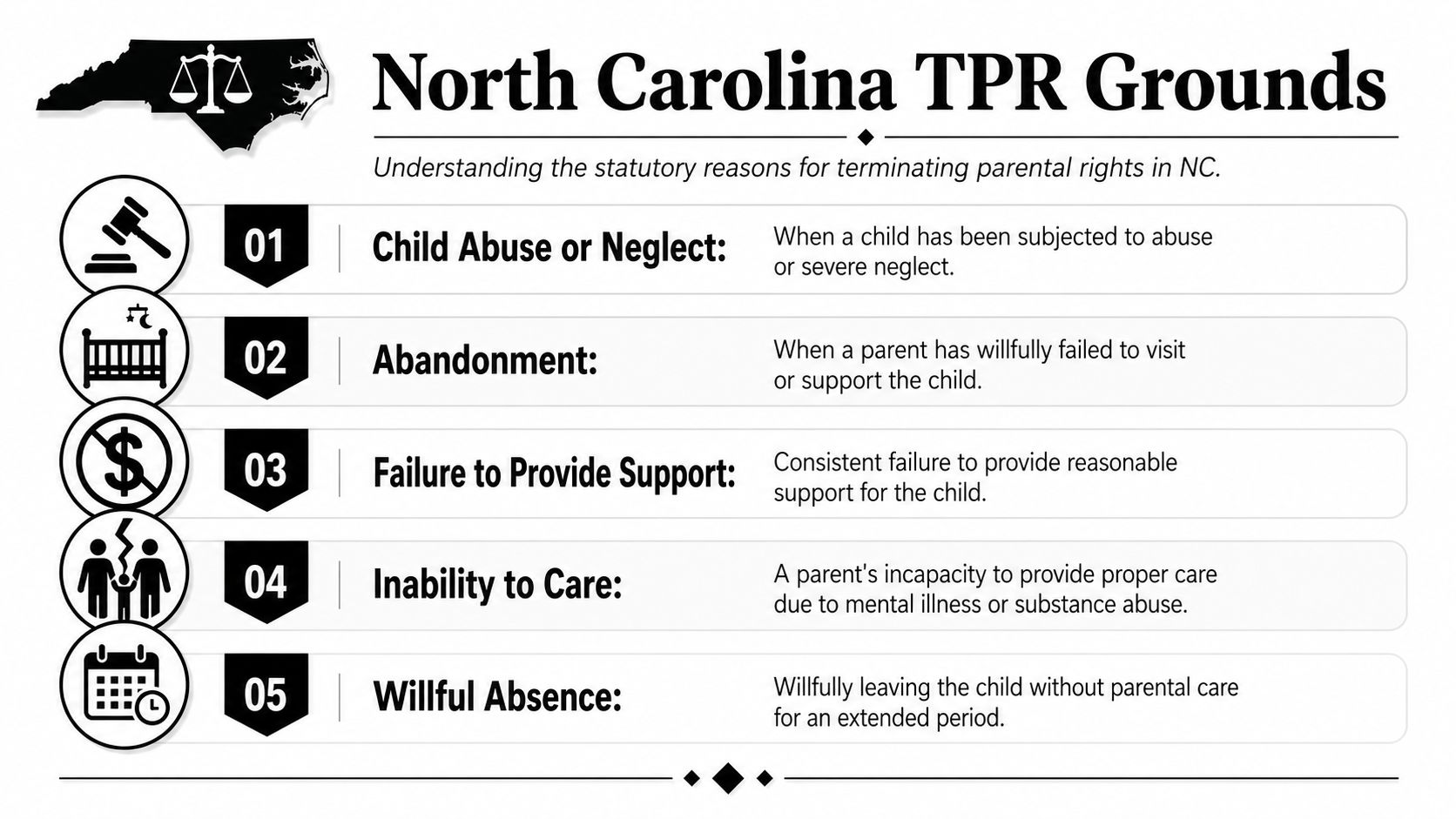
Grounds that come up most often
Understanding the statutory reasons for terminating parental rights in NC.
Some grounds appear more often than others in private family cases.
- Willful failure to pay support for one year or more: A key ground applies when a noncustodial parent willfully fails, without justification, to pay for the child's care, support, and education for one year or more as required. This is often misunderstood. The issue isn't only whether money was unpaid. The court looks closely at whether the failure was willful.
- Willful abandonment for at least six consecutive months: This usually involves more than physical absence. It can include a parent who makes no meaningful effort to maintain a relationship.
- Certain conception-related criminal circumstances: North Carolina law also allows termination if a parent has been convicted of a sexually related offense that resulted in the child's conception.
A practical example helps. If a parent disappears, sends no support, doesn't call, misses birthdays, and makes no effort to see the child, that may support both abandonment and failure-to-support arguments. If a parent loses a job but keeps reaching out, visits when allowed, and tries to contribute what they can, the case is more complicated.
What works and what usually doesn't
People often assume unpaid child support automatically wins a TPR case. It doesn't. Proof has to be specific, organized, and tied to the statute. If support is part of the case, accurate records matter. Families dealing with payment disputes sometimes also need to understand North Carolina Child Support Guidelines Explained, which addresses how North Carolina calculates support through the Worksheet system.
Recent interpretation of the law has also sharpened a point many parents miss. Courts increasingly look beyond money and focus on the child's actual welfare, including non-financial parental engagement, as reflected in North Carolina's enacted juvenile statutes. A parent who pays support but has no emotional contact may still face serious scrutiny if the evidence shows emotional abandonment harming the child. By contrast, a parent who has struggled financially but stays involved may present a very different picture.
Paying support helps. It doesn't automatically answer the larger question of whether the parent-child relationship is real, active, and healthy.
That's one reason these cases are fact-heavy. The legal ground must fit, and the evidence must tell a credible story.
Who Can Start the TPR Process and How to File
One of the biggest misconceptions in North Carolina family law is that a parent can just sign a paper and walk away from parental rights. That is not how North Carolina handles termination cases.
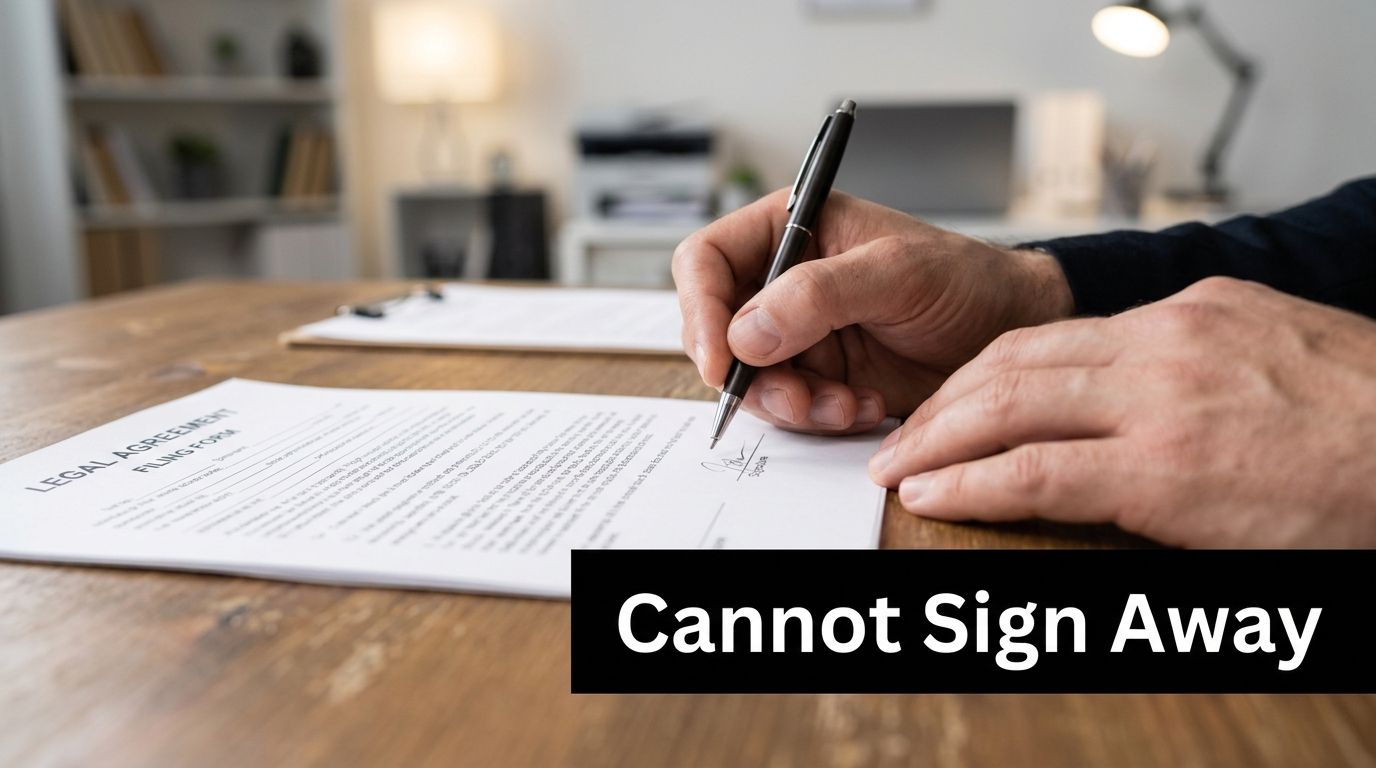
You can't simply sign your rights away
Under N.C.G.S. 7B-1103, a parent cannot file a petition to terminate their own parental rights. Only certain other parties may initiate the case, including the other parent, a prospective adoptive parent, a guardian ad litem, the Department of Social Services, or a person who has lived with the child for at least two continuous years. That rule is described in Wake Family Law Group's discussion of North Carolina termination procedure.
The limited exception people talk about is adoption. In that setting, a parent may consent to relinquishment as part of the adoption process. Outside that context, courts don't allow a parent to escape responsibility by choice alone.
Who may file and what filing really involves
In practical terms, the people most likely to start a private TPR case are:
- The child's other parent
- A prospective adoptive parent
- A qualifying long-term caregiver
- DSS in abuse, neglect, dependency, or foster care-related matters
Filing the case means preparing a petition that states the legal grounds with enough detail to support them. Dates matter. Payment history matters. Contact history matters. A vague filing full of conclusions but short on facts can create problems from the start.
If a child's living arrangement is unstable, families sometimes first address immediate placement through options such as temporary custody in North Carolina. That doesn't replace termination, but it can stabilize the child while the larger legal question is sorted out.
Courts expect precision. “He's never been there” is a feeling. “He had no contact for the relevant statutory period” is the kind of allegation a court can evaluate.
Another point that confuses people is procedure across different family cases. For example, a divorce filing has its own residency rules, including the six-month residency rule discussed in North Carolina Divorce Residency Requirements. A TPR case is different. It has its own filing and standing requirements, and it needs to be handled as its own action.
Navigating the North Carolina Court Process
A termination case feels less overwhelming when you break it into stages. The sequence matters because missing a procedural step can damage an otherwise valid case.
To visualize the process, start here.

The basic court sequence
Most North Carolina TPR cases move through these steps:
Petition filed
The case starts when the authorized party files the petition in the proper court.Service of process
The other parent must be formally served with the lawsuit. This is not a courtesy step. It is a due process requirement.Response and pre-hearing preparation
If the other parent contests the case, attorneys gather records, subpoena witnesses, organize exhibits, and prepare testimony.Adjudication hearing
During this hearing, the judge decides whether a statutory ground for termination has been proven.Disposition hearing
If a ground exists, the judge decides whether termination is in the child's best interest.
North Carolina law also states that a hearing on a TPR petition should generally be scheduled within 90 days from filing, though good cause can justify extension, and a parent has 30 days after service of the TPR order to file a Notice of Appeal and serve it on all parties, as summarized by Breeden Law Office's overview of North Carolina termination cases.
Best interest is its own fight
Many people think the case ends once a statutory ground is shown. It doesn't. The court still has to decide whether termination serves the child.
Emotional reality frequently becomes a direct factor in courtroom proceedings. A parent may be current on support but absent from the child's daily life. Courts are increasingly scrutinizing whether financial payment alone reflects a meaningful parental relationship when there is evidence of emotional abandonment affecting the child's welfare. That can change how judges view “best interest.”
Here is a video overview that may help frame the process before you meet with counsel.
Contested and uncontested cases feel very different
Some cases are effectively uncontested because the parent consents in an adoption context or does not fight the allegations. Others are fully contested and involve witnesses, credibility disputes, and detailed evidence.
| Factor | Uncontested TPR (Parent Consents) | Contested TPR (Parent Fights) |
|---|---|---|
| Overall tone | More procedural and document-driven | More adversarial and evidence-heavy |
| Main issue | Whether the consent and legal requirements are valid | Whether a statutory ground exists and whether termination is in the child's best interest |
| Evidence burden in practice | Often narrower because fewer facts are disputed | Much broader because the court must resolve factual disagreements |
| Hearing experience | Usually more limited | Often includes testimony, records, and cross-examination |
| Emotional strain | Still significant, especially in adoption matters | Usually higher because the conflict stays active through the case |
| Risk of delay | Lower if paperwork is complete | Higher when service, evidence, or witness issues arise |
A contested TPR case is rarely just a legal dispute. It is often a record of years of family breakdown presented under courtroom rules.
The Permanent Impact of Terminating Parental Rights
Once a TPR order is entered, the consequences are lasting. That's why families need to think not only about winning the case, but about what life looks like after it.

What the order changes
Consider a common stepparent-adoption scenario. A mother has sole care of the child. The biological father has had no real involvement for a long time. The stepfather has acted as the child's day-to-day parent for years. If the court terminates the biological father's rights, that clears the legal path for the stepfather to adopt.
That change affects more than visitation. It ends the terminated parent's legal right to make decisions, seek custody, or claim a legal parental role going forward. It also changes the child's legal family structure in a permanent way.
The emotional side families don't always expect
Even when termination is the right legal result, it can still carry emotional complexity. Children may feel relief, grief, confusion, or all three. Caregivers sometimes expect the order to end the emotional fallout immediately, but court orders don't erase history.
A second scenario shows the trade-off. A father has paid support but has remained emotionally absent for years. The child sees him as a stranger. The mother believes termination will finally create peace. It may. But if there is no adoption waiting and no immediate replacement of that legal role, the family should think carefully about whether termination solves the problem they have.
Legal finality and emotional closure are not the same thing.
That is often why judges look closely at the child's long-term stability, not just the adults' conflict.
Exploring Alternatives to Terminating Parental Rights
Termination is sometimes necessary. It is not always the best first move.
Options that may fit the family better
Some families need protection and structure more than they need permanent severance. Depending on the facts, these alternatives may better serve the child:
- A detailed custody order: The court can restrict visitation, define communication rules, and assign decision-making authority.
- Guardianship: A caregiver may receive authority to care for the child without fully ending the parent-child legal relationship.
- Modification of existing orders: If a current order no longer works, targeted changes may solve the problem more directly than a TPR case.
Families who already have an order in place often need to start with modifying a North Carolina custody agreement, especially when the issue is safety, inconsistency, or school and medical decision-making.
Why this matters strategically
A parent may say, “I want him out of our lives.” That reaction is understandable. But the better legal question is, “What order gives this child the most stability with the least avoidable harm?”
Sometimes the answer is termination connected to adoption. Sometimes it's a stronger custody framework. Sometimes mediation helps resolve a narrow dispute while preserving a relationship that still has value for the child. Good legal advice narrows the remedy to the actual problem.
How a North Carolina Family Lawyer Can Help
Termination cases combine strict procedure with heavy emotions. That mix is where mistakes happen. A parent may have facts that sound compelling, but if the petition is drafted poorly, service is defective, or the evidence doesn't line up with the statute, the court may never get to the heart of the story.
A lawyer helps by identifying whether the case fits TPR, gathering records in a way the court can use, preparing witness testimony, and building the best-interest argument with the child at the center. Legal counsel also helps a parent defend against termination when the allegations are overstated, incomplete, or legally insufficient.
The Law Office of Bryan Fagan handles North Carolina family law matters, including disputes involving custody, support, and related parent-child issues. In a TPR case, one of the most important services a lawyer provides is honest advice about whether termination is the right path or whether a different remedy will better protect the child and your long-term position.
Common questions from North Carolina parents
Can I terminate my own parental rights in NC?
Usually, no. A parent can't file a petition to terminate their own rights outside limited adoption-related circumstances.
How long does a TPR case take in North Carolina?
The court should generally schedule the hearing within 90 days of filing, though good cause can extend that. Real timing depends on service, court scheduling, and whether the case is contested.
Is unpaid child support enough by itself?
Not automatically. The court looks at whether the statutory ground is met and whether termination is in the child's best interest.
What if the parent pays support but never sees the child?
That can still create serious issues. Courts are paying closer attention to emotional absence and the child's welfare, not just the payment record.
Can a stepparent adopt without terminating the other parent's rights?
In many situations, termination or valid relinquishment is a necessary step before the adoption can move forward.
If you're dealing with a possible termination case in North Carolina, get advice before you file, respond, or rely on assumptions from friends or online forums. A consultation can clarify whether you have standing, whether the facts meet a statutory ground, and what option best protects your child.
If you need guidance on how to terminate parental rights in NC, schedule a consultation with Law Office of Bryan Fagan. You can discuss your family's situation, review the legal options available under North Carolina law, and make a plan that protects your child's stability without guessing about the next step.