For answers about marital misconduct in NC, it's likely you're already in a painful situation. You may have found messages on a phone, noticed money disappearing from accounts, or watched your spouse move out and stop contributing to the household. You may also be hearing confident advice from friends that turns out to be legally wrong.
That confusion matters. In North Carolina, marital misconduct can have major consequences in some parts of a divorce case and almost no effect in others. The difference can change whether someone receives alimony, how you prepare your evidence, and what arguments are worth making in court.
People often assume that if a spouse cheated, drank too much, hid money, or acted cruelly, the court will punish that conduct across the board. That isn't how North Carolina law works. Some misconduct matters a lot. Some matters only in narrow ways. Some matters only if you can prove it with real evidence tied to the right time period.
A practical approach helps. Before you argue about what was unfair, you need to know what the law recognizes, what proof a judge will consider, and what steps protect your position instead of weakening it. Those trade-offs are where many cases are won or lost.
Facing a Difficult Truth in Your Marriage
Many clients reach this point after weeks or months of uncertainty. They suspect something is wrong, but they don't know whether what they're seeing is legally important or just part of a marriage breaking down. That distinction is hard to sort out when you're also trying to care for children, protect finances, and make decisions about separation.
In North Carolina, the label marital misconduct doesn't apply to every hurtful act. It refers to specific conduct recognized by statute, and timing matters. A lot of stress comes from not knowing whether the behavior you experienced fits the law or whether it will affect alimony, custody, or property issues.
Practical rule: Don't assume morally wrong conduct is automatically legally significant. In family court, the right facts matter only when they're tied to the right claim.
A spouse who had an affair may have created a strong alimony issue. A spouse who spent money recklessly may have created a property issue, depending on the facts. A spouse who was disrespectful may have behaved terribly without creating the kind of claim people expect. The legal system often separates emotional harm from actionable evidence.
That can feel cold, but it also gives you a path forward. When you understand how North Carolina treats misconduct, you can stop chasing every upsetting fact and start focusing on the facts that move your case.
What Is Marital Misconduct Under North Carolina Law
North Carolina gives marital misconduct a specific legal meaning. Under N.C. Gen. Stat. § 50-16.1A(3), it includes nine specific acts that must occur during the marriage and before, or on, the date of separation, as summarized by Patrick, Harper & Dixon's discussion of marital misconduct and alimony.
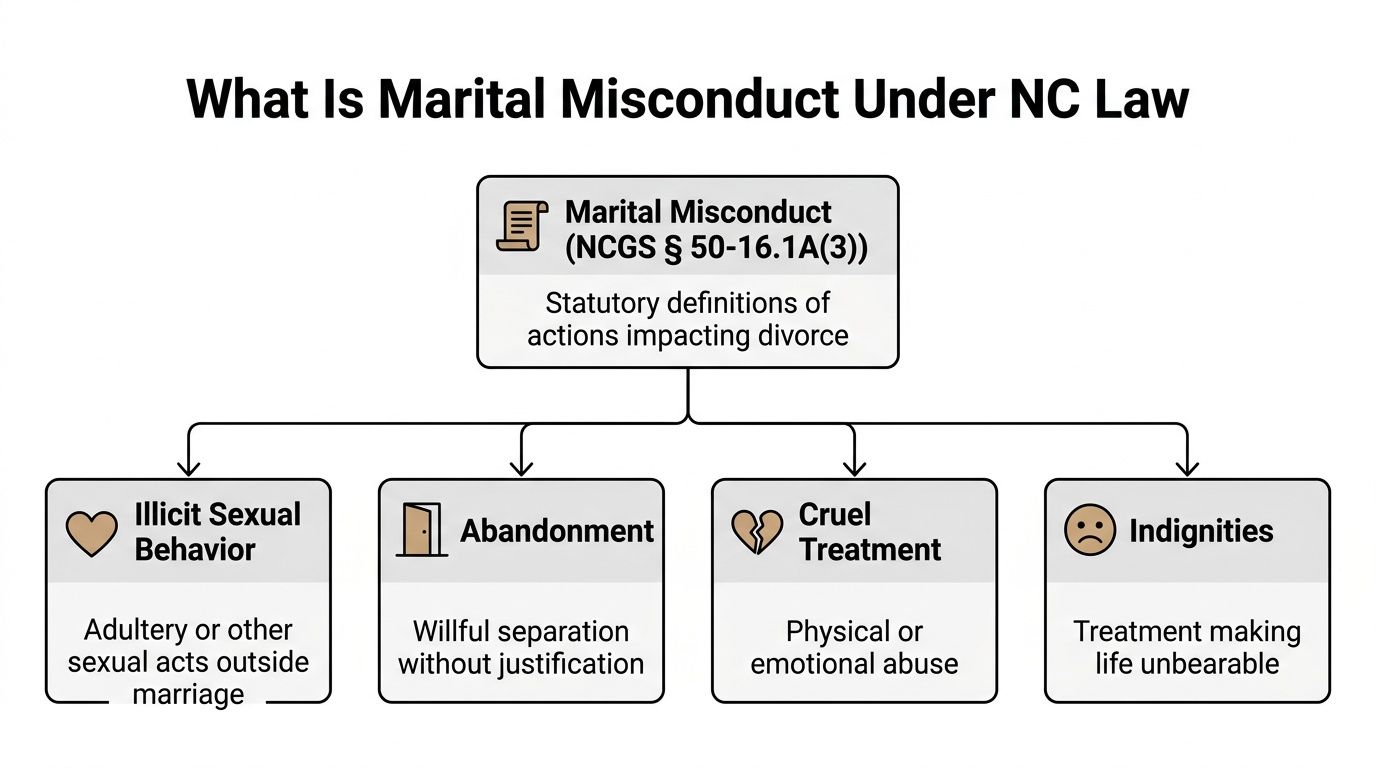
The nine statutory categories are:
Illicit sexual behavior
Abandonment
Malicious turning out-of-doors
Cruel or barbarous treatment endangering life
Indignities rendering life intolerable
Reckless spending or asset concealment
Excessive use of alcohol or drugs
Willful failure to provide necessary subsistence
Involuntary separation due to a criminal act
What those terms mean in plain English
Some of these phrases sound old-fashioned because they are. The law still uses them, so it's important to translate them into everyday language.
- Illicit sexual behavior means adultery or similar sexual conduct outside the marriage.
- Abandonment usually means one spouse leaves without justification and without intent to resume the marriage.
- Malicious turning out-of-doors involves forcing a spouse out of the marital home.
- Cruel or barbarous treatment refers to conduct dangerous enough to threaten life or serious safety.
- Indignities covers repeated degrading treatment that makes married life intolerable.
- Reckless spending or asset concealment includes wasting money or hiding assets in a way that harms the marital relationship.
- Excessive alcohol or drug use means substance abuse serious enough to affect the marriage.
- Willful failure to provide subsistence involves refusing to support a spouse when able to do so.
- Involuntary separation due to a criminal act applies when criminal conduct forces the separation.
The one category that changes alimony automatically
Only illicit sexual behavior carries an automatic statutory consequence. If the dependent spouse committed adultery, the court must deny alimony unless that conduct was condoned or both spouses engaged in it. If the supporting spouse committed adultery, the court must award alimony. For the other eight categories, the court has discretion in deciding whether misconduct affects alimony, the amount, and duration.
That distinction is why timing and proof matter so much in these cases. It also explains why people who are separated often ask questions about new relationships. If you're trying to understand those risks, dating during separation in North Carolina deserves careful attention.
For a narrower discussion of support issues, How Marital Misconduct Affects Alimony in NC addresses why adultery and other misconduct can change an alimony outcome.
How Misconduct Actually Affects Your Divorce Case
The same allegation can matter a great deal in one part of a divorce and not at all in another. That's one reason people waste time and money on bad arguments. They focus on proving betrayal when the primary legal issue is support, or they expect a custody advantage from facts that don't meet the custody standard.
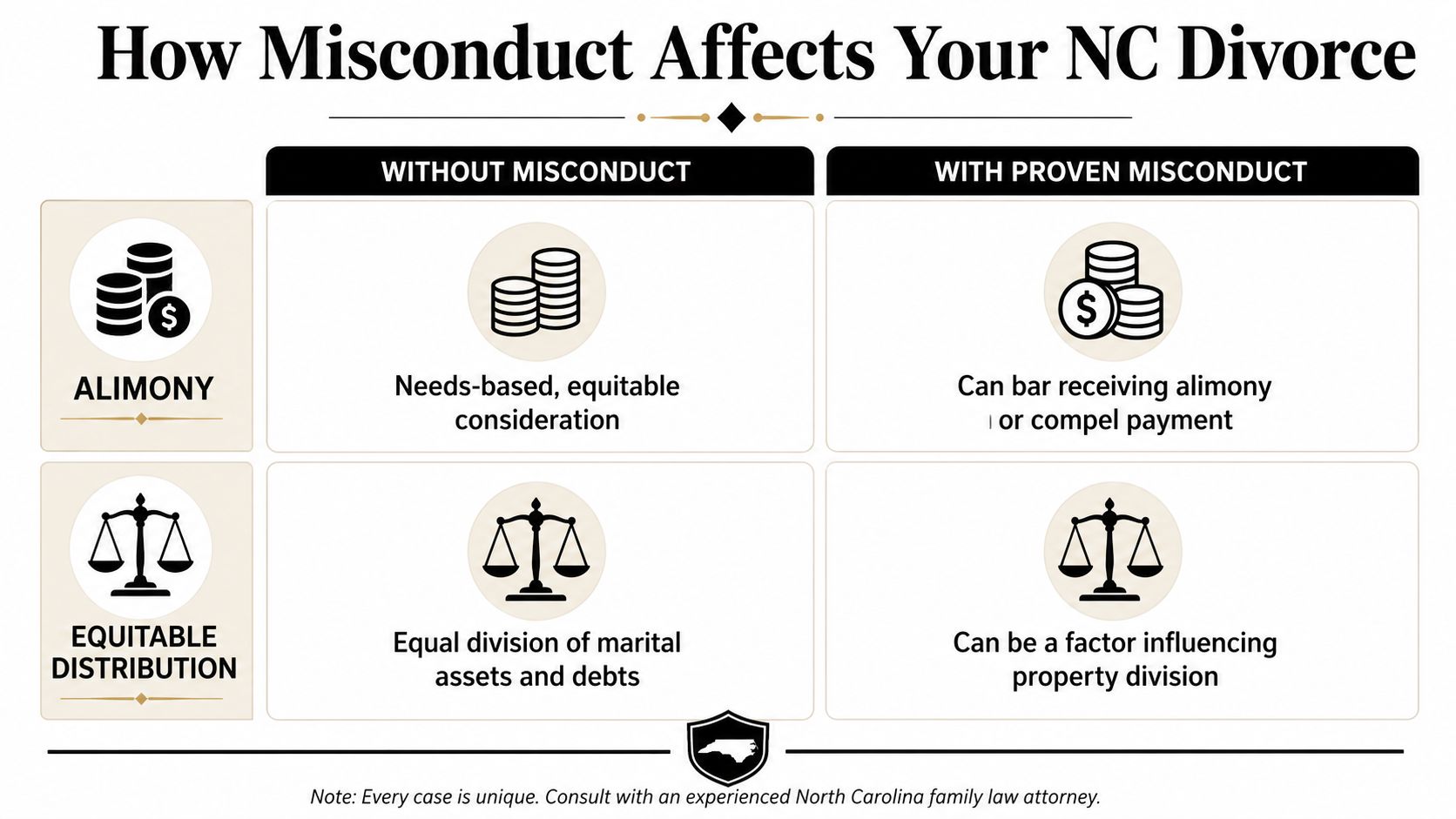
Near the start of this analysis, this visual helps frame the different lanes:
Alimony is where misconduct matters most
In North Carolina, misconduct is often most important in alimony and post-separation support. The spouse making the allegation has the burden of proof and must show the misconduct happened more likely than not, meaning a greater than 50 percent probability, as explained in this North Carolina discussion of what counts as marital misconduct.
That same source also notes two points clients often miss. First, if misconduct was condoned, such as an affair that was forgiven, the court won't consider evidence of that act for alimony. Second, either spouse may request a jury trial on the issue of marital misconduct, which gives the allegation unusual procedural weight in a family law case.
A simple example shows how this plays out. If a lower-earning spouse seeks alimony and the higher-earning spouse can prove that lower-earning spouse committed illicit sexual behavior before separation, the support claim may fail even if the financial need is real. If the facts point the other way, the misconduct can drive the result in the opposite direction.
This is also where clients need to think strategically. A weak adultery claim can distract from stronger financial arguments. A well-supported claim can reshape settlement discussions quickly.
Later in the case, video resources can also help clients understand the support issues that often travel with misconduct disputes.
Property division usually doesn't turn on fault
One of the biggest myths in marital misconduct NC cases is that bad behavior automatically changes who gets what property. As a general rule, fault doesn't control equitable distribution in North Carolina. If you're sorting out that process, equitable distribution in North Carolina is the framework that governs division of marital assets and debts.
That means a spouse usually doesn't get a bigger share of property because the other spouse cheated, acted badly, or caused the marriage to end. Clients are often frustrated by this, but it reflects North Carolina's no-fault divorce structure.
The practical exception involves financial behavior tied to the marital estate. If one spouse drained accounts, concealed assets, or spent marital funds recklessly, those facts may matter because they affect the property itself, not because the court is punishing bad character.
| Issue | Usually relevant | Usually not relevant |
|---|---|---|
| Alimony | Adultery and other statutory misconduct | General resentment without proof |
| Property division | Waste, concealment, diversion of assets | Adultery by itself |
| Child support | Financial information | Marital fault |
Child custody follows a different standard
Custody is where many people make the biggest mistake. They assume adultery, abandonment, or heavy drinking automatically decides parenting rights. In most cases, it doesn't.
The custody question is the child's welfare. If misconduct doesn't affect the child, it often doesn't carry weight in custody litigation. A parent's affair may be morally significant but legally weak unless it connects to parenting harm, such as exposing the child to dangerous situations, neglect, or substance use that puts the child at risk.
Courts want evidence tied to the child, not just evidence that one spouse was a bad husband or wife.
That distinction changes how evidence should be gathered. If the concern is custody, focus on school issues, unsafe supervision, documented impairment around the children, or proof of neglect. If the concern is alimony, focus on timing, relationships, and corroborating details tied to pre-separation conduct.
Proving Marital Misconduct in a NC Court
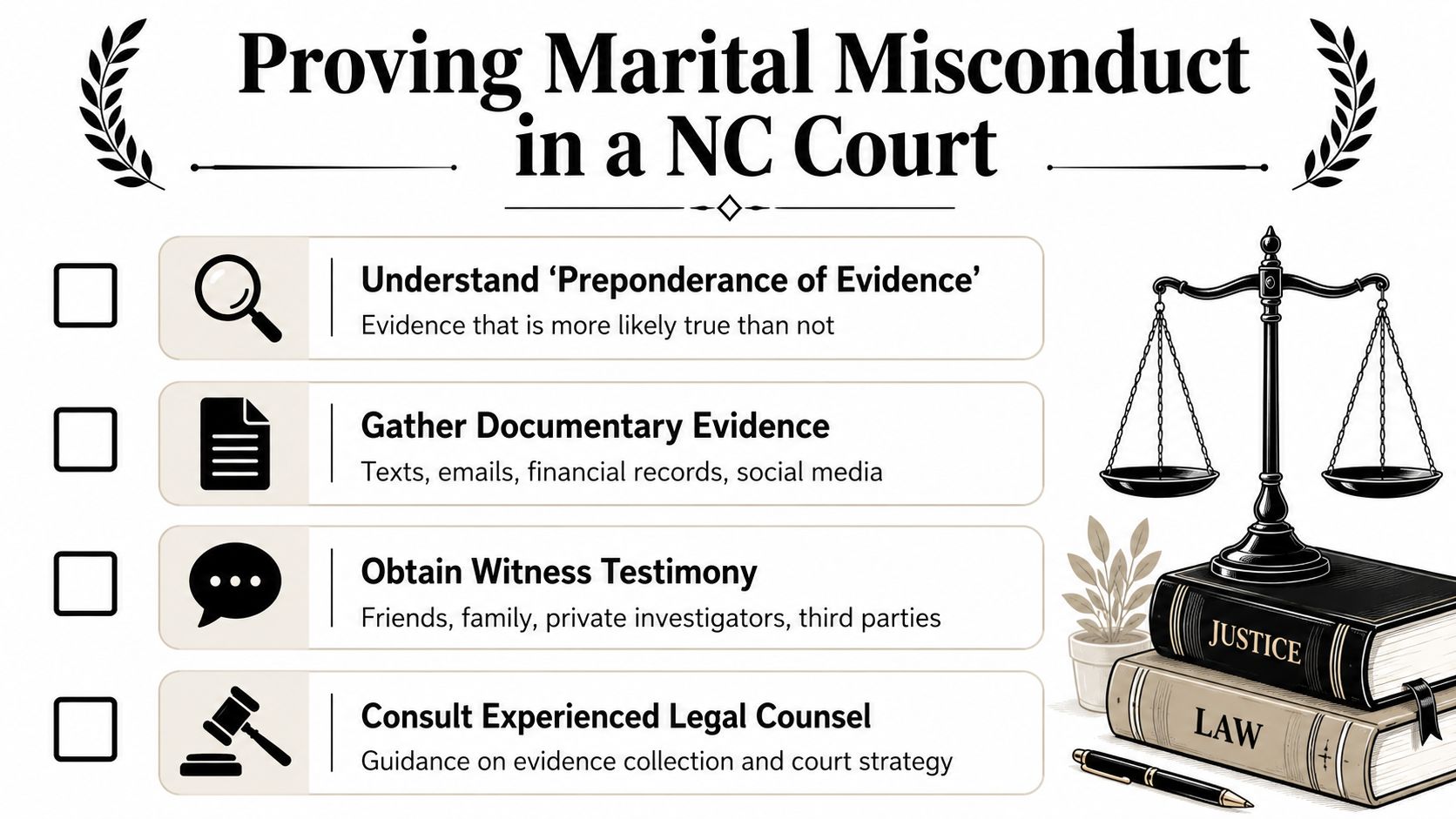
A suspicion isn't enough. A rumor isn't enough either. In court, the question is whether you can produce evidence that makes the allegation more likely true than not.
What judges look for
North Carolina courts want tangible proof. According to Johnson Law Group's explanation of alimony evidence, useful evidence can include social media posts showing affection, vacation photos with third parties, gift purchases, cohabitation indicators, cell phone records with texts, emails, and location data, and physical evidence gathered by a private investigator. That source also notes that courts don't treat changed privacy settings as protection. Facebook and Instagram content may still be discoverable.
For adultery allegations, one document or one text message rarely carries the whole case. What often works is a pattern. A set of messages, a hotel charge, a shared trip, and witness testimony may fit together in a way that becomes persuasive.
A practical evidence checklist
If misconduct may become part of your NC divorce case, careful documentation matters more than dramatic confrontation.
- Preserve digital records: Save texts, emails, direct messages, screenshots, and photos in original form if possible.
- Track spending: Review bank and credit card statements for unusual gifts, travel, cash withdrawals, or missing funds.
- Document dates: The date of separation is critical. Evidence must line up with conduct during the marriage and before, or on, that date.
- Identify witnesses: Friends, relatives, neighbors, or investigators may have observations that support or contradict your claim.
- Stay lawful: Don't hack accounts, record illegally, or take documents you aren't entitled to access.
Evidence lesson: Courts decide cases on documented facts, not on who tells the more emotional story.
What works and what doesn't
A real-world example helps. Suppose a spouse claims adultery based only on a gut feeling and a hidden phone password. That's usually weak. Suppose instead there are affectionate messages, travel records showing overnight trips with the same person, purchases of gifts, and testimony placing the couple together. That is a very different case.
The same logic applies to financial misconduct. If a spouse says, "Money just vanished," that may not carry much weight by itself. If account statements show large withdrawals, unusual transfers, or spending inconsistent with ordinary marital expenses, the argument becomes more concrete.
The strongest cases are usually built discreetly and methodically. People often hurt themselves by confronting too early, deleting messages in anger, or posting about the issue online. Once litigation is likely, disciplined record-keeping matters.
Common Defenses Against Misconduct Allegations
An accusation doesn't equal a finding. North Carolina misconduct claims can fail because the proof is weak, because the conduct doesn't fit the statute, or because a legal defense applies.
Condonation
Condonation means forgiveness. In practice, this usually comes up when one spouse learns of an affair and then resumes the marital relationship in a way that suggests the conduct was forgiven. If that happened, the earlier act may lose its force in an alimony dispute.
The details matter. A short attempt to reconcile doesn't always answer every question, but condonation is a real issue that should be evaluated carefully.
Connivance
Connivance means one spouse encouraged or facilitated the misconduct and then tried to use it later as a legal weapon. These cases are less common, but the defense exists for a reason. Courts don't look favorably on manufactured fault claims.
Recrimination
Recrimination usually means both spouses engaged in misconduct. In adultery-related alimony disputes, that can shift the court from a mandatory outcome to a discretionary one. When both parties have problematic facts, the clean moral narrative often falls apart.
A separate practical issue arises in higher-asset cases involving spending and concealment. Collins Family Law's discussion of when marital misconduct is relevant in North Carolina notes that the NC State Bar's 2025 Family Law Practicum found 42% of high-asset divorce cases in NC include allegations of financial misconduct, while 19% of online articles explain its legal weight in equitable distribution. That gap shows why people often underestimate defenses tied to business records, account tracing, and intent.
Proof problems are still defenses
Many allegations fail for a simpler reason. The evidence may show suspicious conduct, but not enough to satisfy the legal standard. A spouse may have had close communications with someone else without proof strong enough to establish illicit sexual behavior. Another may have spent heavily, but not in a way that legally qualifies as reckless dissipation of marital assets.
That is why both sides need strategy, not just outrage.
Frequently Asked Questions About Marital Misconduct
Does adultery affect child custody in North Carolina
Usually, adultery alone doesn't decide custody. The issue is whether the conduct affects the child. Hall & Booth Smith's discussion of the impact of marital misconduct in North Carolina notes that a 2024 NC Judicial Council survey found 68% of custody litigants in NC believe adultery alone justifies denying custody, yet only 12% of appellate rulings cite adultery as a custody factor without additional harm to the child. Courts look for evidence such as abuse, substance use that endangers the children, or documented neglect.
Can conduct after separation count as marital misconduct
Post-separation conduct isn't independent proof of marital misconduct for alimony purposes. It may still matter in a limited way if it corroborates conduct that happened before separation. In practice, that means the separation date should be documented carefully and early.
Are social media posts really usable in court
Yes, they can be. Posts, photos, messages, and location information may become evidence if they are relevant and properly obtained. People often think deleting posts or changing privacy settings solves the problem. It usually doesn't.
What if both spouses cheated
That can change the legal analysis, especially in alimony cases. North Carolina doesn't treat mutual misconduct the same way it treats a one-sided claim. Questions about support often require a closer review of the statutory framework, and North Carolina alimony laws are a useful starting point.
Do I need a private investigator
Not always. Some cases are proven through records, witness testimony, and digital evidence. In other cases, an investigator can provide structure and credibility that the court finds helpful. The right choice depends on what you already have, what you still need, and whether the likely value of the claim justifies the cost.
Protect Your Rights with an Experienced NC Attorney
Marital misconduct claims can feel personal, but they have to be handled strategically. The strongest cases usually come from disciplined fact gathering, careful timing, and a clear understanding of where misconduct matters and where it doesn't. That is especially true when alimony, financial records, or disputed separation dates are involved.
Waiting too long can create avoidable problems. Evidence disappears. Stories change. Accounts get moved. Harmful assumptions harden into bad decisions. Early legal advice can help you preserve proof, avoid self-inflicted mistakes, and focus on the claims that affect your North Carolina case.
If you're dealing with suspected adultery, financial concealment, abandonment, or a related issue, legal guidance should be practical and specific to your facts. No lawyer can promise an outcome, but a sound strategy can protect your position and reduce unnecessary risk.
If you need advice about marital misconduct in NC, schedule a consultation with the Law Office of Bryan Fagan. The firm works with North Carolina clients facing divorce, alimony, custody, and property disputes, and can help evaluate the facts, identify useful evidence, and discuss the next legal steps for your situation.