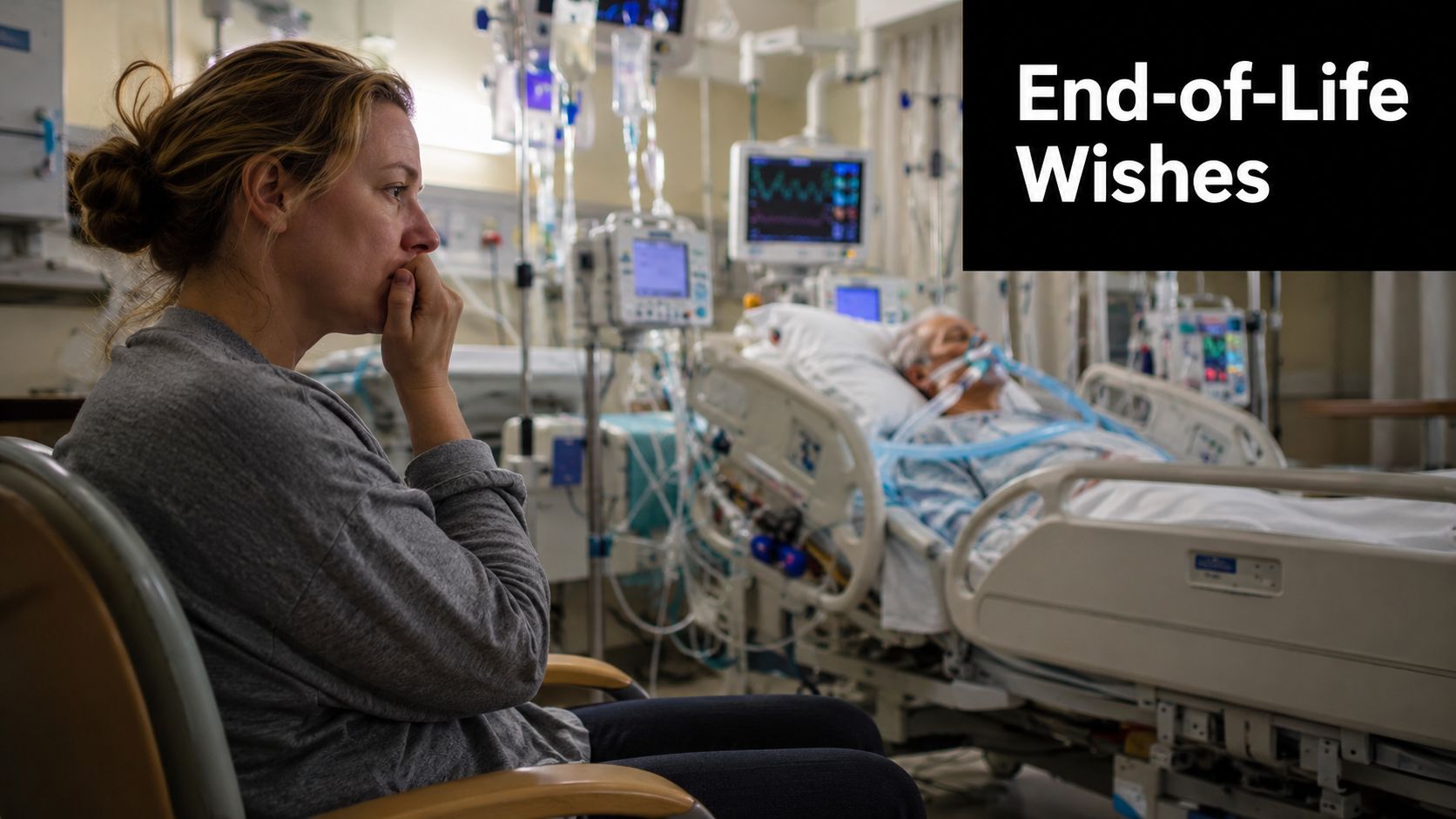
A hospital phone call can turn advance planning into an urgent legal problem. Your parent may be unable to speak after a stroke, while family members and physicians try to determine whether continued life support reflects that person's wishes. Without a valid North Carolina living will, loved ones may be left making emotionally difficult decisions without clear legal direction.
North Carolina calls this document an Advance Directive for a Natural Death, and its execution requirements are formal. The document must be signed, witnessed, and properly acknowledged. A witness who seems convenient, a missing notary, or confusion about the role of a health care power of attorney can undermine the plan when it matters most.
What a Living Will Does Under North Carolina Law
Under N.C.G.S. § 90-321, a North Carolina living will, formally called a Declaration of a Desire for a Natural Death, applies when a person cannot make or communicate health care decisions and a statutory medical condition exists. The declaration addresses conditions such as an incurable condition, an irreversible coma, or advanced dementia as diagnosed by a board-certified neurologist under N.C.G.S. § 90-321(a)(2).
That rule matters at the bedside. A patient may be unable to speak while relatives and physicians review whether continued treatment follows the patient's instructions. A general family conversation may offer context, but it does not give the medical team the same written direction as a valid declaration.
What treatment instructions can address
The document can state whether physicians should withhold or withdraw specified life-prolonging measures. The North Carolina statutory form addresses choices involving:
- Mechanical ventilation: Whether breathing support should continue during a qualifying condition.
- Artificial nutrition: Whether nutrition delivered through medical means should be withheld or withdrawn.
- Artificial hydration: Whether medically supplied fluids should continue.
- Comfort-focused care: Treatment to relieve pain and distress remains available even when life-prolonging measures are limited.
A living will does not order the medical team to stop all treatment. It addresses identified interventions under identified conditions. Providers may continue appropriate comfort care and other treatment that does not conflict with the declaration.
Practical rule: Discussing wishes with family helps, but those conversations do not replace a properly executed North Carolina advance directive.
Why the document matters at the bedside
Without a valid declaration, relatives may disagree about the patient's preferences. Physicians may need to rely on other legally authorized arrangements, and the family may face difficult discussions with the hospital or possible court involvement. Delays, conflict, and guilt can follow while decisions are made during a medical crisis.
A properly executed declaration gives the medical team a written expression of the patient's wishes. It also reduces the burden on loved ones to guess which treatment the patient would have chosen.
The document has a limited purpose. It does not provide general authority over every health care decision or appoint the person who will make choices when circumstances fall outside its terms. A health care power of attorney serves that broader role and is commonly prepared alongside a living will. Confusing the two documents can leave a family with clear treatment preferences but no appropriately appointed decision-maker, or an appointed agent without written instructions for end-of-life care.
Statutory Requirements for a Valid Living Will
North Carolina's statutory framework makes execution more than a signature on a downloaded form. Under G.S. 90-321, the signer must follow a formal process designed to establish authenticity, capacity, and independence from improper influence.
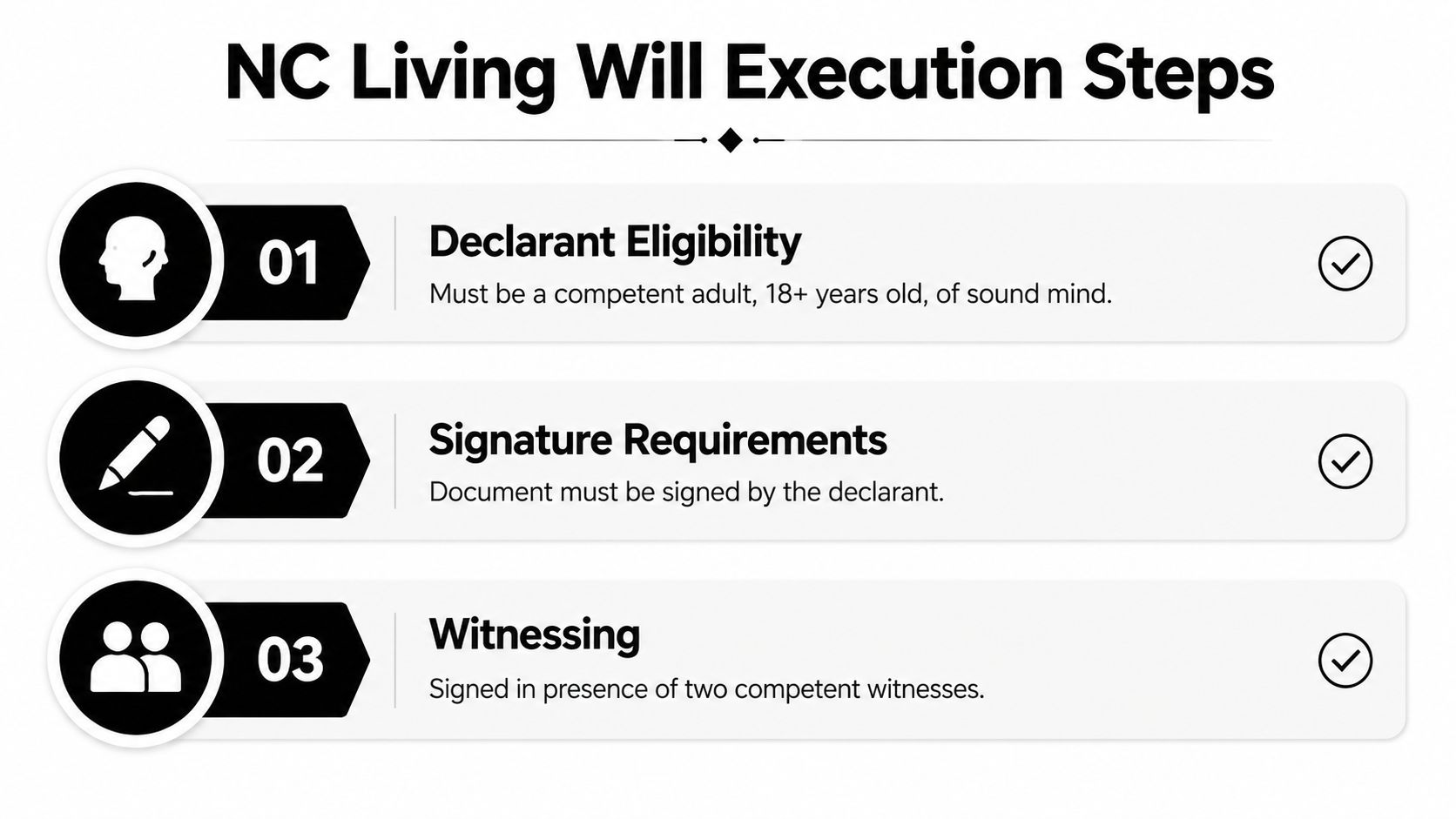
Follow the execution sequence
First, confirm the declarant's eligibility. The person signing must be a competent adult and of sound mind at the time of execution. The statutory materials identify adulthood as beginning at 18 years of age. If capacity is already in question, waiting can create a serious challenge to the document.
Second, sign the declaration correctly. The declarant should sign the document in the required manner. North Carolina law also permits another person to sign at the declarant's explicit direction and in the declarant's presence. That alternative should be documented carefully, particularly when illness or physical limitations affect the signer.
Third, use two qualified witnesses. The witnesses must be adults who can observe the signing and understand the required attestation. They must believe the declarant is of sound mind, and they cannot fall within the statutory disqualification categories. The statute excludes people such as close relatives, potential heirs, creditors, and certain health care workers involved in the declarant's care. The North Carolina Bar Association guidance explains that these formal execution rules apply to living wills and health care powers of attorney.
Fourth, acknowledge the document. The declarant's signature must be proved before a notary public, or acknowledgment may be taken by a clerk or assistant clerk of superior court. A document that is witnessed but never notarized or otherwise properly acknowledged doesn't satisfy the complete North Carolina workflow.
Avoid casual attestation language
The statutory form supplies language for the declarant, witnesses, and notarial acknowledgment. If a nonstandard form is used, it still needs to express the necessary declaration and preserve the required execution elements. A notary's role is to authenticate the acknowledgment, not to decide whether the medical instructions are wise or whether an improperly drafted document complies with every legal requirement.
A signature page may contain language similar in function to:
The declarant signed or acknowledged this declaration in our presence, appeared to be of sound mind, and acted voluntarily.
That sample isn't a replacement for the statutory form or legal review. The exact document should be checked for compliance before signing.
Even a clear statement of wishes can fail if one execution element is missing. North Carolina's formal process exists so hospitals and families can have greater confidence that the document is genuine and voluntarily signed. A person researching unrelated legal rules, such as the North Carolina Divorce Residency Requirements, shouldn't assume that a document valid for another legal purpose follows the same signing requirements as an advance directive.
Living Will vs Health Care Power of Attorney
A living will and a health care power of attorney solve different problems. Treating them as interchangeable is one of the most common planning errors in North Carolina.
The living will provides instructions for end-of-life treatment when the specified statutory conditions exist. A health care power of attorney appoints an agent to make health care decisions when the principal lacks capacity. That agent may need to address surgery, medications, rehabilitation, consent to treatment, or other medical questions that don't fit neatly into an end-of-life declaration.
| Feature | Living Will, Declaration of Natural Death | Health Care Power of Attorney |
|---|---|---|
| Primary function | States treatment preferences in qualifying end-of-life circumstances | Names an agent to make health care decisions during incapacity |
| Decision-maker | Speaks through written instructions to medical providers | Gives authority to a chosen health care agent |
| Scope | Focused on life-prolonging treatment and natural-death decisions | Broader medical decisions, potentially including mental health treatment |
| Timing | Applies when statutory triggering conditions and incapacity are present | Applies when the principal lacks decision-making capacity, according to the document and law |
| Practical value | Provides direct guidance about the most serious treatment choices | Handles unexpected or routine decisions the living will doesn't anticipate |
Why the agent still matters
A living will can't predict every medical development. A person may be temporarily incapacitated after an accident and need a decision about a procedure that isn't addressed in the declaration. The health care agent can interpret the person's known values and make decisions within the authority granted by the document.
North Carolina permits a health care power of attorney to be combined with a declaration for a natural death when both satisfy their respective legal requirements, as reflected in North Carolina legislative materials. The two documents can therefore operate as a coordinated advance-care-planning package rather than isolated paperwork.
Many residents should consider both. The living will states what should happen in the extreme circumstances it covers, while the health care power of attorney gives a trusted person authority for the many medical decisions that arise outside those circumstances. If the documents address the same end-of-life question, the living will generally provides the direct instruction unless the documents and applicable law authorize a different result.
For related planning purposes, a durable power of attorney is discussed separately in North Carolina durable power of attorney guidance. That document shouldn't be confused with the health care power of attorney, because the authority and purpose may differ.
Storing and Updating Your Advance Directive
A signed living will can't help if the hospital and family don't know it exists. Storage and communication are part of the plan, not administrative details to handle later.
Make the document available
Keep the original in a secure location that can still be reached during an emergency, such as a fire-resistant home safe. Give copies to the people most likely to need them:
- Health care agent: The agent should know the document's location and understand the patient's preferences.
- Primary care physician: Ask the office to place a copy in the medical record.
- Relevant hospital: A local hospital may be able to maintain the directive in its records.
- Close family members: They should know whom to contact and where the original can be found.
North Carolina also maintains an Advance Health Care Directive Registry under Chapter 130A. The registry provides a formal location for filing advance directives so they can be accessed when treatment decisions become urgent. State materials also describe online access using a file number and password, and the Secretary of State's registry information identifies a $10 registration fee. Confirm current filing procedures and forms before submitting anything.
You can learn more about how advance planning fits within broader estate administration through North Carolina probate planning guidance, but don't assume probate documents automatically place a living will in a hospital's hands.
Revoke or replace deliberately
North Carolina allows a competent declarant to revoke a living will. Revocation may be written or communicated through another clear and consistent expression of intent, and it becomes practically important to communicate the revocation to the attending physician and everyone holding a copy, as described in the North Carolina revocation materials.
The cleanest update is usually a new, properly executed declaration. Destroying an old original alone may not be enough if copies remain in a physician's file, a family member's records, or the state registry. After signing a replacement, distribute it and ask recipients to remove or mark the prior version.
Review the document after divorce, a major diagnosis, a change in treatment preferences, or a move to North Carolina from another state. Also reconsider the named agent after a death, estrangement, or change in trust.
Common Mistakes That Invalidate a Living Will
The biggest risk isn't always unclear medical language. It's often a defective signing ceremony.
A family may find a form online, ask relatives to witness it, and place it in a drawer. That approach can fail because North Carolina restricts who may serve as witnesses and requires notarization or acknowledgment. A person may have expressed clear wishes, yet the document still creates a legal dispute if the execution record is defective.
| Mistake | Legal Consequence |
|---|---|
| Using a blood or marriage relative as a witness | The witness may be disqualified, threatening the directive's validity |
| Using a potential heir, creditor, or connected health care worker | The statutory independence requirement may not be satisfied |
| Omitting notarization or acknowledgment before an authorized official | A witnessed-only document may not meet North Carolina's execution rules |
| Relying on a generic form with inadequate declaration language | Providers may question whether the document qualifies as a North Carolina declaration |
| Confusing a living will with a health care power of attorney | No agent may be available for decisions outside the living will's limited scope |
| Leaving an outdated agent designation in place | A deceased or estranged agent may be unable or unwilling to act |
The practical consequences
When a document fails, family members may need to pursue guardianship proceedings or ask the hospital to address competing views through internal review. Physicians may face uncertainty about which instructions to follow, while relatives may fall back on assumptions about what the patient would have wanted.
Don't treat a template as a complete plan. A North Carolina will template addresses a different estate-planning purpose and doesn't replace an advance directive for medical treatment.
The safer approach is to verify the witness relationships, complete the acknowledgment, review the instructions for clarity, and coordinate the living will with a health care power of attorney. Those are preventable steps, and they should be handled before a medical emergency rather than during one.
Protect Your Wishes With Experienced Legal Guidance
North Carolina supplies a statutory form, but filling in blanks isn't always enough. Blended families, difficult diagnoses, prior documents from another state, and concerns about family conflict can require careful coordination rather than a one-page transaction.
An estate planning attorney can help you:
- Choose witnesses who don't create a statutory disqualification problem.
- Confirm the signing and acknowledgment process.
- Coordinate the living will with a health care power of attorney.
- Identify whether separate medical orders, such as a DNR order, should be discussed with your health care providers.
- Review how the directive fits with your broader estate plan.
- Prepare registry filings and distribute copies to the people who need access.
Legal guidance can't guarantee that every future medical question will be simple. It can reduce avoidable uncertainty and help ensure that your documents accurately express your decisions under North Carolina law. That preparation may also spare family members from a court proceeding or a painful disagreement about treatment.
The Law Office of Bryan Fagan works with North Carolina individuals and families on estate planning, wills, trusts, and probate-related matters. A consultation can help determine whether you need a new living will, a companion health care power of attorney, or a coordinated review of documents already in place.
The Law Office of Bryan Fagan offers North Carolina estate planning consultations to review or create advance directives and coordinate them with your broader plan. Schedule a consultation so your wishes are properly executed, shared with the right people, and accessible when medical decisions become urgent.