In North Carolina, a Durable Power of Attorney is a foundational legal document that lets you give a trusted person the authority to manage your financial and property affairs. A critical aspect of North Carolina law, established by the NC Uniform Power of Attorney Act, is that all powers of attorney are now automatically durable—they stay effective even if you later become incapacitated.
Understanding Your Financial Co-Pilot: What is a Durable Power of Attorney in NC?

Think of a Durable Power of Attorney (DPOA) as appointing a trusted co-pilot for your financial life. It’s a core part of any solid North Carolina estate planning, designed to protect you and your assets while you are still living.
This legal tool allows you, the “principal,” to choose someone you trust—your “agent”—to step in and handle your affairs if you become unable to do so yourself. This could happen because of an unexpected accident, a sudden illness, or a gradual decline in health.
The Roles of Principal and Agent
Understanding the key players is straightforward:
- The Principal: This is you. You are the one creating the document and granting authority. You must be legally competent—meaning of sound mind—and fully understand what you are signing at the moment you create the DPOA.
- The Agent (or Attorney-in-Fact): This is the person you choose to act on your behalf. They have a serious legal responsibility, known as a fiduciary duty, to act only in your best interests, manage your assets carefully, and avoid any conflicts of interest.
Too many people see a DPOA as strictly an end-of-life tool. In reality, it’s a proactive step that provides security and peace of mind at any stage of life. It ensures that if you are ever temporarily or permanently incapacitated, someone you hand-picked can immediately manage critical financial responsibilities.
A common misconception is that a spouse or adult child can automatically handle your financial accounts if you're incapacitated. This is simply not true in North Carolina. Without a DPOA, your family may be forced into a costly and public court proceeding called guardianship just to pay your bills.
The Power of "Durability" in North Carolina Law
A significant change in North Carolina law has made these documents even more powerful. Before 2018, a Power of Attorney was not automatically durable; you had to include specific language to ensure it would remain valid after you became incapacitated.
Today, thanks to the North Carolina Uniform Power of Attorney Act (N.C.G.S. Chapter 32C), durability is the default. This means any Power of Attorney created under current law automatically remains effective even if you can no longer make decisions for yourself. This simple but critical change provides immense security for families across North Carolina.
By establishing a durable power of attorney in NC, you are not giving up control. You are ensuring that control stays in the hands of someone you trust, rather than being left to a court’s discretion.
How the NC Uniform Power of Attorney Act Protects You
Before 2018, the laws governing a durable power of attorney in North Carolina could create heartbreaking and costly problems for families. A major legal update, the North Carolina Uniform Power of Attorney Act (N.C.G.S. Chapter 32C), modernized the entire system to provide much-needed clarity and security.
This law wasn’t just a minor tweak; it fundamentally changed how these critical documents operate in our state. The most important change is that all North Carolina Powers of Attorney created after January 1, 2018, are automatically durable. This means the document stays legally valid even if you become incapacitated. You no longer need to include special "magic words" to make it durable—in fact, the opposite is now true. If for some reason you wanted a POA to end upon your incapacity, you would have to state that explicitly.
The Problem With Pre-2018 POA Laws
To appreciate why the current law is such an improvement, it helps to understand the challenges of the old system. Before 2018, you could draft a perfect durable power of attorney, but it wasn't legally valid for many purposes unless it was recorded with the county Register of Deeds before you became incapacitated. This small, often-overlooked step tripped up countless North Carolina families.
Let’s look at a practical example that shows just how damaging the old law could be.
Real-World Scenario: A Costly Delay
Imagine Sarah’s elderly father, David, who lives in Raleigh, created a durable power of attorney in 2016 and named her as his agent. He signed it and gave her a copy for safekeeping, thinking he had all his affairs in order. A year later, David had a severe stroke that left him unable to communicate or manage his finances.
When Sarah went to his bank in Cary to use the POA to pay for his medical care, the bank rejected it. Why? Because the document had never been recorded with the Wake County Register of Deeds while David was still competent. Under the old rules, the POA was essentially useless for many transactions. Sarah was now facing a long and expensive court battle to be appointed his legal guardian, all while critical bills piled up.
This exact situation was a devastatingly common problem for many families. The new Act was designed specifically to prevent this kind of crisis.
Why Reviewing Old Documents Is Critical
If you or a loved one has a power of attorney that was signed before January 1, 2018, it is still governed by the old, more complicated laws. While that document might still be technically valid, it may not offer the protection you think it does. It could be missing the right language or may not have been recorded, leaving your family vulnerable just like Sarah’s.
An old power of attorney is not automatically updated by the new law. It's essential to have any pre-2018 documents reviewed by an experienced North Carolina estate planning attorney to confirm they are still legally sound and meet your current needs.
This review isn't just about legal compliance; it’s about making sure your plan actually works when your family needs it most. An attorney can help you decide if your existing document is sufficient or if creating a new durable power of attorney in NC under the current, more protective statute is the wisest path forward.
How to Create a Valid DPOA in North Carolina
Putting a durable power of attorney in place is one of the most important steps you can take to protect your future. But creating a document that holds up under scrutiny in North Carolina involves more than just downloading a generic form. To ensure your DPOA is legally sound, you must follow specific rules laid out in state law.
The single most critical requirement for executing a valid durable power of attorney is the signature and notarization. North Carolina law is absolutely clear on this.
Under North Carolina General Statute § 32C-1-105, your signature on the power of attorney document must be acknowledged before a notary public.
This isn't just a technicality. It means you must physically sign the document in front of a licensed notary, who will confirm your identity and formally witness the act. This step is a powerful safeguard against fraud or claims that you were forced to sign.
Understanding Legal Capacity to Sign
For any DPOA to be valid in North Carolina, the person signing it must have “legal capacity.” In plain English, this means you must be of sound mind and fully understand the decision you are making.
Specifically, you need to be able to grasp:
- What a DPOA is and why you are creating it.
- The specific powers you are giving to your agent.
- The real-world consequences of granting someone that authority.
If someone were to challenge your DPOA later, a court would look at whether you understood the nature of your assets and who you were entrusting them to. This is precisely why it’s so important to create a DPOA while you are healthy and thinking clearly—not waiting for a crisis to force your hand.
Choosing the Right Agent and Successors
Your choice of agent is perhaps the most significant decision you'll make in this entire process. You are handing this person the keys to your financial kingdom. This decision should never be made lightly.
Your ideal agent is someone who is:
- Trustworthy: This is the absolute foundation. You must have complete confidence that they will always act in your best interests.
- Financially Responsible: The person should have a solid history of managing their own finances wisely.
- Willing and Able: Serving as an agent can be a heavy lift. Make sure your chosen person understands the duties and is willing to take them on.
- Located Conveniently: While not a legal mandate, having an agent nearby can make handling day-to-day banking and property matters far more practical.
It’s also incredibly wise to name at least one successor agent. This is your backup—someone who can step in if your first choice can't serve because of death, illness, or any other reason. Naming successors ensures your plan continues without a hitch, preventing a court from having to appoint a guardian for you. These are similar considerations to making a will, and you can find more guidance by reviewing our post on creating a North Carolina will template.
This diagram shows how North Carolina’s power of attorney laws have evolved.
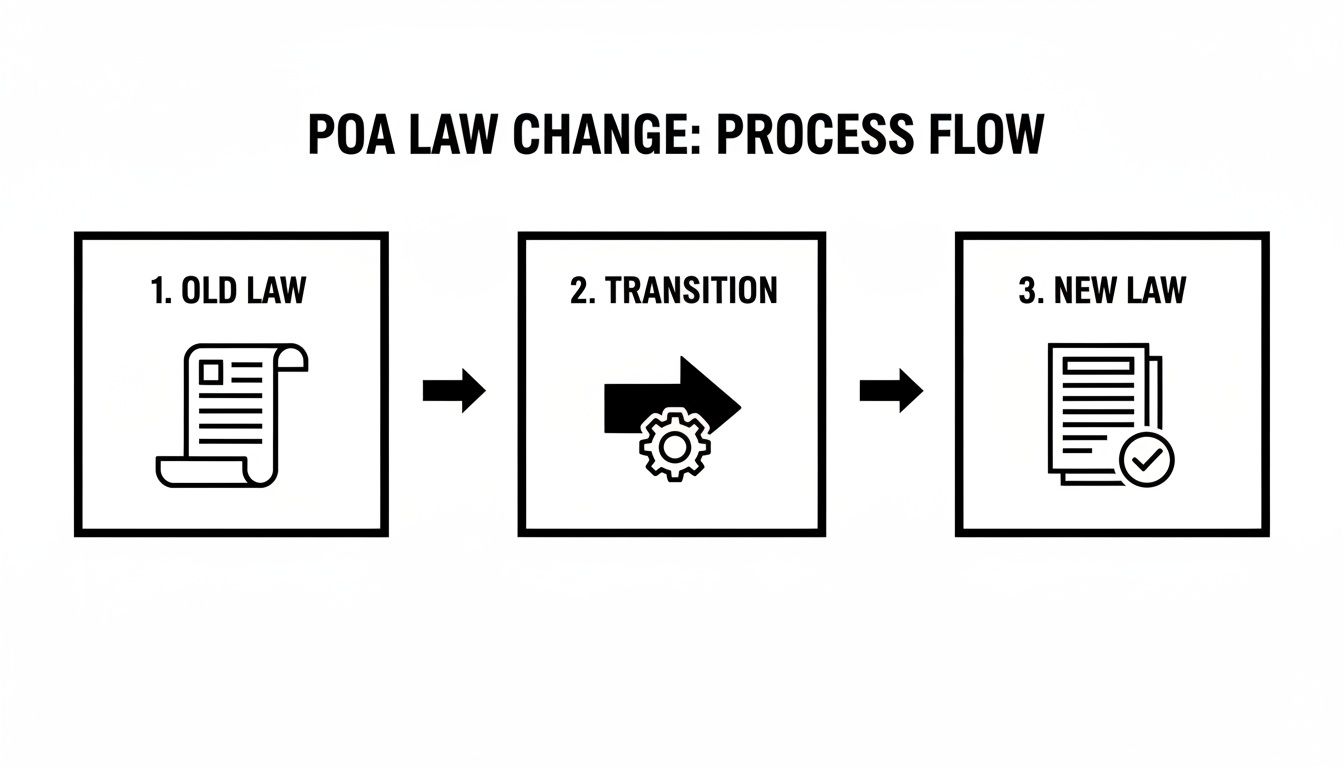
The image highlights the move from older, more complicated rules to the modern legal framework. The key change occurred on January 1, 2018. After this date, all new DPOAs must be notarized but no longer require witnesses. This notary-only requirement, found in N.C.G.S. § 32C-1-105, adds a significant layer of security against fraud.
NC Durable Power of Attorney Checklist
To ensure your DPOA is valid and effective, following a clear, step-by-step process is crucial. This checklist breaks down the essential actions according to North Carolina law.
| Step | Action Required | Key Consideration (NC Law) |
|---|---|---|
| 1. Select Your Agent | Choose a trustworthy and capable primary agent. | Your agent must be an adult (18+) or a qualified financial institution. |
| 2. Name Successor Agents | Designate at least one backup agent. | This avoids a court-appointed guardianship if your primary agent cannot serve. |
| 3. Draft the Document | Clearly define the specific powers you are granting. | Powers must be explicitly stated to be granted (e.g., real estate, banking). Work with an attorney for proper wording. |
| 4. Confirm Legal Capacity | Ensure you are of sound mind and understand the document. | A DPOA signed without capacity can be invalidated by a court. |
| 5. Sign and Notarize | Sign the document in the physical presence of a licensed notary public. | N.C.G.S. § 32C-1-105 requires notarization for all DPOAs signed after Jan. 1, 2018. |
| 6. Store and Distribute Copies | Keep the original in a safe, accessible place. Provide copies to your agent(s) and financial institutions. | Your agent will need a copy to act on your behalf. |
Following these steps is crucial for creating a document that will function as intended. An improperly executed DPOA can be rejected, leaving your family with no choice but to pursue a costly and time-consuming guardianship proceeding.
The Powers and Responsibilities of Your Agent in NC
Granting someone a durable power of attorney is a profound act of trust. You are giving your chosen agent the legal key to your financial world, so it's critical to understand both the powers you are granting and the strict duties that come with them under North Carolina law.

When you create a durable power of attorney in NC, you can give your agent broad authority to handle a wide range of financial matters. These powers are designed to let them step into your shoes and manage your life seamlessly if you become incapacitated.
Standard powers typically give your agent the authority to:
- Manage your bank accounts, including making deposits and withdrawals.
- Pay your bills, such as your mortgage, utilities, and insurance premiums.
- File your tax returns with the IRS and NC Department of Revenue.
- Handle real estate transactions, like buying or selling property.
- Oversee your investments and retirement accounts.
- Deal with government benefits, such as Social Security or Veterans Affairs.
These powers ensure your financial life doesn't grind to a halt just because you can't personally manage it.
The Fiduciary Duty: Your Agent’s Legal Obligation
In North Carolina, an agent is far more than a helper; they are a fiduciary. This is a powerful legal term that means your agent is required by law to act with the highest degree of good faith and loyalty, always putting your interests ahead of their own.
Under North Carolina General Statute § 32C-1-114, an agent has a mandatory duty to act according to your reasonable expectations and solely in your best interest. This isn’t just a suggestion—it's the law.
This fiduciary duty legally binds your agent to several key responsibilities:
- Act Loyally: They must avoid all conflicts of interest and any form of self-dealing. For instance, they can't use your money to give themselves an unauthorized loan or buy your property for a steep discount.
- Keep Detailed Records: Your agent must keep a meticulous log of every transaction made on your behalf. Every dollar spent and every asset managed needs to be accounted for.
- Keep Your Property Separate: They are strictly forbidden from commingling, or mixing, your funds with their own. Your money must stay in accounts that are clearly designated as yours.
Failing to uphold these duties can lead to serious legal consequences for the agent, including being held personally liable for any financial losses you suffer.
Understanding and Granting "Hot Powers"
While a standard DPOA grants extensive authority, some powers are so significant that North Carolina law requires you to grant them specifically. These are often called "hot powers," and they are spelled out in N.C.G.S. § 32C-2-201.
These powers are not automatically included in a DPOA. You must deliberately "opt-in" by initialing or checking a box next to each specific power you want to grant.
These sensitive powers include the ability for your agent to:
- Make gifts of your property.
- Create or change rights of survivorship on your accounts.
- Change a beneficiary designation on your life insurance or retirement plans.
- Create, amend, or terminate a trust on your behalf.
For example, say you wanted your agent to continue your tradition of giving financial gifts to your grandchildren for their birthdays. You must explicitly grant the power to make gifts. Without that specific grant, your agent is legally barred from doing so. This opt-in system forces you to thoughtfully consider these high-impact authorities, protecting you from unintended consequences.
DPOA vs. Healthcare POA vs. Guardianship in NC
When you start planning for the future, the legal terms can feel like a maze. In North Carolina, three tools often cause confusion: the Durable Power of Attorney (DPOA), the Health Care Power of Attorney (HCPOA), and Guardianship. While they all come into play when someone can’t make their own decisions, they serve entirely different purposes.
Understanding these differences is critical. A durable power of attorney in NC protects your finances, a Health Care Power of Attorney protects your health, and guardianship is what happens when you haven’t planned for either.
The Two Types of Power of Attorney You Need in North Carolina
Think of your life as having two major domains: your financial world and your personal well-being. North Carolina law requires separate, distinct documents to grant someone authority over each of these areas.
Durable Power of Attorney (DPOA): This is for your property and finances. Your agent can pay your mortgage, manage investments, and file taxes if you become unable to do so yourself. It is governed by N.C.G.S. Chapter 32C.
Health Care Power of Attorney (HCPOA): Governed by a separate statute (N.C.G.S. Chapter 32A), this empowers your agent to make critical medical decisions for you. This can range from consenting to a specific treatment to choosing a long-term care facility.
A single "power of attorney" document does not cover everything. You absolutely need both a DPOA for finances and an HCPOA for medical care to be fully protected. You can name the same trusted person for both roles, but they remain two separate legal instruments.
POAs vs. Guardianship: Your Choice vs. a Court's Choice
The most important distinction comes down to control. Powers of Attorney are proactive tools that put you in charge. Guardianship is a reactive court proceeding that takes control away from you and your family.
The core difference is simple: with a POA, you choose who makes decisions for you. With guardianship, a judge chooses for you, and the entire process is public, expensive, and slow.
A guardianship is a public court case where a clerk of court declares you legally incompetent and appoints someone to manage your affairs. It's an intrusive, costly, and often emotionally draining process for families.
By creating both a DPOA for your finances and an HCPOA for your healthcare, you are building a powerful shield against the uncertainty and expense of a guardianship case. It is the most effective way to ensure your wishes are honored by the people you trust most. You can find out more about the different POA requirements across the country to see how North Carolina's law provides strong protections.
Comparing Legal Tools for Incapacity in NC
This table offers a direct comparison of the key features of a Durable Power of Attorney, a Health Care Power of Attorney, and a court-ordered Guardianship in North Carolina.
| Feature | Durable Power of Attorney (DPOA) | Health Care Power of Attorney (HCPOA) | Guardianship |
|---|---|---|---|
| Purpose | Manages financial and property affairs. | Manages medical and healthcare decisions. | Court-ordered control over finances, personal care, or both. |
| Who Decides | You choose your agent while you are competent. | You choose your healthcare agent while competent. | A judge appoints a guardian after you are legally incapacitated. |
| Process | A private document signed and notarized. | A private document signed and notarized (with witnesses). | A public, formal, and often lengthy court proceeding. |
| When It Starts | Immediately or upon your incapacity, as you specify. | Only upon your incapacity as determined by a physician. | Only after a court declares you incompetent. |
| Cost | Minimal legal fees to draft a proper document. | Minimal legal fees to draft a proper document. | Can be very expensive, involving court costs and ongoing legal fees. |
Revoking or Changing Your NC Durable Power of Attorney
Putting a durable power of attorney in place is a crucial part of planning, but it’s not set in stone. Life changes, relationships shift, and the person you trusted five years ago may not be the right choice today.
Fortunately, North Carolina law gives you complete control to change your mind. As long as you have legal capacity, you can modify or entirely cancel your DPOA. This power ensures your estate plan always reflects your current wishes.
Your Right to Revoke a DPOA
As long as you are legally competent—meaning you fully understand what you’re doing and its consequences—you can revoke a power of attorney at any time. You are always in the driver’s seat.
However, just deciding you want to make a change isn’t enough. You must follow specific, formal steps to make the revocation legally binding. If you don't, a former agent could continue making financial decisions on your behalf.
How to Properly Revoke a NC Durable Power of Attorney
To officially cancel your DPOA, you need to follow a clear legal process:
Create a Written Notice of Revocation: This is a formal legal document that clearly states your intent to cancel a specific DPOA. It must identify the original document by its date and name the agent whose authority is being terminated.
Sign and Notarize the Revocation: Just like the original DPOA, your revocation document must be signed and notarized.
Deliver Copies to All Necessary Parties: This is the most important step. You must give a copy of the notarized revocation to your former agent. You also need to send it to every bank, financial institution, or other party that has a copy of your old DPOA on file and relies on it.
Simply telling your old agent they are "fired" is not enough. Without a written, notarized notice delivered to your bank, they may continue to honor the old DPOA, believing it is still valid.
When a DPOA Terminates Automatically
In certain situations, a DPOA automatically ends under North Carolina law without you having to do anything. These events include:
- Your Death: A DPOA is only valid while you are alive. The moment you pass away, your agent’s authority stops, and the executor named in your will takes over your estate.
- Divorce: If your spouse is your agent and you get divorced, their authority is automatically revoked by law unless your DPOA specifically states their power should continue.
- Revocation: When you properly sign and execute a new DPOA, it typically includes language that automatically revokes all previous ones.
Frequently Asked Questions About Durable Power of Attorney in NC
Does a Durable Power of Attorney need to be filed with the court in NC?
No, a durable power of attorney does not need to be filed with the court in North Carolina to be valid. It is a private document. The only common exception is for real estate transactions. If you want your agent to sell or mortgage property, the DPOA must be recorded with the Register of Deeds in the county where the property is located.
Can I appoint more than one person as my agent in North Carolina?
Yes, you can name co-agents to act together. However, your DPOA must clearly state whether they can act "severally" (independently) or must act "jointly" (together on all decisions). A joint requirement can cause delays if agents disagree or one is unavailable. A common and practical strategy is to name one primary agent and then one or two successor agents to serve in a specific order if the primary agent cannot.
What happens if I become incapacitated in NC without a DPOA?
If you become incapacitated without a durable power of attorney, no one has the automatic legal authority to manage your finances—not even your spouse. Your family would be forced to go to court to initiate a guardianship proceeding. A judge would then declare you incompetent and appoint a guardian to manage your affairs. This public and costly process can be avoided with a properly drafted DPOA.
Is a power of attorney from another state valid in North Carolina?
Generally, yes. Under N.C.G.S. § 32C-1-106, a power of attorney executed in another state is valid in North Carolina if it was validly executed under that state's laws when it was created. However, financial institutions in NC may be more familiar and comfortable with a document that follows North Carolina's format and statutes, which can make transactions smoother for your agent.
How is a durable power of attorney different from a will?
A durable power of attorney is for managing your financial affairs while you are alive, especially if you become incapacitated. It automatically terminates upon your death. A will, on the other hand, only takes effect after you die. It specifies how your property should be distributed and names an executor to handle your estate. They are both essential but serve completely different purposes in an estate plan. A DPOA is a key tool for avoiding guardianship and can also be part of a plan for how to avoid probate in North Carolina.
Secure Your Future with a North Carolina Durable Power of Attorney
Navigating the specifics of a durable power of attorney is a critical step in securing your future and protecting your family from the stress and expense of a court-appointed guardianship. The decisions you make today can provide lasting peace of mind for you and your loved ones. The laws are specific, and getting it right matters.
If you are a North Carolina resident with questions about creating a new DPOA or reviewing an older one, the experienced attorneys at the Law Office of Bryan Fagan are here to provide the clear, practical guidance you need. We will help you build an estate plan that is strong, secure, and perfectly aligned with your wishes.
Schedule a consultation with our North Carolina team today. Visit us online at https://bryanfaganlaw-nc.com to get started.