If you’ve been paying for daycare, doctor visits, clothes, school supplies, and groceries on your own while the other parent contributed little or nothing, you’re probably asking a simple question with a complicated legal answer. Can a North Carolina court make the other parent pay for the years that already passed?
Sometimes, yes. But timing matters, proof matters, and the legal path matters.
Many parents use the phrase retroactive child support nc when they’re really talking about one of three different things: support going forward, unpaid support under an existing order, or support for a past period when no order existed yet. North Carolina treats those issues differently. A case can be won or lost by using the wrong label, filing too late, or failing to gather the right income records for the correct years.
Understanding Your Right to Past Child Support in North Carolina
A common scenario looks like this. A mother and father separate when their child is very young. No one files for child support right away. One parent keeps the child housed, fed, insured, and in daycare, while the other parent helps only occasionally, or not at all. Years pass, and the parent carrying the load wants the court to address that unpaid past responsibility.
That claim is called retroactive child support. In plain English, it means asking the court to award child support for a period before the case was filed. It is not the same as ongoing support, and it is not the same as arrears from a prior order.
What retroactive support is and what it is not
Three terms get mixed together all the time:
- Prospective support means support ordered going forward.
- Arrears means unpaid support that was already required by an existing court order.
- Retroactive support means support for an earlier period when there was no court order in place yet.
That distinction matters because the evidence, defenses, and time limits are not the same.
North Carolina places an important limit on private retroactive claims. A custodial parent can generally seek reimbursement only for the past three years before filing, not for the child’s entire life, as explained in this discussion of North Carolina retroactive child support limits. That same source also notes that the law moved away from requiring detailed proof of every past child-related expense in many cases, and now courts may apply the Child Support Guidelines based on income during the relevant years.
Practical rule: Waiting feels easier in the short term, but delay can permanently cut off part of a retroactive claim.
Why parents misunderstand this issue
Parents often assume, “If I raised the child alone for seven years, I can recover seven years.” That isn’t how North Carolina usually handles a private retroactive claim. The filing date becomes critical.
If you’re considering a claim, the first questions usually are these: Was there ever a court order? Was public assistance involved? Has paternity been established? Did the other parent make informal payments that might count for credit? Those facts shape both the value of the claim and the strategy.
Eligibility for Retroactive Child Support Claims
A common consultation starts like this. A parent has been covering rent, groceries, school costs, and medical bills alone for years, and now wants to know whether North Carolina will require the other parent to pay for all of that past time.
The answer depends less on how unfair the situation feels and more on the legal posture of the case. In practice, retroactive child support claims usually fall into two categories. One is a private claim between parents where no child support order existed for the period in question. The other involves reimbursement after public assistance was provided for the child.
Two different types of retroactive claims
In a private case, the parent seeking support usually asks the court to award support for a limited past period before the filing date, along with current support going forward. The three-year limitation often controls the strategy. If a child is ten years old and no case is filed until now, the court generally is not looking back through the child’s entire life in a private action.
Public assistance cases follow a different path. If the child received certain benefits, the state may pursue reimbursement for assistance paid on the child’s behalf. That claim is not just about one parent seeking repayment from the other. It brings in the government’s right to recover funds, and the look-back period can differ from the three-year limit that applies in many private claims.
That distinction matters early. It affects who brings the claim, what period is at issue, and what documents need to be collected.
Retroactive Child Support Scenarios in North Carolina
| Scenario | Who Files the Claim? | Look-Back Period Limit | Primary Beneficiary |
|---|---|---|---|
| No prior child support order | Usually the custodial parent or caretaker with legal standing | Three years before filing | The child, through the custodial household |
| Public assistance provided for the child | The state, or a case involving state enforcement | Five years for reimbursement tied to assistance | The state, as reimbursement for benefits provided |
What usually has to be in place before filing
A retroactive claim becomes much stronger when these threshold issues are clear:
- No existing support order covered that same period. If an order already existed, the problem is often unpaid arrears, not retroactive support.
- A legal duty of support can be established. In a married-parent case, that issue is often straightforward. In an unmarried-parent case, paternity may need to be established first.
- The pleading specifically asks for retroactive support. Courts usually do not award it unless the request is plainly made.
- The filing date still preserves the period worth pursuing. Waiting can reduce what can be claimed in a private case because of the three-year limit.
Paternity cases deserve special attention. If the father has not been legally established, the court may need to address parentage before it reaches support. That can change timing, proof, and settlement posture. It also affects whether a parent is dealing with a straightforward support case or a combined paternity and support action, which usually takes more planning.
Why the filing date changes the value of the case
Many parents assume the court will automatically reimburse every dollar spent raising the child. North Carolina law is often narrower than that. In many private cases, the filing date sets the outer boundary for what can be recovered, which is why delay can materially reduce the claim.
There is also a practical calculation issue built into eligibility. Older North Carolina cases often focused on proof of the child’s actual past expenses. More recent practice frequently centers on what support likely would have been under the North Carolina child support guidelines and worksheets during the relevant years. That shift affects how lawyers evaluate whether a retroactive claim is worth bringing. In some cases, guideline-based calculations make the claim more predictable. In others, especially older periods with poor income records or unusual expenses, the evidence becomes harder and the dispute more expensive.
A realistic example
Suppose a child is six. The parents were never married. No support order was ever entered. One parent paid nearly all of the child’s expenses, but paternity was never formally established. That parent may have a viable claim, but the case may need to address parentage first, and the private retroactive claim will usually be limited to the period the law allows before filing.
Change one fact and the case looks different. If the child received public assistance, the state may have its own reimbursement claim. That can alter negotiations quickly because the case is no longer only about support between the parents.
High-income cases require a different analysis
Eligibility is only part of the question in higher-income families. Once parental income rises above the range where the Guidelines apply on a presumptive basis, the court has more discretion and will look more closely at the child’s reasonable needs and the family’s standard of living. That can affect the value of a retroactive claim and the evidence needed to support it.
I often tell clients to start with three dates and two documents. Identify when support should have started, when any public assistance was received, and when the case can be filed. Then gather proof of parentage, if it is disputed, and proof of each parent’s income for the relevant years. Those details usually tell you whether you have a strong private claim, a state reimbursement issue, or both.
How Courts Calculate Retroactive Child Support Awards
Calculation is where many parents get surprised. They expect the court to total up receipts and reimburse every dollar one parent spent. North Carolina law doesn’t always work that way now.
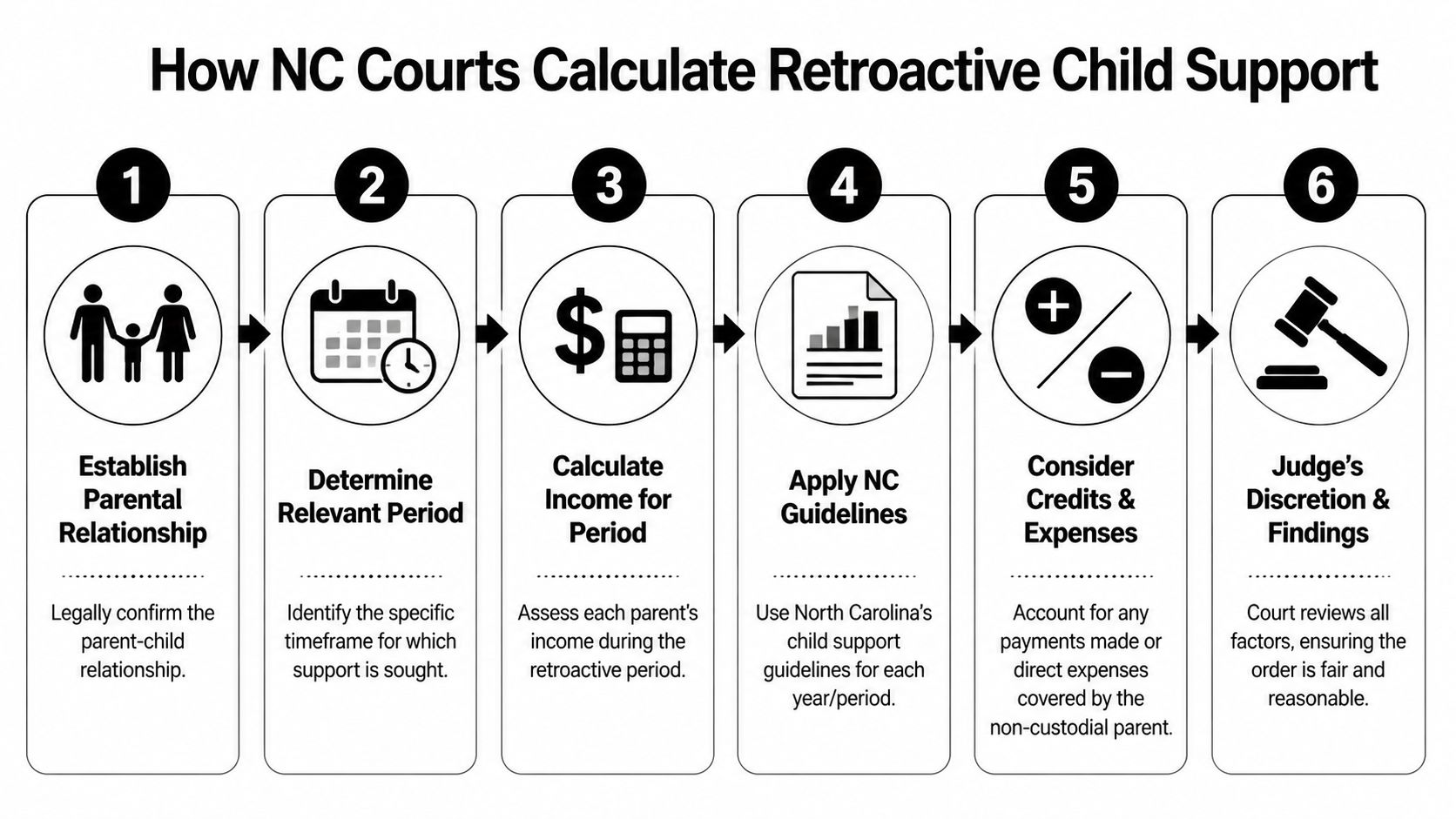
Instead, the court often asks a different question. What should the paying parent have paid during the retroactive period if support had been set then?
The income shares model in practice
North Carolina uses an income shares approach. The goal is to estimate the support level the child would have received if both parents had contributed in proportion to their incomes while living separately. In plain terms, the court looks at what each parent earned during the relevant years and applies the guideline framework for that period.
If you want a basic orientation to the worksheets and framework, this overview of North Carolina child support guidelines is a useful starting point.
Retroactive calculation usually depends on historical income, not just what each parent earns today. That often means collecting older tax returns, W-2s, pay stubs, business records, and other documents that show what each parent made during the past period at issue.
The law changed in an important way
Older North Carolina cases often focused heavily on actual expenses. A parent might need to prove daycare bills, clothing costs, medical expenses, school expenses, formula, diapers, and similar child-related spending in detail.
The more modern approach is often simpler in structure but not always easier in practice. Courts may apply the Child Support Guidelines in effect during the retroactive period using the parents’ incomes from those years. The shift reduces some of the burden of proving every receipt, but it increases the importance of proving reliable historical income.
A real-world example of how this works
Assume a parent files in 2026 and seeks retroactive support for the permissible pre-filing period. The court may examine the parents’ income records from the relevant earlier years, determine which guideline version applied during each period, and run the appropriate worksheet.
That process usually includes several moving parts:
- Identify the correct period based on the filing date and the legal basis for the claim.
- Gather historical income records for both parents for each relevant year.
- Determine the custody arrangement that fits Worksheet A, B, or C.
- Include allowable items such as childcare or health insurance when the evidence supports them.
- Apply the guideline version in effect then, not necessarily the version used today.
- Account for proven credits or offsets if the other parent made direct support contributions.
Client advice: A retroactive support case is often won with documents from prior years, not testimony alone.
Guidelines versus actual expenses
Parents often ask which method produces the higher number. There isn’t a universal answer.
The guideline-based method can be efficient because it gives the court a structured formula. But in some cases, actual expense evidence still matters, especially when a parent needs to show childcare, medical costs, or other facts that affect the worksheet. In higher-income situations, or when the case falls outside the presumptive guideline range, practical proof of the child’s needs becomes more important again.
What works and what doesn’t
Strong retroactive claims usually share the same features:
- Clean income proof: tax returns, payroll records, and business documents from the right years
- Accurate timelines: dates of separation, filing, custody patterns, and periods of nonpayment
- Worksheet discipline: using the correct worksheet and the correct period
- Focused expense proof: especially for childcare, insurance, and medical costs that matter to the calculation
Weak cases usually fail for more avoidable reasons:
- relying on memory instead of records
- using current income when the court needs historical income
- asking for a period that reaches too far back
- assuming every purchase for the child will be reimbursed dollar for dollar
Evidence and Defenses in a Retroactive Support Case
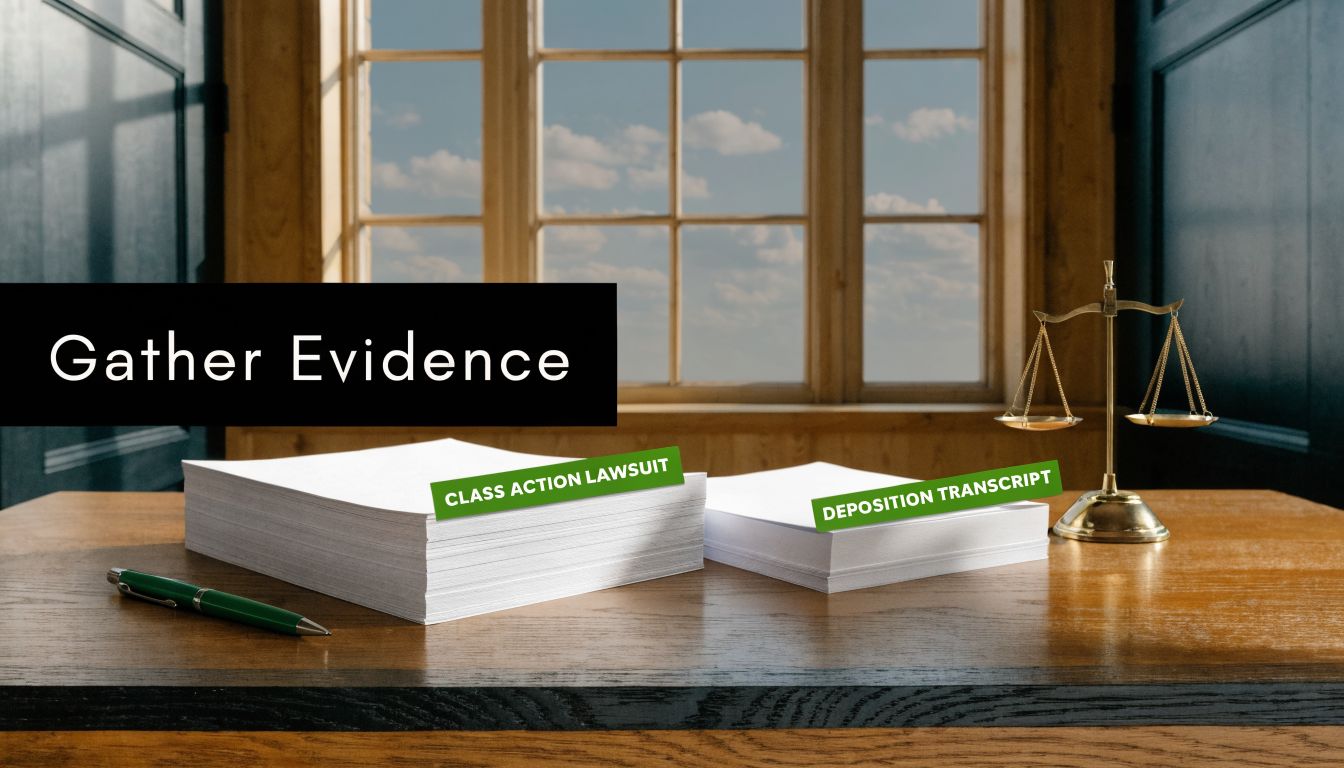
Retroactive child support cases are document-driven. The parent seeking support has to prove more than unfairness. The parent opposing the claim needs evidence too, not just objections.
Evidence that helps build a strong claim
A well-prepared claim usually starts with a paper trail. In practice, the most useful documents often include:
- Historical income records such as tax returns, W-2s, 1099s, and pay stubs
- Child-related cost records including daycare invoices, insurance records, medical bills, and school-related expenses when relevant
- Communication history like texts, emails, or messages discussing support, requests for help, or admissions about income
- Proof of custody reality that shows where the child primarily lived during the retroactive period
- Records of partial payments so the court can distinguish no support from inconsistent support
If the other parent controls the key financial records, formal discovery may be necessary. That can include requests for documents, interrogatories, subpoenas, or other court-approved tools to obtain income evidence.
Defenses that often matter
One of the most important defenses is the three-year statute of limitations under N.C.G.S. § 1-52(2) for private retroactive claims. Another practical defense is credit for money or support already provided informally.
This discussion of North Carolina defenses to retroactive child support claims notes both points clearly. It also explains that laches usually does not bar retroactive child support claims because of the public policy favoring a child’s right to support, citing Napowsa v. Langston, 95 N.C. App. 14 (1989).
What laches means and why parents misuse it
Laches is a legal doctrine based on delay. In many civil disputes, someone who waited too long might hear, “You sat on your rights.”
Child support is different. Courts generally treat support as a right that belongs to the child, not merely a debt one parent can ignore until the other parent sues. So while delay can matter because of the statute of limitations, delay alone usually isn’t enough to defeat the claim under laches.
Delay may shrink the time period you can recover. It usually doesn’t erase the child’s right to support altogether.
Informal contributions can change the number
A non-custodial parent may argue, with records, that they already contributed directly. That might include payments clearly tied to rent, daycare, medical expenses, or other child support needs. The key is proof and purpose.
A common mistake is assuming every purchase counts. Gifts, occasional shopping, or vague transfers without documentation may not carry much weight. Clear records matter far more than broad statements like “I helped all the time.”
For a short overview of how family court evidence issues can arise, this video gives useful context before a hearing:
What usually helps in court
Judges respond well to organized evidence. A timeline, year-specific income records, and clearly labeled payment proof often do more than emotional testimony.
From a strategy standpoint, these cases are rarely about one dramatic fact. They turn on whether the paperwork matches the legal theory. That’s why preparation often makes the difference between a support award that reflects reality and one that doesn’t.
Special Circumstances Affecting Retroactive Support
Some retroactive support cases involve issues that aren’t obvious at first. Paternity is one of the most important. Third-party caregiving is another. Pregnancy-related expenses also create confusion.
Paternity must be addressed first
If parentage hasn’t been legally established, the court may need to resolve that issue before support can be ordered. In many cases involving unmarried parents, a support claim and a paternity issue move together.
That matters because a person can’t usually be ordered to pay child support in North Carolina unless there is a legal basis tying that person to the child as a parent. If paternity is disputed, the support portion of the case may slow down until the court addresses parentage.
Birth costs are not the same as all pregnancy costs
Parents often assume they can recover every expense connected to pregnancy and preparing for a baby. North Carolina law is narrower than that.
This explanation of North Carolina limits on pre-birth retroactive support expenses states that N.C.G.S. § 49-15 limits pre-birth claims to medical costs, and that non-medical items such as maternity clothes or nursery furniture are generally not recoverable. It also notes an appellate decision reversing an award of more than $5,000 in non-medical pre-birth costs.
A nursery purchase may feel just as necessary as a medical bill. Legally, they are not treated the same way.
Grandparents and other third-party caregivers
In some families, a grandparent or another third party has carried the practical burden of raising the child for a meaningful period. Those situations can create support questions that are more complex than a standard parent-versus-parent case.
Standing, custody posture, and the terms of any existing orders matter a great deal. If you’re already dealing with an order and the support arrangement no longer matches the child’s living situation, the issue may overlap with a request to modify child support in North Carolina.
Separation agreements can affect the analysis
Private agreements between parents can also complicate retroactive claims. In some cases, a valid written separation agreement may cap what can be awarded for a certain period unless emergency circumstances justify more. Whether that applies depends heavily on the language of the agreement and whether it was incorporated into a court order.
This is one reason broad internet advice often misses the mark. Retroactive child support nc cases are highly fact-specific, especially once paternity, prior agreements, or third-party caregiving enter the picture.
Frequently Asked Questions About Retroactive Child Support in NC
Can I get retroactive child support if I never filed before
Sometimes, yes. A parent can seek retroactive support for a prior period even if no earlier case was filed, but the court will look closely at timing, legal standing, and proof. The biggest mistake is assuming delay doesn’t matter.
Is retroactive support the same as child support arrears
No. Arrears are unpaid amounts due under an existing support order. Retroactive support concerns a past period before support was formally ordered. That difference affects both how the case is presented and what defenses apply.
What if the other parent paid me informally
Informal payments can matter. If the other parent can prove direct support contributions, the court may give credit and reduce the final amount that would otherwise be awarded. The issue usually turns on documentation and whether the payment was for the child’s support.
Can parents waive retroactive support by private agreement
Sometimes an agreement affects the scope of the claim, but private deals don’t automatically eliminate the child’s right to support. Courts examine the wording, whether the agreement is valid, and whether it limits or caps support for a specific period. This is an area where a document review is critical.
What if the paying parent had little or no income during the retroactive period
That doesn’t automatically end the case. The court still has to determine what income information is reliable for the relevant years. If a parent was unemployed, underemployed, self-employed, or earning money in irregular ways, the evidence becomes more contested and the presentation matters more.
Can a retroactive support award be changed later
A retroactive award often functions differently from ongoing support. Future support can sometimes be modified when circumstances change, but a judgment for a past period is generally treated more like a fixed determination of what should have been paid for that earlier time. Whether any later relief is possible depends on the procedural posture and the specific order entered.
Do I need receipts for everything I bought for my child
Usually not for every single purchase. In many cases, guideline-based calculation centers more on the parents’ historical incomes than on proving every receipt. Still, records for childcare, insurance, medical costs, and direct support payments can remain very important.
Protect Your Child’s Financial Future and Your Rights
A parent often comes in after years of covering rent, food, school costs, and medical bills alone, only to learn that North Carolina may limit how far back a claim can reach. That timing issue matters. In many cases, the three-year lookback shapes the value of the case, the proof required, and the strategy from day one.
Retroactive child support cases turn on more than whether support should have been paid. The court may have to decide whether the claim fits within the statute of limitations, whether the older actual-expense approach applies or the Child Support Guidelines control, and whether paternity must be established before support can be ordered. If public assistance was involved, the state may also have a reimbursement claim that changes who is pursuing payment and what records matter most.
These cases reward preparation, not assumptions.
For the parent seeking support, that means building a clean timeline, gathering income records for the right years, and identifying whether the claim belongs in a custody case, a child support action, or a paternity proceeding. For the parent defending the claim, it means testing the dates carefully, reviewing credits for direct support, and challenging weak proof about income or expenses. Small errors can affect the result for years because a past-support award often becomes a fixed judgment.
If you need advice specific to your facts, county, and procedural posture, speak with a lawyer who handles these cases regularly. You can review your options with a North Carolina child support lawyer. If you need help with retroactive support, paternity-related support issues, enforcement, or defense against a past-support claim, contact the Law Office of Bryan Fagan for a consultation through the firm’s contact page.