A lot of parents land on this page at the same moment in their lives. The relationship has changed, the household budget has changed, and nothing feels stable yet. One parent is asking, “What am I supposed to pay?” The other is asking, “How do I make sure my child is covered?” Both are worried the numbers will be unfair.
That stress gets worse when the answers online are too simple. North Carolina child support is not just a rough estimate or a verbal agreement between parents. It is a legal calculation tied to custody, income, and documented expenses. If an order already exists, the process can shift again into modification or enforcement.
A good child support lawyer north carolina families can rely on does more than fill out forms. The lawyer tests the numbers, checks whether the right worksheet applies, builds evidence that will hold up in court, and pushes back when the other side leaves out income, inflates expenses, or ignores an order. That work matters because small mistakes in the record can affect a parent for years.
Navigating Child Support in North Carolina
One common situation looks like this. A parent separates, starts paying rent alone, and tries to keep the child’s routine intact. School costs continue. Health insurance still has to be paid. Childcare still has to be arranged. Then the question of support arrives, often before anyone feels financially ready.
Another common situation is more frustrating. A support order is already in place, but real life has shifted. One parent now has more overnights. A job changed. Medical costs changed. Or support has stopped being paid. At that point, the issue is no longer just “What is fair?” It becomes “What can I prove?”
North Carolina law gives structure to these cases, but structure does not eliminate conflict. Parents still argue about income, parenting time, insurance coverage, work-related childcare, and whether a change is serious enough to justify a new order. In practice, the outcome often turns on records, not opinions.
That is why strategy matters early.
What parents usually need first
Many parents do not need a lecture on family law. They need direct answers to practical questions:
- What worksheet applies: The custody schedule can change the support formula.
- What income counts: Salary is only part of the picture in some cases.
- Which expenses matter: Some costs go into the calculation and some do not.
- Whether court action is necessary: Informal side deals often create bigger problems later.
Practical takeaway: Child support cases are easier to manage when you treat them like evidence-driven financial cases, not just emotional disputes between parents.
A lawyer’s role is not to create conflict for its own sake. It is to protect the child’s financial support and protect the parent from avoidable mistakes. If you are trying to understand your rights, your exposure, or your options in North Carolina, clarity starts with the legal basics.
Understanding North Carolina Child Support Fundamentals
Child support exists for the child, not as a reward or punishment for either parent. That sounds simple, but many disputes go off track because parents treat support as a bargaining chip in a custody fight or a fairness contest between adults. Courts do not see it that way.
Under N.C.G.S. § 50-13.4, the court can enter child support orders based on the child’s needs and the parents’ circumstances. In practical terms, North Carolina is trying to preserve a reasonable level of support for the child after separation.

For a broader overview of the framework, many parents start by reviewing child support in NC laws.
What child support is meant to cover
Support generally addresses ordinary child-related living expenses. Think of the costs that keep a child housed, fed, clothed, and able to function day to day. It is tied to the child’s care, not the personal spending choices of either parent.
That does not mean every disagreement about money belongs in a child support case. Courts focus on support needs recognized under North Carolina law and the guideline process. Parents often make the mistake of arguing over lifestyle items when the core issue is whether the correct income and expense information has been presented.
Terms parents should understand
A few terms come up constantly.
- Custodial parent: Usually the parent with primary physical custody, though the label can become less useful in shared arrangements.
- Non-custodial parent: Often the parent who has fewer overnights and may pay support, though the exact setup matters.
- Gross income: The starting point for support calculations under the guidelines.
- Extraordinary expenses: Certain higher or unusual child-related costs that may affect the calculation.
These labels matter because they shape how the court analyzes the case. They do not decide who is the “better” parent.
The best-interest idea in plain English
People hear “best interest of the child” and assume it means the judge will do whatever feels generally fair. That is not how it works. In child support matters, the child’s best interest is reflected through a structured process. The court looks at the child’s needs, the parents’ ability to contribute, and the parenting arrangement.
A useful analogy is this. North Carolina treats child support like a shared household obligation that survives the breakup of the adult relationship. The parents may no longer live together, but the child’s basic financial support still has to be built from both households.
Key point: A parent cannot safely assume that private understandings, rough estimates, or “we will figure it out later” will protect them. Clear orders and accurate records protect both the child and the parent.
How Child Support Is Calculated in North Carolina
A parent comes into my office with a number the other side pulled from an online calculator, confident that the case is simple. Then we examine the pay records, the overnight schedule, the child’s health insurance cost, and the childcare invoices. The number often changes, sometimes by a lot.
North Carolina child support is calculated under the North Carolina Child Support Guidelines, using a set formula tied to income, custody, and certain child-related expenses. The guidelines control in most cases. If the parents’ combined income exceeds $360,000 per year, the court has more discretion and looks closely at the child’s actual needs and each parent’s ability to pay, as explained in this discussion of North Carolina child support calculations.
A quick estimate can be useful at the start. It should never be treated like a final answer. Support cases turn on inputs, proof, and worksheet selection.
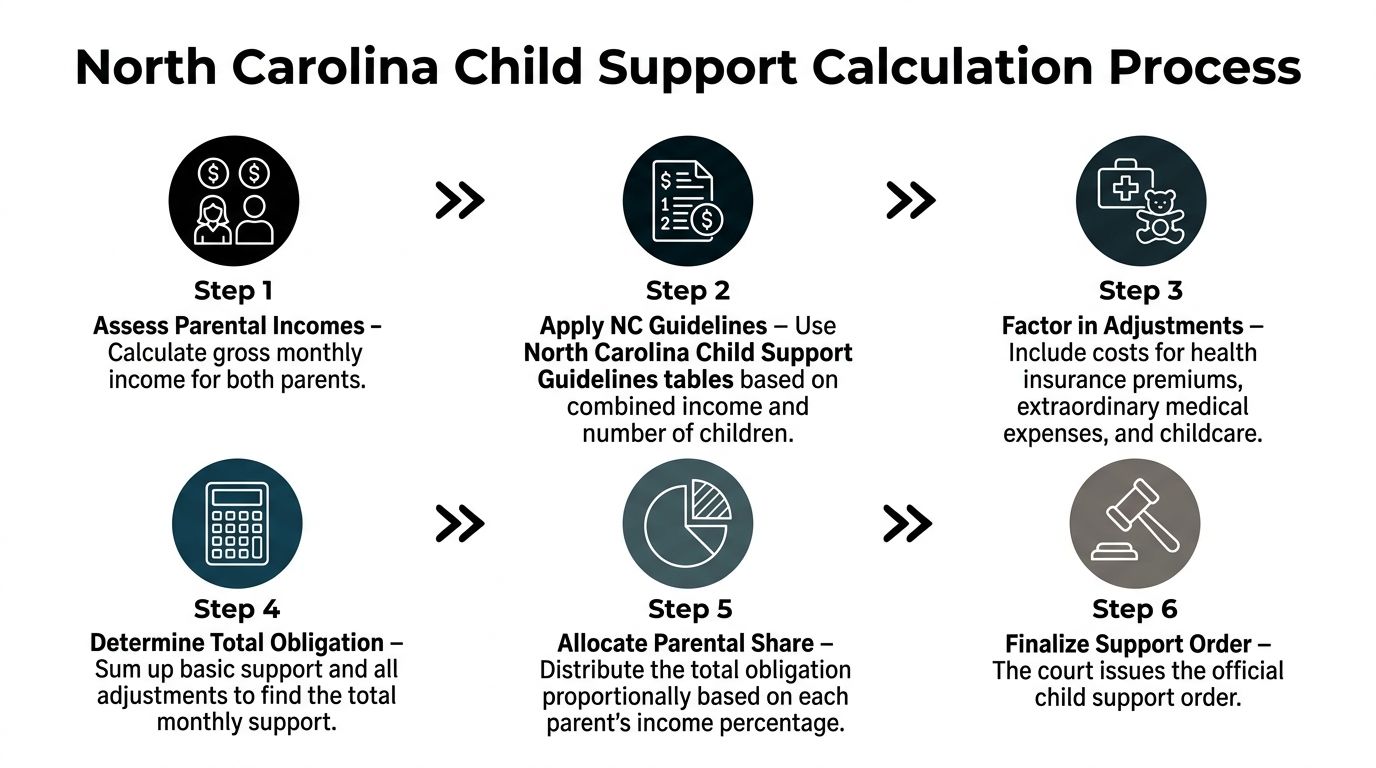
A visual overview helps:
The worksheet can change the result
North Carolina uses different worksheets based on the parenting arrangement. Choosing the wrong one can distort the support amount before the court ever reaches the harder disputes about income or expenses.
| Worksheet | Custody Arrangement | Parenting Time Requirement |
|---|---|---|
| Worksheet A | Primary custody | One parent has the child for over 243 nights annually |
| Worksheet B | Shared custody | Each parent has at least 123 nights |
| Worksheet C | Split custody | Multiple children are split between parents |
This issue is strategic, not clerical. If the evidence supports shared custody but the case is presented under primary custody, the monthly figure can be materially different. I pay close attention to calendars, school records, exchange logs, and prior court orders because overnight counts are often contested long before trial.
What goes into the formula
The calculation begins with both parents’ gross incomes. The guidelines then apply the schedule for the combined income level and number of children, with adjustments for certain recurring child-related costs.
The inputs that matter most are:
- Gross monthly income: Wages are only the starting point. Commissions, bonuses, self-employment earnings, rental income, and other sources may need to be addressed.
- Health insurance premiums for the child: Only the child’s share of the premium should be included, and that amount should be documented clearly.
- Work-related childcare: Daycare, after-school care, and similar costs can affect support if they are necessary for employment or a job search.
- Extraordinary expenses: Private school, ongoing medical treatment, therapy, or other unusual expenses require records and a persuasive explanation.
A guideline calculation is only as good as the numbers fed into it. Parents often focus on the final amount before they have done the harder work of proving the components.
Parenting time can drive the support amount
Overnights are not just part of custody negotiations. They can determine which worksheet applies and, in turn, the amount of support.
Under the guideline structure, Worksheet A applies when one parent has more than 243 nights per year. Worksheet B applies when each parent has at least 123 nights. Worksheet C applies in split-custody cases involving multiple children.
A common example is a family that started with every-other-weekend visitation and shifted, in practice, to a near-equal schedule. If that change is real and can be proven, the support calculation may need to be redone under a different worksheet. If the schedule changed after entry of the current order, the parent may also need to pursue a formal child support modification in North Carolina instead of assuming the payment should adjust automatically.
Later in the process, many parents find it useful to hear a plain-language explanation of how courts work through support issues:
Where cases often go wrong
In real cases, the formula itself is rarely the problem. The dispute is usually about whether the income figure is complete, whether an expense is legitimate, or whether the parenting schedule presented is the one followed.
These are the pressure points I see most often:
- Self-employment income: Tax returns may understate cash flow, or they may reflect legitimate business expenses that need careful analysis rather than assumptions.
- Bonuses, overtime, and irregular pay: Some income is predictable enough to include. Some is too uncertain to treat as a stable monthly figure without more context.
- Childcare proof: Courts expect invoices, payment histories, and evidence that the expense is work-related.
- Insurance allocation: The child’s portion must be separated from family coverage and shown accurately.
- Extraordinary expenses: Judges want records, not general statements that a cost feels reasonable.
Practice tip: Strong child support cases are built like financial files. Clean records, accurate calculations, and credible testimony usually matter more than broad arguments about fairness.
The 2025 guideline updates and real-world strategy
North Carolina’s child support guidelines were updated effective January 2025. That matters for two reasons. First, calculations should be grounded in the current guideline framework. Second, older informal estimates may now be less reliable.
The larger point is strategic. A support case is not won by citing the worksheet alone. It is won by proving income correctly, identifying the right custody structure, and deciding whether a deviation argument is worth pursuing or likely to distract from a stronger guidelines-based position.
That is where experienced counsel adds value. In serious cases, I treat child support as both a math problem and an evidence problem. Some files require a straightforward worksheet. Others require forensic review of business records, careful tracing of fluctuating income, and a clear plan for showing the court why a requested number is supported by documents instead of assumptions.
Modifying and Enforcing Child Support Orders in NC
A parent loses hours at work, the custody schedule shifts, or support has not been paid in months. At that point, the issue is no longer how support was calculated the first time. The issue is what can be proved now, and which procedure fits the problem.
Modification and enforcement are separate paths in North Carolina. Filing the wrong one wastes time, increases expense, and can leave the existing order in place longer than it should be.
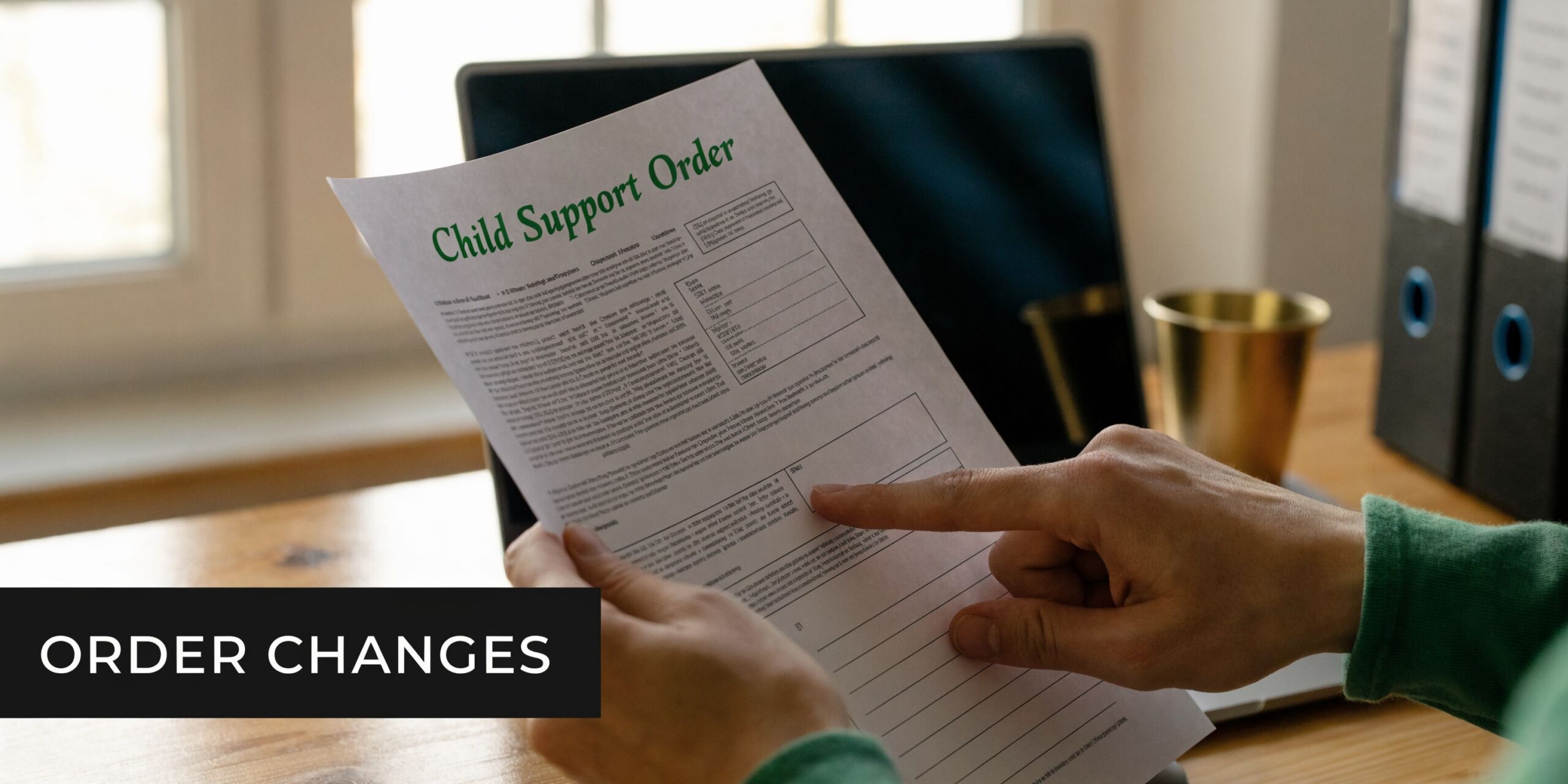
If you need the mechanics of changing an existing order, this guide on how child support modification works in North Carolina is a useful starting point.
When modification is the right move
A modification asks the court to change an existing order because the facts have materially changed since entry of the current order. That usually involves income, the child’s expenses, or the number of overnights.
Common examples include:
- Job loss or reduced earnings: The change must be real and documented, not temporary speculation.
- A substantial increase in income: If one parent’s earnings rise meaningfully, support may need to be recalculated.
- A different custody schedule: More or fewer overnights can shift the worksheet used and the resulting amount.
- New child-related costs: Health insurance, work-related childcare, or other recurring expenses may look very different than they did when the order was entered.
The strategy matters as much as the reason. A parent may have a valid basis to modify and still lose if the numbers are incomplete, the timing is poor, or the record does not show the change clearly under the current guidelines, including the 2025 updates.
Side agreements create trouble here. If the order requires one amount, that amount remains due until a judge signs a new order. Text messages and verbal understandings do not erase arrears.
When enforcement is the right move
Enforcement applies when an order already exists and a parent is not complying with it. In many cases, that means missed payments. In others, it means partial payments, chronic late payments, or failure to maintain ordered insurance coverage.
North Carolina courts can enforce support through contempt proceedings and other collection tools. Consequences can be serious, including income withholding, license problems, and other penalties tied to unpaid support. The longer the arrears sit, the harder the situation usually becomes for both sides.
For the parent seeking payment, delay often means a larger arrears balance and a weaker paper trail. For the parent accused of nonpayment, delay can turn a manageable problem into a contempt hearing.
The evidence that decides these cases
Post-order child support disputes are rarely won by broad claims about fairness. They are won with records.
For modification, the court usually needs a before-and-after picture. What income existed when the current order was entered. What income exists now. What changed in the schedule. What changed in the child’s actual expenses. If a parent is self-employed, paid in cash, earns commissions, or has irregular bonuses, the financial review often becomes more detailed than people expect.
For enforcement, the focus is narrower but no less important. What was ordered. What was paid. When it was paid. Whether the failure to comply was willful. A payment history, bank records, wage information, and communications tied to specific dates often matter more than testimony alone.
Useful documents often include:
- Tax returns, W-2s, 1099s, and recent pay stubs
- Business records if income is self-employed or fluctuating
- Health insurance statements showing the child’s actual cost
- Childcare invoices and proof the expense is work-related
- Calendars, school records, or app logs showing overnight patterns
- Payment ledgers, bank statements, and receipts
- Messages that support the timeline, not just general complaints
I often tell clients the hearing is only the final step. Essential work starts earlier, when the file is built in a way the judge can follow without guesswork.
Practical mistakes that hurt good cases
Certain errors show up again and again.
Waiting too long to file is one. Child support generally does not adjust itself because circumstances changed in real life. A court order has to be changed through the court.
Another is assuming the other parent’s income can be challenged without documents. If income is understated, counsel may need discovery, subpoenas, or a close review of business and banking records. That is where forensic financial analysis can shift the case from suspicion to proof.
A third mistake is treating a contempt case like a modification case, or the reverse. If support is unaffordable because income dropped, the answer may be modification. If support was ordered and not paid, enforcement is usually the right path.
Key point: A strong post-order case depends on matching the legal remedy to the facts, then proving those facts with organized records and a clear timeline.
A child support lawyer north carolina families hire for modification or enforcement work should do more than file papers. Counsel should identify the correct procedure, test the financial evidence, and build a record that holds up under scrutiny.
The Strategic Role of a Child Support Lawyer
The law gives the framework. Strategy decides how well that framework is used.
A parent without counsel often sees child support as a number generated by a form. An experienced lawyer sees a series of decisions. Which worksheet should apply. Whether the income figure is complete. Whether the expenses are properly documented. Whether a deviation argument is worth pursuing or likely to distract from a stronger guideline case.

Without counsel versus with counsel
Consider two versions of the same case.
In the first, a parent appears alone and brings pay stubs, rough childcare estimates, and a general belief that the other parent earns more than claimed. The parent may be sincere, but sincerity is not evidence. The court has limited tools if the file is incomplete.
In the second, the parent appears with organized financial records, a clear overnight history, insurance documentation, and a focused legal theory. If the other side’s income is unclear, counsel can push discovery, request records, and test unsupported claims.
The difference is often not drama in the courtroom. It is preparation beforehand.
Where lawyers add real value
A strong attorney can help in several ways that materially affect the case:
- Financial analysis: Support numbers can be wrong when income is understated or expenses are unsupported.
- Discovery and subpoenas: In harder cases, records from employers, banks, or other third parties may matter.
- Hearing strategy: Some facts belong in the foreground. Others are noise.
- Negotiation advantage: Settlements improve when both sides know one parent is ready to prove the case in court.
A lawyer also helps clients avoid self-inflicted mistakes. Parents often send messages, make informal concessions, or agree to terms they do not fully understand. That can create a weak record later.
Practical advice: The best child support representation is often quiet and technical. It is less about speeches and more about building a file the judge can trust.
Deviation arguments require discipline
Many parents believe their case is unusual enough that the guideline amount should not apply. Sometimes that is true. Often it is not.
The key is disciplined case selection. If your facts do not support a credible deviation argument, spending time on that fight can weaken the overall case. A good lawyer tells you when to press that issue and when to focus on getting the guideline calculation right.
That is one reason a child support lawyer north carolina clients trust should give candid advice, not just optimistic advice. Good strategy is not saying yes to every argument. It is choosing the arguments that can be proven.
Choosing Your North Carolina Child Support Attorney
You sit down for a consultation expecting a quick answer about child support. Instead, critical questions begin. Is the other parent paid in cash or through a business account? Has custody shifted in practice even if the order never changed? Are 2025 guideline changes likely to affect the worksheet or the argument over a modification? The lawyer you hire should be able to spot those issues early, because child support cases are rarely won by filling in blanks alone.
A good attorney does more than file papers. Good counsel identifies what has to be proved, what records will matter, and whether your case calls for negotiation, formal discovery, or a prompt hearing. That is the difference between a lawyer who handles routine family matters and one who is prepared for disputed income, enforcement problems, and support cases tied closely to custody or divorce.
What to look for in a lawyer
Start with the lawyer’s case experience, not marketing language.
- North Carolina family law experience: Local court practice matters. Filing habits, evidentiary expectations, and hearing procedures can differ from county to county.
- Financial precision: Child support disputes often turn on pay stubs, tax returns, business records, overtime history, childcare costs, and health insurance proof. Your lawyer should be comfortable reading the numbers and spotting gaps.
- Evidence-focused strategy: Ask how the lawyer proves income, parenting time, and changed circumstances. Conclusions are easy. Admissible proof is what matters.
- Straight answers about risk: Some cases should settle early. Others should not. You need candid advice about likely outcomes, cost drivers, and weak points.
- Ability to see the larger case: Support often overlaps with custody, separation, and property issues. In that setting, it helps to work with a North Carolina divorce lawyer who understands how one decision in a support case can affect the rest of the family law file.
One more point matters. Choose a lawyer who can tell you when a position is legally weak, even if it is emotionally appealing. That kind of honesty saves clients money and often improves the result.
Questions to ask at a consultation
Use the first meeting to test how the lawyer thinks.
- How would you verify the other parent’s real income if the paperwork looks incomplete?
- What documents should I collect before we file or respond?
- If the custody schedule on paper is different from what is happening, how do we prove that?
- Do the 2025 guideline updates change how you would assess my case?
- What facts would make you push for settlement, and what facts would make you prepare for court?
- What is likely to increase fees in my case?
Those questions usually reveal whether the lawyer is reacting to your story or building a case. You want the second approach.
Cost concerns and lower-cost help
Cost is a real issue. Child support disputes often arise when one household is already stretched, and fees can increase quickly if income is hidden, records are disorganized, or prior orders were ignored.
Some parents still benefit from targeted help instead of full representation. That may include a paid consultation, worksheet review, document preparation, or hearing preparation. Limited-scope services are not right for every case, but they can be a practical option where the facts are straightforward and the parent is organized.
Free resources also exist. Legal Aid of North Carolina offers its LANC-LIA legal information tool for parents looking for basic guidance and self-help materials. A significant share of child support cases involve at least one parent without full legal representation, so these tools can help people get oriented. They are not a substitute for counsel in a disputed case, especially where income is unclear, enforcement is contested, or a modification depends on a well-built evidentiary record.
The right attorney should help you match the level of legal help to the actual risk in your case. That is a practical decision, not a sales pitch.
Common North Carolina Child Support Questions
Can parents agree to change child support without going to court
Parents often do this after a job change, a new custody schedule, or a temporary financial squeeze. The problem is simple. If the court order still says one number and you pay another, the ordered amount usually remains enforceable until a judge signs a new order.
Private agreements can help resolve a dispute, but they should be reduced to writing and submitted for approval. Otherwise, arrears can build on paper even when both parents believed they had worked things out.
What if my income changes after the order is entered
A change in income can support a modification, but only if it is documented and legally significant under the facts of the case. Pay stubs, tax returns, profit and loss statements, business records, and evidence of changed childcare or health insurance costs often matter more than a parent’s explanation in court.
Timing matters too. North Carolina courts generally do not rewrite past due support because a parent waited to file. If income dropped months ago, filing sooner usually protects you better than trying to explain the delay later.
Does shared custody automatically eliminate child support
No. Shared custody changes the calculation. It does not cancel support by itself.
The court still looks at each parent’s income, the number of overnights, health insurance premiums for the child, work-related childcare, and other guideline factors. I often see parents focus only on a 50-50 schedule and miss the financial records that drive the worksheet result.
Can the court go outside the guideline amount
Yes, but a deviation is not automatic and it is not based on fairness alone. A parent asking the court to depart from the guideline amount needs evidence showing why the presumptive number would not meet the child’s reasonable needs or would otherwise be unjust in that case.
That is a strategic issue, not just a legal one. A deviation request can help in the right case, such as unusually high child-related expenses or atypical income facts, but weak deviation arguments can distract from a stronger guideline presentation. Since the 2025 guideline updates, careful worksheet selection, accurate income proof, and a clean evidentiary record usually matter more than broad claims that the standard amount feels wrong.
What if the other parent is not paying
Start with the order itself. Enforcement depends on having a valid order, knowing what was due, what was paid, and whether the failure to pay was willful, temporary, or tied to a change that should have been addressed through modification.
Repeated texts and verbal demands rarely solve the problem. Court enforcement may involve payment records, bank records, employment information, and proof that the parent had the ability to comply. In some cases, the better strategy is to pursue enforcement immediately. In others, the facts point to a prompt modification filing instead of letting arrears and legal fees grow.
Protect Your Family’s Future with a NC Child Support Lawyer
Child support cases affect more than one monthly payment. They shape housing choices, childcare decisions, school stability, and the financial pressure each parent carries after separation. When the number is wrong, the damage does not stay on paper.
North Carolina gives parents a structured system, but structure is not the same thing as simplicity. The right worksheet must be used. Income must be supported. Expenses must be documented. If the order needs to change or be enforced, the court needs a clear evidentiary record.
That is where legal help becomes practical, not optional. A strong attorney can identify weak points early, separate useful arguments from emotional distractions, and present the case in a way a judge can act on. For many parents, that is the difference between feeling stuck and moving forward with a plan.
If you are dealing with a new support case, a disputed calculation, a requested modification, or unpaid support, now is the time to get focused advice. The sooner you understand your position under North Carolina law, the better your options usually are.
If you need guidance on a child support matter in North Carolina, contact the Law Office of Bryan Fagan. The firm works with North Carolina families facing support disputes, modifications, and enforcement issues, and can help you evaluate your facts, your risks, and your next steps in a confidential consultation.