Your child is about to turn 18. Maybe graduation is coming up. Maybe it isn’t. Maybe wage withholding is still coming out of your check, and you’re wondering whether support stops automatically or whether one wrong move could leave you accused of not paying enough.
That’s a common place to be in North Carolina family law. It’s also where parents make expensive mistakes.
When people search when does child support end in nc, they usually want a simple answer. The simple answer is that court-ordered child support in North Carolina generally ends at age 18. But the legal answer is more specific than that, and the details matter. If your child is still in school, if there’s an emancipation issue, if your order includes more than one child, or if there are unpaid arrears, the end date may not be as straightforward as you expect.
A child support case can feel routine until the final stage. Then the practical questions pile up fast. Should you keep paying through graduation? Do you need to file something? What if your child stopped attending school? What if your co-parent says one thing, but the court order says another?
Navigating the End of Your Child Support Obligation in NC
North Carolina law gives a framework, but families still have to apply that framework to real life. The safest approach is to treat the termination date as a legal milestone that needs to be verified, documented, and handled carefully.

Why the final stage creates so many problems
Most parents don’t get in trouble because they meant to avoid support. They get in trouble because they guessed. They assumed support ended on a birthday. They relied on an informal conversation. They stopped wage withholding in their own mind before the court system caught up.
That’s where overpayments and enforcement issues start.
North Carolina’s child support rules are built around the child’s age, school status, and, in some cases, special circumstances affecting independence. The law tries to balance a parent’s financial obligation with a child’s actual need for support. That sounds simple, but in practice, the timing can be narrow and fact-specific.
Practical rule: Don’t treat your child’s 18th birthday as the only date that matters. Check the order, the school status, and the exact event that legally ends support.
What usually works and what usually doesn’t
Parents protect themselves when they do three things early:
- Confirm the legal trigger: Is the child already finished with secondary school, still attending, or in a situation that may extend or shorten support?
- Collect proof: Birth records, school records, graduation information, enlistment paperwork, or other documents matter.
- Address the order directly: If your case requires court action, take it before arrears build.
What doesn’t work is self-help. Stopping payments because the situation seems obvious can backfire if the court file, employer withholding, or support agency records still show an active obligation.
The point isn’t to make the process more complicated than it needs to be. The point is to end the obligation correctly, so you don’t keep paying longer than required or stop too early and face enforcement.
The Age 18 Rule and the High School Graduation Exception
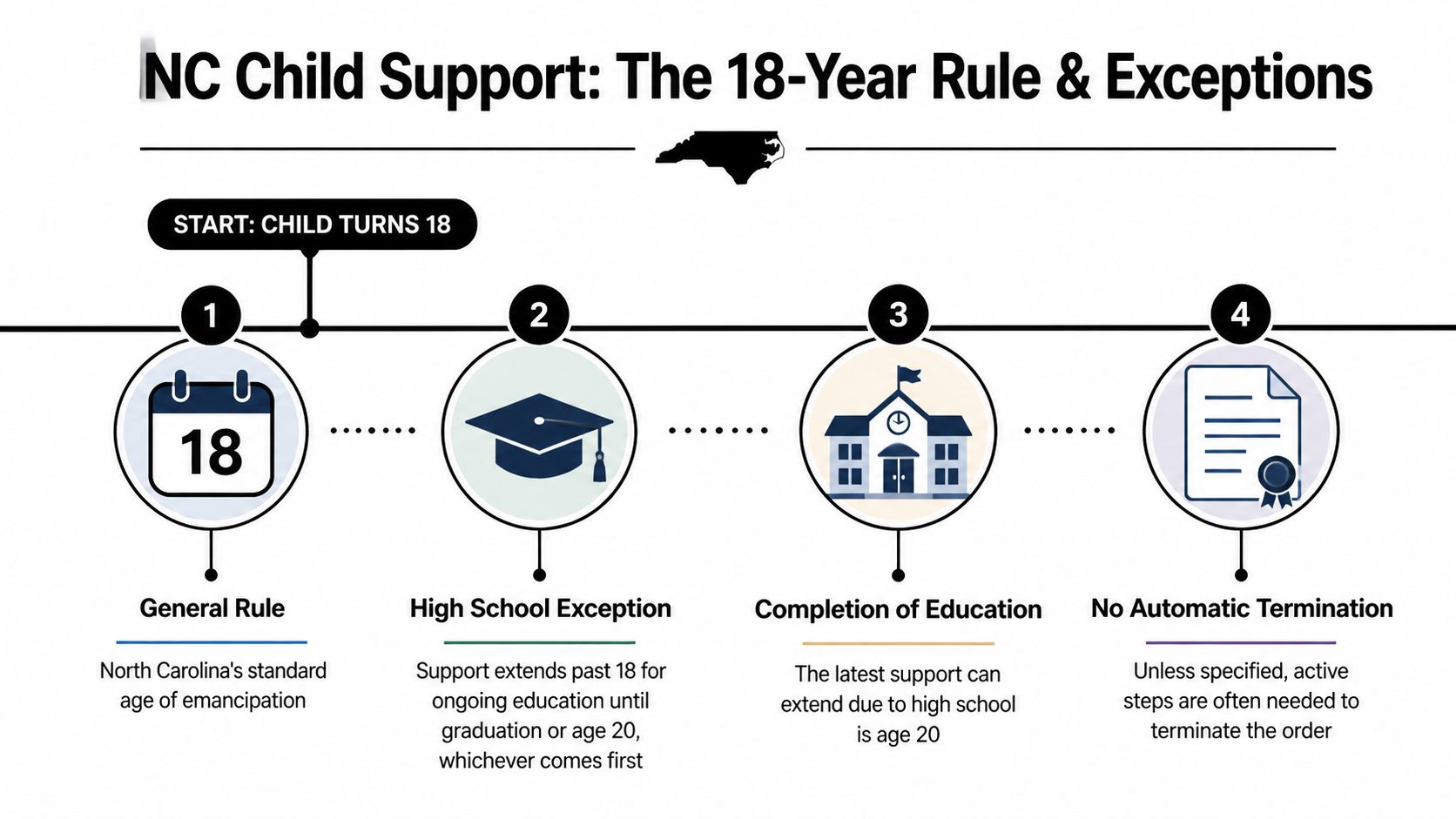
The starting point is North Carolina General Statutes section 50-13.4(c). Under North Carolina law, child support generally ends when the child turns 18. But that’s only the starting point.
If the child is still enrolled in primary or secondary school at 18, support can continue beyond that birthday. According to Women’s Law’s explanation of N.C. child support duration, support continues until the child graduates, stops attending regularly, fails to make satisfactory academic progress toward graduation, or reaches age 20, whichever happens first.
The basic rule
If your child finishes high school before turning 18, the support obligation usually ends when the child reaches 18.
That’s the cleanest scenario. It’s also the one many parents assume applies in every case. It doesn’t.
The most common exception
The high school exception is the rule that catches many parents off guard. A child can be legally an adult for many purposes and still qualify for ongoing child support if that child remains in school and is making satisfactory progress toward graduation.
If your child turns 18 while still in primary or secondary school, support can continue until graduation, loss of regular attendance, failure to make satisfactory academic progress, or the child’s 20th birthday. The first of those events controls.
That means a parent shouldn’t stop paying because the child had an 18th birthday party.
Why this exception matters in practice
Many high school seniors turn 18 during the school year. In that situation, support often continues through the end of that school period if the child remains enrolled and progressing appropriately. The law recognizes that a birthday doesn’t instantly eliminate the need for support while a child is still working toward finishing school.
This is also where facts matter. “Still enrolled” and “making satisfactory progress” are not throwaway phrases. If a child has stopped attending regularly or is no longer making progress toward graduation, the paying parent may need to address that directly rather than continue paying based on assumptions.
For parents trying to estimate the end date, it helps to separate two questions:
- When does the child turn 18
- What is the child’s school status at that time
Those two answers usually determine whether the obligation ends at 18 or continues for a limited period beyond it.
Read your order along with the statute
Some support orders are drafted clearly. Others aren’t. Some state an event-based termination date. Others leave room for confusion, especially when wage withholding remains active or when the support amount covers more than one issue under the broader family case.
If you’re trying to make sense of the payment amount itself while looking ahead to termination, North Carolina’s child support guidelines overview can help provide context on how support is calculated. But calculation and termination are different questions. A correct amount can still be paid for the wrong duration if the ending event is misunderstood.
A frequent misconception
Parents often ask whether support automatically stops at 18 no matter what. The answer is no. The law itself creates the school-based exception.
Another misconception is that continuing support after 18 means support will continue indefinitely. It won’t under the ordinary high school rule. The statute places a hard outer limit at age 20 for this kind of extension.
When Child Support Can End Before or Extend Beyond Age 20
The age 18 rule and school extension handle most cases, but not all of them. Some situations end support earlier. Others can extend it beyond the usual timeline.

According to Doyle Divorce Law’s discussion of child support termination in North Carolina, pre-18 termination can occur in 5 key scenarios: proven non-paternity, mutual parental agreement, child marriage, military service enlistment, or court emancipation for a mature, financially independent minor. The same source also notes that courts may continue support indefinitely past age 20 for a child whose mental or physical disability prevents self-support.
Early termination through emancipation
Emancipation means the law treats a minor as independent before age 18 for this purpose. In North Carolina, that can arise in several ways.
Marriage is one example. A minor who marries is generally considered emancipated. Military enlistment can also trigger early termination issues. Court-ordered emancipation is another route, but that usually requires a formal legal showing that the minor is mature and financially independent.
Mutual parental agreement appears in discussions of early termination, but clients must exercise caution. Agreement between parents may be part of the path, but an informal side deal is not the same as a legally effective end to a court order. If the order remains active, private understandings can create serious payment disputes later.
Non-paternity issues
A proven non-paternity situation can affect support, but these cases are technical and fact-sensitive. Timing, prior orders, testing, and procedural posture all matter.
This is not an area for assumptions or internet advice. If paternity is in dispute, a parent needs case-specific legal guidance before treating the obligation as ended.
Parents often focus on what feels fair. Courts focus on what the order says, what the statute allows, and what evidence supports the requested change.
Support for a child with disabilities
North Carolina law can treat disability cases differently from ordinary school-completion cases. If a child has a mental or physical disability that prevents self-support, the court may order support to continue beyond the ordinary ending point.
That kind of extension is not automatic in the same way the high school extension operates. It depends on the court’s findings and the evidence presented. Medical records, educational plans, and proof of ongoing dependency may all matter.
For families dealing with disability-related support questions, the legal issue usually isn’t just duration. It’s also how to present the child’s needs clearly and how to structure the order so it reflects reality rather than guesswork.
College and post-secondary support
Many parents assume North Carolina requires support through college. It doesn’t automatically do that.
Post-secondary support may be enforceable if the parents agreed to it in a valid separation agreement or if the obligation appears in an enforceable order. In other words, college support usually turns on prior agreement or specific legal language, not on a general statewide rule that every parent must pay through a child’s college years.
That distinction matters because parents often confuse moral expectations with legal obligations. A parent may choose to help with college. That is different from being legally required to do so under a binding agreement.
What works when exceptions may apply
The most effective approach is to identify which category you’re in before acting. Ask:
- Is this a standard age-and-school case
- Is the child legally emancipated
- Is there a disability that affects self-support
- Did the parents sign an agreement covering college or vocational education
Those are very different legal paths.
What usually fails is trying to force every case into the general age 18 rule. That shortcut can lead a paying parent to stop too soon, or it can lead a receiving parent to assume support will continue when the law doesn't require it.
Real-World Scenarios What Happens in Practice
The law becomes easier to understand when you attach it to common family situations. These examples show how the rules usually play out.
Scenario one
A child graduates from high school at 17 and turns 18 later that year.
In that situation, support typically ends at the 18th birthday. The child has already completed secondary school, so the school-based extension doesn’t keep the obligation going.
Scenario two
A child turns 18 during the spring semester of senior year and graduates in June.
Support doesn’t end just because the child turned 18. If the child is still attending school and making satisfactory academic progress, the obligation usually continues until graduation.
Graduation timing matters. A support obligation that would otherwise end at 18 may continue through the end of the child’s senior year if the statutory school conditions are still met.
Scenario three
A child is 19, still technically enrolled, but has stopped making meaningful progress toward graduation.
Paying parents frequently encounter frustration in these circumstances. Enrollment alone may not answer the question. If the child has ceased regular attendance or failed to make satisfactory academic progress, the paying parent may need to seek relief rather than continue waiting and hoping the issue resolves itself.
The legal point is practical. If the facts support termination, the parent usually needs proof and a proper court request instead of a unilateral stop in payments.
Scenario four
A 17-year-old enlists in the armed forces.
Military service can trigger emancipation issues before age 18. That can support early termination of child support, but the paying parent should still handle the order carefully and document the event.
Summary of Child Support Termination Events in North Carolina
| Termination Event | Triggering Condition | Is a Court Motion Required? |
|---|---|---|
| Age 18 standard end date | Child reaches 18 and no school-based extension applies | Often the legal duty ends by operation of law, but administrative follow-up may still be needed |
| High school completion after 18 | Child graduates while still qualifying for the school exception | Often the legal duty ends at the qualifying event, but records should still be updated |
| Loss of regular attendance or satisfactory progress | Child remains over 18 but no longer meets school-based requirements | Usually yes, if there is a dispute or active order administration issue |
| Marriage before 18 | Child becomes emancipated through marriage | Usually yes, to align the order and withholding with the legal change |
| Military enlistment before 18 | Child becomes emancipated through service | Usually yes, especially to stop active enforcement mechanisms |
| Court-ordered emancipation | Court declares minor emancipated | Yes |
| Disability preventing self-support | Court finds support should continue beyond the ordinary cutoff | Yes |
| College support by agreement | Binding agreement or order requires continued support | Enforcement depends on the language of the agreement or order |
The takeaway from these examples
The rule itself may be clear, but applying it depends on facts you can prove. In practice, the parent who documents school records, graduation dates, and emancipation events is usually in a much stronger position than the parent who relies on assumptions.
The Process for Terminating Your Child Support Order
Knowing when support should end is only half the problem. The other half is making sure the order, withholding, and agency records reflect that ending date correctly.
Automatic legal ending versus action you still need to take
Some termination events happen by operation of law. For example, the ordinary ending point tied to age and school completion may not require a new motion just to create the legal ending event itself.
That does not mean you should do nothing.
Wage withholding, clerk records, and agency systems don’t always fix themselves on your preferred timeline. A parent who assumes payroll deductions will stop automatically may discover that support is still being taken after the legal basis for ongoing support has ended.
Documents that matter
Good documentation solves a surprising number of disputes. Depending on the issue, that may include:
- Birth records: These help confirm the child’s date of birth.
- School records: Diplomas, transcripts, enrollment confirmations, and attendance information may be central when the child is over 18.
- Military paperwork: If enlistment is the triggering event, get proof.
- Court papers: Emancipation orders, agreements, and prior support orders all matter.
- Disability-related records: If support may continue because a child cannot support themselves, evidence needs to be organized early.
North Carolina law also allows court discretion in certain situations involving whether support should cease when the usual school extension is in question. The enacted statute, N.C. Gen. Stat. § 50-13.4, is where that language begins, and in practice the issue often turns on whether the child is making satisfactory progress and whether the parent has the records to prove otherwise.
When you likely need to file something
A motion is often necessary when the ending event is disputed, when emancipation is involved, when support should end early because the child is no longer progressing in school, or when the support amount needs further adjustment.
This is also true when one child is aging out but the order structure creates confusion about what amount remains due for another child. The legal trigger and the administrative fix are not always the same thing.
If you’re dealing with a change that affects the ongoing order, North Carolina child support modification guidance is often part of the broader conversation because termination and modification can overlap in real cases.
Don’t stop paying first and ask questions later
That’s one of the costliest mistakes parents make.
If support is still being enforced through an active order, stopping payment without confirming the legal and procedural status can create arrears, contempt issues, and a much harder cleanup process later. Even when a parent is ultimately correct on the law, poor timing and missing documentation can make the case more difficult than it needed to be.
A short explanation can help:
A practical sequence that usually helps
- Read the current order carefully. Look for event-based language, not just payment language.
- Identify the exact ending event. Birthday, graduation, emancipation, or something else.
- Gather proof before the cutoff date. Don’t wait until there’s already a dispute.
- Confirm how payments are being made. Direct pay, wage withholding, or through a support agency each creates different practical steps.
- File promptly if the situation requires court action. Delay often creates avoidable conflict.
Keep the focus on proof, timing, and procedure. Parents usually get better outcomes when they treat termination as a legal process, not just a calendar event.
For families who want legal help with that process, the Law Office of Bryan Fagan handles North Carolina family law matters that include child support questions, modifications, and enforcement issues.
Addressing Unpaid Child Support After Termination
One point needs to be clear. Ending current child support does not erase unpaid child support that already accrued.
Arrears and ongoing support are separate issues. A parent may no longer owe future monthly support, but still owe past-due amounts that came due before the termination event. Those amounts remain enforceable.
Why this causes so much confusion
Parents often assume the account should be “closed” once the child becomes an adult or support otherwise ends. That isn’t how arrears work. If payments were missed while the obligation was active, the debt can continue after the child support duty itself has ended.
That’s why it’s risky to treat the end date as a reset button. It isn’t.
What enforcement can look like
North Carolina can continue enforcing arrears after termination of current support. The exact tools used depend on the case posture, but the larger point is practical. Parents shouldn’t assume that adulthood of the child means collection efforts disappear.
Ending future support and collecting past-due support are two different tracks. One can stop while the other continues.
This also matters for parents who stop paying too early. If you guess wrong about the termination date, the unpaid amounts that accumulate can become arrears, even if you believed in good faith that support should have ended.
What about overpayments
The reverse problem also happens. Sometimes a parent keeps paying after the legal obligation has ended because withholding was never stopped or because nobody updated the records promptly.
When that happens, act quickly. Gather payment records, identify the legal end date, and address the issue through the proper court or agency channels. Whether reimbursement, credit, or another remedy is available can depend on the facts and how the payments were processed.
What doesn’t work is waiting too long and assuming the system will correct itself without a request and supporting documentation.
Your North Carolina Child Support Termination Questions Answered
What if my child gets a GED instead of a high school diploma
The answer depends on whether the GED changes the child’s status under the order and statute in your case. The practical issue is whether the child is still enrolled in qualifying primary or secondary education and whether the legal basis for continuing support still exists. This is a good example of why parents should review the specific order and school records instead of relying on assumptions.
Can my ex and I agree to end child support early without going to court
You can agree on many things as co-parents, but an informal agreement does not safely replace a court order. If the order remains active, private side agreements can leave one parent exposed to later claims for unpaid support. If you both want the obligation changed, formalizing that change is the safer path.
Does support stop if my child moves out of the custodial parent’s home but is still in school
Not automatically. A child’s living arrangement may matter, but it does not by itself cancel an existing support order. The legal effect depends on the facts, the order’s language, and whether the move changes custody, support entitlement, or the child’s status under North Carolina law.
If my child is over 18 and not doing well in school, can I just stop paying
No. If the issue is lack of regular attendance or failure to make satisfactory academic progress, the safer course is to gather records and seek proper relief. Stopping first can create arrears if the court or agency has not recognized the change.
How do I recover child support that I overpaid
Start with documentation. You’ll need proof of the legal termination event, proof of the payments made after that point, and the payment method involved. Recovery is not always automatic. In many cases, a parent needs to pursue the issue formally and should do so promptly before records become harder to sort out.
Protect Your Rights with a North Carolina Family Law Attorney
When people ask when does child support end in nc, the short answer is usually age 18. The correct answer depends on school status, emancipation, disability, existing agreements, and whether the order has been properly updated. Small mistakes at the end of a case can create unnecessary arrears or unnecessary overpayments.
If you need help reviewing your order, preparing a motion, or resolving a dispute about the ending date, a North Carolina child support lawyer can help you evaluate the facts and choose the right legal step for your case.
If you live in North Carolina and need guidance on ending, enforcing, or correcting a child support order, schedule a consultation with Law Office of Bryan Fagan. A case-specific review can help you confirm the true termination date, avoid preventable payment mistakes, and protect your rights under North Carolina law.