If you're reading about child support guidelines nc, there's a good chance you're in the middle of a hard transition. You may be separating from your child's other parent, reviewing papers you didn't expect to deal with, or wondering how a court decides what is fair when one household becomes two. Most parents aren't trying to game the system. They want to know what the rules are, what the court will look at, and how to avoid mistakes that cost time and money.
That uncertainty is real. A parent who pays support may worry about being ordered to pay based on bad numbers. A parent who receives support may worry that the other side is hiding income or minimizing what the child needs. In North Carolina, the law does give structure to that problem. The Guidelines are meant to create a starting point that is predictable, child-focused, and grounded in the parents' financial circumstances.
In practice, the process is more than plugging numbers into a form. The worksheet matters. The overnight schedule matters. Income documentation matters even more. In some cases, the formula answers the question. In others, especially where self-employment, unusual expenses, or high income are involved, the actual work starts after the worksheet.
Parents who want a practical overview of the process can also review this North Carolina child support overview alongside legal advice specific to their facts.
Navigating Child Support in North Carolina
A common situation looks like this. One parent has moved out, the children are adjusting to a new schedule, and both households are suddenly carrying expenses that used to be shared. School costs still exist. Groceries still exist. Health coverage still matters. The question quickly becomes simple and urgent: who pays what, and how does North Carolina decide?
North Carolina child support law tries to answer that through an organized system rather than guesswork. Courts don't start with personal opinions about who seems more responsible. They start with the Child Support Guidelines, which are designed to estimate an appropriate support amount in many cases and to protect the child's needs.
What parents usually get wrong at the start
Many clients assume child support is based only on who earns more. That's not how it works. Income is central, but so are custody overnights, childcare costs tied to work, and health-related costs that fit within the Guidelines.
Others assume an informal agreement is enough. It may feel easier to handle support privately, especially early in a separation, but problems often surface later. If payments become inconsistent or one parent says the agreement was temporary, the lack of a clear court order can create avoidable conflict.
Practical rule: The best early move is to gather clean financial records and a realistic parenting schedule before arguing about the final number.
Why the system feels complicated
It feels complicated because real families are complicated. Some parents are salaried employees with steady income. Others are paid through commissions, own businesses, receive rental income, or have irregular compensation. Some children have routine expenses. Others have educational, medical, or scheduling needs that make a basic worksheet less straightforward.
The good news is that the law gives a framework. The better news is that most confusion can be reduced once you identify three things:
- Which worksheet applies: The custody arrangement drives that decision.
- What each parent's income is: Not just what appears on a single paycheck.
- Whether the case fits the standard formula: Some cases don't, and that matters.
Understanding the Core Principles of NC Child Support
North Carolina child support is grounded in N.C. Gen. Stat. § 50-13.4 and the statewide Child Support Guidelines. The basic idea is straightforward. Children should receive support from both parents, and the amount should reflect the parents' financial ability and the child's needs.
The income shares model in plain English
North Carolina uses an income shares approach. This approach is similar to dividing a household pie. If parents were still living together, the child would benefit from the combined financial resources of both households. After separation, the court tries to preserve that same proportion of support as much as possible.
That doesn't mean both parents write equal checks. It means the court looks at the total available income and allocates responsibility in proportion to each parent's financial share. One parent may be paying support directly to the other. But legally, both remain responsible for supporting the child.
What rebuttable presumption means
When the Guidelines apply, the worksheet amount is a rebuttable presumption. In plain terms, the court starts by presuming that the guideline amount is the correct amount. A parent can ask the court to depart from that amount, but the parent asking for a different result must show why the standard amount would be unfair or fail to meet the child's reasonable needs.
That matters because many parents walk into court assuming the judge will "do what seems fair." Judges do exercise judgment, but they do so within a legal framework. If the case falls within the Guidelines, the worksheet amount has real weight.
The guideline figure is not a suggestion. It is the presumptive amount unless the court has a legal reason to depart from it.
Terms that matter in your case
A few terms come up often:
- Obligor: The parent ordered to pay child support.
- Obligee: The parent who receives support for the benefit of the child.
- Gross income: The income figure used as a starting point in the calculation.
- Deviation: A court-ordered amount that differs from the guideline amount because the facts justify it.
These words sound technical, but they describe practical issues. Who pays. Who receives. What income counts. Whether the standard amount fits the case.
The 2023 updates changed the playing field
North Carolina's Child Support Guidelines had a significant update effective January 1, 2023, including an increase in the income cap from $30,000 per month to $40,000 per month, reflecting updates to tax rates, the Consumer Price Index, and federal poverty levels, as explained by the UNC School of Government's review of the 2023 Child Support Guidelines.
That update matters in two ways. First, more families now fall within the worksheet-based system. Second, the revised Guidelines also adjusted the self-support reserve, which is intended to keep a very low-income parent from being pushed below a minimum subsistence level while still recognizing the duty to support a child.
Why this matters to a real parent
A parent doesn't need to memorize every line of the Guidelines. But you do need to know whether your case is a routine worksheet case or one with complications. That single distinction often determines whether the focus should be on clean documentation, negotiation around expenses, or a deeper argument about deviation.
Determining Gross Income for Your NC Child Support Case
In many cases, the biggest dispute isn't over the child. It's over income. One parent says the other earns more than claimed. The other says the numbers are being exaggerated. That's why child support litigation often turns on documents long before it turns on courtroom argument.

North Carolina's method puts parental income at the center of the calculation. It can include wages, salaries, bonuses, and passive income. The system uses Worksheets A, B, and C based on custody arrangements, and 86.93 percent of North Carolina child support cases currently maintain active court orders, according to this overview of calculating child support in North Carolina.
What usually counts as gross income
For many employees, gross income starts with wages or salary. But courts don't stop there if a parent receives compensation in other forms. Income can also involve commissions, bonuses, pension income, and rental earnings.
That broad view is important because a support case should reflect economic reality, not just a base paycheck. If a parent regularly receives significant extra compensation, the court will want to know about it.
A useful way to think about it is this: if money regularly increases a parent's ability to support the child, it may be relevant to the support analysis.
Self-employment cases need closer review
Self-employment is where many support disputes become more detailed. A business owner may have legitimate expenses. A business owner may also run personal spending through the business, whether intentionally or casually. Courts know that difference matters.
Consider a parent who owns a landscaping company. The business brings in revenue, but the parent also pays for equipment, insurance, fuel, and payroll. Those may be ordinary business expenses. On the other hand, if the business pays for primarily personal items or inflated expenses that don't appear necessary to operate the company, the court may take a harder look.
A practical self-employment example
Suppose a parent says, "My business barely made money this year." That statement alone won't carry much weight. The court will usually want records that show what came in and what went out.
Useful records often include:
- Profit and loss statements: These show business income and expenses over time.
- Bank records: Business deposits often tell a clearer story than a tax return standing alone.
- Tax returns: They matter, but they aren't always the final word in a support case.
- Supporting receipts or ledgers: These help separate true operating costs from questionable deductions.
Courts tend to focus on substance over labels. Calling something a business expense doesn't automatically make it one for child support purposes.
What doesn't work well in court
Parents often hurt their own credibility by producing incomplete records, mixing business and personal finances, or insisting the other side should "just trust" their summary. That rarely ends well.
These habits create avoidable problems:
- Using cash without records: If income can't be traced, the court may view the presentation with skepticism.
- Claiming large deductions without explanation: Unsupported deductions can invite a challenge.
- Waiting until the hearing to organize finances: Last-minute explanations usually look weaker than consistent records produced early.
When a court may impute income
Sometimes the problem isn't hidden income. It's reduced income. If a parent is voluntarily unemployed or underemployed, the court may examine whether that reduction is genuine or strategic. This is often called imputing income, meaning the court attributes income based on earning capacity rather than accepting the parent's current lower earnings at face value.
A good-faith job change is different from a bad-faith attempt to avoid support. If a parent leaves a stable job for sound reasons, that may be understandable. If a parent quits work right before a support hearing without a persuasive reason, the court may be much less sympathetic.
The best preparation is boring and thorough
The strongest income presentation is usually the least dramatic one. Organized pay records. Clear tax returns. Business documents that match actual practice. Explanations that are consistent from one filing to the next.
If your income is unusual, irregular, or tied to a business, don't assume the worksheet will sort it out on its own. It won't. The numbers are only as reliable as the evidence behind them.
A Step-by-Step Guide to the NC Child Support Worksheets
The worksheet drives the calculation in many North Carolina cases. Parents often focus first on income, which makes sense, but the correct worksheet can change the result in a meaningful way. In child support guidelines nc cases, the worksheet is tied to custody overnights, not just labels like "primary" or "joint."
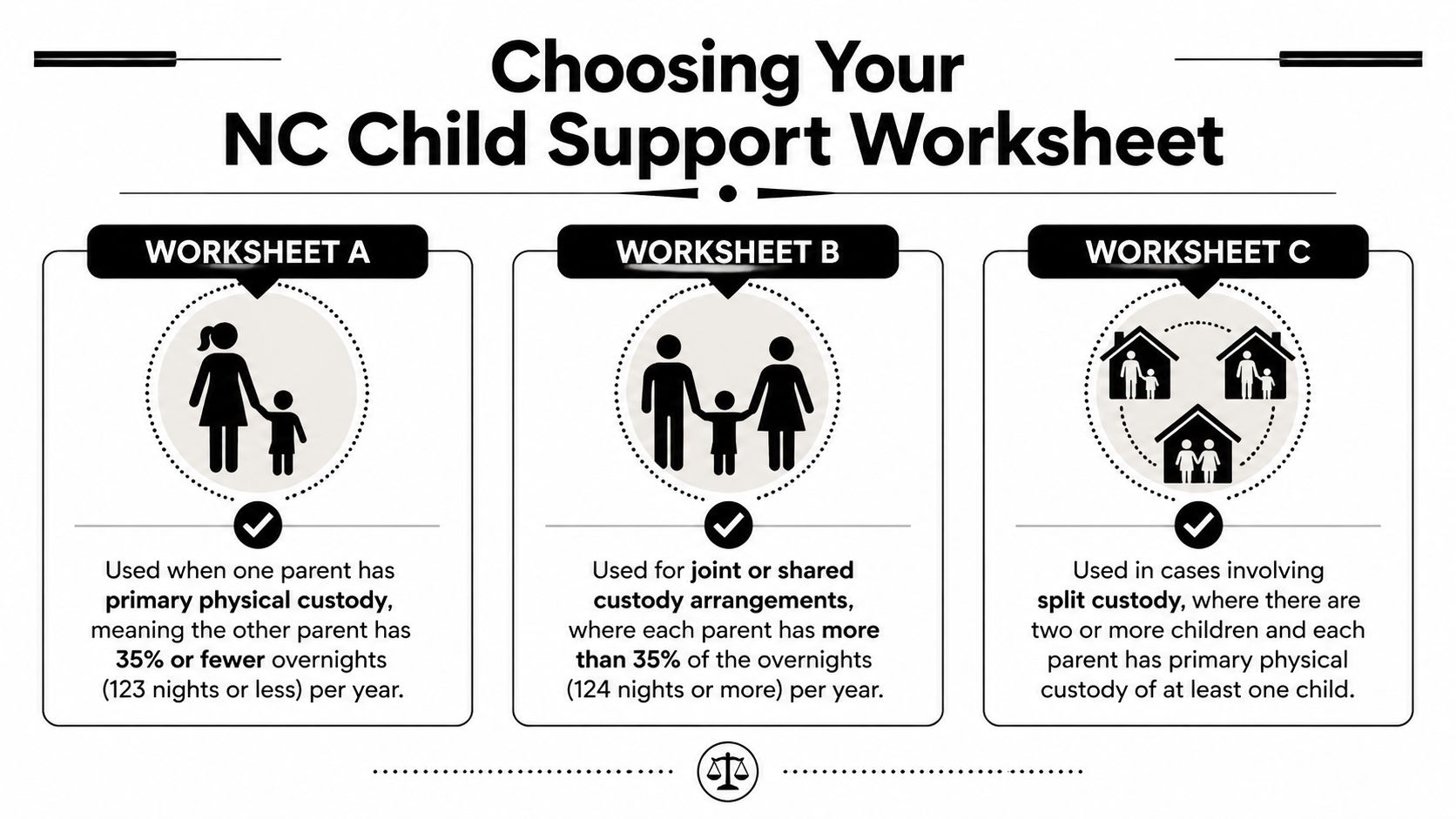
The North Carolina Child Support Guidelines apply a rebuttable presumption when parents' combined adjusted gross monthly income is up to $40,000, and worksheet choice depends on custody overnights: Worksheet A for primary custody where one parent has 243 or more nights per year, Worksheet B for shared custody where each parent has at least 123 nights, and Worksheet C for split custody, as summarized in this discussion of North Carolina's updated 2023 child support guidelines.
Worksheet A when one parent has primary physical custody
Worksheet A is used when one parent has the child for most overnights during the year. In practical terms, this is the classic arrangement where one parent is the primary custodial parent and the other has less parenting time.
This worksheet tends to be the most familiar to parents because the structure is more straightforward. The court inputs the parents' incomes and approved add-on expenses, then calculates the support obligation owed by the parent who does not have primary physical custody.
Worksheet B when custody is genuinely shared
Worksheet B applies when each parent has enough overnights to qualify as shared custody. This worksheet is more nuanced because it acknowledges that both parents are maintaining homes, daily supplies, transportation, and recurring child-related expenses.
That doesn't mean support disappears in shared custody. A common misconception is that a near-even timeshare cancels support. It often doesn't. If one parent earns substantially more, that parent may still owe support after the Worksheet B adjustment.
Here is a simple way to think about Worksheet B:
- Start with each parent's income. The court needs reliable current income information for both sides.
- Add allowable expenses. Health insurance, work-related childcare, and similar approved categories are considered.
- Account for overnights. The shared schedule affects the proportional calculation.
- Reach the presumptive amount. That figure is the starting point unless a deviation is justified.
Shared custody changes the math. It doesn't automatically eliminate child support.
A practical example helps. Suppose both parents have the child enough nights to use Worksheet B. One parent earns significantly more and also pays the child's health insurance. The worksheet doesn't merely split everything down the middle. It weighs the income shares, adjusts for the custody structure, and then accounts for the insurance cost in the final presumptive figure.
Worksheet C in split custody cases
Worksheet C is for split custody, usually when there are multiple children and each parent has primary physical custody of at least one child. These cases are less common, but when they arise, using the wrong worksheet can seriously distort the result.
Split custody cases often require especially careful review of the parenting arrangement. Parents may use broad terms in conversation that don't match the legal structure. The court will look at where each child primarily resides, not at shorthand labels used by the family.
What gets entered into the worksheet
The worksheet is only as accurate as the inputs. Courts typically examine several categories:
- Current gross income: This remains the backbone of the calculation.
- Preexisting support obligations: These may affect adjusted figures.
- Health and vision insurance costs: The current Guidelines specifically include vision-related costs within the defined health expense framework.
- Work-related childcare: Daycare or similar costs tied to employment can be included.
- Extraordinary expenses: These may be considered when appropriate and supported.
A parent who brings incomplete records into this process may still get a result, but it may not be the right result.
To see the worksheet discussion in action, some parents find it useful to review a visual explanation before digging into their own numbers:
A quick comparison of the three worksheets
| Worksheet | Typical custody pattern | Main question |
|---|---|---|
| A | One parent has primary physical custody | What should the non-primary parent pay? |
| B | Each parent has enough overnights for shared custody | How should support be adjusted given both households' parenting time? |
| C | Split custody among multiple children | How should support be balanced when each parent has primary custody of at least one child? |
Where parents go wrong with worksheets
The most common worksheet mistakes are practical, not legal.
- Counting overnights loosely: Courts care about actual overnights, not rough estimates.
- Using the wrong schedule on paper: A proposed schedule and an actual exercised schedule may not be the same.
- Ignoring add-on costs: Insurance and childcare can materially affect the number.
- Assuming equal time means zero support: It often doesn't.
If there's a disputed schedule, don't treat the worksheet as a final answer until the parenting time issue is settled. In many support cases, custody facts and support facts are tightly connected.
Deviating from the Guidelines High Income and Special Expenses
The worksheet is powerful, but it isn't the end of every case. North Carolina law allows the court to move away from the guideline amount when the presumptive figure would be inadequate, excessive, or otherwise unjust under the facts. In such situations, support cases often become more individualized.

High-income cases are analyzed differently
When combined parental income exceeds the current guideline cap, the court doesn't automatically extend the worksheet upward. Instead, the court looks to the child's reasonable needs and the family's accustomed standard of living under N.C. Gen. Stat. § 50-13.4(c).
That sounds abstract until you apply it to a real family. In a moderate-income case, the focus may be on standard living costs, insurance, and childcare. In a high-asset or high-income case, the analysis may involve a broader picture of the child's established lifestyle. The court still won't approve expenses just because a parent can afford them. But the law also doesn't force a child from a financially comfortable family into an artificially reduced standard of living after separation.
What reasonable needs can look like
"Reasonable needs" doesn't mean only bare necessities. It usually includes ordinary categories such as housing, food, transportation, school-related costs, and medical care. In some families, it may also include expenses tied to the child's established activities, educational setting, or consistent routines.
For example, if a child has long attended a particular private school, receives specialized services, or has an ongoing activity that is part of the family's regular lifestyle, those facts may become part of the court's analysis. The question is not whether the expense sounds impressive. The question is whether it is reasonable for this child, in this family, based on credible evidence.
In higher-income cases, the persuasive evidence is rarely a spreadsheet alone. Courts often need context about how the child actually lives and what expenses are genuinely tied to that life.
Extraordinary expenses require proof
Even in cases that otherwise fit the Guidelines, certain expenses may justify adjustment or special attention. These often include things like specialized medical needs, unusual education costs, or other necessary child-specific expenses.
What works well is targeted proof. A parent who seeks inclusion of an expense should be prepared to show why it exists, why it is reasonable, and why it benefits the child. General claims that an expense is "important" usually aren't enough if the other parent disputes it.
Helpful evidence in deviation cases
- Invoices and billing records: These show the actual amount and frequency of the expense.
- School or provider documentation: Useful when the expense relates to education, treatment, or a program.
- History of the child's routine: Past enrollment or long-term participation can matter.
- Financial affidavits: These help the court compare claimed needs with the parties' resources.
What doesn't persuade a judge
Some arguments fail because they are too broad. A parent may say, "My child deserves the best." That's understandable, but it isn't a legal standard. The court needs evidence tying the requested support to the child's actual needs and the family's circumstances.
Likewise, a high-income parent can't assume the court will accept an artificially low support position solely because the other parent's household can survive without more. Child support is not a test of whether the receiving parent can "make do." It is about the child's right to support consistent with the law.
How to Modify or Enforce Your NC Child Support Order
A child support order isn't meant to stay frozen when life changes substantially. Jobs change. Children develop new needs. Insurance costs shift. Parenting schedules evolve. North Carolina law allows modification when there has been a substantial change in circumstances, and waiting too long can make a fix harder than it needs to be.
One often-missed point is this: a significant change in a child's health care needs, whether through insurance availability or cost, can qualify as a substantial change of circumstances under 45 C.F.R. § 303.8(d) and support a review even if the final support amount doesn't change, as noted in this North Carolina Child Support Guidelines course material.
When modification makes sense
Parents often assume they need a dramatic event before filing to modify support. Sometimes they do. Often they don't. The legal question is whether the change is substantial enough to justify court review.
A few examples commonly raise modification issues:
- A meaningful income shift: A raise, job loss, or change in compensation structure can alter the support picture.
- A different custody schedule: More or fewer overnights can change the proper worksheet or the resulting amount.
- New child-related expenses: Health care changes are especially important under the federal compliance provision noted above.
- Changed availability of insurance: Even if the support number doesn't move much, the allocation of responsibility may need revision.
Parents considering a formal change can review this North Carolina child support modification guide as a starting point.
If your order no longer matches the way your child actually lives or the way expenses are actually being paid, it's worth reviewing the order before the mismatch gets expensive.
Enforcement is different from modification
Modification asks the court to change the order going forward. Enforcement asks the court to address noncompliance with the existing order. Those are different tools, and choosing the wrong one can delay relief.
If support is unpaid, North Carolina has several enforcement mechanisms. Depending on the circumstances, collection efforts may involve income withholding, interception of available funds, license-related consequences, or contempt proceedings. The exact route depends on the arrears, the existing order, and whether the nonpayment appears willful.
What usually works best
The best results usually come from acting early and documenting clearly. If you're seeking a modification, gather updated pay records, insurance information, childcare evidence, and proof of any changed parenting schedule. If you're seeking enforcement, organize payment records, the current order, and any communications that show nonpayment or inconsistent payment.
What doesn't work is informal drifting. If one parent pays less without a court order, or if both parents verbally change support without formal approval, those decisions can create serious problems later.
Common Questions About North Carolina Child Support
Below are concise answers to questions parents often ask in consultation.
| Question | Answer |
|---|---|
| When does child support end in North Carolina? | The answer depends on the facts and the wording of the order. For many parents, this is one of the first timing questions to review carefully. This guide on when child support ends in North Carolina is a helpful starting point, but the exact answer should be tied to your order and your child's circumstances. |
| Can parents agree to a child support amount without going to court? | Parents can reach agreements, but an out-of-court arrangement may not protect either side if a dispute arises later. A court order provides enforceability and reduces later arguments about what was actually agreed. |
| Does shared custody mean nobody pays support? | No. Shared custody affects the worksheet analysis, but it doesn't automatically eliminate support. If one parent earns more or pays certain approved child-related expenses, support may still be owed. |
| Are health insurance costs part of child support in NC? | Yes. Health-related costs can be part of the calculation, and the current Guidelines also address vision-related costs within that framework. Proper documentation matters. |
| What if the other parent is self-employed and I think the income is understated? | That issue often requires close review of business records, bank statements, tax returns, and claimed expenses. Self-employment cases are common areas for disputes over what income should really count. |
A misconception worth clearing up
Many parents think child support and custody are bargaining chips. They aren't. A parent doesn't get to withhold visitation because support wasn't paid, and a parent doesn't get to stop paying support because visitation is being frustrated. Those are separate legal issues, and mixing them usually makes the case worse.
Schedule a Consultation with a North Carolina Family Lawyer
Child support cases often look simple from the outside. Then the details begin to matter. Which worksheet applies. Whether income is being reported accurately. Whether a claimed business expense is legitimate. Whether the case fits the standard formula or calls for a deviation. Those issues can affect the outcome far more than most parents expect.
A lawyer's role isn't just to argue in court. It's to identify the pressure points early, present the right financial proof, and keep a temporary dispute from becoming a long-term problem. That matters whether you're trying to establish support, challenge an unfair number, seek a modification, or enforce an order that isn't being followed.
If you live in North Carolina and need clear advice about child support guidelines nc, getting case-specific guidance is the safest next step. The law provides structure, but your facts determine how that structure applies.
If you need help with child support, custody, modification, or enforcement issues in North Carolina, schedule a consultation with the Law Office of Bryan Fagan. The firm works with North Carolina families to evaluate support obligations, review financial records, address contested income issues, and build practical strategies focused on protecting both parental rights and a child's financial stability.