You're sitting at the kitchen table after a funeral, sorting through mail and trying to make sense of a will that seems to put one child in charge and leave you with far less than you expected. That's often the moment a surviving spouse in North Carolina first hears about the spousal elective share. It's not a loophole, and it's not an automatic windfall. It's a statutory safety net that can matter a great deal when a will, intestacy, or a mix of probate and nonprobate transfers leaves a spouse short.
A Moment That Brings Families to the Elective Share
A lot of people think the will controls everything. Then the estate gets opened, letters testamentary or letters of administration issue, and the surviving spouse realizes the numbers don't feel right.
That's when the spousal elective share NC estate rules start to matter. North Carolina gives a surviving spouse a right to ask for a court-determined minimum instead of taking only what the will or intestacy would leave behind. The details are in North Carolina Chapter 30, Article 1A, and the modern framework took effect on October 1, 2013. The statute replaced older inheritance formulas with a marriage-length schedule tied to the decedent's total net assets. North Carolina's elective share statute shows the current structure.
The practical question is simple, even if the law isn't. Did the estate plan leave the spouse with less than the statute guarantees, once you count what already passed outside the will? If yes, the elective share may be worth pursuing. If no, the claim may be smaller than it first appears, or it may disappear after the asset math is done.
If the estate plan leaves a surviving spouse short, North Carolina law may let that spouse claim a statutory minimum, but the claim has to be handled on time and with the right paperwork.
Four questions usually decide whether the elective share matters in a real family dispute. What is it? Who can claim it? How is it calculated? And what can shrink it or wipe it out? If you're trying to answer those questions for your own family, you're in the right place.
What the Spousal Elective Share Actually Is in North Carolina
A surviving spouse often first hears about the elective share after reading a will that feels too thin, or after learning that important assets passed outside probate. North Carolina law gives that spouse a statutory right to reject what the will, or in some cases intestacy, leaves behind and ask for a minimum share set by law instead. The right comes from the marriage itself, not from whether the decedent chose to leave property to the spouse.
The modern rule appears in the statute that took effect on October 1, 2013. The spouse's share depends on the length of the marriage, and the calculation starts with total net assets, not just the property that goes through probate. From there, the law reduces the amount by property already passing to the surviving spouse, so the final number can be very different from what a family expects at first glance. A visual guide illustrating the spousal elective share legal right to reject a will in North Carolina.
The policy behind the rule is practical. A spouse should not be left financially stranded because a will leaves them out, or because assets were arranged so that nearly everything passed somewhere else. The elective share acts as a backstop, a legal floor that can step in when the estate plan does not leave enough for the surviving spouse.
North Carolina is not a community property state, so the elective share does not mean the spouse automatically receives half of everything. The statute works more like a measuring stick. First, it looks at the size of the estate base. Then it asks how much property the spouse already received through the will, through beneficiary designations, or through other nonprobate transfers. That second step is where families are often surprised, because the elective share can shrink once those other assets are counted.
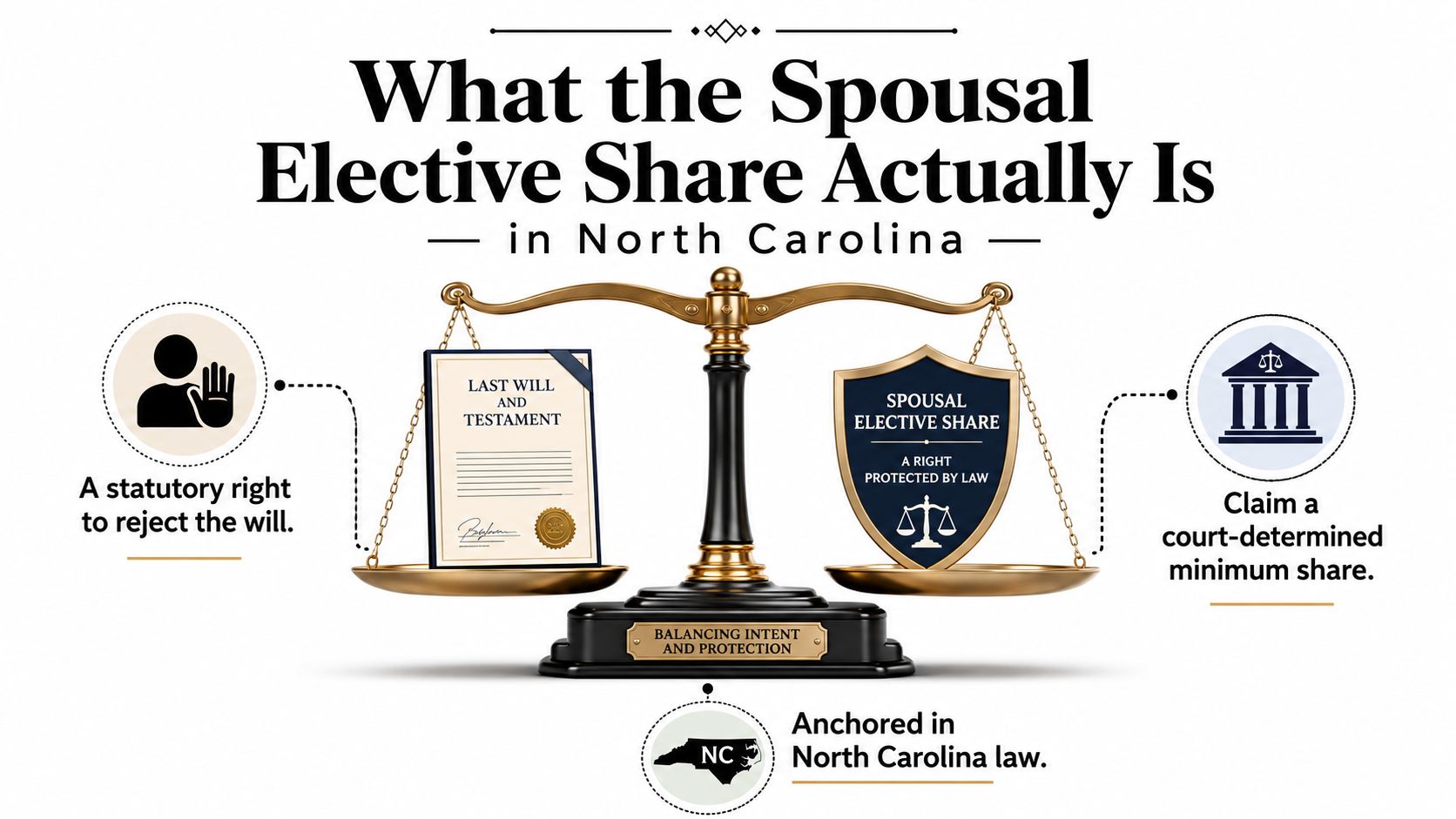
Plain-English summary: A surviving spouse can sometimes reject what the will leaves and claim a court-set minimum under North Carolina law, but the final amount depends on the asset mix and the paperwork.
That is the point many families miss. A spouse may already be receiving something under the will, or may have received assets directly outside probate. The elective share does not look only at the will page. It looks at the whole transfer picture, including the property that moved by other legal routes before anyone ever files in probate.
How North Carolina Calculates the Elective Share
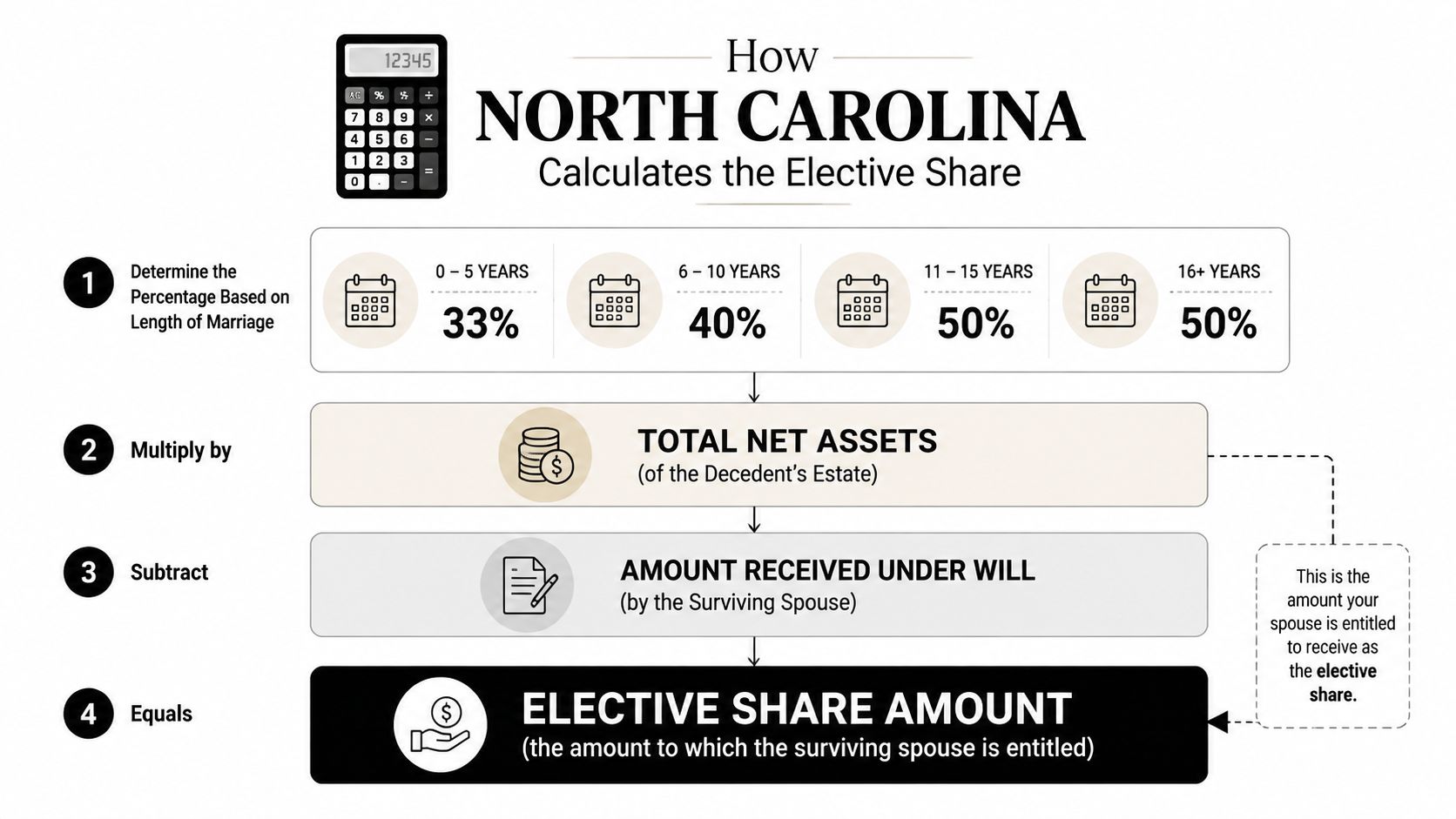
A surviving spouse in North Carolina usually starts with one question: how much is the statute going to count? The answer comes from a formula with three moving parts. First, you identify the marriage-length percentage. Second, you apply that percentage to total net assets. Third, you subtract the net property passing to the surviving spouse. That last step matters because the percentage on paper is not always the amount the spouse ends up receiving.
The statute uses a sliding schedule. The applicable share is 15% if the marriage lasted less than 5 years, 25% for 5 to less than 10 years, 33% for 10 to less than 15 years, and 50% for 15 years or more. That schedule appears in Article 1A of Chapter 30, and the practice explanation at A North Carolina practice explanation of the elective share gives a plain-English overview of how the calculation works.
Why nonprobate transfers matter
The subtraction step is where families often get caught off guard. North Carolina measures the elective share as “(applicable share of Total Net Assets) minus Net Property Passing to Surviving Spouse.” In practical terms, the court does not look only at the will. It also counts property that passed by beneficiary designation, survivorship rights, or other routes outside probate if those assets are part of the spouse's transfer picture.
That matters because a spouse may already have received enough value before the elective share is ever filed. If a retirement account names the spouse as beneficiary, if a bank account passes by survivorship, or if other nonprobate assets already moved to the spouse, those transfers can reduce what remains to be claimed through the elective share. Families sometimes expect the statutory percentage to operate like a simple allowance, but the actual result works more like a balance sheet. Start with the estate base, then subtract what the surviving spouse already has in hand.
A simple example helps. If the applicable share produces a number of $200,000, but the spouse has already received $140,000 in net property passing outside probate, the elective share claim is measured against the remaining difference. If the nonprobate transfers are large enough, the elective share can shrink to a much smaller figure, or disappear altogether.
Practical rule: Do not estimate the elective share from the will alone. List what already passed to the spouse outside the will, then compare that total with the statutory percentage.
This is also why the probate inventory matters before anyone assumes the final number. A spouse needs to know what is in the estate, what passed outside probate, and what waiver language may already control the result. For a fuller picture of how the estate administration side fits together, the firm's explanation of the North Carolina probate process is a useful companion to the elective share calculation.
Filing Deadlines and the Procedure You Cannot Afford to Miss
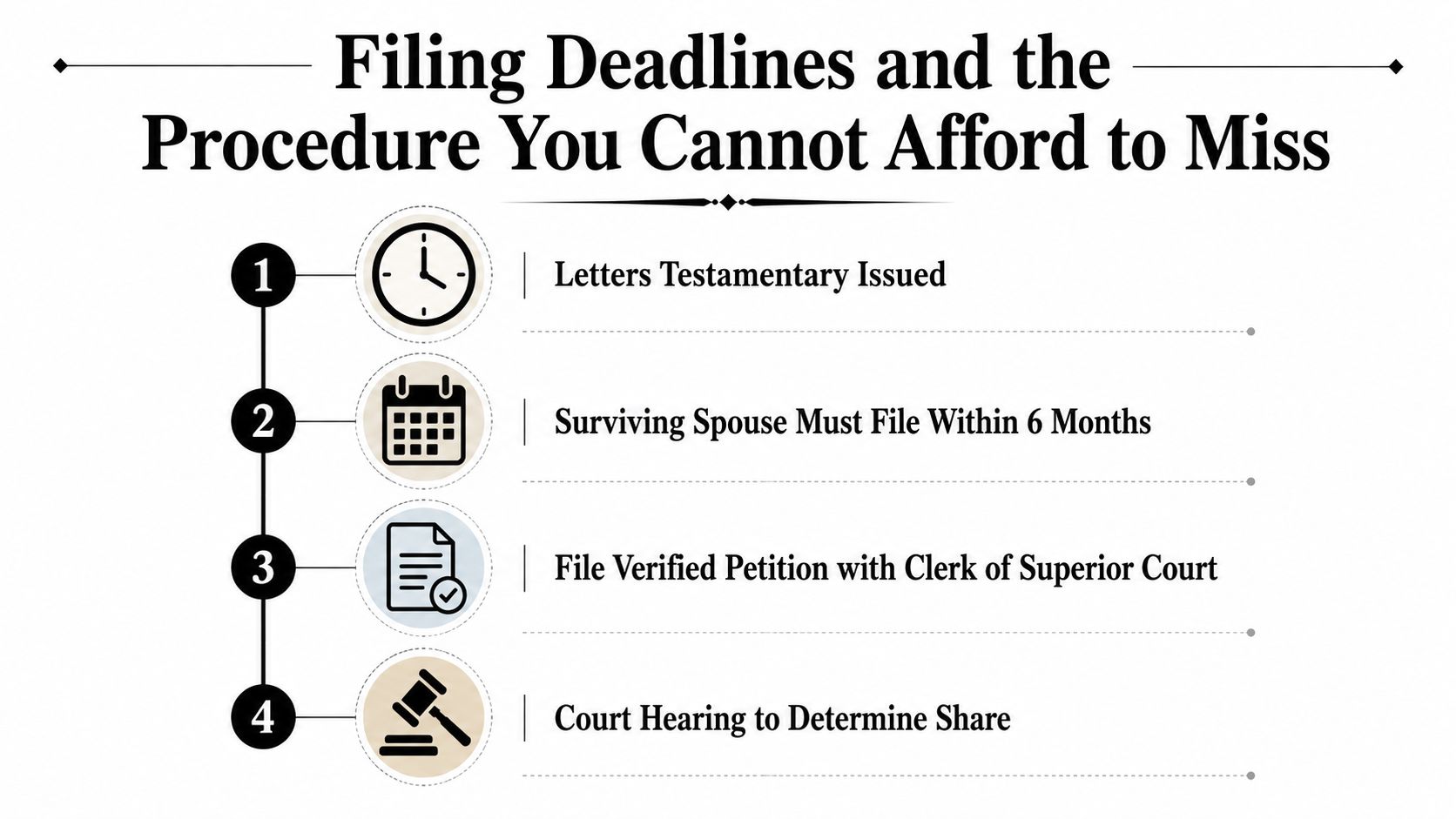
A surviving spouse can have a valid elective-share claim and still lose it by waiting too long. North Carolina requires the spouse to file a petition within 6 months after letters testamentary or letters of administration are issued. The filing is tied to probate procedure, not to a general sense of fairness.
What has to happen first
The petition must be filed in the county of primary administration. It also has to be a verified petition, which means the spouse signs it under oath. That detail matters because a casual letter or informal objection does not preserve the claim.
The deadline is the trap. A spouse who waits to “see how the estate plays out” can lose the right entirely, even if the marriage was long and the result feels unfair.
Before meeting with counsel, a spouse should gather the probate papers, the will if there is one, and whatever can already be learned about property that may pass outside the will. That includes jointly titled property, accounts with beneficiary designations, and other assets that may already have moved to the surviving spouse outside probate. Those items can change the final elective-share number before the petition is even filed.
A spouse also needs the larger probate picture, because the elective share does not exist in a vacuum. The firm's explanation of the North Carolina probate process helps show where the petition fits into the administration timeline.
Short version: If the petition is not filed within six months of the letters, the elective-share right can be lost even when the spouse would otherwise have a valid claim.
A common mistake is waiting to investigate the estate before deciding whether to file. That delay is risky. Filing keeps the issue alive, while delay can give up the claim before anyone finishes sorting out the assets. In probate, deadlines do not pause just because the family is still talking.
Three Real-World Scenarios With Sample Calculations
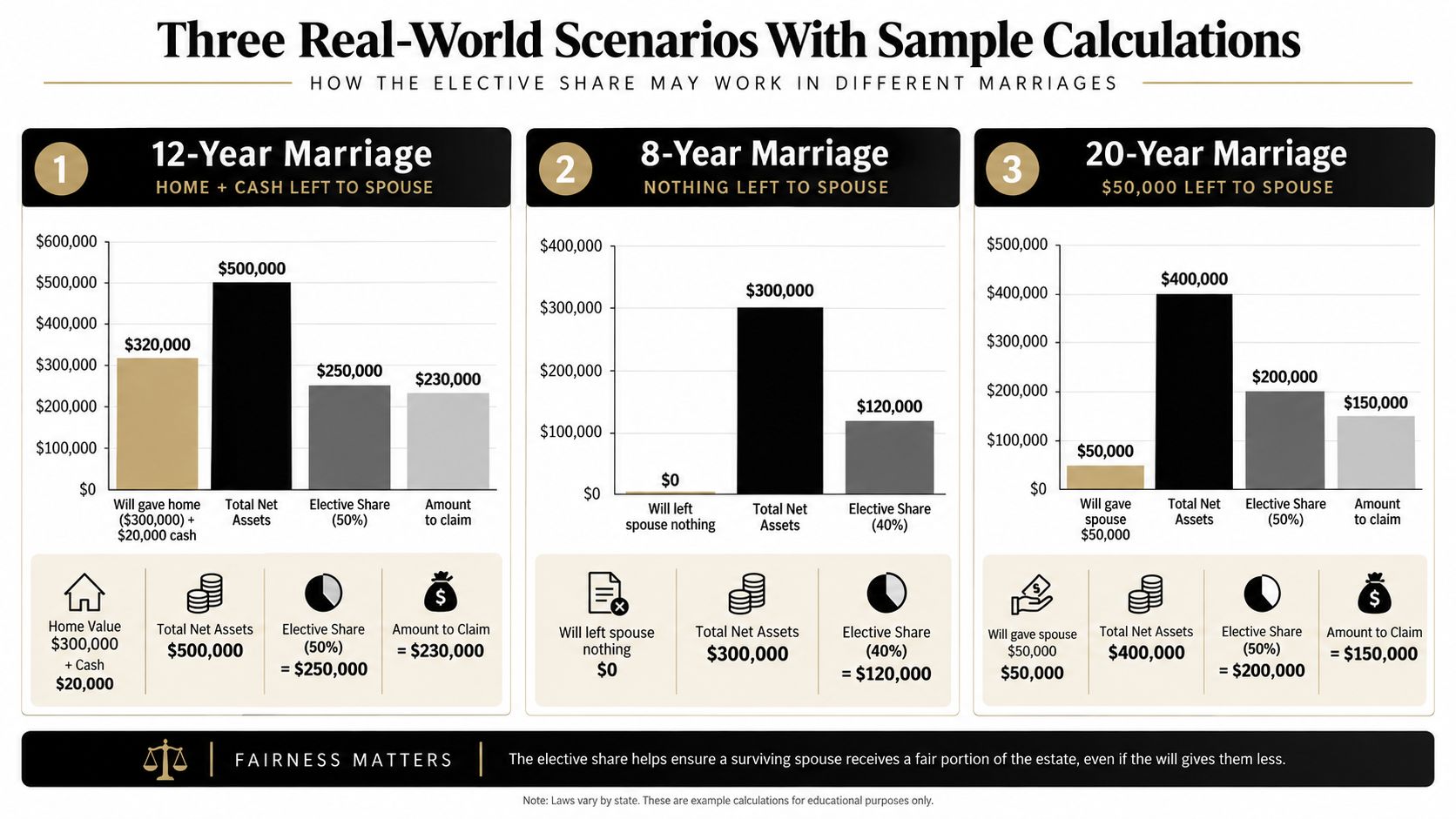
A worked example usually makes the rule click faster than a long statutory explanation. The numbers below are illustrations, not promises, and they use the same logic North Carolina uses in real probate disputes.
Scenario one, a 12-year marriage
A spouse was married for 12 years, so the applicable share is 33%. If the estate's total net assets are $500,000, the statutory share starts at $165,000. If the will already left the spouse the home valued at $300,000 plus $20,000 in cash, then the property already passing to the spouse exceeds the elective share amount.
The takeaway is simple. When the spouse already received more than the statutory minimum, there may be nothing left to claim through the elective share.
Scenario two, a 4-year marriage
A spouse was married for 4 years, so the applicable share is 15%. If total net assets are $300,000, the elective share starts at $45,000. If nonprobate life insurance already paid the spouse more than that amount, the claim can drop to zero after subtraction.
That surprises people because they focus on the will and ignore the beneficiary designation. Once the spouse has already received enough property that counts toward the share, the elective-share claim may not add anything.
Scenario three, a 20-year blended-family marriage
A spouse was married for 20 years, so the applicable share is 50%. If total net assets are $400,000, the elective share starts at $200,000. If the will or trust already gave the spouse $50,000, the elective-share claim would be reduced by that amount, subject to the full statutory accounting of what already passed.
The takeaway is that a long marriage does not automatically mean the spouse collects half of everything in cash. It means the statute starts at half of total net assets, then adjusts for property already received.
For families trying to understand related support issues, Child Support Above the NC Guidelines is a reminder that North Carolina law often changes the math once facts move outside the ordinary worksheet. Estate administration works the same way, the starting point is not always the ending point.
Common Exceptions That Can Shrink or Eliminate the Share
The elective share is powerful, but it is not automatic. A valid written waiver can reduce or eliminate the claim, and North Carolina law recognizes waiver mechanics that can be signed before marriage or through an attorney-in-fact with proper authority. The statute and the UNC School of Government both make clear that timing and enforceability matter. UNC's explanation of the elective share highlights the waiver and deadline issues that often get missed in basic summaries.
Where waivers and agreements come in
A properly drafted marital agreement can waive the elective share, and a premarital agreement can do the same if it's enforceable under North Carolina law. A spouse might sign away rights years earlier and still be bound, but only if the waiver was valid when made and still effective under the governing facts. That's why a waiver is not something to hand-wave past.
The same caution applies in divorce-related situations. If a divorce is pending or final, the spousal status that supports the elective share may be altered or gone. Trust planning can also change the practical result, especially where most of the value sits in a revocable trust rather than in assets passing through a will.
For readers comparing estate planning tools, Prenuptial Agreements in North Carolina is relevant because North Carolina enforces premarital agreements to protect assets when they're drafted and executed properly.
For the basics of passing property without a will, this firm's intestate succession overview is a helpful contrast point. Intestacy can set its own result, but it still doesn't make the elective share automatic.
Most asked question: Can a spouse sign away the elective share? North Carolina law allows waiver in writing, but the waiver has to be valid, enforceable, and tied to the actual facts of the marriage and estate.
Planning Strategies for Spouses and Estate Owners
If you're the surviving spouse, the first move is to gather the asset picture before the deadline runs. Ask about beneficiary designations, joint ownership, and trust-held property, because those items can change the final number fast. Then decide whether the goal is a negotiated settlement or a formal elective-share filing.
If you're the estate owner, planning works best before the crisis starts. Marital agreements, beneficiary designations, and trust structuring all affect how much property is likely to count toward the spouse's elective share. A pre-marital waiver may also matter in a second marriage, but only if it's valid under North Carolina law and consistent with the rest of the plan.
Some families can sort these issues with careful drafting. Others need help because the estate already opened and the clock is running. The Law Office of Bryan Fagan handles probate filings, blended-family planning, elective-share disputes, and related estate questions for North Carolina residents, which makes it one option when you need a real estate-planning and litigation lens on the same file. You can also review how to avoid probate in North Carolina if you're trying to understand how planning choices affect the eventual dispute.
Frequently Asked Questions From North Carolina Families
Does the elective share apply if spouses were separated but not divorced?
Usually, the starting point is whether the person was still a surviving spouse at death. Separation alone doesn't answer every question, because the facts around the marriage, any agreement, and any pending divorce can matter. If you're in that situation, the statute in Chapter 30 and the divorce record need to be checked together.
Can the elective share be claimed against a revocable trust?
A revocable trust can matter because the elective share looks at more than just the will. If the trust holds most of the value, the property may still affect the total net assets analysis or the amount already passing to the spouse. The exact treatment depends on how the trust assets and beneficiary interests are structured.
Can a spouse withdraw the election after filing it?
That depends on the procedural posture of the case and what the clerk or court has done with the filing. Once the petition is on file, you should assume the claim has legal consequences and get advice before trying to back out. A careless withdrawal can leave the spouse with no fallback if the estate position changes.
How does the elective share interact with a wrongful-death claim?
Those are different claims with different purposes. A wrongful-death claim belongs to the estate process for a different reason than the elective share, and the two should not be confused. If both exist in the same matter, the estate administration needs to be coordinated carefully.
If you're dealing with an elective-share dispute, a marital agreement, a blended-family estate plan, probate filings, or a contested will, a single conversation can clarify the deadlines and options before anything becomes irreversible. Schedule a consultation with the Law Office of Bryan Fagan to discuss your specific facts and get grounded North Carolina guidance for the next step.
If you're worried that a will, trust, or beneficiary designation has left you short, the Law Office of Bryan Fagan can help you sort out the elective-share deadline, the asset math, and the waiver questions before the window closes. Visit Law Office of Bryan Fagan to schedule a consultation and talk through your North Carolina estate situation with a real plan for the next step.