If you've just separated and the bills are still landing in your name, the fear is usually immediate. Rent, groceries, insurance, and the ordinary costs of daily life do not pause just because a marriage has changed. In North Carolina, postseparation support, often called PSS, exists for that exact gap, when one spouse needs temporary help before the court decides longer-term alimony or the parties reach a final divorce.
Many people search postseparation support eligibility nc because they are trying to answer one difficult question quickly, can I get help now? The answer depends on whether you fit North Carolina's definition of a dependent spouse, whether your resources are enough to meet your reasonable needs, and whether the other spouse has the ability to pay. That sounds technical, but the practical question is simple, can you keep the household running while the case is pending?
Clients often assume support starts only after the divorce is final. In North Carolina, the timing starts earlier. PSS serves as a temporary bridge after separation, and your date of separation and any pending alimony claim shape the analysis from the beginning.
Introduction When Separation Leaves You Financially Exposed
A recent separation can turn one household into two budgets overnight. Maybe your spouse handled most of the mortgage, or maybe you relied on one shared paycheck and now you are trying to cover a full month of bills on your own. PSS addresses immediate stability during the period between separation and final support rulings, because North Carolina law recognizes that a separated spouse may need help before the case is resolved.
North Carolina treats this as a temporary remedy, not a final decision about long-term support rights. The court can order support after separation and before divorce while a divorce, annulment, or alimony case is still moving through the system. The point is to keep one spouse from carrying the financial strain alone while the other controls more of the income.
Practical rule: PSS addresses immediate stability after separation while the court works through the support case. If your matter is headed toward alimony or absolute divorce, the support question starts now, not later.
That timing matters because people often confuse PSS with alimony. Alimony can last longer and depends on a separate final determination, while PSS is designed to keep the household functioning until the court decides the next step. If you are also sorting out child support, the financial picture can overlap with North Carolina Child Support Guidelines Explained, which uses the Worksheet system to calculate child support in a different part of the case.
A separation can also leave people feeling pressured to file the wrong thing first. If you are unsure whether you need temporary support, a divorce filing, or both, a consultation can help you protect the right claim before deadlines and court orders start shaping the case.
What Postseparation Support Means in North Carolina
A spouse may keep paying the mortgage, buy groceries, and still fall behind after separation. PSS exists for that moment. It is temporary support paid after separation but before divorce, and it helps cover the gap while the court sorts out the larger support issues.

The practical point is simple. PSS keeps cash flow from collapsing while a dependent spouse waits for the court to decide the support case. Under G.S. 50-16.2A, the order is tied to separation and to the status of an alimony claim, so it can end when the order says it ends, when alimony is awarded or denied, when the claim is dismissed, or when absolute divorce is entered if no alimony claim is pending. In plain English, the support lasts only while the legal issue is still open.
The date of separation matters because it marks the start of the temporary-support question. It also helps define which rights are still alive and which ones are already being resolved through the support claim. In that sense, PSS works like a financial holding pattern while the case is still in motion.
North Carolina family law treats PSS and alimony as related remedies, but they serve different jobs. PSS addresses the immediate cash-flow problem after separation, while alimony answers the longer-term support question. If you want to see how the final support analysis works, the discussion of alimony laws in North Carolina shows how the court approaches that separate issue.
People sometimes call PSS “temporary alimony,” and that shorthand can help at first. The risk is assuming the court applies one single rule to both remedies. The court still has to make a separate eligibility finding for PSS, and that is often where the case turns.
Who Qualifies for Postseparation Support Under NC Law
North Carolina does not let either spouse ask for PSS just because the household is strained. The requesting party has to be a dependent spouse, and that status is the heart of the eligibility analysis. If there's no dependency, there's no PSS, even if life feels expensive and stressful.
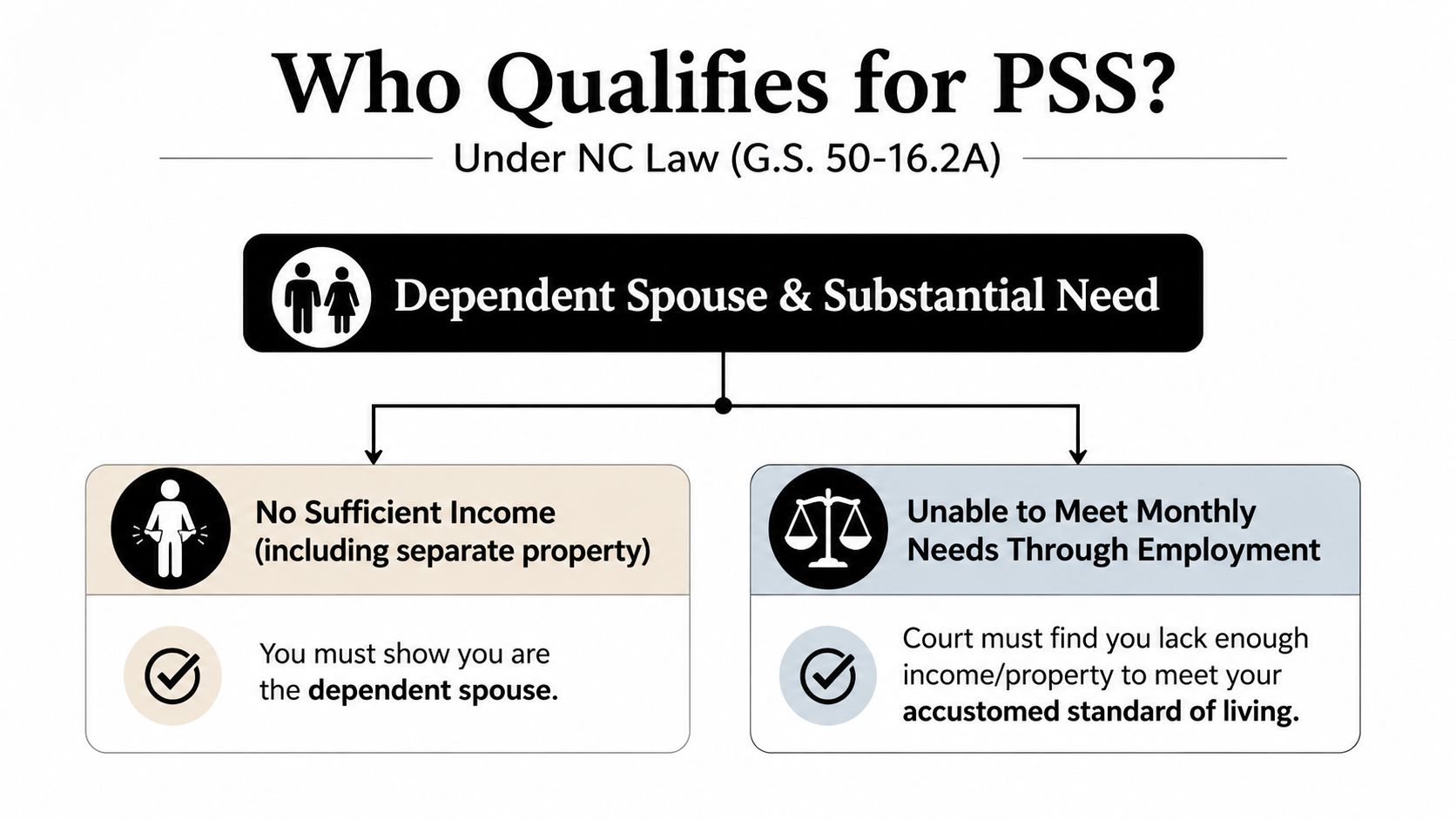
North Carolina's statute says the dependent spouse's resources must be inadequate to meet reasonable needs, and the supporting spouse must have the ability to pay. The court then looks at the parties' accustomed standard of living, current employment income, other recurring earnings, income-earning abilities, debt service obligations, necessary living expenses, and other legal support duties, all before deciding whether temporary support is justified.
The two-part test in plain English
The first question is whether the spouse asking for support needs it in the legal sense. Need is not just “I'm uncomfortable” or “my budget is tight.” The court looks at whether income, property, and other resources are enough to meet reasonable needs after separation.
The second question is whether the other spouse can pay. A person can have a job and still not have enough free cash flow to support two households, so the court examines more than a paycheck. That's why debts, recurring income, and other support obligations matter so much.
A North Carolina family-law lawyer will often use the term substantially dependent. Under practitioner materials, that means the spouse is substantially dependent on the other spouse for maintenance and support, or substantially in need of maintenance and support from that spouse. In other words, the law is focused on real economic dependence, not just a general sense that one side earned more during the marriage.
A spouse can be hardworking and still qualify if the numbers show a real gap between reasonable needs and available resources. A spouse can also earn income and still be unable to meet the court's standard for independence.
A common misunderstanding
One of the biggest mistakes people make is assuming any hardship equals eligibility. It doesn't. North Carolina uses a specific statutory test, and courts look at financial facts, not sympathy alone. That's also why proper separation matters, because the support claim has to fit the dependent-spouse and supporting-spouse relationship, not just a general argument that someone needs help.
If you're not sure whether your situation fits, separation requirements in NC are worth understanding before you file. The date and quality of the separation can affect whether your support request is even in the right posture.
How to File for Postseparation Support and What to Expect
Either party may move for PSS in a Chapter 50 case, but the request still has to be tied to separation and a support claim that belongs in the case. North Carolina bar materials explain that PSS can be ordered in an action for divorce, annulment, or alimony without divorce, which means the case does not have to wait for the final divorce judgment.
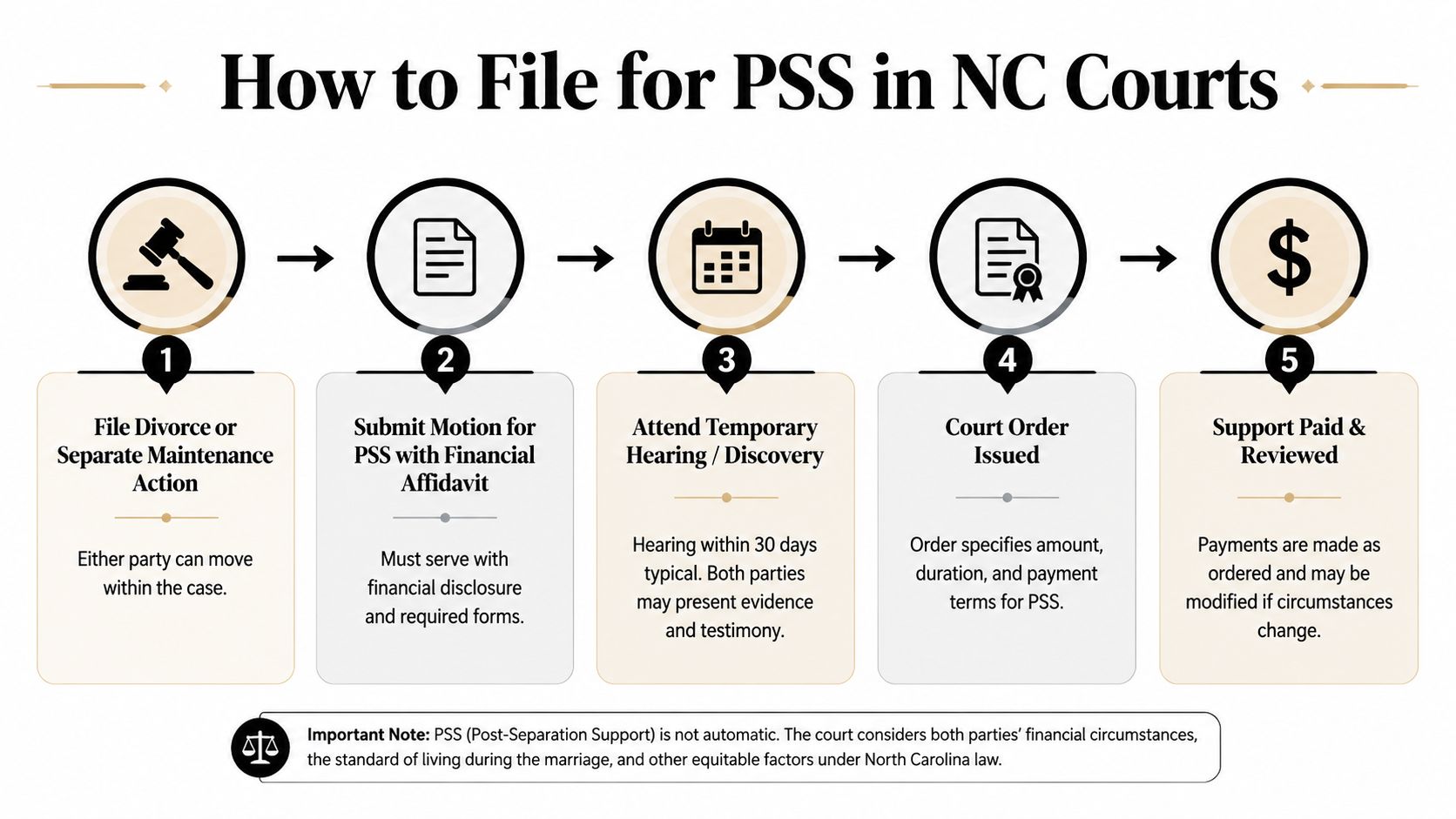
The process usually starts with a properly filed court action and a motion or request for temporary support. Financial disclosures matter because the judge needs enough information to compare need and ability to pay. That is why many lawyers gather tax returns, pay stubs, expense summaries, bank records, and proof of recurring obligations before the hearing.
What judges tend to look for
A judge wants a clean story supported by documents. If you're asking for support, you need to show what it costs to live, what money comes in, what bills go out, and why the gap is not temporary in the ordinary sense. If you're responding to a request, you want to show where the other side's numbers are off, overstated, or incomplete.
Practical rule: Temporary support hearings reward preparation. If the numbers are messy, the court has less to work with, and that can affect timing as well as outcome.
The hearing itself may move faster than the rest of the case, because PSS is a temporary remedy. Still, “temporary” does not mean casual. Judges expect organized evidence, a focused argument, and an understanding of how the support request fits into the broader divorce or alimony case.
Filing strategy matters
A lot of stress in these cases comes from timing mistakes. If you wait too long, you may be trying to catch up after financial pressure has already done damage. If you file too early without the right pleadings or evidence, you can slow the case down and create avoidable disputes.
A clear motion, good financial records, and a realistic hearing plan are usually better than a rushed filing. If you're trying to figure out the sequence, how to file for separation in NC can help frame the bigger procedural picture that surrounds a PSS request.
Real World Examples of Postseparation Support Decisions
A spouse who stayed home with the children for years will often have a very different PSS claim from a spouse who worked full-time during the marriage. The key question is whether the evidence shows legal dependency, unmet need, and the other spouse's ability to pay. In North Carolina, a dependent spouse must show actual substantial dependence, or substantial need, for maintenance and support.
One common scenario involves a spouse who worked part-time while the other spouse covered most household expenses. After separation, the dependent spouse has to pay for housing, insurance, and ordinary living costs on a single income. If the records show that available resources fall short of reasonable needs, PSS may be available while the alimony claim is pending. The court still looks closely at whether the requesting spouse is dependent in the legal sense, because that finding is what opens the door to temporary support.
Contrasting household examples
Another case can look much less clear. Two spouses may both earn income, keep separate accounts, and pay their own bills after separation. Even when one spouse earns more, the court may find that the lower-earning spouse can meet reasonable needs without temporary support if the household finances do not show the kind of dependency PSS requires.
Courts award PSS when the evidence shows dependency, unmet need, and ability to pay.
The result often turns on the record more than the emotion behind the request. County practice, judge discretion, and the quality of the financial proof can all shape the outcome, which is why one case may appear strong at the outset while another looks similar but does not hold up well in court.
PSS also operates as a temporary bridge tied to the alimony case. It is meant to help during the gap after separation while the court addresses whether alimony should be awarded, denied, or otherwise resolved under G.S. 50-16.2A. If the underlying alimony claim ends, the temporary support does too, which is part of what separates PSS from a final support order.
Building Your Case and Responding to Common Challenges
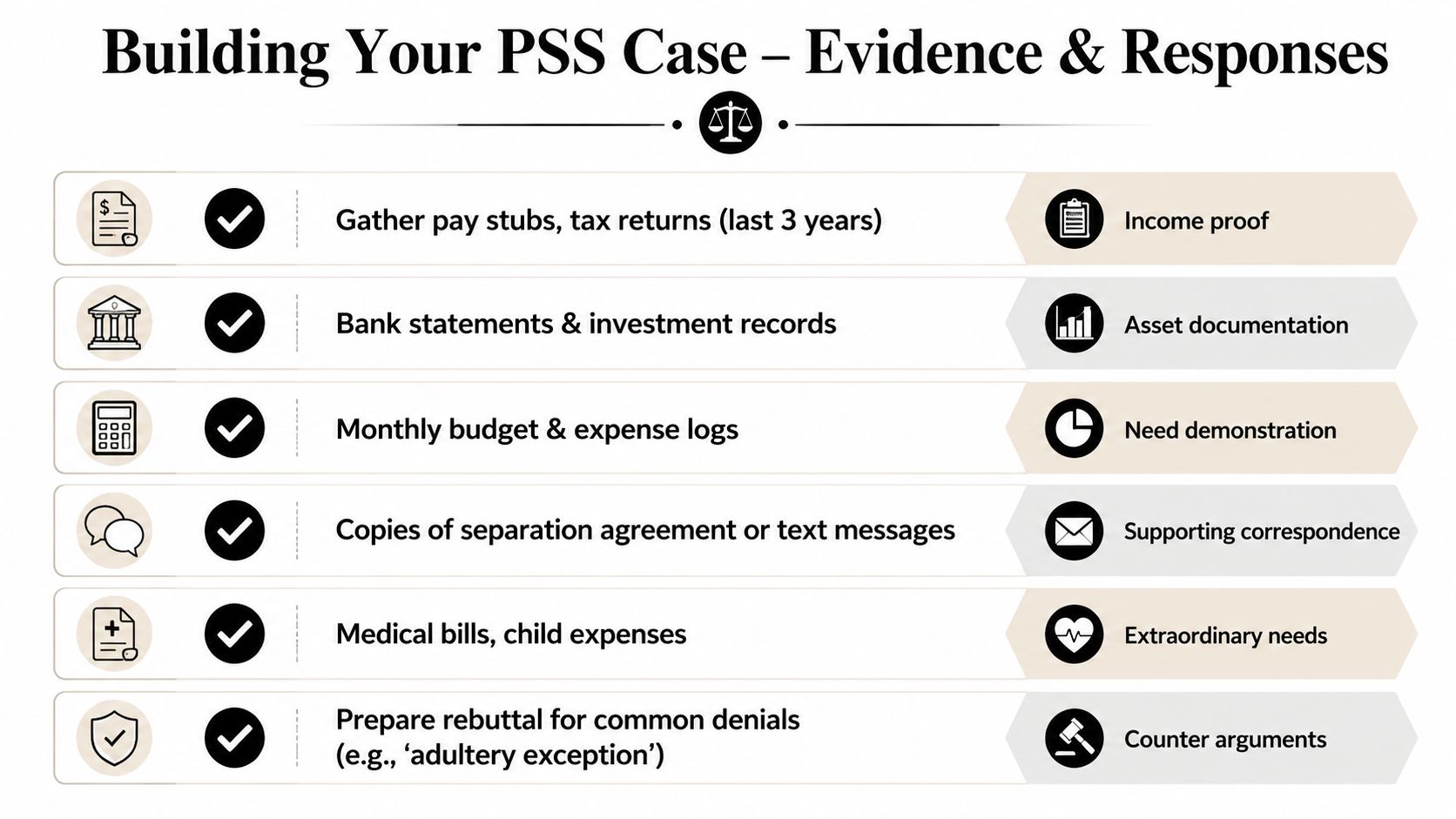
The strongest PSS files usually start with documents, not arguments. Pay stubs, tax returns, bank statements, monthly budgets, debt records, and proof of recurring expenses all help the court see the difference between actual need and bare assertions. If your living expenses have jumped because of separation, show it with the records, not just a summary.
What to gather before the hearing
A practical file often includes income proof, asset documentation, a monthly budget, correspondence showing the separation or support discussions, and records of unusual expenses. If children are involved, keep those records separate from the PSS proof so the support claim stays clean and focused. If a medical issue affects your ability to work or your monthly costs, document that clearly.
Common defenses and how they show up
The other side may argue that you're not dependent, that you have enough income or property to cover your needs, or that the paying spouse cannot afford the request. Those are not side issues, they go straight to the center of the case. The court also may consider whether there are other legal support duties already eating into income.
Some people worry about misconduct claims. Those can matter in North Carolina family-law disputes, but the financial proof still has to carry the day on PSS. Even strong emotion does not replace a credible budget and a believable earnings picture.
When support ends or changes
PSS is temporary by design in North Carolina, and it ends on the earliest of several events, including the date set in the order, an order awarding or denying alimony, dismissal of the alimony claim, or entry of an absolute-divorce judgment when no alimony claim is pending. That means a case can change quickly if the divorce posture changes or the alimony claim falls away.
If circumstances change, don't guess about the next step. The order, the pending claims, and the separation timeline all matter at the same time.
For families trying to stabilize finances while the case is open, the right response is usually to keep records current and stay alert to changes in income, employment, and court deadlines. If you need help thinking through the evidence or the defense side, the Law Office of Bryan Fagan is one option North Carolina residents can use for family-law guidance in a PSS dispute.
Take the Next Step Toward Financial Stability in North Carolina
PSS is not for every separated spouse, but when it fits, it can provide meaningful short-term relief. The key points are simple, PSS is temporary, it belongs to a dependent spouse, and eligibility turns on need and ability to pay under North Carolina law. Waiting until divorce is final can be a costly mistake if you need help now or need to preserve an alimony claim.
FAQ
How long does postseparation support last in North Carolina?
It lasts only until one of the termination events in the statute happens, such as the date in the order, an alimony ruling, dismissal of the alimony claim, or an absolute divorce when no alimony claim is pending.
Can either spouse ask for PSS?
A motion may be filed by either party in a Chapter 50 case, but only a spouse who qualifies as a dependent spouse can receive it.
Do I have to wait for divorce before asking for support?
No. PSS is designed to operate after separation and before divorce, which is why timing matters so much.
Does PSS require proof of marital misconduct?
Not as a basic eligibility point. The core question is dependency, need, and ability to pay.
What if I'm not sure whether I'm legally separated yet?
That question needs careful review, because separation is a threshold issue for PSS and for the related support claims that may follow.
If you're in North Carolina and trying to protect your finances after separation, don't wait until the pressure becomes unmanageable. A focused consultation can help you decide whether PSS belongs in your case, what evidence to gather, and how to avoid mistakes that can affect support later.
If you're dealing with separation and need help understanding PSS, the Law Office of Bryan Fagan can help you evaluate eligibility, organize financial proof, and plan the next filing step with your long-term stability in mind. Visit Law Office of Bryan Fagan to schedule a consultation and get clear guidance on your North Carolina family-law options.