If you're engaged and someone has raised the idea of a prenup, you're probably feeling two things at once. One is practical concern about money, property, family obligations, or a business you've built. The other is emotional discomfort. Many couples worry that bringing up a prenuptial agreement means planning for failure.
In North Carolina, that's not how a well-handled prenup works. A strong agreement usually does the opposite. It forces honest financial disclosure, clears up assumptions before marriage, and reduces the chance that confusion turns into conflict later. For some couples, that means protecting a family business. For others, it means deciding how debts will be handled, preserving an inheritance, or making sure one spouse isn't exposed to risks created by the other.
A North Carolina prenup is also part of a broader planning conversation. Couples who are thinking carefully about asset protection often look at related issues, including how to protect assets from creditors, ownership structure, and estate planning. The key is to approach the agreement early, calmly, and with complete transparency.
Planning Your Future with a North Carolina Prenup
Talking about a prenuptial agreement NC couples can use in real life is rarely easy. Still, awkward doesn't mean harmful. In my experience, the hardest part is usually the first conversation, not the legal drafting.
A useful way to frame the discussion is this: a prenup isn't a prediction about divorce. It's a written plan for handling financial issues that already exist. If one of you owns real estate, has substantial savings, expects an inheritance, has children from a prior relationship, or carries meaningful debt, those facts don't disappear because you're getting married.
Why couples ask for prenups
Some people assume prenups are only for the very wealthy. That's not accurate. They often make sense when one or both people want clarity about:
- Separate property: What each person owned before marriage
- Debt responsibility: Whether one spouse should remain solely responsible for certain loans or obligations
- Business ownership: How a company interest will be treated if the marriage ends
- Family wealth: Whether gifts or inheritances will stay separate
- Support expectations: Whether spousal support will be limited, modified, or waived within the limits of North Carolina law
A good prenup conversation sounds less like a fight and more like financial planning before a major life decision.
What works and what doesn't
What works is starting early, exchanging information fully, and letting each person have time to review the terms with their own lawyer.
What doesn't work is presenting a drafted agreement right before the wedding, minimizing important details, or treating the document like a one-sided loyalty test. Those choices create legal risk and personal resentment.
North Carolina law gives couples a clear framework. If you're considering a prenup, the goal isn't to make the document harsh. The goal is to make it informed, voluntary, and specific enough to hold up when it matters.
What Is a Prenuptial Agreement Under NC Law
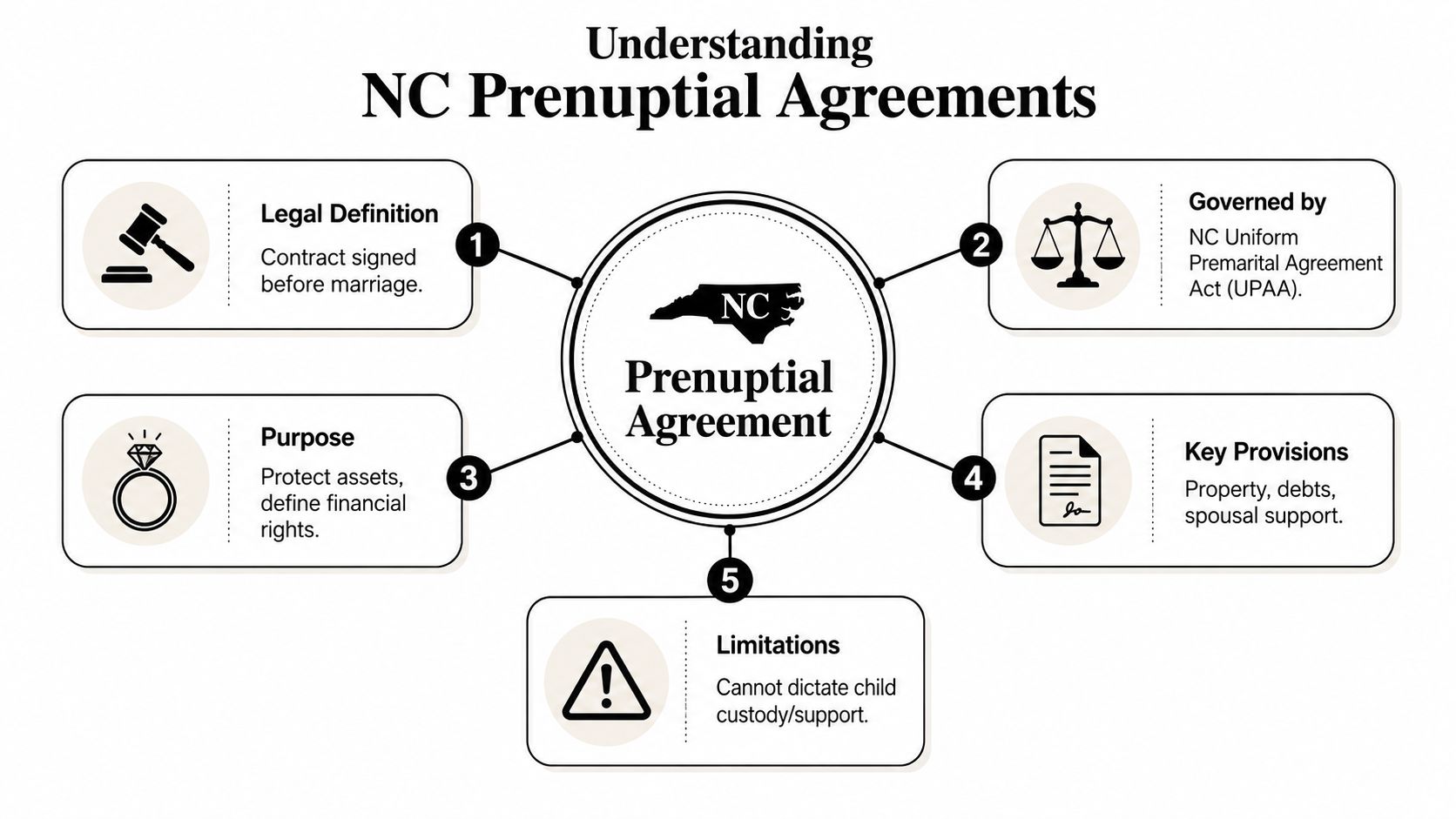
A prenuptial agreement is a contract signed before marriage that sets rules for certain financial rights and obligations if the marriage ends by separation, divorce, or death. In plain English, it's a private roadmap for handling issues that North Carolina law would otherwise decide through default rules.
Consider it a financial constitution for the marriage. It doesn't control everything, but it can establish the rules for major property and support issues before disagreements arise.
The North Carolina legal framework
In North Carolina, prenuptial agreements are governed by the Uniform Premarital Agreement Act, effective for agreements executed on or after July 1, 1987, under Chapter 52B. Under N.C. Gen. Stat. § 52B-4, an agreement can address property rights, spousal support, death benefits, and other lawful matters, but N.C. Gen. Stat. § 52B-4(b) prohibits any clause that adversely affects a child's right to support, as explained in this North Carolina discussion of prenuptial and postnuptial agreements.
That means the agreement can address many financial questions, including who keeps premarital assets and how some obligations will be handled. It can't take away the court's authority over child support.
Important limit: A North Carolina prenup cannot validly waive, limit, or predetermine child support. Courts keep authority over child support because that right belongs to the child, not the parents.
What a prenup can and can't do
A properly drafted prenup may cover:
- Property ownership and division
- Debt allocation
- Spousal support terms
- Death-related financial designations
- Choice of law provisions
- Other lawful financial terms that don't violate public policy
It cannot validly decide child custody or lock in child support terms in advance.
Many online summaries misrepresent prenups. They describe prenups as blanket protection documents. In reality, they're narrower and more technical than that. The better way to understand them is as enforceable financial agreements with firm legal boundaries.
For readers comparing options, Prenuptial Agreements in North Carolina gives a factual overview of how NC enforces premarital agreements to protect assets.
Making Your NC Prenup Legally Sound
A prenup can say all the right things and still fail if the process was flawed. In North Carolina, enforceability often turns less on whether the agreement feels generous and more on whether each person signed it knowingly, voluntarily, and with fair financial disclosure.

Voluntariness matters more than people expect
An NC prenuptial agreement isn't enforceable if a party proves they didn't sign voluntarily. It's also unenforceable if it was unconscionable when signed because the other party didn't provide fair and reasonable financial disclosure, there wasn't a written waiver of that disclosure, and the person lacked adequate knowledge of the other's finances, as discussed in the North Carolina Bar analysis on creating a watertight prenuptial agreement in North Carolina.
In practical terms, "voluntary" means more than just signing your name. A court will look at whether someone was pressured, misled, rushed, or denied a real chance to get advice.
Common problems include:
- Last-minute delivery: One person receives the agreement too close to the wedding
- Unequal information: Assets, debts, or income aren't disclosed clearly
- Emotional pressure: The message is sign now or the wedding is off
- No meaningful review: One party doesn't have enough time to understand what they're giving up
Unconscionable doesn't mean merely unfavorable
Clients often ask whether a prenup has to be "fair." North Carolina doesn't require perfect balance in the everyday sense people use that word. Courts focus on whether the agreement was made without deception and with adequate information.
That's an important distinction. A one-sided result doesn't automatically destroy a prenup. But a one-sided result combined with missing disclosures, hidden debts, or serious pressure can create a real enforceability problem.
Practical rule: If you want a prenup to survive scrutiny, treat the drafting process like a formal financial transaction. Full disclosure, enough time, and separate legal advice aren't optional in practice.
The safeguards that usually help
If I were advising a couple on what most improves enforceability, I would focus on process before wording. The strongest protections usually include:
Independent counsel for both parties
North Carolina law doesn't require each side to hire a separate lawyer, but it is strongly recommended. Separate counsel helps show that each person understood the agreement and had a fair chance to negotiate.Complete financial disclosure
Income, assets, liabilities, and major obligations should be disclosed clearly. Vague summaries invite future arguments.Thoughtful drafting
Boilerplate language often misses the key issues, such as business growth, inherited property, or debt tied to a closely held company.Time before the wedding
Signing under pressure is one of the easiest ways to create litigation risk later.
The takeaway is simple. A valid prenuptial agreement NC courts are more likely to enforce starts with a clean process. Drafting is only half the job. Execution matters just as much.
Common Clauses and Real-World Examples
Most North Carolina prenups cover the same broad subjects, but the value of the agreement comes from the details. Generic language often fails where real life gets messy. That is especially true when property changes during the marriage.
Property and debt clauses people actually need
A solid prenup often addresses whether certain assets will remain separate property, how new debts will be assigned, and whether either spouse will have a claim to appreciation in value of premarital property.
Here are common examples:
- A house owned before marriage: The agreement may state that the home remains one spouse's separate property, while also addressing what happens if marital funds later pay the mortgage or renovations.
- Student loans or business debt: A prenup can clarify whether one spouse remains solely responsible.
- Inheritance protection: If one spouse expects family wealth, the agreement can define how inherited assets should be treated.
- Spousal support clauses: The agreement may limit or waive support, subject to North Carolina's public policy limits.
The overlooked issue of asset appreciation
One of the biggest weak spots in many prenups involves growth in value of a premarital asset. Under North Carolina law, a critical nuance is that premarital assets that increase in value due to marital effort can be reclassified. Without explicit clauses separating appreciation caused by marital labor from passive market growth, active spousal involvement can convert otherwise separate property into marital property, a point noted in this discussion of North Carolina prenuptial agreements.
That sounds abstract until you put it into a real scenario.
Suppose one spouse owns a small construction company before marriage. After the wedding, the other spouse leaves a separate career and starts handling payroll, hiring, scheduling, and client communications. Over time, the company becomes much more valuable.
If the prenup only says, "The business remains separate property," that may not fully answer the hard question. Why did the business grow? If the increase came in part from marital labor, management, or active participation by either spouse during the marriage, the appreciation may become a dispute under equitable distribution principles. For readers who want background on that system, this overview of equitable distribution in North Carolina is useful.
The most expensive prenup mistakes usually aren't dramatic. They're omissions. A missing clause about business growth can matter more than a page of standard definitions.
What better drafting looks like
A more careful prenup may distinguish between:
| Issue | Better question to answer |
|---|---|
| Business ownership | Who owns the business itself |
| Business appreciation | Whether growth stays separate or becomes partly marital |
| Marital labor | Whether work by either spouse creates a reimbursement or ownership claim |
| Passive gains | Whether market-driven appreciation stays separate |
Experienced drafting matters. The agreement should identify the asset, define how future increases will be treated, and address whether marital contributions create any offset, reimbursement, or shared interest. If that point is ignored, the prenup may protect the original asset but still leave a major fight over the value created during the marriage.
The Step-by-Step Process Costs and Timeline
The prenup process is manageable when couples start early and follow a clear sequence. Problems usually come from delay, not complexity.
A realistic workflow includes discussion, disclosure, drafting, review, revision, and final execution. The exact pace depends on the issues involved, including whether there is a business, real estate, or support language that needs negotiation.
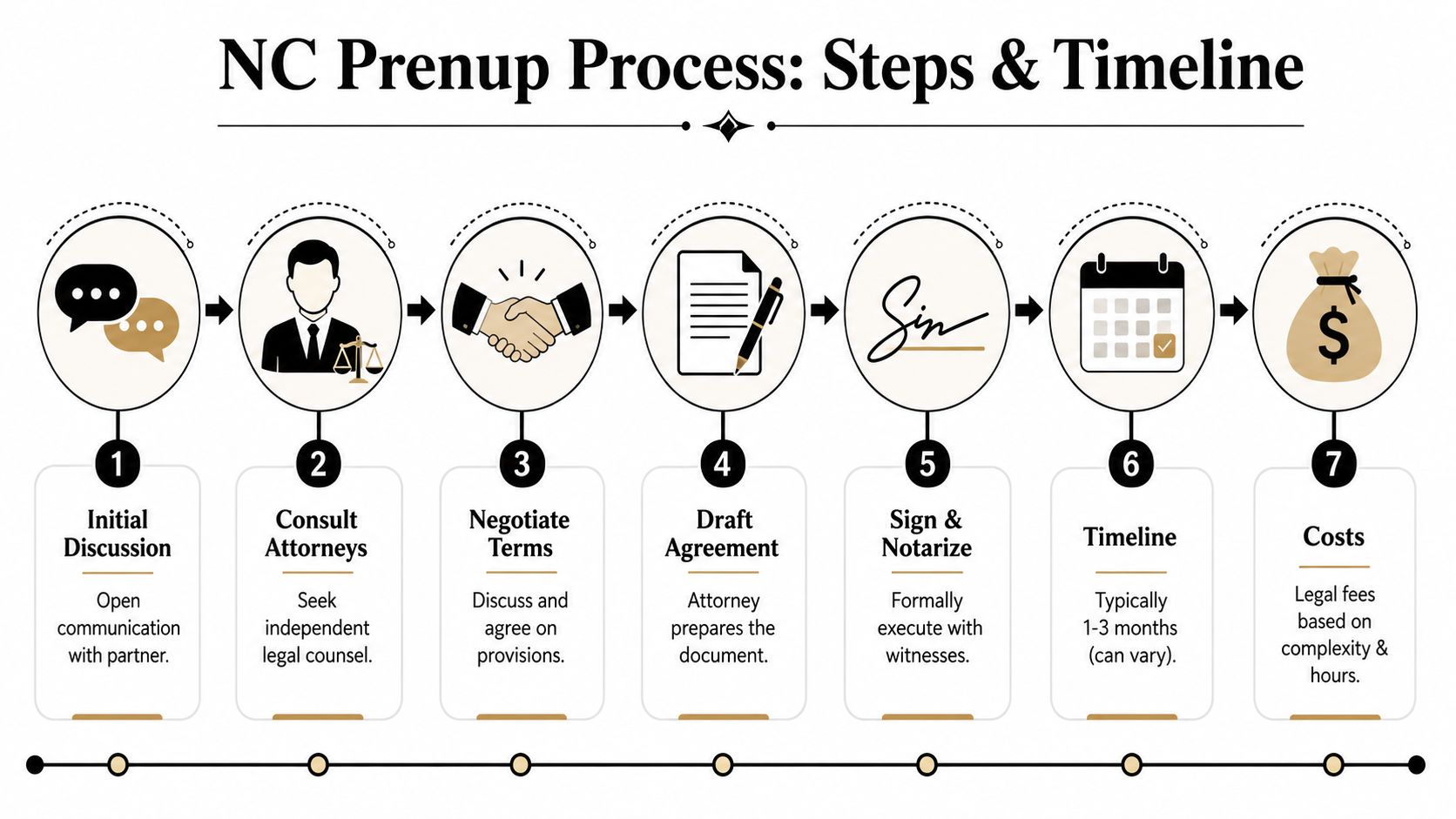
A practical sequence that tends to work
Start with the personal conversation
One person raises the issue, but both should discuss the reason for it. If the goal is asset protection, debt separation, or family planning, say that directly.Each person speaks with a lawyer
Separate counsel helps avoid later claims that one person didn't understand the agreement or had no meaningful advice.Exchange financial information
This usually includes income, major assets, debts, business interests, and expected inheritances if they affect negotiations.Draft and negotiate specific terms
Broad goals become real contract language. Vague intentions don't help much.Leave room for review before signing
Time matters. Rushed execution creates avoidable problems.
A short video overview can help if you're still deciding whether this process fits your situation.
Costs and timing in North Carolina
The average cost to draft a prenup in North Carolina can range from $760 for a standard agreement to over $3,000 for complex cases, and legal guidance also strongly advises finalizing the agreement at least 30 days before the wedding to reduce claims of undue influence, according to this North Carolina cost guide on what to include in a prenup.
That range makes sense in practice. A straightforward agreement for a couple with limited assets may be relatively contained. Costs rise when there are businesses, significant investment accounts, family money, unusual debt issues, or extensive revision rounds.
A related question many couples ask is whether separate legal representation is worth the expense. In most cases, yes. Paying for two lawyers up front is often cheaper than litigating whether the agreement is enforceable later. If you're also comparing broader family law expenses, this guide to North Carolina divorce cost helps put the trade-off in perspective.
Sign early enough that neither person feels cornered. A prenup should look deliberate on paper because it was deliberate in real life.
Prenuptial vs Postnuptial Agreements in NC
A prenuptial agreement is signed before marriage. A postnuptial agreement is signed after marriage. That timing difference sounds simple, but it changes how the agreement is evaluated and when couples tend to need one.
Some couples start engaged and run out of time to finish a prenup correctly. Others marry young, acquire assets later, and then realize they want a written agreement once a business grows or financial circumstances become more complicated.
When each one fits
A prenup usually fits best when the concern already exists before marriage. Examples include premarital real estate, a family business, expected inheritance issues, or debt one party wants to keep separate.
A postnup often comes up after a major life shift, such as one spouse leaving work to support the other's business, receiving family money, or revisiting support expectations after income changes.
Prenuptial vs. Postnuptial Agreement in North Carolina
| Feature | Prenuptial Agreement | Postnuptial Agreement |
|---|---|---|
| Timing | Signed before marriage | Signed after marriage |
| Main use | Plans for existing premarital concerns | Addresses issues that arise during marriage |
| Typical trigger | Protecting assets or clarifying obligations before the wedding | Financial changes, business growth, inheritance, or revised expectations |
| Court focus | Voluntariness, disclosure, lawful terms | Similar concerns, often with close attention to fairness and process in the marital context |
| Amendment issues | Can be changed later only by proper written agreement | Any revocation or amendment must also be in signed writing |
One practical point matters here. A prenup doesn't become valid unless the marriage happens. If no marriage occurs, the agreement is void. After marriage, any amendment or revocation has to be in writing and signed by both spouses to be enforceable. That written-form requirement is one reason couples should avoid informal side agreements and email understandings about major financial rights.
NC Prenup FAQs and Your Next Steps
Can a prenup in North Carolina be changed after we're married
Yes. North Carolina allows amendment or revocation after marriage, but any change must be in a signed writing to be enforceable. Casual oral agreements won't do. North Carolina law also allows parties to modify spousal support in a prenup, but a court may override that provision if enforcing it would make a spouse eligible for public assistance, as explained in this discussion of North Carolina prenuptial agreements and spousal support limits.
Can a prenup decide child support or custody
No. Those issues stay with the court. A parent can't use a prenup to take away a child's right to support or predetermine custody outcomes.
What happens if we don't have a prenup
Without one, North Carolina law supplies the default rules for property and support issues. That doesn't mean disaster, but it does mean you may leave important decisions to future negotiation or litigation instead of deciding them now.
Do both people need their own lawyer
It's not strictly required for every agreement, but it's one of the best safeguards available. Separate lawyers help show that each person had advice, time, and a real opportunity to negotiate.
If you're considering a prenuptial agreement NC residents can rely on, the right next step is a private legal consultation focused on your facts. The questions that matter most are rarely generic. They involve your property, your debts, your family, and the life you're building.
If you're considering a prenup, separation agreement, divorce, or another family law issue in North Carolina, Law Office of Bryan Fagan can help you evaluate your options and understand what North Carolina law allows. Schedule a consultation to discuss your circumstances, your goals, and whether a prenuptial agreement makes sense for you before the wedding date creates unnecessary pressure.