A lot of North Carolina families reach the same point in a remarriage. The child already calls the stepparent “Dad” or “Mom,” the school form is already signed by both adults, and the only thing missing feels like a final piece of paper. Then someone asks the question that changes the conversation: what makes it legal in North Carolina.
That is where stepparent adoption NC stops being a family milestone and starts being a court process. The law gives blended families a clear path, but it also draws hard lines around marriage, residency, consent, and the rights of the other parent. In other words, this is usually doable, but it is not a casual formality.
Where Most North Carolina Families Start
A couple usually comes in thinking the adoption is just paperwork. They have been married for years, the child has lived in the home, and the stepparent has done everything a parent does, from school pickup to bedtime routines. Then they learn that North Carolina treats the legal parent-child relationship as something the court has to change through a formal process, not by family agreement alone, as reflected in the state's adoption framework described in North Carolina adoption laws.
The emotional part is easy to understand. The legal part is where people get surprised. North Carolina's stepparent-adoption statute is built around written consent and specific legal consequences, including the fact that the adoption keeps one parental line intact while ending the child's legal tie to the other parent under the statute's consent framework in Chapter 48, Article 4. That means the adoption is not just about adding a parent, it is also about legally replacing one.
Practical rule: if the family is already functioning like a parent-child unit, the court still wants the file to prove it in the way the statute requires.
That is why these cases show up years into a remarriage. The family is already living the reality, but the courthouse does not recognize that reality until the petition, consents, notice, and final decree line up. A quiet stepchild adoption can feel simple from the living room, yet still stall because one document is missing or one parent cannot be located.
For many clients, the primary question is not whether they love the child. It is whether they are ready for the legal trade-offs that come with adoption, especially the termination of the other parent's rights and the inheritance consequences tied to that change. This guide is built for that moment, the point where a loving blended family needs plain answers about what works, what doesn't, and where North Carolina law draws the line.
Who Qualifies for a Stepparent Adoption in NC
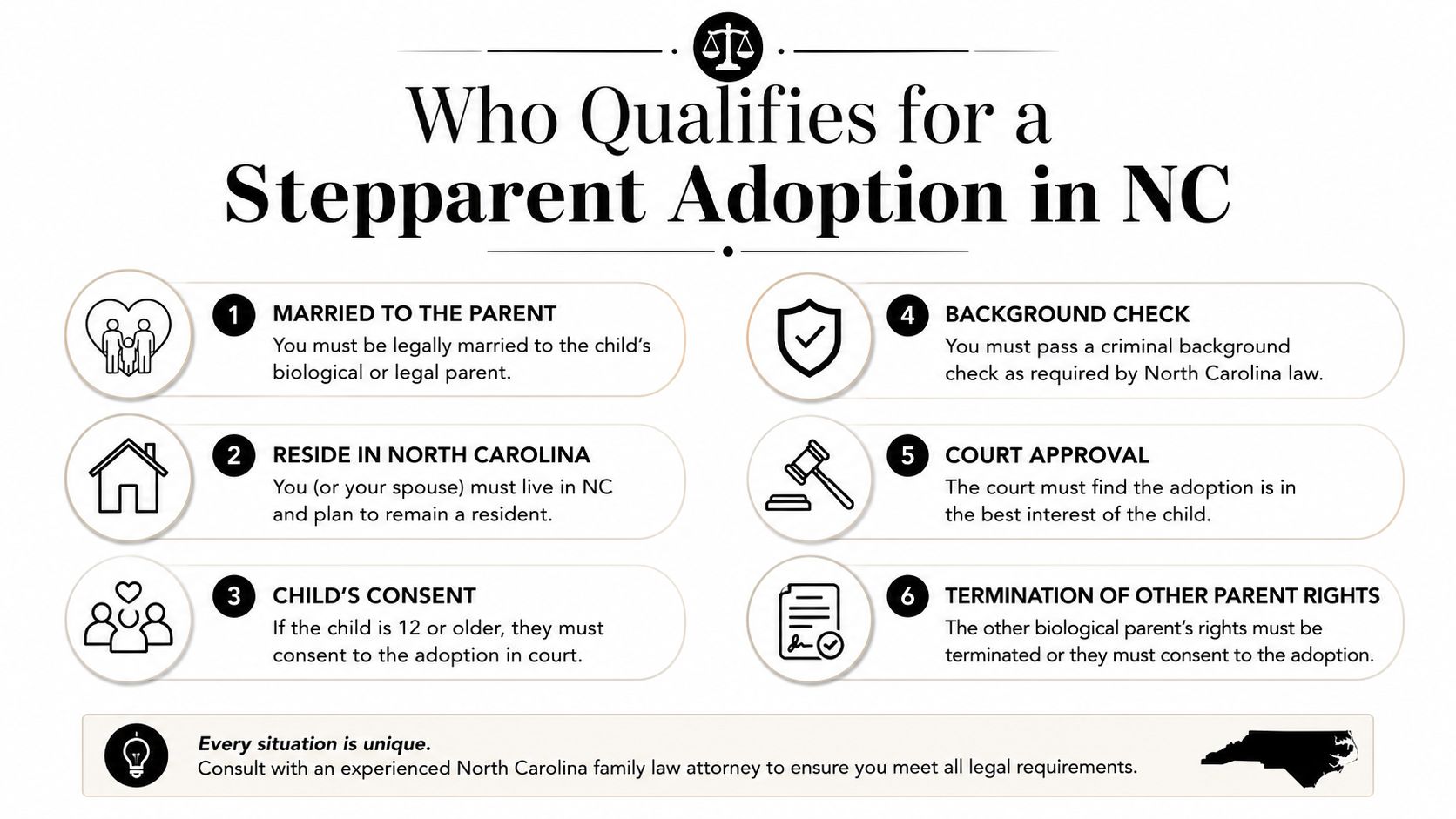
North Carolina's eligibility rules are narrower than a lot of families expect. The stepparent must be legally married to the child's parent, and the child must have lived primarily with that married couple for the statutory period before filing. Under North Carolina General Statutes § 48-4-101, that means the child generally must have lived primarily with the spouse-parent and stepparent during the six months immediately before filing the petition, which is confirmed in practitioner guidance on stepparent adoption in North Carolina.
Marriage and residency come first
A couple who moved in together last year and never married usually cannot use the stepparent-adoption route yet. North Carolina ties this process to a legal marriage, not a long-term relationship or shared household alone. The reason is straightforward, the court is changing legal parentage, so the adult relationship at the center of the petition has to be legally recognized first.
The residency piece matters just as much. Families often think the clock starts when the stepparent became active in the child's life, but the statute focuses on the child's primary living arrangement during the six months before filing. If the child splits time between homes or only recently moved in, that can change the filing date.
The child's age and consent can matter
Children age 12 or older must provide written consent in many North Carolina stepparent-adoption cases, and the court guidance also notes a mandatory 90-day waiting period before the final decree can be issued. That means an older child isn't just a passive subject of the case. Their written agreement becomes part of the file, and the final order can't be rushed past the statutory waiting period.
A common example is a married couple with a 13-year-old who has lived with them for years. That family may be eligible on paper, but the child still has to sign the required consent, and the case still has to move through the waiting period. A different family, with a 10-year-old who has only lived in the home for four months, may need to wait.
For families trying to understand the downstream effects of adoption on support, custody, and the court worksheets that may already exist in their case history, North Carolina Child Support Guidelines Explained is useful background because it shows how North Carolina uses the Worksheet system in support calculations.
The biggest mistake is assuming cohabitation alone is enough. North Carolina wants the marriage, the residency window, and the supporting documents all in the same file.
Building the Paperwork Packet North Carolina Courts Expect

The filing packet is where otherwise strong cases lose time. A clerk is not looking for a family story, they are looking for forms, certified records, and proof that each legal condition has been met. The packet usually needs the child's birth certificate, the marriage certificate, any prior divorce decrees, and any existing custody or support orders that explain who has legal authority today.
What the clerk is really checking
Each document does a different job. The marriage certificate proves the qualifying relationship. The birth certificate identifies the child and the legal parents already on record. Divorce decrees and custody orders show whether anyone else has rights that the adoption will affect, which matters because the adoption changes legal relationships, not just household routines.
In a smooth case, a family can gather the certified records in one weekend, especially if older orders are easy to find. In a messier file, one missing certified decree can stop everything while someone tracks down the court file from a prior county. That delay is common because clerks generally need the actual certified record, not a screenshot or a family copy.
Why stepparent cases are different from other adoptions
A stepparent adoption usually moves through a narrower set of issues than a stranger adoption, but that doesn't make the paperwork lighter. The court still wants to see the legal foundation for the adoption and the documents showing who must consent, who must be notified, and what prior orders may need to be addressed. Local practice can still affect how that packet is screened, which is why two families with similar facts may get different questions from different clerks.
Practical rule: if a document could answer a question about marital status, custody, or another parent's rights, bring the certified copy. If it exists in the court system, assume someone may ask for it.
The administrative part is often the slowest part, not the hearing. Families that prepare the packet carefully usually save themselves from avoidable back-and-forth with the clerk, and that matters when everyone is trying to plan around school, work, and travel.
Consent, Termination, and When the Other Parent Is Missing
North Carolina's consent rule is the part that many believe they understand, until they read the statute closely. The consent signed by the parent married to the stepparent must be in writing, notarized, and state that the parent has legal and physical custody of the child while voluntarily consenting to the adoption, under the state's adoption statute in Chapter 48, Article 4. That same consent also has to explain the legal effect of the adoption, including that it does not end the legal parent-child relationship between the consenting parent and the child, but it does terminate the child's legal relationship with the other parent.
That termination is broad. It cuts off inheritance rights through the other parent and ends any existing custody, visitation, or communication order tied to that parent. In plain English, the adoption preserves one parental line and replaces the other, which is why this process feels so final.
When consent is easy, and when it isn't
A cooperative noncustodial parent can sign the necessary consent and the case can stay relatively straightforward. The file still has to be complete, but the legal fight usually stays small. In that version of the case, the hardest part is often paperwork and scheduling, not contested litigation.
The harder scenario is the one many families search for, when the other parent is absent, unreachable, or refuses. North Carolina-facing guidance notes that the core issue is often not the adoption petition itself, but the separate problem of terminating parental rights or proving service when the parent cannot be found. That is where a straightforward family-law matter becomes an evidentiary one, because the court needs proof that the legal parent was notified or that termination grounds exist before the adoption can move ahead.
The missing-parent problem changes the case shape
A parent who disappeared years ago can still hold legal rights if those rights were never terminated. That means the family may need service by publication or a separate termination-of-parental-rights proceeding first, depending on the facts. A refusal to sign is not the same thing as a right to ignore the case, and a missing parent is not the same thing as a legally erased one.
For families dealing with the termination side of the process, How to Terminate Parental Rights in NC is a practical starting point because the adoption often depends on that earlier step. North Carolina court guidance also says an attorney is not required to start or finalize an adoption, but that does not make the missing-parent path simple.
The hardest cases usually fail on proof, not intention. If the other parent is gone or refusing, the court cares about notice, records, and legal grounds.
Contested Versus Uncontested Adoptions in North Carolina
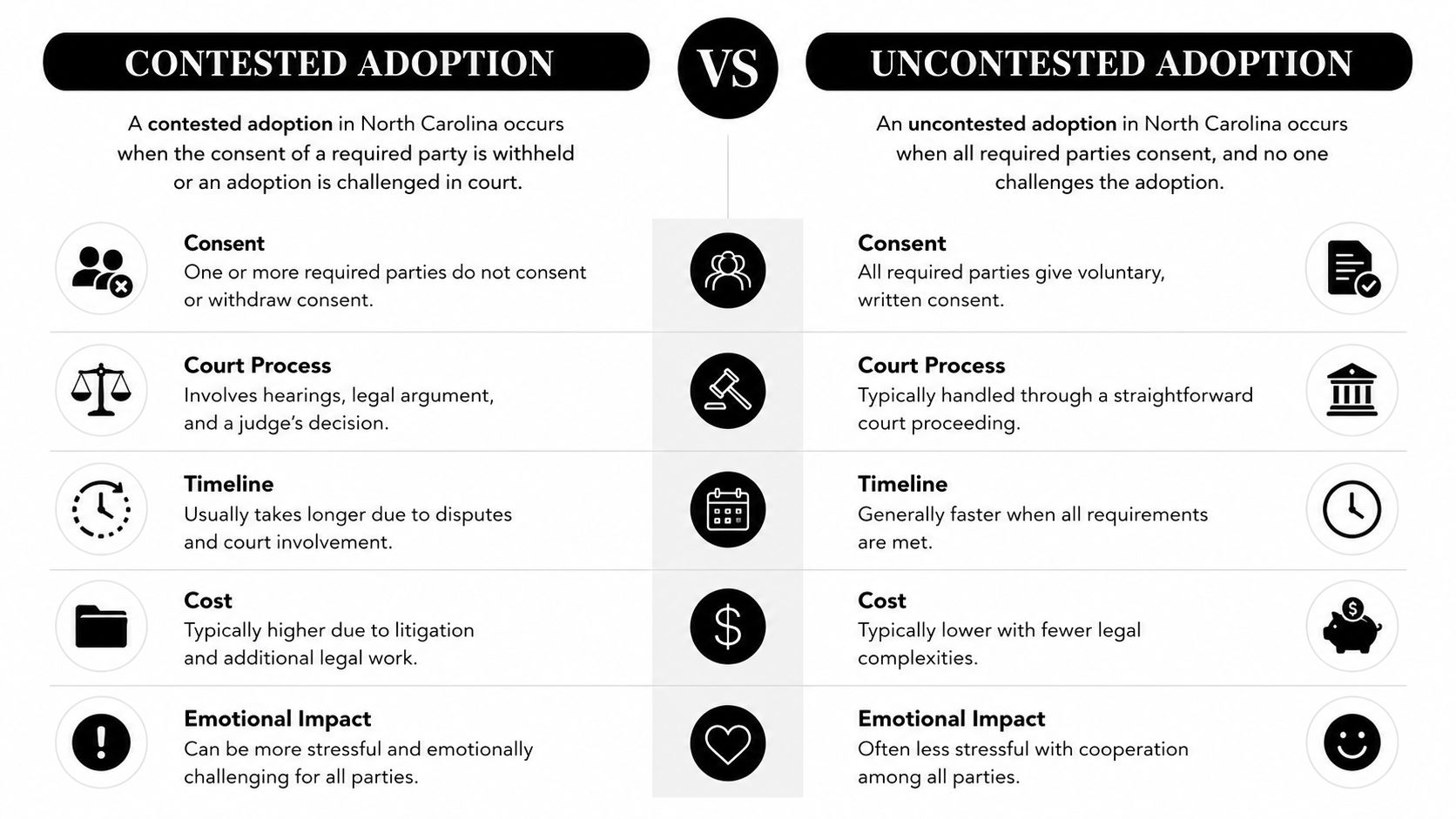
The words “stepparent adoption” can hide two very different courtroom experiences. An uncontested case usually means the adults agree, the packet is clean, and the clerk and court can move through the statutory steps without a fight. A contested case means someone objects, cannot be found, or has to be brought in through a separate legal process before the adoption can happen.
What the uncontested path looks like
In an uncontested matter, the family usually submits a complete packet, the required consents are signed, and the case waits out the mandatory timing rules before the hearing and final decree. The court still reviews the file, but there is usually less drama and fewer evidentiary issues. In practice, this is the version most marketing content talks about because it is easier to explain and easier to sell.
What changes when the case is contested
A contested case is not just “slower.” It shifts from paperwork to proof. Service has to be handled properly, the other parent may challenge what happened, and the court may need to decide whether the legal prerequisites have been met before any adoption decree can be entered. That can put the family into a separate termination or notice dispute before the adoption itself is even ready.
Local practice matters here too. Some counties move efficiently once the packet is complete, while others are more exacting about background checks, document screening, or follow-up paperwork. That is why two families with nearly identical facts can still have different experiences at the clerk's office.
The difference is not emotional, it's procedural. One path assumes cooperation and a complete record. The other path assumes conflict, missing proof, or both.
Typical Timelines, Fees, and What to Expect at the Hearing
North Carolina court guidance notes a mandatory 90-day waiting period before a final decree can be issued in adoption cases, and that waiting period shapes the whole calendar. A family with signed consents and a complete file still needs to plan around that statutory delay. If the child is age 12 or older, the written consent step has to happen too, which can affect when the petition is ready to move.
Stepparent Adoption Timelines and Cost Components in NC
| Phase | Typical Timeframe | Common Cost Items |
|---|---|---|
| Document gathering | Before filing | Certified birth certificate, marriage certificate, prior orders |
| Filing and clerk review | After the packet is submitted | Court filing fee, copying, certified record fees |
| Notice and consent process | Depends on the case | Service costs if notice is required |
| Waiting period | At least 90 days before final decree | Usually no separate court charge, but the case cannot be rushed |
| Hearing and decree | After the file is ready | Attorney fees if counsel is hired |
The cost side is usually driven by the file, not by the judge. Certified records, service, and any extra notice steps add expense. Cases that need service by publication or separate termination work usually cost more in time and paperwork than a clean uncontested case.
At the hearing, the judge or clerk wants to know the basics are satisfied, the consents are valid, and the adoption fits North Carolina law. The family should expect a short, formal proceeding, not a long trial in an uncontested matter. Older children can feel nervous about the formality, so it helps to explain that the hearing is about confirming the legal step, not testing whether the stepparent has earned the role.
A smooth hearing usually starts with a clean file. If the packet is missing a certified order or a required consent, the hearing is not the place to fix it.
Next Steps for North Carolina Families
A good stepparent adoption file in North Carolina usually comes down to four things, eligibility, documents, consent, and timing. If the family is married, the child has lived primarily in the home for the required period, the records are in order, and the other parent's rights have been dealt with correctly, the case is much easier to move. If any one of those pieces is weak, the path can change fast.
A simple checklist to use today
- Confirm the marriage and residency facts. Make sure the six-month window is satisfied before filing.
- Gather certified records. Birth certificate, marriage certificate, prior divorce decrees, custody orders, and support orders all belong in the file if they exist.
- Check the other parent's status. If consent is missing, the case may need termination or service work first.
- Ask about local county practice. Clerk screening and document expectations can differ from county to county.
- Plan for the hearing and waiting period. Even clean cases have a statutory timeline.
If the process involves an absent parent, a contested objection, or a confusing custody history, it helps to get advice before the petition goes in. For broader family-law planning in North Carolina, Guardianship of a Minor in NC can also be useful background because it shows how the court thinks about legal responsibility for children in related but different situations.
A lawyer is not required in every adoption case, but professional review often matters when the file has an old order, a missing parent, or county-specific questions. That kind of review can keep a family from filing the wrong packet and waiting months to learn it needs to be redone.
Law Office of Bryan Fagan helps North Carolina families sort out stepparent adoption issues, including eligibility, consent problems, and the court paperwork that can slow a case down. If you're ready to see what your county may require and whether your family is in the filing window, visit Law Office of Bryan Fagan to schedule a consultation.