When a marriage is ending, individuals aren't worried about legal labels first. They're worried about the house, the retirement account, the car loan, the credit cards, and whether years of financial effort will be divided fairly. In North Carolina, those concerns fall under one system: equitable distribution.
That phrase sounds simple. It isn't. Many people assume equitable distribution in NC means a strict half-and-half split. It doesn't. North Carolina isn't a community property state. Instead, the court sorts property, values it, and then decides what division is fair under North Carolina law.
A couple may have lived in one home for years, built savings in one spouse's name, and carried debt on the other's cards. On paper, that can look uneven. Under the law, title alone often doesn't control the outcome. That's why people are often surprised to learn that the main fight isn't only about who owns something. It's about how the asset is classified, when it's valued, and whether there is a good reason to move away from an equal split.
Navigating Property Division in Your North Carolina Divorce
A common situation looks like this. One spouse stays in the house after separation and keeps paying the mortgage. The other moves out and worries that they've lost their claim to the home's value. Meanwhile, both spouses are looking at retirement accounts, vehicle loans, bank accounts, and household debts, trying to guess what a judge would do.
That guessing usually creates more stress than clarity.
In North Carolina, property division during divorce is handled through equitable distribution under N.C. Gen. Stat. § 50-20 and related statutes. The court does not exclusively ask whose name is on the deed or account. It asks what property is marital, what property is separate, what property is divisible, what each item was worth, and whether an equal split would prove fair.
Equitable doesn't mean automatic equality. It means the court starts from equality and then examines fairness under North Carolina's statutory rules.
That distinction matters. Addressing equitable distribution NC issues demands more than a generic divorce article. It calls for a North Carolina-specific explanation of how courts classify assets, how debts fit into the picture, and why recent changes in the economy have made valuation disputes more complicated than many older guides suggest.
What people often get wrong
Several misconceptions come up early:
- "If it's in my spouse's name, it's theirs." Not necessarily. Title and classification are different issues.
- "My inheritance is always protected." It may be, but only if it stayed separate.
- "The court always does 50/50." That's the starting point, not the guaranteed result.
- "The value today is all that matters." In many cases, the date of separation becomes a critical dividing line.
What actually helps
The people who protect themselves best usually do three things early:
- Gather records before documents disappear or accounts change.
- Identify the date of separation clearly because it affects classification and valuation.
- Get legal advice before making major financial moves like refinancing, selling, transferring funds, or cashing out accounts.
Understanding the Three Types of Property in NC
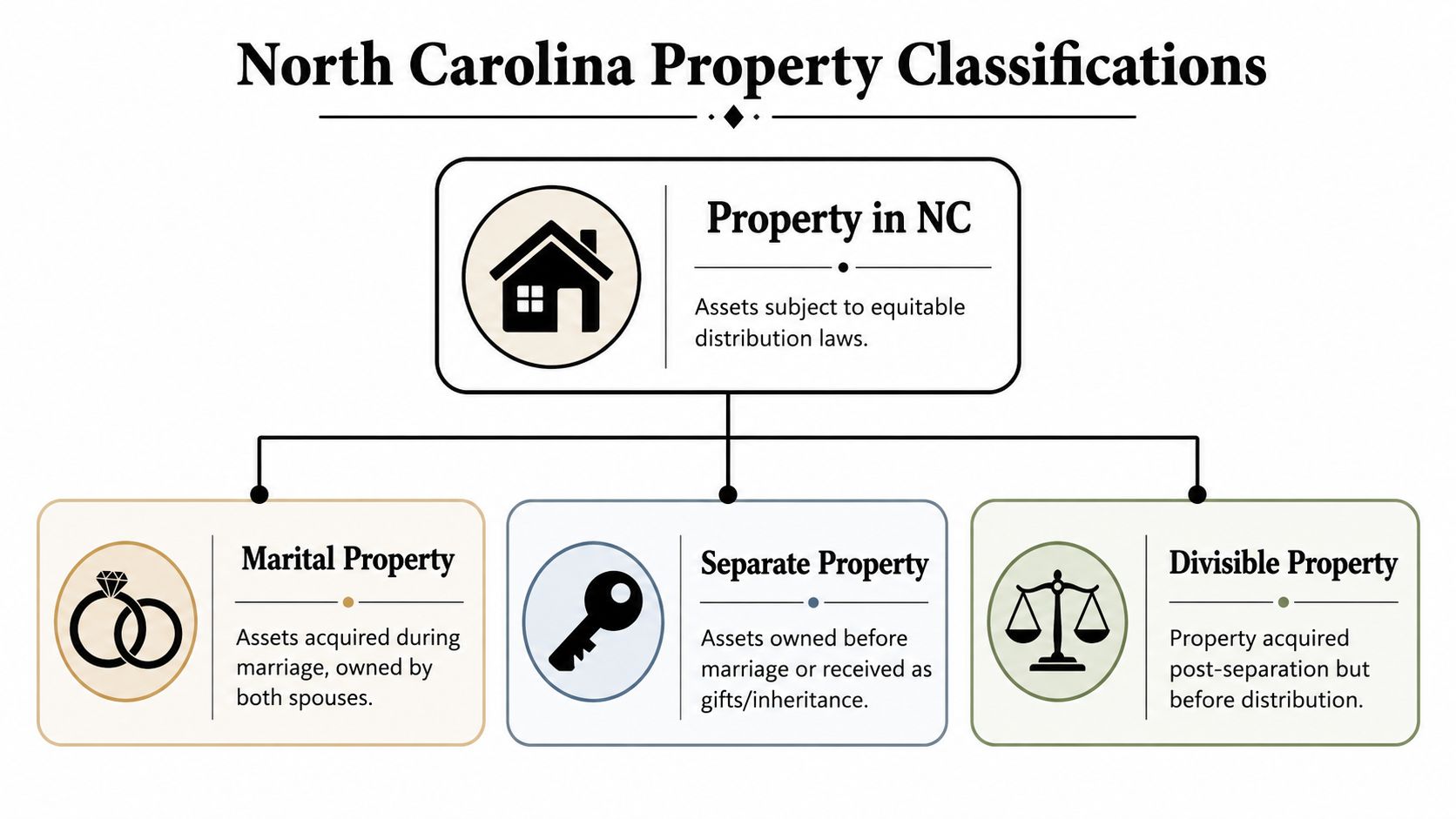
Before a court can divide anything, it must sort property into categories. Under NCGS 50-20 and 50-21, the court must first identify, classify, value, and then divide property. Classifications are marital (acquired during the marriage), divisible (post-separation passive changes in value), and separate (pre-marital, gifted, or inherited). Misclassification can shift hundreds of thousands of dollars in high-asset cases according to the North Carolina Bar guidance on practical aspects of equitable distribution.
Marital property
Marital property usually means property acquired during the marriage and before separation. Think of marriage as an economic partnership. If either spouse acquired an asset during that partnership, the law often treats it as part of the marital estate, even if only one name appears on the account or title.
Examples often include:
- The home purchased during marriage
- Retirement growth earned during marriage
- Vehicles bought during marriage
- Savings accumulated before separation
- Debt incurred for marital purposes
A paycheck deposited into one spouse's sole account can still produce marital property. The same goes for a brokerage account opened in one spouse's name during the marriage.
Separate property
Separate property is usually what a spouse brought into the marriage, or what that spouse later received by gift or inheritance and kept separate. A simple way to think about it is this: separate property is what you brought into the business of marriage, or what was given to you alone and preserved as your own.
Practical rule: Separate property is easiest to protect when the paper trail is clean.
That last part matters. If inherited funds were deposited into a joint account and then used for family expenses or to pay down a mortgage, the issue becomes much harder. People often assume intent is enough. In court, documents matter.
For a more focused discussion of classification, Marital, Separate, and Divisible Property in NC addresses how North Carolina classifies property for division in divorce.
Divisible property
Divisible property is the category many people haven't heard of until they're already in a dispute. It generally covers certain post-separation changes related to marital property, especially passive gains or losses that occur after separation but before distribution.
A familiar example is a retirement account that rises or falls after the parties separate. Another is a house that changes in value before trial.
Why this sorting step matters so much
Classification isn't a technicality. It's the framework for everything that follows.
Consider two spouses arguing over the same bank account. One says it was funded with inherited money. The other says marital earnings were deposited into it for years. The court's answer to that classification question can change the final outcome dramatically.
A large part of equitable distribution NC litigation comes down to tracing. Where did the asset come from? When was it acquired? Was it kept separate? Was it mixed with marital funds? Those are the questions that decide whether an item gets divided at all.
How NC Courts Value and Divide Marital Assets
North Carolina adopted its equitable distribution system in 1981, treating marriage as an economic partnership. Courts begin with a presumption that a 50/50 split is equitable but can deviate based on 13 statutory factors, reflecting a focus on fairness over rigid formulas, as described in the UNC School of Government equitable distribution materials.
That broad principle becomes concrete through a working process. In most cases, the court moves through identification, valuation, and distribution.
Step one is identifying what exists
Every asset and debt should be listed carefully. That includes obvious items like the home, vehicles, retirement accounts, and credit cards. It can also include business interests, stock options, restricted accounts, deferred compensation, and reimbursement claims tied to separate property.
Missing records often create expensive problems. If an account existed but no one has statements near separation, proving value becomes harder. If a spouse owned a business, valuation may require more than a balance sheet. In those cases, a business valuation for divorce may become part of the evidence.
Step two is valuing property at the correct point in time
North Carolina law requires valuation as of the date of separation, with room in some cases to consider certain later changes when properly raised. That sounds straightforward until the economy moves sharply between separation and trial.
A house may have one value when the spouses separate and a very different value later. A retirement account may drop, recover, or swing repeatedly. When that happens, one spouse may argue the change was passive and therefore divisible. The other may argue the increase came from post-separation effort, payments, upkeep, or management and should be treated differently.
The date of separation isn't just a date on a form. It often anchors the entire financial analysis.
Why economic volatility now matters more than many people expect
Recent inflation, real estate volatility, and investment swings have intensified valuation disputes. A spouse who stayed in the home after separation may say the later increase in value came partly from mortgage payments, taxes, maintenance, or strategic timing. The other spouse may say the market rose on its own and both parties should share that gain.
This issue matters in practical terms because post-separation appreciation can materially affect what each spouse receives. The legal fight often turns on whether the change was passive or tied to active efforts. Many general divorce guides mention valuation dates but don't spend enough time on this modern problem.
Step three is distributing the net marital estate
Once assets and debts are classified and valued, the court looks at net value, meaning value minus associated liens or debts. Then the court decides how to divide that net estate.
North Carolina starts from an equal division presumption, but equal doesn't mean identical item-by-item allocation. One spouse may keep the house while the other receives a larger share of retirement funds or other property to balance the overall division.
If you're still at the beginning of the case, How to File for Absolute Divorce in North Carolina explains the steps, residency rule, and filing requirements for an NC divorce. Filing for divorce and resolving equitable distribution are related, but they aren't the same task.
The 13 Factors That Determine an Equitable Split
The default position in North Carolina is equal division. But equal division can be challenged. While 50/50 is the starting point, the statute allows courts to vary from this if an equal division is inequitable. Factors like income, contributions as a homemaker, and duration of the marriage are weighed, and court-ordered divisions can legally deviate, often landing in the 45/55 or 40/60 range depending on the circumstances according to this discussion of North Carolina's unequal division framework.
Judges don't pick a number at random. They work through the statutory factors in N.C. Gen. Stat. § 50-20(c).
The court's fairness checklist
| Factor Category | Examples and What the Court Considers |
|---|---|
| Income and liabilities | Differences in earnings, debts, access to property, and overall financial position when the division becomes effective |
| Prior support obligations | Whether one spouse has financial obligations from an earlier marriage |
| Length of marriage and health | The duration of the marriage, along with each spouse's age and physical or mental health |
| Child-related housing needs | Whether a parent with custody needs to stay in the marital residence and use household effects for the children |
| Separate retirement expectations | Whether one spouse has separate pension or deferred compensation rights not subject to distribution |
| Contributions to acquiring marital property | Wage earning, homemaking, parenting, and indirect support that helped build the marital estate |
| Contributions to separate property growth | Whether a spouse directly helped increase the value of the other spouse's separate property during marriage |
| Liquid versus illiquid assets | Whether assets are easily divided or difficult to convert without disruption |
| Business valuation concerns | Whether keeping a business intact makes economic sense and whether valuing it is difficult |
| Tax consequences | The tax effect a particular distribution may create for either spouse |
| Post-separation conduct affecting assets | Whether either spouse preserved, developed, neglected, wasted, devalued, or converted marital or divisible property after separation |
| Death before order | Statutory considerations if a spouse dies before the equitable distribution order is entered |
| Any other just and proper factor | Additional fairness issues the court finds relevant under the statute |
How these factors play out in real life
One of the most important misunderstandings is the idea that only direct earnings count. They don't. A spouse who left the workforce to raise children, manage the household, or support the other spouse's career may have a strong argument that an equal split isn't enough to reflect the economic realities of the marriage.
A second common issue involves asset type. A family business may be valuable but hard to split cleanly. A judge may award the business to one spouse and offset that award with other property, rather than forcing a sale that harms both parties.
A good equitable distribution argument isn't just "this feels unfair." It ties specific facts to specific statutory factors.
What usually doesn't work
Several arguments tend to disappoint people:
- Moral blame unrelated to finances. Property division is not designed to punish every bad act in a marriage.
- Vague claims without records. If you say an asset was wasted, hidden, or preserved through your efforts, evidence matters.
- Title-only arguments. In North Carolina, whose name is on the asset is often less important than when and how it was acquired.
Equitable Distribution in Action A Real-World Scenario
A hypothetical helps show how these rules work in ordinary life. Suppose John and Jane are divorcing in North Carolina after a long marriage. They own a home with a mortgage, two vehicles, retirement accounts, some savings, and credit card debt. Jane spent years out of the workforce raising children. John remained the primary wage earner.
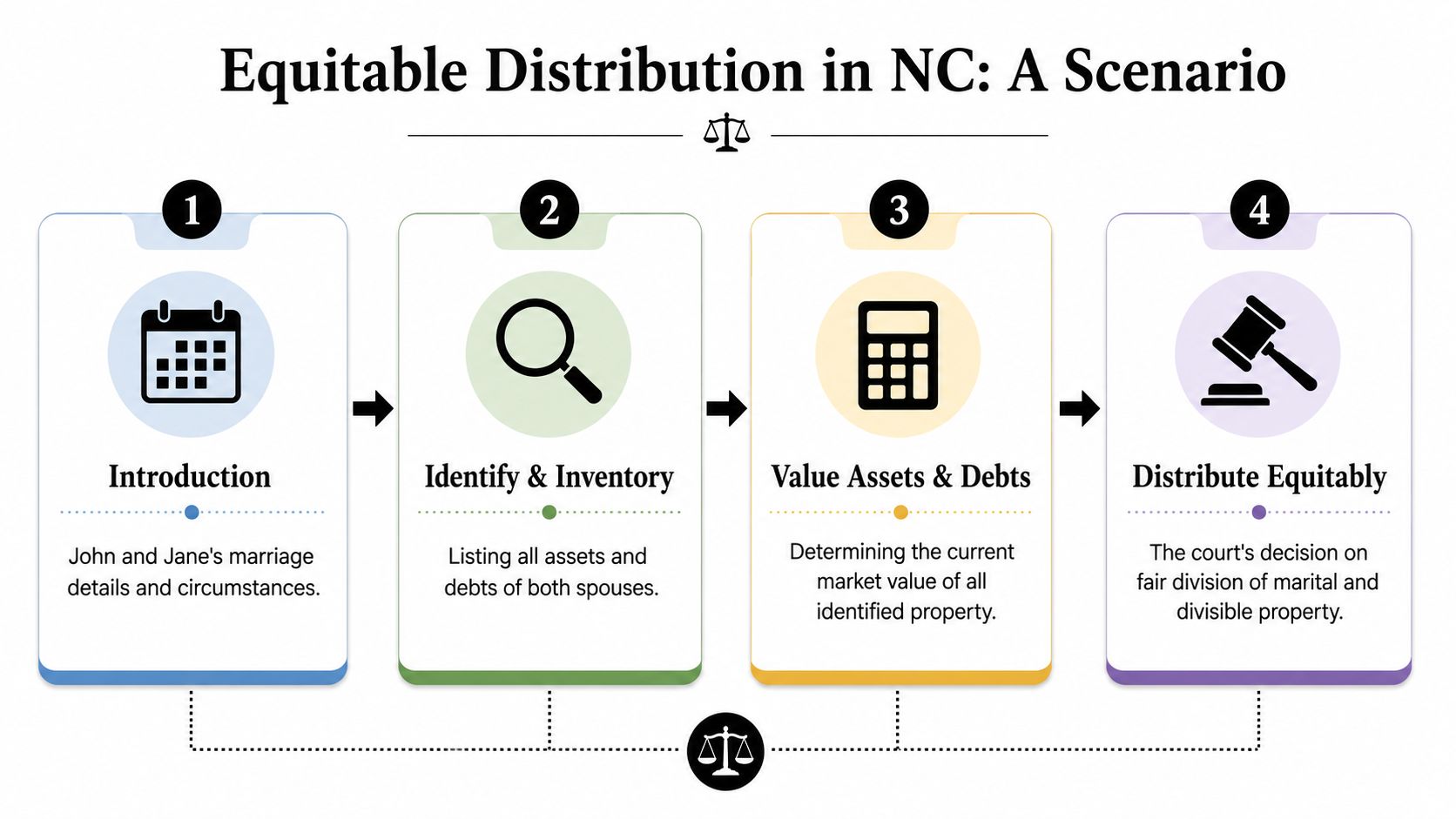
First the court identifies and classifies
The house purchased during the marriage is usually marital. The portion of retirement accumulated during the marriage is usually marital. Savings built before separation are typically reviewed the same way. Credit card debt may also be marital if it was incurred for family purposes.
Now add one complication. Jane received an inheritance during the marriage and kept it in a separate account. That may remain separate property. But if she later used part of it toward improvements on the marital home, tracing and classification become more disputed.
Then the court values each item
The court assigns values and subtracts related debt to determine net value. If one vehicle has a loan, the loan reduces that vehicle's net value. If the house has a mortgage, the home's net value is equity rather than gross market price.
In many cases, spouses focus heavily on the home. That's understandable. The emotional value is high, and the financial stakes are often high too. Questions like who gets the house in a North Carolina divorce often depend on whether one spouse can keep it, refinance it, and offset the other spouse's share elsewhere.
Two different outcomes may both be lawful
In one version, the judge finds no reason to depart from equal division and structures a roughly equal overall result. John may keep one account, Jane may keep another, and one spouse may receive a distribution payment so the total net result balances.
In another version, the judge gives Jane a greater share because her years as a stay-at-home parent are a significant statutory factor. That doesn't mean every homemaker automatically receives more. It means the court can recognize long-term non-financial contributions when dividing the marital estate.
Recent economic conditions have made this even more contested. Post-2021 inflation and rapid housing market changes have intensified disputes over whether post-separation appreciation in assets like real estate is passive or active. This timing issue can materially alter the equitable share each spouse receives, as discussed in this North Carolina analysis of equitable distribution timing disputes.
Common Disputes and Proactive Asset Protection
A common pattern looks like this. One spouse moved inherited funds into a joint account years ago, the couple refinanced the home during a hot real estate market, and by the time the case reaches court, account balances and property values no longer resemble what they were at separation. In North Carolina equitable distribution cases, those details often drive the dispute.

The disputes that appear most often
Commingling is one of the most frequent problems I see. Separate property can lose its clear identity when it is deposited into a joint account, used for marital expenses, or mixed with other funds without a clean paper trail. The issue is not only what the asset started as, but whether it can still be traced.
Hidden or incomplete financial information is another major source of conflict. If one spouse handled the banking, investments, business books, or online accounts, the other spouse may not know what exists, what was transferred after separation, or whether income is being reported accurately.
Valuation fights have become more serious in the last few years. A house may have jumped in value after separation because the local market rose. A retirement account may have dropped because of market swings. A closely held business may look stronger on paper because prices increased, while its actual cash flow got tighter. Those changes matter because North Carolina cases often involve distinguishing passive market movement from value tied to a spouse's post-separation effort, payments, or management.
Business interests are especially difficult. One spouse may believe the business is being undervalued. The other may argue that its apparent growth happened after separation and should not be shared the same way. Without reliable records, a sound valuation method, and sometimes a neutral or competing expert, settlement gets harder and trial gets more expensive.
What usually helps protect your position
Good preparation changes the case.
- Pull records early. Get bank statements, retirement statements, deeds, mortgage records, credit card statements, tax returns, payroll records, and business documents before access becomes limited.
- Preserve the separation-date picture. Save statements and screenshots that show balances, debts, and account ownership as close to the date of separation as possible. That snapshot often matters as much as the current value.
- Do not make informal transfers. Moving money, retitling property, selling assets, or paying unusual expenses without advice can create tracing problems and invite claims of dissipation.
- Keep proof of separate property. Inheritance records, gift letters, premarital statements, and closing documents can make the difference between a strong claim and a weak one.
- Use formal discovery when needed. Subpoenas, document requests, interrogatories, and depositions exist for a reason. They help get records instead of relying on assumptions.
- Match the strategy to the asset. Real estate, stock options, pensions, restricted accounts, and private businesses each require a different approach.
For some families, divorce is only one part of the financial risk. Planning for liability exposure and ownership structure can overlap with long-term financial planning. This guide on how to protect assets from creditors addresses related issues that often come up in broader asset-protection conversations.
A short discussion of the process can also help clarify what to expect:
The strongest cases are usually built on documents, timing, and restraint. Careful records, a realistic position on value, and a clear explanation of what changed between separation and trial often carry more weight than accusations. The Law Office of Bryan Fagan handles North Carolina family law matters, including equitable distribution disputes, and early case planning often helps clients avoid expensive mistakes before positions harden.
Your Next Steps and Frequently Asked Questions
Rather than more theory, what's needed at this stage are clear answers and a practical next move. If you're dealing with equitable distribution NC concerns, focus first on documents, dates, and decisions you can't easily undo.
Frequently asked questions
Is North Carolina a 50/50 divorce state
Not exactly. North Carolina starts with a presumption that equal division is equitable, but the court can order an unequal split if the statutory factors support it.
Is inheritance divided in a North Carolina divorce
Usually not if it qualifies as separate property and stayed separate. Problems arise when inherited funds are mixed with marital funds or used in ways that make tracing difficult.
Who is responsible for marital debt
Debt can be part of equitable distribution just like assets are. The key question is often whether the debt was incurred during the marriage and for marital purposes, not merely whose name appears on the account.
What happens to the marital home
There isn't one automatic outcome. One spouse may keep the house and offset the other spouse's share with other assets, the home may be sold, or the court may structure a different arrangement depending on the facts.
How long does equitable distribution take
That depends on the complexity of the estate, the level of conflict, the need for appraisals or business valuation, and the county's court calendar. Some matters resolve by agreement. Others require substantial litigation.
If you're separated or expect separation soon, don't wait until assets have changed hands and records are harder to recover. A consultation can help you identify what is marital, what may be separate, what needs valuation, and where recent market volatility may affect your case.
North Carolina residents dealing with property division issues can schedule a consultation with the Law Office of Bryan Fagan to discuss their specific circumstances, review assets and debts under North Carolina law, and build a practical strategy for equitable distribution.