You may be sitting at the kitchen table with a spouse who's been drinking too much, coming and going without explanation, or making home life feel unbearable, and you're trying to figure out whether North Carolina law gives you any real options before a final divorce is available. That's often the moment people first hear about divorce from bed and board in North Carolina, and it's easy to misunderstand what it does. It is not an absolute divorce, but it can be a powerful fault-based court order when the facts fit the statute and you need the court to step in now.
What Divorce From Bed and Board Means in North Carolina
A client usually hears the phrase divorce from bed and board, or DBB, after weeks or months of stress. The spouse may have been pushed out of the home, worn down by repeated insults, or stuck in a situation that feels unsafe, yet a final divorce still isn't available because the one-year separation clock hasn't run. In that setting, DBB gives the injured spouse a way to ask a North Carolina court for a court-ordered separation based on fault, not just a private decision to live apart.
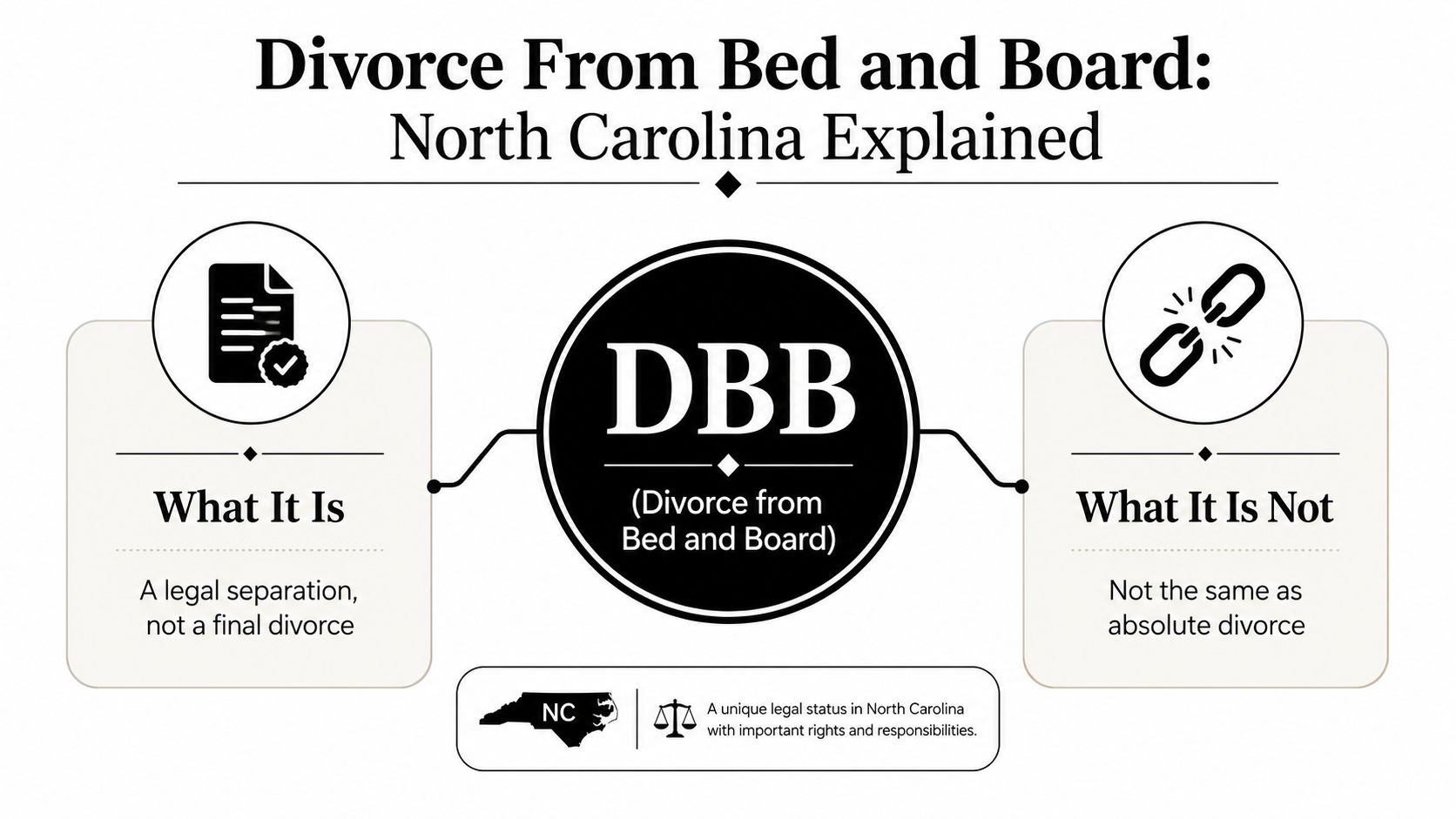
The statute's history goes back to 1871–72, which shows how long this remedy has been part of North Carolina family law. The age of the statute matters because DBB is not a brand-new workaround, it's a long-standing tool the legislature kept in place for hard cases. The state statute lists exactly six grounds, and they are the only grounds that matter under this remedy, as set out in N.C. Gen. Stat. § 50-7.
What DBB does in real life
DBB does not end the marriage. It does suspend most rights and duties of marriage, and that's why people often use it when home life has broken down but the final divorce date hasn't arrived yet, as described by the North Carolina Bar's explanation of divorce from bed and board. The practical effect is real, but limited. Your spouse is still your spouse, remarriage is not allowed, and the legal marriage bond stays intact.
That distinction trips people up all the time. If you need the court to recognize fault, protect your interests, and create a legal separation structure while you wait for absolute divorce eligibility, DBB may fit. If you're looking for a marriage-ending decree right away, it doesn't do that. North Carolina courts make that line very clear, and the state's divorce page explains that after DBB separation, the spouse still must wait the statutory one year before filing for absolute divorce (North Carolina Courts).
Practical rule: DBB can help when the marriage is still legally intact, but the living situation is no longer workable.
For readers trying to sort out the difference between leaving the home, separating legally, and asking for DBB, a plain explanation of legal separation in North Carolina is a useful companion. DBB is narrower than many assume, but in the right case it gives a judge a way to address conduct that has made married life intolerable before the marriage can be dissolved.
The Six Statutory Grounds Explained in Plain English
A spouse usually reaches this point after a hard moment, maybe after being pushed out of the home, maybe after months of drinking, insults, or fear that finally made the situation feel unlivable. That moment often raises the same question, does North Carolina law recognize this as fault. For divorce from bed and board NC grounds, the answer depends on whether the facts fit one of the six grounds written into the statute. The court is looking for conduct, not just a marriage that has gone bad.
North Carolina does not let a spouse ask for DBB because the relationship is unhappy. The statute gives six specific fault grounds, and each one has to be tied to real conduct. If the facts do not match one of those grounds, DBB is usually not the right remedy, even if the marriage has clearly broken down.
The six grounds in everyday terms
- Abandonment means one spouse has left without a lawful excuse and without the other spouse's consent. It is more than a temporary stay-away or a cooling-off period.
- Maliciously turning a spouse out of doors covers forcing the other spouse out of the home in a wrongful way. This is about ejecting a spouse, not about ordinary arguments over who is sleeping where.
- Cruel or barbarous treatment endangering life is the most serious safety-based ground. It includes physical violence, threats, or behavior that puts health or life at risk.
- Indignities making life intolerable refers to a pattern of degrading, humiliating, or abusive conduct. The North Carolina Bar stresses that this requires a course of conduct or pattern of behavior, not a single incident (North Carolina Bar).
- Excessive alcohol or drug use making life burdensome usually involves ongoing substance use that disrupts family life, safety, or stability.
- Adultery means marital infidelity, but it is a fault ground, so the proof has to be tied to actual misconduct, not suspicion alone.
The statute's language is old-fashioned, but the idea is straightforward. The law separates ordinary marital friction from conduct serious enough to justify court intervention. One bad weekend, one ugly text thread, or one drunken argument usually is not enough by itself.
A spouse looking at these grounds often wants to know whether one label fits every bad situation. It does not. A drinking problem may fit one ground, repeated humiliation may fit another, and a forced eviction from the home may fit a different one entirely. Lawyers look at the pattern, the setting, and the proof, not just the name of the problem.
North Carolina law on fault also overlaps with the broader idea of marital misconduct. A clear explanation of that concept appears in the firm's detailed analysis of marital misconduct in North Carolina, which helps show how conduct can matter in family law even when the marriage itself is not yet over. For readers who need legal help with divorce and related claims, the North Carolina Divorce Lawyer page points to that broader service area without changing the fact that DBB itself is a separate, fault-based remedy.
What Evidence and Documentation You Will Need
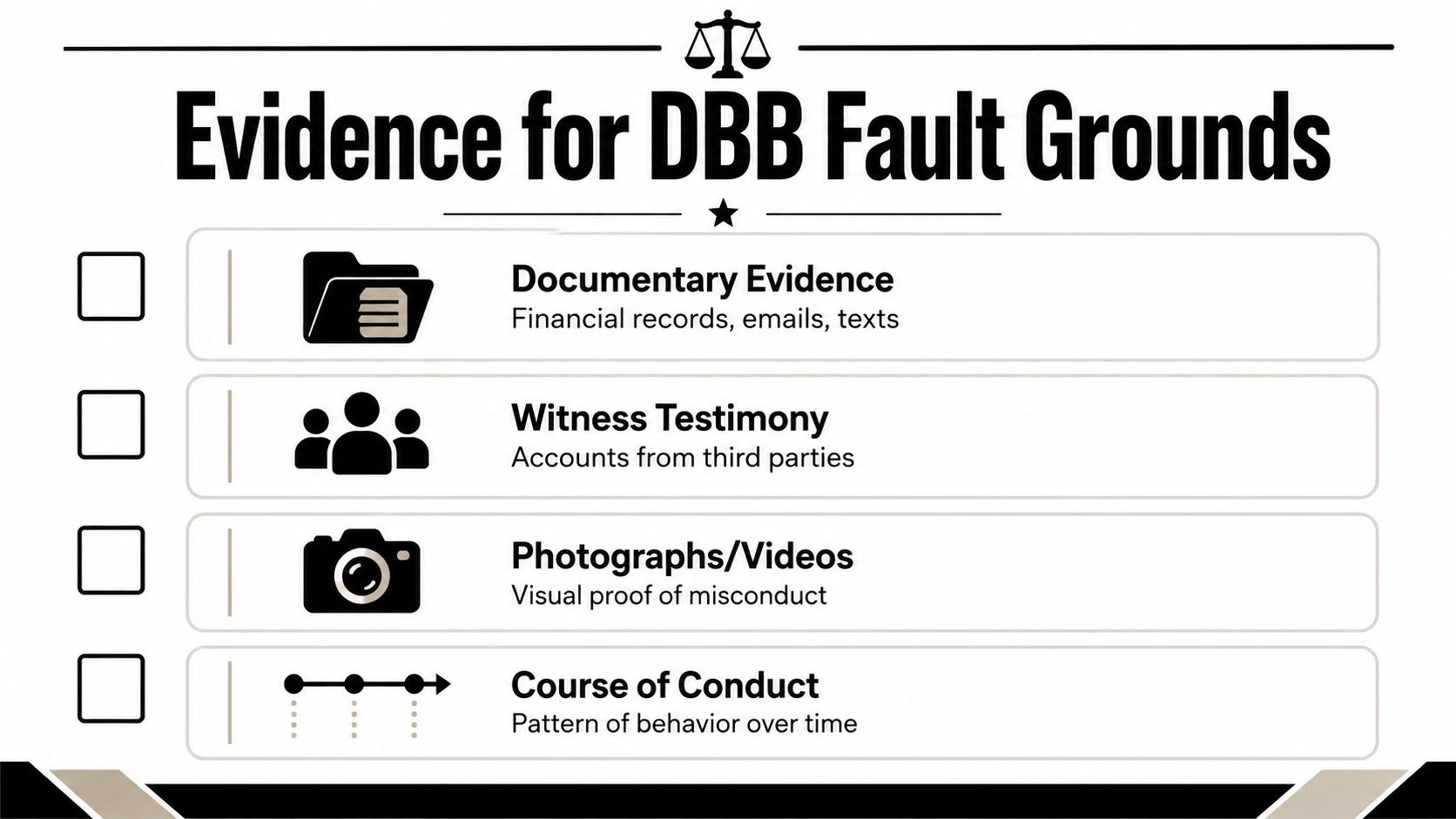
DBB cases turn on proof, and proof usually means more than a spouse's account. The court is looking for facts that match a statutory ground, and the strongest cases usually show a pattern rather than a single blowup. That matters because the North Carolina Bar's warning about course of conduct is not just a technical detail, it's often the difference between a convincing DBB case and one that falls apart at hearing.
The kinds of proof that actually help
A strong file usually includes texts, emails, photos, and videos that show the conduct over time. If cruelty, intimidation, or humiliation is involved, medical records and police reports can matter a lot because they show outside documentation, not just a private dispute. When substance use is the issue, records of missed work, prior interventions, police calls, or witnessed incidents can help show the behavior is ongoing rather than isolated.
Witnesses also matter. A neighbor, family member, babysitter, or co-worker may be able to describe what they saw, heard, or were told in a way that helps the judge understand the pattern. If there has already been a Chapter 50B protective order, that can be especially important because it may show that a court has already had to address safety concerns in a separate but related proceeding.
A one-time fight is easy to describe and hard to prove as DBB grounds. Repeated conduct, documented in real time, is much stronger.
Common proof problems people run into
Adultery is the ground that often creates the most frustration. Suspicion is common, but suspicion is not proof. If a spouse only has a hunch, the case is weak. The same is true for substance abuse claims that rely only on hearsay or for indignity claims based on one ugly argument with no history behind it.
That is why I tell clients to start a simple record as soon as they think DBB might be in play. Save messages. Keep dates. Write down who saw what. If you're dealing with safety issues, don't try to build the case by confronting the other spouse. Preserve the evidence, document the incidents, and talk with counsel about the safest way to move forward.
DBB Compared to Absolute Divorce and Separation
A lot of confusion starts with the word “divorce” in DBB. In North Carolina, that word does not mean the same thing in every setting. Divorce from bed and board, absolute divorce, and voluntary separation each do a different legal job, and mixing them up can lead to bad timing decisions. The state courts describe DBB as a court-ordered separation, not an absolute divorce.
The practical comparison
| Feature | DBB | Absolute Divorce | Voluntary Separation |
|---|---|---|---|
| What it is | Fault-based court-ordered separation | Final legal ending of the marriage | Spouses living separate and apart by choice |
| Does it end the marriage? | No | Yes | No |
| Can you remarry? | No | Yes, after the divorce is final | No |
| Does fault have to be proven? | Yes | No, after the separation period | No |
| Does it require a court order to exist? | Yes | Yes, for the divorce decree | No |
| Does the one-year separation rule still matter? | Yes | Yes | Yes |
Why the one-year clock still matters
DBB does not erase the one-year separation requirement for absolute divorce. That point matters because clients sometimes hear “court-ordered separation” and assume the marriage can be ended right away. It cannot. Even after a DBB order, the spouses still have to satisfy the statutory separation period before the marriage can be dissolved.
North Carolina's divorce information page lays out that structure, and the general absolute divorce path is also explained in the firm's page on absolute divorce in North Carolina.
Voluntary separation is different from DBB because it is usually just an arrangement between spouses. It can start the separation clock if the parties are living separate and apart, but it does not give a judge any fault finding by itself. DBB, by contrast, can give the injured spouse a court ruling based on the other spouse's misconduct.
For a client, the choice is rarely about labels. It is about what relief is needed now. If the immediate problem is safety, possession of the home, or a judicial finding of fault, DBB may be the sharper tool. If the goal is to move toward an eventual no-fault divorce after separation, a voluntary separation may be enough.
How a DBB Action Moves Through the Court Process
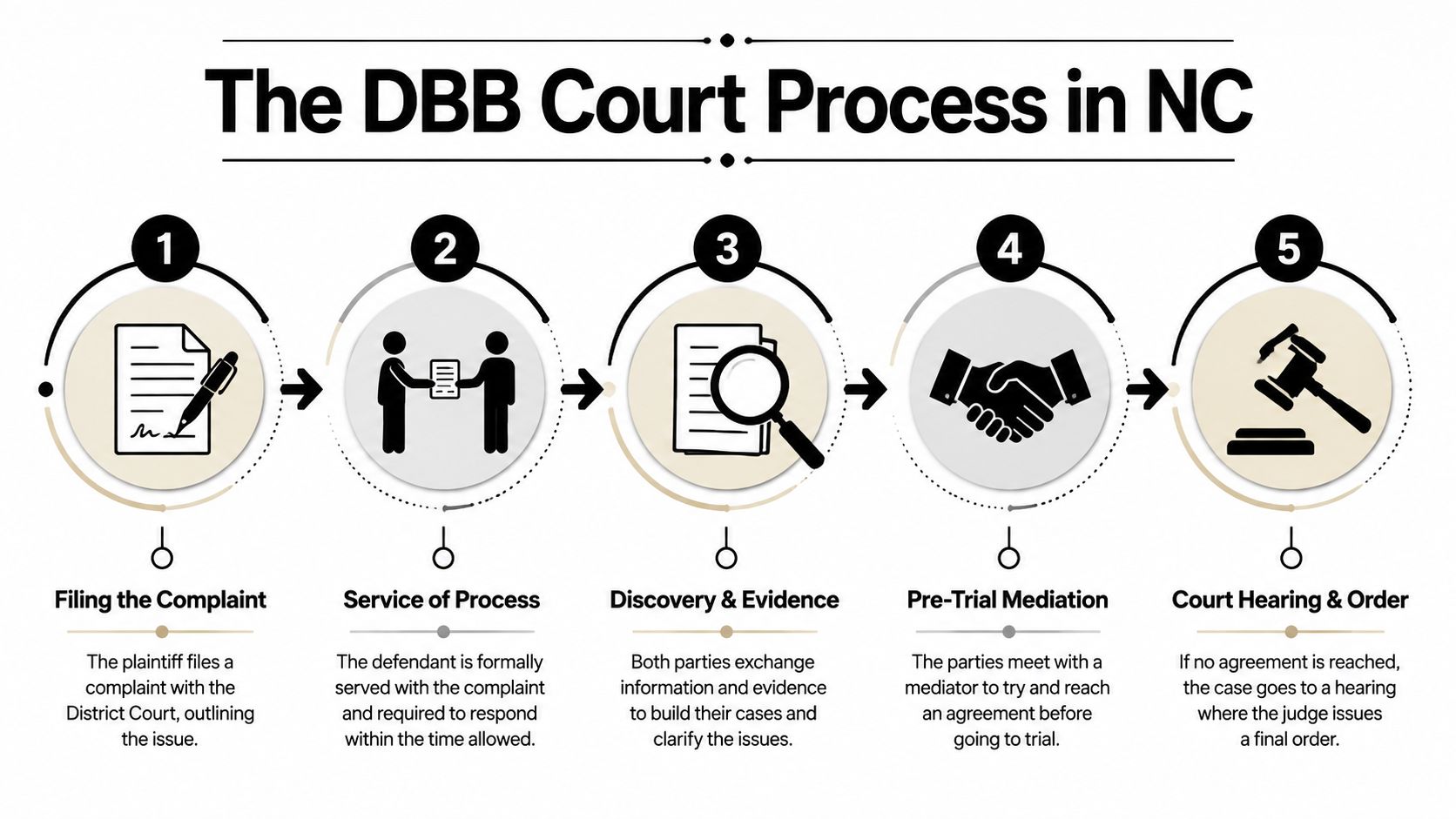
DBB starts like other North Carolina family law cases, with a complaint filed in the proper county. The spouse asking for relief must lay out the facts, identify the ground, and ask for the court order. After filing, the other spouse has to be served, because a court can't act fairly without notice and a chance to respond.
What usually happens after filing
The responding spouse can answer the complaint and may file a counterclaim or raise defenses. In many cases, the parties also ask for temporary relief while the case is pending, especially if there are issues about support or possession of the home. Discovery may follow, which is where each side exchanges documents and asks for information that supports or undermines the claimed ground.
Here's the simple version of the sequence.
- Filing the complaint. The injured spouse starts the case with allegations that fit one of the six grounds.
- Service of process. The other spouse gets formal notice.
- Discovery and evidence exchange. The parties gather records, witness statements, and documents.
- Settlement discussion or mediation. Some cases narrow the issues before hearing.
- Court hearing and order. The judge decides whether the facts support DBB.
Reconciliation matters
North Carolina law also allows the parties to resume cohabitation. That matters because moving back in together, even temporarily, can affect the posture of the case and create disputes about whether the separation or fault theory still makes sense. If a couple tries to reconcile, the details matter, including whether they resumed married life or just shared space for a short period.
Bottom line: DBB is not a paper exercise. It rises or falls on pleadings, service, evidence, and the judge's view of the facts.
That's why these cases benefit from careful drafting and careful timing. A complaint that is too vague or too emotional can be hard to prove. A complaint that is grounded in dates, conduct, and documents gives the court something usable.
Practical Effects on Custody, Support, and Property
DBB is not the final divorce, but it can change the ground rules while the marriage is still legally intact. In real life, that means it often shows up in cases where one spouse needs help with the house, the children, or money before the parties can finish the separation period. It also comes up in unsafe homes, which is why it can sit alongside a Chapter 50B protective order when domestic violence is part of the picture.
A DBB case often travels with other family law claims. Custody and child support still have to be handled on their own merits, and the court can look at the children's day-to-day needs separately from the fault issue. Support claims may also be part of the same larger case, because a spouse who has been forced into a separation often needs interim financial relief while the action is pending.
The image below captures that consultation moment many people face when they're trying to understand what to ask for and what to file.

Where DBB fits in the bigger case
Property rights are another common surprise. Even though DBB does not end the marriage, it can preserve separation-based claims that later matter in property division and post-separation support litigation. That's part of why DBB is strategically important, it can help a spouse build a record and maintain a position of strength while the marriage remains intact.
Child custody and child support are especially fact-driven. A judge will focus on the children's needs, the parents' conduct, and the current living arrangement. DBB doesn't automatically decide those issues, but the same conduct that supports DBB may also support urgent requests tied to parenting or safety.
The practical connection to Chapter 50B matters too. If the facts involve threats, assault, or coercive control, a protective order may provide faster, separate relief from domestic violence concerns. DBB and 50B serve different functions, and many clients need both analyzed together rather than in isolation.
Later in the case, the parties and the court may also need a clean record for support and property claims. That is one reason lawyers pay close attention to the separation date, the living arrangement, and any temporary orders entered while the case is pending.
Common Misconceptions Worth Correcting
The biggest mistake is thinking DBB ends the marriage. It doesn't. It is a court-ordered separation, not an absolute divorce, and remarriage is not allowed until the marriage is dissolved through the normal divorce process.
Another common mistake is assuming DBB makes the one-year waiting period disappear. It doesn't. The statutory separation period still matters before an absolute divorce can be filed. Clients also sometimes assume that filing DBB automatically settles custody, support, or the house. It doesn't do that by itself, because those issues usually need their own claims, motions, or orders.
A few more misunderstandings cause real trouble:
- One argument is enough. Usually it isn't, especially for indignities, where North Carolina expects a pattern of behavior rather than a single event.
- Fault is required for every divorce. That's not true in North Carolina. DBB is fault-based, but absolute divorce after the separation period does not require proving fault.
- DBB is just a threat. It's a real lawsuit with real consequences if the facts support it.
- A spouse's story alone always wins. It might not. Evidence still matters, especially when the other side disputes the facts.
The safest way to think about DBB is as a targeted remedy. It is narrow, serious, and tied to the statute. If the facts fit, it can help a spouse who needs court intervention before absolute divorce is available. If the facts don't fit, another North Carolina option may be a better match.
Frequently Asked Questions About DBB in NC
Can my spouse remarry after a divorce from bed and board?
No. DBB does not end the marriage, so remarriage is not allowed.
How long does a DBB case take in North Carolina?
There's no fixed timeline. The pace depends on service, evidence, motions, and whether the case settles before hearing.
Can DBB be filed with a Chapter 50B protective order?
Yes, in the right case. DBB and a protective order serve different purposes and can be analyzed together when safety is part of the problem.
What if we try to reconcile during the case?
That can affect the case, because North Carolina recognizes resumed cohabitation. The details matter, so the timing and living arrangement should be reviewed carefully.
Do I have to prove fault to get an absolute divorce later?
No. DBB requires fault, but absolute divorce in North Carolina follows the statutory separation period and does not depend on proving fault.
If you think one of the divorce from bed and board NC grounds may fit your situation, don't wait to sort it out alone. The Law Office of Bryan Fagan helps North Carolina clients evaluate fault-based claims, protect safety, and connect DBB to the rest of a divorce strategy in a careful, practical way. Visit Law Office of Bryan Fagan to schedule a consultation and talk through what your facts support.