You're trying to make sense of a marriage that has already been damaged, and the hardest part is often not the emotion, it's the legal confusion. In North Carolina, an alienation of affection lawsuit is not a divorce claim and it's not a way to sue your spouse for leaving. It is a narrow civil claim aimed at a third party whose conduct is said to have interfered with the marriage, and North Carolina remains one of the few states where that claim still exists Smith Debnam on case frequency and outcomes.
What an Alienation of Affection Lawsuit in NC Truly Is
A husband in Charlotte may think the only legal fight is the divorce itself. Then he learns the person he believes stepped into the marriage, not his spouse, is the one who may be sued. That is the basic shape of an alienation of affection lawsuit nc case, a claim brought against an outsider who is alleged to have intentionally interfered with the marital relationship Sodoma Law overview of the claim.
Who the claim is really against
North Carolina still recognizes this tort, but it is tightly framed. The lawsuit targets a third party, often a paramour or another outside influencer, because the law focuses on the interference itself rather than on punishing a spouse through a separate civil claim. One North Carolina source also notes that a business or company cannot be sued for alienation of affection here, which matters for anyone who assumes the claim reaches everyone connected to the breakup Sodoma Law overview of the claim.
The older North Carolina cases describe the protected marital interest as affection, society, companionship, and assistance North Carolina Court of Appeals case. That sounds formal, but the point is simple. The law protects the working relationship between spouses, not just the fact that a marriage license existed on paper.
Practical rule: if the complaint is really about the breakup itself, it probably is not enough. The claim has to center on outside conduct that interfered with the marriage.
What the lawsuit is and isn't
This claim is not a routine divorce remedy, and it does not replace custody, support, or equitable distribution. North Carolina practitioners describe it as a specialized civil action with limited use. One firm article reports only about 200 to 250 cases are filed each year statewide, with most not reaching trial Smith Debnam on case frequency and outcomes. That limited filing volume helps explain why the tort feels unusual in modern family litigation.
A plain-English way to understand it is this. The claim asks whether a third party caused a real loss of marital affection, and whether the proof is strong enough to hold that person legally responsible. The Law Office of Bryan Fagan's North Carolina divorce lawyer resource is a useful general reference for divorce-related claims under North Carolina law North Carolina Divorce Lawyer.
The Three Elements a Plaintiff Must Prove in North Carolina
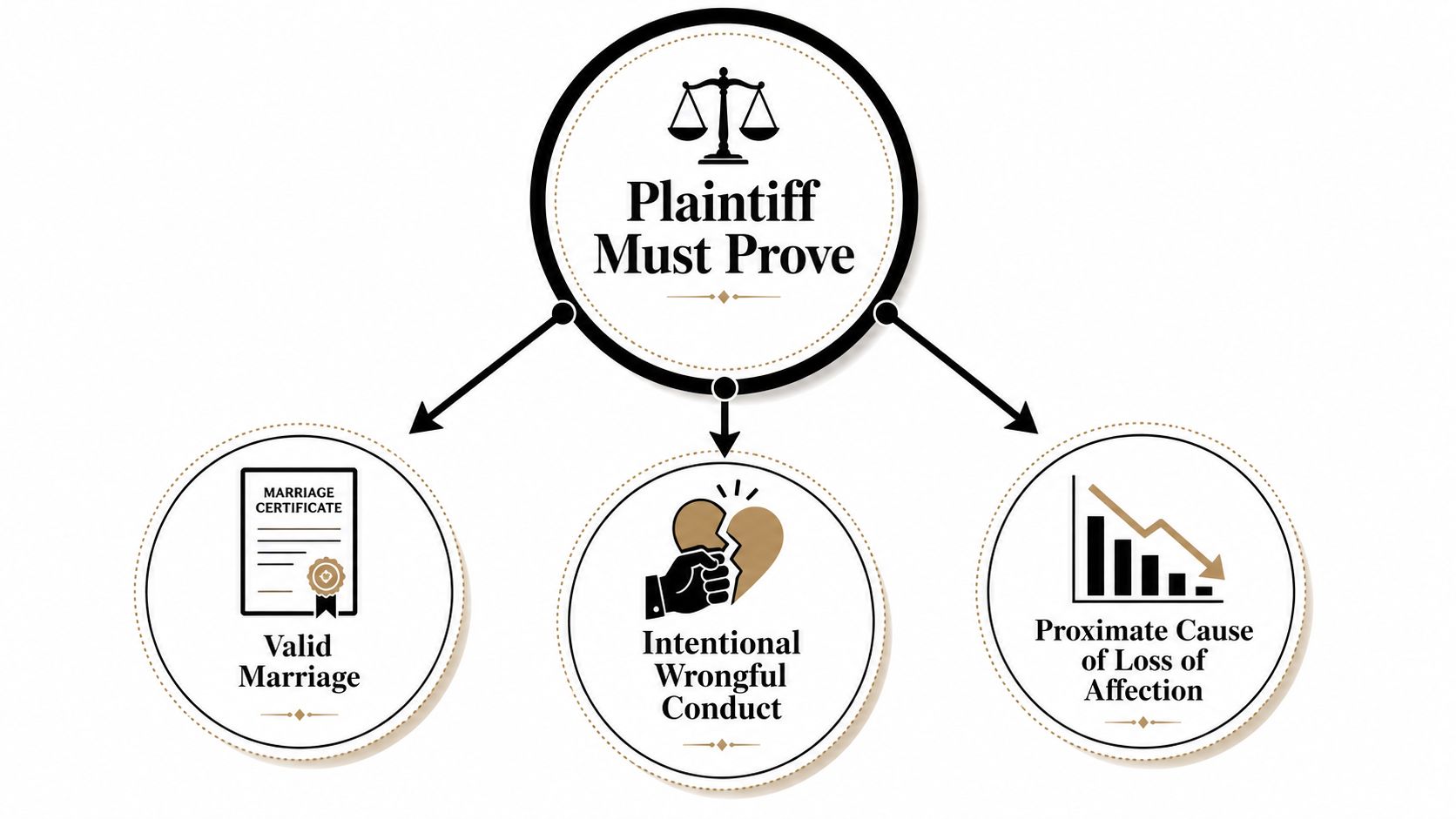
North Carolina common law still uses a three-part test. The plaintiff has to prove a valid marriage with genuine love and affection, that the affection was destroyed or alienated, and that the defendant's wrongful and malicious conduct caused or contributed to that loss North Carolina Court of Appeals case. That sounds straightforward until you get to the hard part, causation, which is where many cases turn.
Element one, a real marriage with real affection
The first question is whether the marriage had genuine affection before the alleged interference. This doesn't mean the marriage had to be perfect. It means the spouse bringing the claim must show there was still an actual marital bond, not just a paper marriage already on life support.
Element two, the affection was lost
The second element asks whether that affection was destroyed. North Carolina cases frame the interest broadly as loss of affection, society, companionship, and assistance North Carolina Court of Appeals case. In practice, that means the plaintiff needs to show the marriage changed in a meaningful way, not merely that the couple argued or drifted.
Element three, the defendant caused or contributed to the loss
This is the technical centerpiece. The plaintiff must connect the third party's conduct to the marital breakdown, not just point to marital unhappiness McIlveen Family Law explanation. North Carolina sources emphasize that the defendant does not have to be the sole cause, but the plaintiff still has to show the outsider's wrongful conduct was part of the causal chain.
One key way to think about it is this, the law asks whether the third party was a meaningful cause of the loss of affection, not whether the marriage had zero preexisting problems. That distinction is why documents, messages, witness testimony, and timing matter so much.
Bottom line: the claim is built on evidence, not suspicion. A cheating allegation alone is not the whole case, and marital conflict alone is not enough either.
Statute of Limitations and the Pre-Separation Cutoff
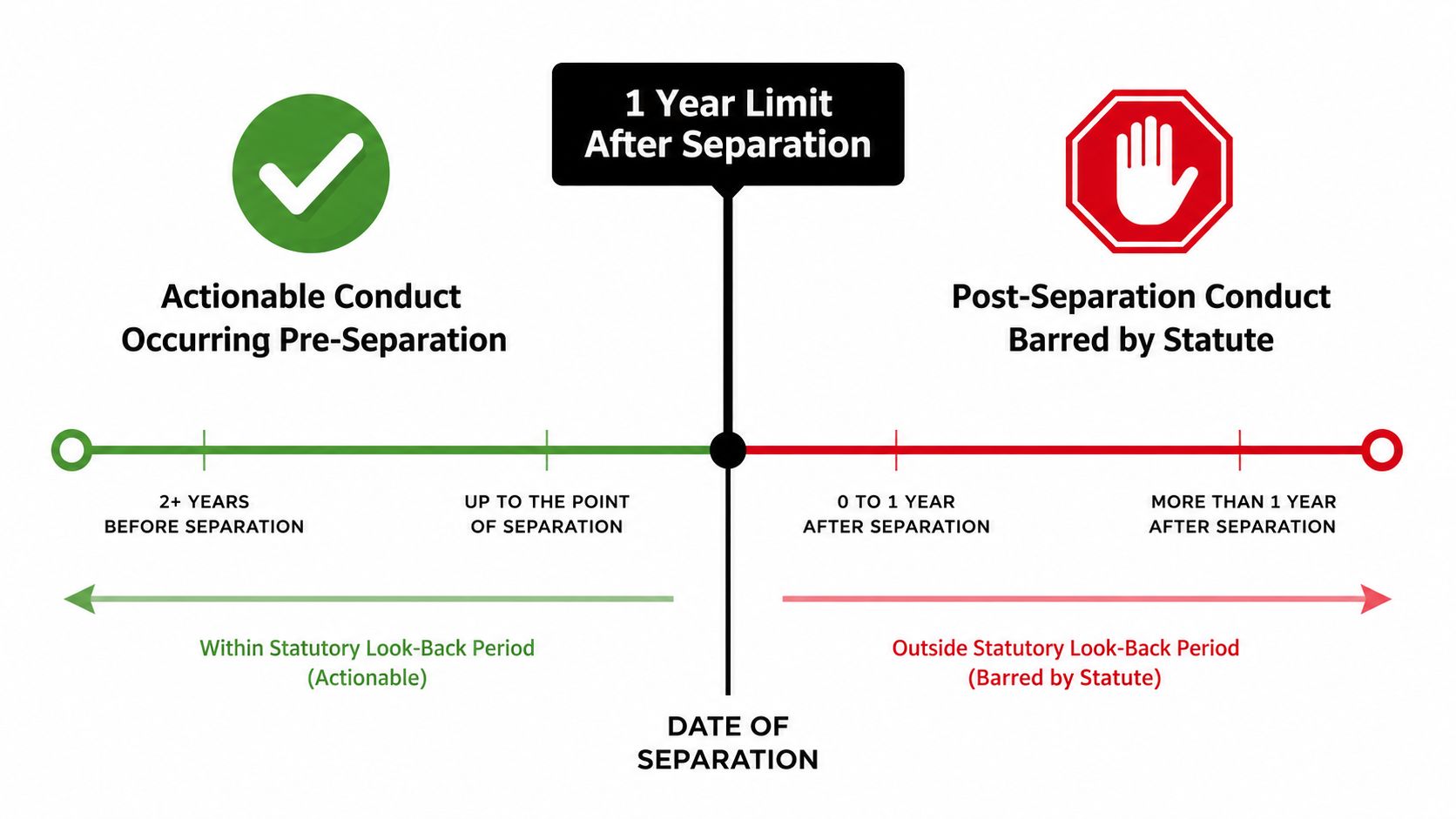
A client often asks, “If the messages were awful, why does timing matter so much?” In North Carolina, timing can decide the case before anyone reaches the substance. Under N.C. Gen. Stat. § 52-13, conduct after the spouses physically separate with intent that the separation be permanent does not support the claim, and the lawsuit must be filed within three years of the last act that can give rise to it North Carolina General Statutes § 52-13.
Why the cutoff matters so much
The statute draws a hard line at permanent separation. Once the spouses have physically separated with the intent that the separation be permanent, later conduct does not support an alienation of affection claim. So the lawyer has to sort the evidence into two buckets, what happened before separation and what happened after it began.
That distinction trips up a lot of people. A spouse may discover the affair later, but discovery is not the trigger for this tort. The legal clock turns on the last actionable act, and North Carolina materials stress that the key question is whether the defendant's conduct happened before the permanent separation began LawSmith overview. If you are also trying to understand divorce timing, the One-Year Separation Rule in North Carolina is a separate issue, but the dates often have to be lined up carefully in the same file.
What evidence usually defines the deadline
The deadline usually turns on ordinary evidence, not a single dramatic admission. Text messages, call logs, travel records, and witness testimony can show when the conduct happened and whether it occurred before the permanent separation. If the only proven contact came after the spouses had already separated for good, the claim gets much weaker. If the record shows repeated pre-separation contact, the timing issue can still support the case.
Practical rule: build the file around the last actionable pre-separation conduct, not around the day the affair was discovered.
That is why these cases often feel like a timeline problem first and a relationship case second. The plaintiff still has to prove the tort, but the court will not ignore the cutoff just because the underlying facts are upsetting.
Real-World Scenarios and What Evidence Courts Look At
A North Carolina alienation of affection claim usually rises or falls on ordinary details, not a dramatic confession. A spouse sees repeated late-night messages, unexplained meetups, secrecy around phone use, and a third party who keeps contacting the married spouse even after the relationship starts to show strain. In that kind of file, the question is whether the outsider's conduct helped cause the loss of affection, not just whether an affair happened.
A useful first step is to separate conduct that may support the claim from conduct that is only awkward or upsetting. If you are trying to understand how the conduct fits into a broader family law case, a page on North Carolina marital misconduct can help frame the difference between bad behavior in general and the facts that matter for this tort.
What conduct tends to matter
North Carolina practitioners say wrongful conduct can include repeated contact, secrecy, and behavior that deepens the relationship until the marriage breaks down McIlveen Family Law explanation. If sexual activity is shown, one source notes that malice may be presumed, although intercourse is not required to prove the tort. That changes how lawyers argue the evidence, even when the plaintiff does not have direct proof of every private encounter.
Evidence often comes from:
- Messages and emails, especially if they show secrecy, planning, or repeated contact.
- Phone records and location information, when they line up with the timeline.
- Witness testimony, including coworkers, friends, or family who noticed the relationship changing.
- Separation dates and marital history, because pre-separation conduct is the key focus.
A helpful way to look at the proof is this. The court wants a story it can follow from start to finish. Did the third party just sit on the edge of the marriage, or did that person actively contribute to the breakdown?
The practical problem is proving the controlling cause, the conduct that tipped the marriage over. A judge or jury may see flirting, emotional support, and private messages as background noise unless the plaintiff can connect them to the loss of affection in a clear way. That is why lawyers spend so much time lining up texts, travel records, and witness accounts into one timeline, since the pieces matter more when they point in the same direction.
Circumstantial proof often carries these cases. The North Carolina case law shows that courts can look at the overall pattern, not just one isolated act, and post-separation facts may matter only because they help explain what happened before the marriage ended. That is also where nominal damages can change settlement talks. Even if the plaintiff cannot show a large dollar loss, a viable claim can still create pressure because the defendant faces the risk of a judgment and the stigma that comes with it.
Filing and Procedural Steps for Bringing the Claim
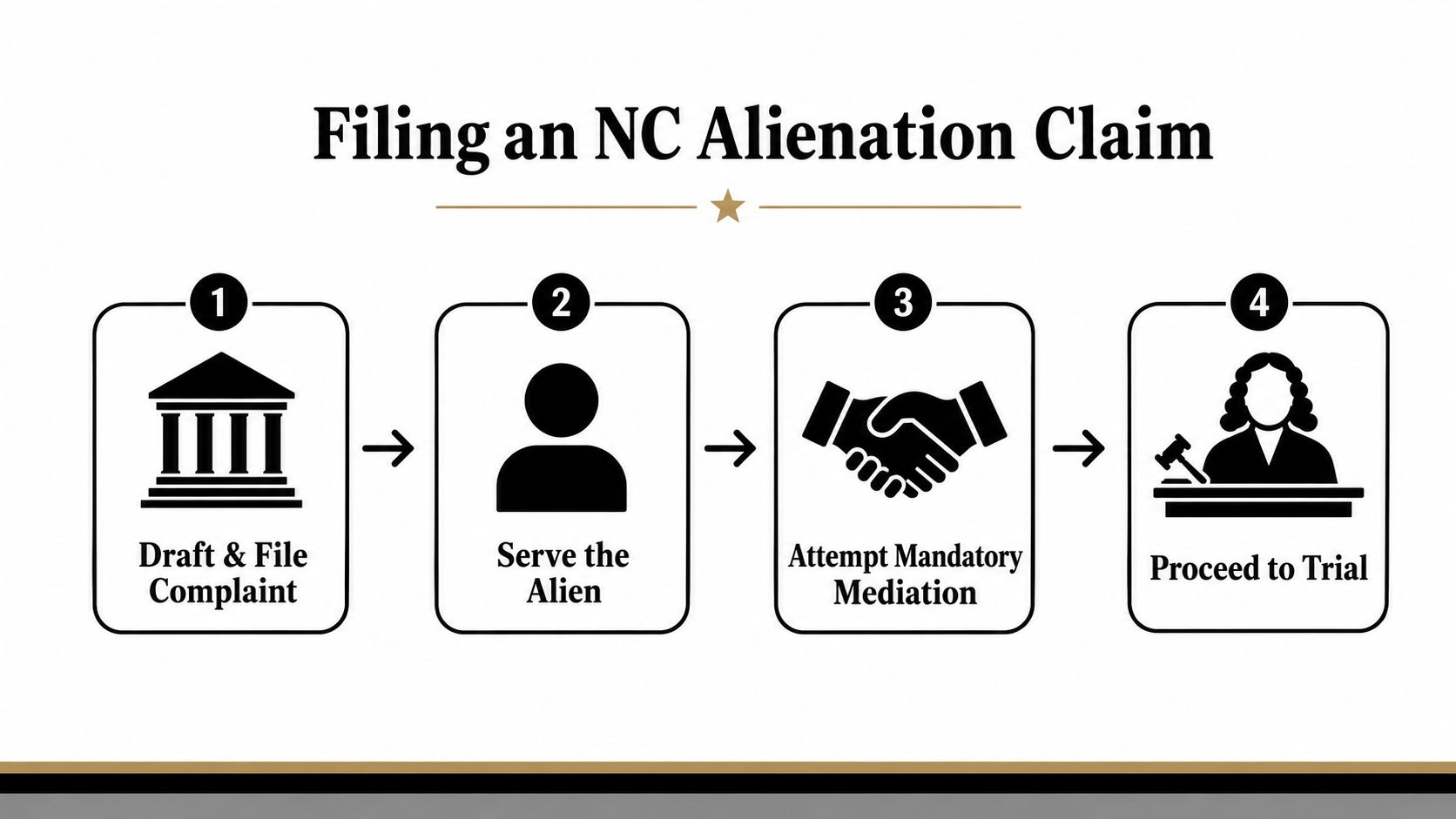
An alienation claim is filed as a civil action in North Carolina Superior Court. In practical terms, that means the plaintiff files a complaint, serves the defendant, and then the case moves through normal civil procedure, including an answer, discovery, motions, and possibly settlement talks or trial. Venue usually depends on where the defendant lives or where the cause of action arose, so local geography can matter early North Carolina civil practice sources summarized in practice materials.
Who gets sued and who doesn't
The claim is directed at the third party, not the spouse who left the marriage. North Carolina sources also state that a business or company generally cannot be sued for alienation of affection here Sodoma Law. That distinction matters because many people first assume the lawsuit can be aimed at everyone involved. It usually can't.
What happens after filing
After the complaint is filed and served, the defendant can respond with defenses or motions. Discovery usually follows, and that's where the evidence fight happens, documents are exchanged, written questions are answered, and depositions may be taken. If the case survives those stages, the court may see mediation, pretrial motions, and then trial.
In a case like this, the early papers matter because they define the timeline and the theory of causation. If the plaintiff cannot tie the defendant's conduct to a pre-separation loss of affection, the case can narrow quickly.
For readers who want a general family-law resource while sorting through the broader divorce picture, the same firm's North Carolina Divorce Lawyer page describes representation for absolute divorce and related claims under North Carolina law.
Practical rule: the lawsuit is built in discovery. The complaint starts the case, but the records and testimony usually decide whether it has real traction.
Damages, Settlement Position, and Realistic Outcomes
North Carolina recognizes compensatory damages for the loss of affection, society, companionship, and assistance, and it also allows punitive damages when the conduct warrants them. The practical point is that the amount, if any, still turns on the proof, the timeline, and how much room the defendant has to challenge causation.
Why nominal damages matter
North Carolina practice materials also note that the jury can award nominal damages even when the plaintiff cannot prove a specific dollar amount of loss North Carolina jury instruction summary referenced in practice materials. That matters because a plaintiff may still obtain a judgment even when the injury is hard to value in dollars. In settlement talks, that can change the defendant's position because the risk is no longer limited to a complete defense verdict.
What realistic outcomes look like
A North Carolina law-firm source that discusses outcomes says only a few cases result in financial awards, and most do not reach trial Smith Debnam on case frequency and outcomes. That does not mean the claim has no practical value. It means the case usually turns on whether the evidence clearly links the third party's conduct to the breakdown of the marriage.
A few things often affect settlement pressure:
- Strength of the timeline
- Quality of the communications
- Whether sexual activity can be shown
- How credible the witnesses are
- Whether the defendant has a real defense on causation
If the proof is thin, the case may function more as a bargaining position than a likely trial win. If the proof is strong, even nominal damages can matter because the defendant may want to avoid the cost, uncertainty, and public exposure of litigation.
Common Misconceptions About This Claim in NC
A lot of confusion comes from assuming alienation of affection works like a punishment for cheating. It doesn't. The tort is about wrongful interference by a third party, not about turning every marital breakup into a lawsuit Sodoma Law. That is why the spouse who left the marriage is usually not the defendant.
Three mistakes people make
First, people think the lawsuit is the same thing as divorce. It isn't. Divorce ends the marriage; this claim is a separate civil case about interference and damages.
Second, people think any post-separation dating can support liability. North Carolina law says conduct after physical separation with intent that the separation be permanent is barred under § 52-13 N.C. Gen. Stat. § 52-13.
Third, people assume a strong emotional story guarantees a strong legal case. It doesn't. North Carolina still requires proof of the causal chain, and the claim can fail if the evidence doesn't connect the defendant's conduct to the loss of affection McIlveen Family Law explanation.
Why businesses usually aren't the target
Some readers ask whether a workplace or company can be sued because the relationship started there. North Carolina sources say a business or company cannot be sued for alienation of affection in this state Sodoma Law. The claim stays focused on the individual outsider whose conduct allegedly interfered with the marriage.
The biggest misconception is that this is a fast-money case. It's not. It's a narrow, fact-intensive lawsuit with real timing limits, real proof problems, and no guaranteed result.
Frequently Asked Questions and Next Steps in North Carolina
Can I file after the divorce is final?
Sometimes, yes, but the key issue is whether the claim is still within the three-year limitations period and whether the conduct happened before the legally relevant separation N.C. Gen. Stat. § 52-13. The divorce being over doesn't automatically erase the claim.
Does it matter if the other person lives in another state?
It can. North Carolina practice materials note that nonresidents may still face liability if the court's jurisdiction is properly established through contacts tied to North Carolina Sodoma Law. That issue is fact-specific, so the defendant's location is only one part of the analysis.
How long does an alienation of affection case take?
There isn't a single timeline. Some cases settle during discovery, while others move toward trial after motions and mediation. The more disputed the timing and causation, the longer it usually takes.
Do I need strong proof before I call a lawyer?
Yes. A lawyer will usually want to look at the dates, the messages, the separation history, and any witness accounts before saying whether the claim is viable. If you're unsure where your facts fit, a consultation can help you sort out what matters and what doesn't.
If you're a North Carolina resident and you're trying to figure out whether your situation fits the law, talk with a family law attorney who can review the timeline, the evidence, and the practical options. The North Carolina Divorce Lawyer resource is a helpful starting point if divorce and related claims are part of the same situation.
Law Office of Bryan Fagan helps North Carolina residents sort through divorce-related disputes, civil family claims, and the evidence questions that come with them. If you're dealing with a possible alienation of affection case, visit Law Office of Bryan Fagan to schedule a consultation and get a clear review of your facts, timing, and next steps.