A criminal conversation claim in North Carolina is a civil lawsuit a married person can bring against a third party who had sexual intercourse with their spouse during the marriage. Despite its name, this is not a criminal case and does not carry jail time. It is a civil remedy under North Carolina law designed to compensate the injured spouse for the harm caused by the act of intercourse.
What a Criminal Conversation Claim in North Carolina Actually Means

In simple terms, a criminal conversation claim requires only two things: a valid marriage and proof that the defendant had sexual intercourse with the plaintiff's spouse while the marriage was intact. This is known as a "strict-liability" tort in North Carolina, meaning the plaintiff doesn't need to prove the defendant intended to harm the marriage—the act itself is what matters. The claim is governed by state common law and specific statutes that set time limits.
- Who can sue: A person who was legally married at the time of the sexual act.
- Who can be sued: The third party who engaged in intercourse with the married person.
- What you must prove: Evidence of a valid marriage and evidence of sexual intercourse. Since direct proof is rare, courts often rely on circumstantial evidence like text messages, hotel receipts, or witness testimony.
Key Takeaway: If sexual intercourse during a valid marriage is proven, liability often follows. The defendant's ignorance of the marriage is not a defense.
Criminal Conversation Claim NC at a Glance
Before diving deeper, here is a quick-reference summary of the essential elements of a criminal conversation claim under North Carolina law.
| Question | Answer |
|---|---|
| Is this a criminal charge? | No—it is a civil lawsuit for monetary damages. |
| What are the primary elements? | A valid marriage and sexual intercourse during that marriage. |
| What is the time limit to file? | Generally a three-year statute of limitations from the last act. |
| What evidence is used? | Text messages, photos, hotel records, witness testimony. |
| What are common defenses? | Separation before the act, consent of the plaintiff (connivance), or the statute of limitations has expired. |
Real-World Scenario
Imagine a wife discovers hotel receipts and incriminating text messages proving her husband had a single sexual encounter with a coworker while they were still married and living together. Even if their marriage was already strained, that evidence alone can be enough to support a criminal conversation claim against the coworker. This shows that even a brief affair, not just a long-term relationship, can be the basis for a lawsuit.
If you believe this situation applies to you, it's crucial to act quickly. Schedule a consultation with a North Carolina family law attorney to review your evidence, understand the deadlines, and explore your options.
Why North Carolina Still Allows This Lawsuit
North Carolina is one of a handful of states that still recognizes so-called "heart balm" torts like criminal conversation. While most states have abolished these claims, they remain a significant part of North Carolina's legal landscape and are actively litigated.
Originally, these lawsuits were created to protect the institution of marriage as a legal and economic partnership. In the past, marital infidelity could disrupt inheritance rights, family finances, and social standing. The legal system saw it as a tangible injury to the non-participating spouse's rights.
States that eliminated these torts often did so due to concerns about their potential for blackmail, public humiliation, and invasion of privacy. North Carolina, however, has chosen a different path, refining the tort rather than abolishing it.
North Carolina courts and lawmakers have upheld the tort as a valid civil remedy, tying it to specific timing rules under N.C. Gen. Stat. § 52‑13(a). This statute is critical, as it clarifies that acts occurring after a legal separation are generally not actionable.
Supporters argue that the claim provides real accountability and a path to compensation for a betrayed spouse. They point to the three‑year statute of limitations and significant jury verdicts as evidence that courts continue to recognize the severe emotional and personal harm caused by such actions.
Critics, on the other hand, argue that the tort invades personal privacy and can be used as a weapon in contentious divorces. This tension—between using a public legal remedy for private conduct—remains at the heart of the ongoing debate.
Historical and Legal Rationale
Early on, the law focused on protecting marriage as an economic unit and discouraging behavior that destabilized families. Today, the modern focus is on the very specific elements required: a valid marriage and sexual intercourse. This keeps the claim tied to a concrete act, rather than opening the door to broad moral judgments.
Here is how the two sides typically frame the issue:
Supporter's Perspective:
- Holds third parties accountable for their role in marital infidelity.
- Provides financial compensation for genuine emotional injury and loss of consortium (marital companionship and support).
Critic's Perspective:
- Creates opportunities for coercion or blackmail during divorce settlement negotiations.
- Raises constitutional questions about privacy and sexual autonomy between consenting adults.
Why NC Remains an Outlier
North Carolina courts have consistently affirmed the tort instead of dismantling it. They have, however, placed boundaries on its reach through strict timing rules and evidentiary standards. For example, a plaintiff must provide sufficient proof of both the "opportunity" and "inclination" for intercourse to have occurred.
Consider this practical scenario: a husband uncovers a single hotel bill and text messages from a year ago that prove his wife and a third party were together. If this happened before the couple separated, it could form the basis of a viable criminal conversation claim. This kind of concrete, evidence-based claim helps explain why the tort continues to hold legal weight, even amid controversy.
Learn more about how alienation of affection differs from criminal conversation in North Carolina in our article Alienation of Affection Lawsuit NC.
Whether you are considering a claim or have been named in a lawsuit, schedule a consultation with a North Carolina family law attorney to evaluate the evidence, timing, and your next steps.
The Legal Elements You Must Prove in Court
To succeed with a criminal conversation claim in North Carolina, a plaintiff must prove three specific elements in court.
First, the marriage must have been legally valid at the time the sexual act occurred. This means the couple was not divorced and had not entered into a legal separation with the intent to end the marriage, as defined under N.C. Gen. Stat. § 52‑13(a). For example, if a couple signed a formal separation agreement in January and the affair happened in March, the claim would likely fail.
Second, the defendant must have engaged in sexual intercourse with the plaintiff’s spouse while the marriage was still legally intact. North Carolina law treats this as a specific physical act, not just an emotional affair. A single proven encounter, supported by evidence like hotel receipts, text messages, or witness testimony, can be sufficient. This is where the legal concept of “opportunity and inclination” often comes into play—courts may infer intercourse from strong circumstantial evidence when direct proof is unavailable.
Third, the act of intercourse must have occurred before the date of separation. If the act happened after the couple had physically separated with the intent to end the marriage, it is generally not actionable. However, evidence of post-separation conduct can sometimes be used to corroborate that misconduct occurred before the separation, making the timeline a frequent point of contention in court.
Key Insight: The tort is a "strict liability" claim in North Carolina. This means the plaintiff does not need to prove the defendant intended to break up the marriage, that the marriage was happy, or even that emotional harm occurred. The act of intercourse itself creates liability.
This strict-liability nature is a key difference from an alienation of affection claim. Alienation of affection requires proof that the defendant’s wrongful conduct intentionally caused the loss of affection in the marriage.
- Real-World Example: A single documented act of intercourse during the marriage may be enough to win a criminal conversation claim.
- For an alienation of affection claim, you would also need to show that the defendant’s actions (like a long affair or manipulative behavior) actually caused the loss of love and destroyed the marriage.
Evidence Courts Commonly Consider
- Text messages, emails, and social media DMs showing planning or admission of the affair.
- Photographs, videos, and hotel or travel receipts linking the defendant and the spouse.
- Witness testimony from people who observed the affair.
- GPS data or phone records that establish a timeline and location.
Practical Example
Imagine a husband finds a suggestive email and a matching hotel bill for a single night before he and his wife separated. That evidence could be strong enough to support a criminal conversation claim, even if the marriage was already in trouble. However, to also win an alienation of affection claim, he would need to prove that the defendant's actions directly caused his wife to lose her affection for him.
If you believe you have a claim or are facing one, gather all relevant records immediately and speak with a North Carolina family law attorney to evaluate your proof and understand your legal standing.
Filing Volume, Notable Verdicts, and the Three‑Year Deadline
Understanding the numbers can make the risks and possibilities of a criminal conversation claim in NC more concrete. Reports show that North Carolina courts see several hundred filings per year for criminal conversation and alienation of affection combined. These claims are not just theoretical legal relics; they are actively pursued.
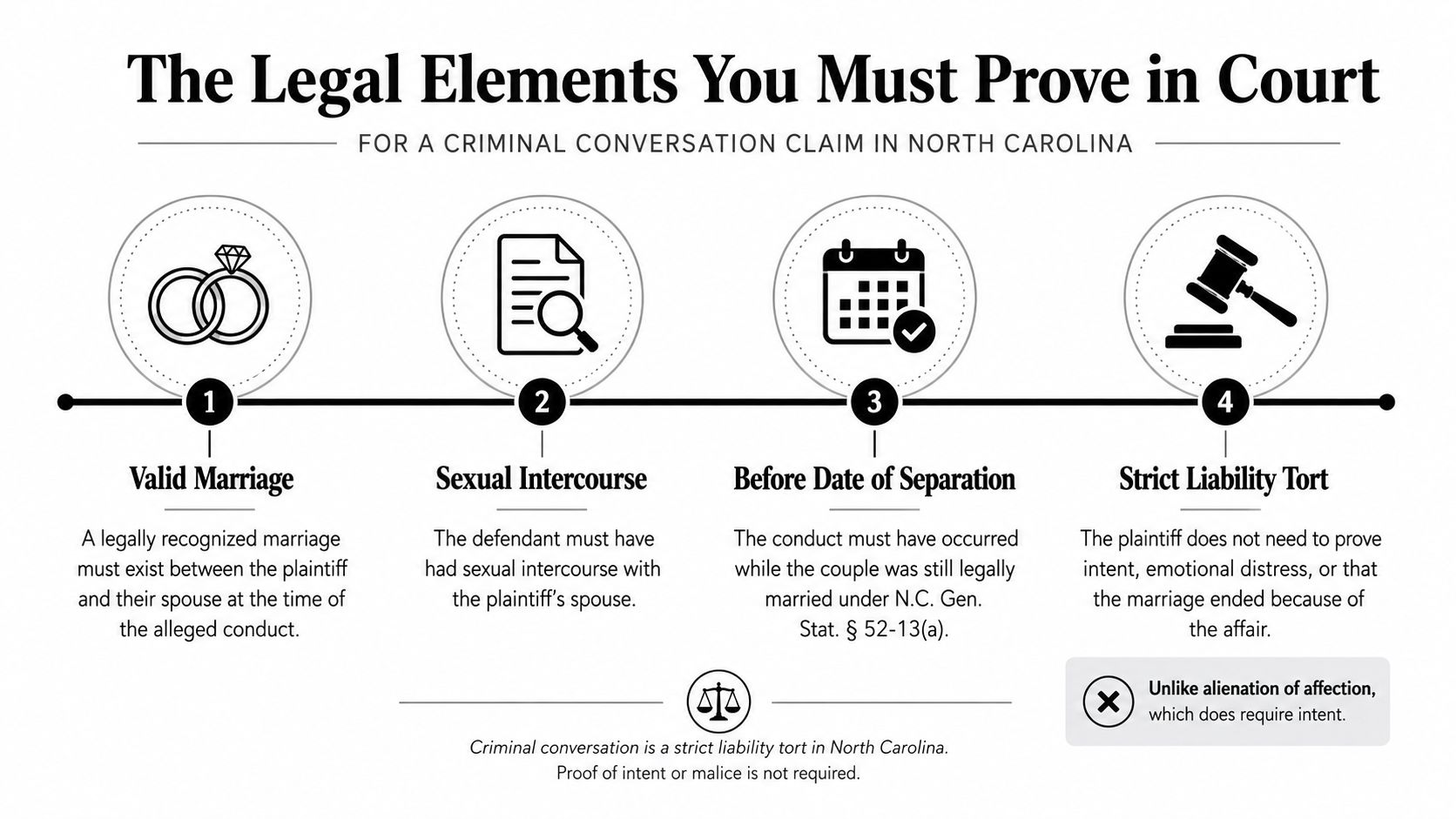
This infographic visualizes the key legal elements a plaintiff must prove and highlights how timing, under N.C. Gen. Stat. § 52‑13(a), is critical to a claim's success.
High-profile jury verdicts also keep these cases in the public eye. For example, juries have returned multimillion-dollar awards, including a reported $9 million verdict in 2010 and an $8.8 million award in 2018. While these numbers demonstrate that juries can impose significant damages for the harm caused, they are outliers and do not represent the typical outcome.
Reported Filing Volume of "Heart-Balm" Suits in North Carolina
The table below summarizes reported filing activity for these claims in North Carolina over recent decades. While exact counts can vary, the trend shows consistent use of this cause of action.
| Period | Reported Filings (per year) | Notes |
|---|---|---|
| Early 2000s | 200–400 | Period of high publicity and more frequent filings. |
| 2010s | 150–300 | Activity continued following several notable verdicts. |
| 2020s | 100–250 | A slight decline is noted, but claims remain active. |
These figures are summary estimates from public reports and legal commentary. They illustrate that while filings may fluctuate, the claim remains a relevant legal tool in North Carolina.
Key Takeaway: Juries have the power to award large damages, but the vast majority of cases are resolved through settlement before ever reaching a trial.
Timing is absolutely critical. North Carolina law imposes a strict statute of limitations. A criminal conversation claim must be filed within three years of the last wrongful act. This means the clock typically starts ticking from the last act of intercourse that supports the claim, not from the date you discovered it.
In very narrow cases, a "discovery rule" might extend this window if the plaintiff could not have reasonably known about the act. Additionally, a separate 10‑year statute of repose can bar any claim after that absolute period, regardless of discovery.
This is why prompt action is essential. For example, if you discover incriminating hotel receipts two years after the encounter occurred, you still have one year left to file your claim. But if you discover them after the three-year mark has passed, your claim may be barred unless a narrow exception applies.
Do not rely on online estimates to calculate your deadlines. A timing mistake can permanently bar your right to recovery. Schedule a consultation with an experienced North Carolina family law attorney to ensure your rights are protected.
Defenses and Common Misconceptions That Trip People Up
A common misconception is that a "criminal conversation" claim is a criminal case. It is not. This is a civil tort, which means no one is going to jail. The remedy is financial compensation for the wronged spouse. However, that doesn't make it a simple case.
Another misconception is that the defendant's ignorance is a defense. It is not. Even if the third party did not know your spouse was married, they can still be held liable. The focus of the law is on protecting the marital relationship, and the burden falls on the third party.
Key Insight: Ultimately, the court is deciding one core question: did sexual intercourse occur between the defendant and the plaintiff's spouse during the marriage? If the answer is yes, liability is likely.
Some people also mistakenly believe that if their marriage was already unhappy, it bars a claim. This is incorrect. While the state of the marriage may influence the amount of damages awarded, it does not typically serve as a complete defense to liability. Similarly, the plaintiff’s own past infidelity (adultery) may reduce the damages but doesn't automatically kill the claim.
Practical Defenses a Defendant Can Raise
- No Intercourse Occurred: The most direct defense is proving that no sexual act took place. This might involve using alibis, travel records, or witness testimony to contradict the plaintiff's allegations.
- Act Occurred After Separation: Under N.C. Gen. Stat. § 52-13(a), if the intercourse happened after the couple separated with the intent to end the marriage, it is not actionable. A signed separation agreement is powerful evidence for this defense.
- Statute of Limitations Expired: If the lawsuit was filed more than three years after the last act of intercourse, the claim can be dismissed as time-barred.
- Connivance (Plaintiff's Consent): In rare cases, a defendant can argue that the plaintiff knew about and consented to or encouraged the affair. This can be a complete defense, but it is very difficult to prove.
Practical Steps for Responding to a Claim
- Do Not Ignore It: Read the complaint carefully and note the deadline to file a formal response with the court.
- Preserve Evidence: Immediately gather any evidence that supports your defense, such as emails, texts, or documents showing the date of separation.
- Consult an Attorney: Do not try to handle this alone. A North Carolina family law attorney can explain the process, protect your rights, and help you file a proper legal response.
Learn more about how adultery can affect divorce outcomes in our article How Does Adultery Affect Divorce in NC.
Every case is unique. No online summary can replace a personalized review of your situation. Schedule a consultation with a North Carolina family law attorney to evaluate your defenses and determine the best path forward.
Damages, Real Verdicts, and What Recovery Actually Looks Like
When a plaintiff wins a criminal conversation claim in North Carolina, the damages they can recover fall into two main categories: compensatory and punitive.
Compensatory damages are meant to cover actual, measurable losses. This can include emotional distress, mental anguish, damage to your reputation, and the loss of marital companionship and support (known as "loss of consortium"). To receive these damages, you must provide evidence linking the defendant's actions to the harm you suffered.
Punitive damages, on the other hand, are designed to punish the defendant for particularly egregious behavior and deter others from similar conduct. To get punitive damages, the plaintiff must prove by "clear and convincing evidence" that the defendant's actions involved elements of fraud, malice, or willful or wanton conduct.
Key Insight: While juries have awarded multimillion-dollar verdicts in some high-profile cases, these are the exception, not the rule. The final recovery amount is often limited by the defendant's ability to pay.
North Carolina has seen some staggering jury awards, including a $9 million verdict in 2010 and an $8.8 million award in 2018. These numbers grab headlines, but they reflect the specific, often extreme, facts of those cases and are not representative of a typical outcome. Most cases that result in a financial award are resolved for far more modest amounts, often through a confidential settlement.
Practical Factors That Shape Recovery
- Insurance Coverage: Most personal liability or homeowner's insurance policies specifically exclude intentional acts like sexual misconduct. This means a defendant's insurance will almost never pay for a criminal conversation judgment.
- Collectibility of Assets: A large verdict is meaningless if the defendant has no assets to pay it. Real-world recovery depends on the defendant's financial picture—their income, property, and other assets.
- Settlement Dynamics: Many cases settle out of court. The settlement amount often depends on the strength of the evidence, the risk of public embarrassment, and the desire to avoid a costly and unpredictable trial.
Reported Verdict Ranges
The table below summarizes notable North Carolina verdicts and offers context on how damages can play out.
| Year | Reported Award | Type of Claim | Why It Matters |
|---|---|---|---|
| 2010 | $9,000,000 | Criminal Conversation | Shows the high-end potential when a jury is moved by the facts. |
| 2018 | $8,800,000 | Heart-Balm Verdict (Combined) | Confirms that large awards remain possible in rare cases. |
| Typical | $10,000–$250,000 | Mixed Compensatory/Punitive | Most reported outcomes and settlements fall in this lower, more realistic range. |
Courts explicitly instruct juries that past verdicts are not a guide for future results. Every award is based on the unique facts and evidence presented in that specific case.
In practice, a plaintiff with strong, documented evidence (like texts and receipts) and credible witnesses will have much more leverage in settlement negotiations. A case built on weaker, circumstantial proof may be dismissed or settled for a much smaller sum.
If you are considering a claim or facing one in North Carolina, schedule a consultation with an experienced family law attorney. They can help you evaluate realistic damage potential and the likelihood of actual collection in your specific case.
Practical Steps If You Are Considering or Facing a Claim
Whether you are thinking about filing a criminal conversation claim in NC or have just been served with a lawsuit, taking immediate, deliberate action is essential. Start by preserving all potential evidence. Save text messages, photos, hotel receipts, emails, and social media posts in their original format.
Document your date of separation and keep any written separation agreements, as the timing of the affair in relation to your separation is crucial under N.C. Gen. Stat. § 52-13(a). A single preserved hotel receipt from before the separation can be the difference between a valid claim and a dismissed case.
For example, take screenshots of digital messages and back up your phone records to a secure cloud service. Courts often rely heavily on circumstantial proof, so the more documentation you have, the stronger your position will be.
Initial Steps For Potential Plaintiffs
- Identify the Defendant: Confirm the name of the third party and your legal marital status on the date of the alleged act.
- Create a Timeline: Organize your evidence chronologically, tying each piece to a specific date.
- Note the Last Act: The three-year statute of limitations typically runs from the last act of intercourse, so this date is critical.
Preserve everything. The evidence you gather in the beginning often determines the outcome long before a trial.
Immediate Actions For Defendants
- Review the Lawsuit: Read the complaint carefully and note the deadline to file a formal, legal response.
- Gather Your Evidence: Collect any proof showing you did not have intercourse or that the act occurred after the couple's legal separation. This could include your own travel records or witness statements.
- Check Your Insurance: Evaluate whether any insurance policies might apply, but be aware that most specifically exclude intentional misconduct.
- Do not post about the case on social media.
- Avoid contacting the plaintiff or any potential witnesses directly.
- Route all communications through your attorney.
Evidence and Defense Examples
- A defendant who produces a signed separation agreement that predates the alleged affair may have a complete defense.
- A plaintiff's text messages showing a date and location can corroborate their timeline and strengthen their case.
- A defendant's alibi supported by GPS logs or work records can effectively undermine the allegations.
When to Consult an Attorney
Schedule a consultation with a North Carolina family law attorney before you file a lawsuit or respond to one. An experienced lawyer can assess the statute of limitations, advise on preserving evidence, evaluate potential defenses, and develop a calm, strategic approach during a highly stressful time.
Read more about proving marital misconduct and related legal actions in our article Marital Misconduct in North Carolina.
For focused guidance tailored to your situation, contact a North Carolina attorney to discuss your case, protect your deadlines, and map out your next steps.
Frequently Asked Questions About Criminal Conversation in NC
Is criminal conversation still legal in North Carolina in 2026?
Yes, as of 2026, criminal conversation is still a valid civil claim in North Carolina. It is not a criminal charge but a "tort," or civil wrong, that allows a spouse to sue a third party for monetary damages. It is governed by state common law and the timing rules found in N.C. Gen. Stat. § 52-13(a).
How long do I have to file a criminal conversation claim?
In North Carolina, you generally have three years from the last act of intercourse to file a claim. The clock starts ticking from the date of the act, not necessarily when you found out about it. If you miss this deadline, your claim will likely be barred forever, so it is critical to act quickly.
What kind of evidence do I need to prove my case?
Since direct proof of sexual intercourse is rare, courts rely on circumstantial evidence that shows both "opportunity and inclination." Strong evidence includes text messages, photos, hotel bills, travel records, witness testimony, and admissions from the parties. The more concrete evidence you have, the stronger your case will be.
Can I sue my spouse for a criminal conversation claim?
No, a criminal conversation claim can only be brought against the third party, not your own spouse. However, the affair can have a major impact on other legal matters between you and your spouse, such as alimony and divorce proceedings.
Can I file a criminal conversation claim at the same time as my divorce?
Yes, it is common to file a criminal conversation lawsuit while also going through a divorce. Although they are separate legal actions, the evidence from the tort claim can influence negotiations over alimony and property division in the divorce. An attorney can help you coordinate the strategy for both cases.
Take the Next Step with a North Carolina Attorney
Navigating a criminal conversation claim is emotionally draining and legally complex. The actions you take now—from preserving evidence to meeting strict deadlines—can determine the outcome of your case. You do not have to face this alone.
If you are a North Carolina resident considering or facing a criminal conversation lawsuit, it is time to seek professional guidance. An experienced family law attorney can provide the clarity and support you need to protect your rights and make informed decisions.
Schedule a confidential consultation today to discuss the specifics of your situation, evaluate your legal options, and create a strategy to move forward.
Contact the Law Office of Bryan Fagan at https://bryanfaganlaw-nc.com for a consultation tailored to North Carolina law.