You're an unmarried mother who has handled nearly every school pickup, doctor's appointment, and bedtime alone. The child's father now wants regular time, or perhaps you're the father asking how to become legally involved. Without a written custody order, an informal arrangement may work until one parent changes their mind, blocks contact, or threatens to move the child.
North Carolina's rules are more precise than the common assumptions. Marriage isn't required to file for custody, but an unmarried father usually must address legal paternity first. That milestone changes the father's ability to seek custody, visitation, and related support rights. The following explanation of NC child custody laws for unmarried parents focuses on that practical pivot and what each parent should do next.
Why Marital Status Changes the Custody Playbook in North Carolina
Consider a mother who has been raising her child without the child's father in the home. She has made the daily decisions, while the father has had limited or inconsistent involvement. If he now asks for visitation, both parents may assume they need to resolve their relationship status before dealing with the child. North Carolina law doesn't require them to marry, divorce, or complete another family-status procedure before a custody case can begin.
The North Carolina Judicial Branch child custody guidance explains that any parent may file for custody, whether the parents are separated, divorced, or never married. The courts also explain that parents don't have to obtain a custody order unless they need one because they disagree about the child's care. A written order becomes important when an informal understanding no longer protects the child's routine or either parent's role.
The difference for unmarried parents appears at the threshold. Under N.C. Gen. Stat. § 49-15, once paternity is established for a child born out of wedlock, the mother's and father's rights, duties, and obligations concerning custody and support are treated the same as they would be for a child born to married parents. The statute traces back to 1967, showing that paternity establishment has long served as the legal gateway for an unmarried father's custody rights. N.C. Gen. Stat. Chapter 49 contains the statutory framework.
The practical distinction
Before legal paternity is established, the unmarried mother generally has the default custodial position. The father may be biologically related and may have a meaningful relationship with the child, but biology alone doesn't create the same enforceable custody position under the statutory framework.
After paternity is established, the father can seek custody or visitation on the same statutory footing as the mother. That doesn't guarantee equal time or a particular result. It means the court can evaluate both parents under North Carolina's custody standards rather than treating the father as someone with no legally recognized claim.
Practical rule: An unmarried father should identify whether paternity has been legally established before assuming he can enforce a parenting schedule.
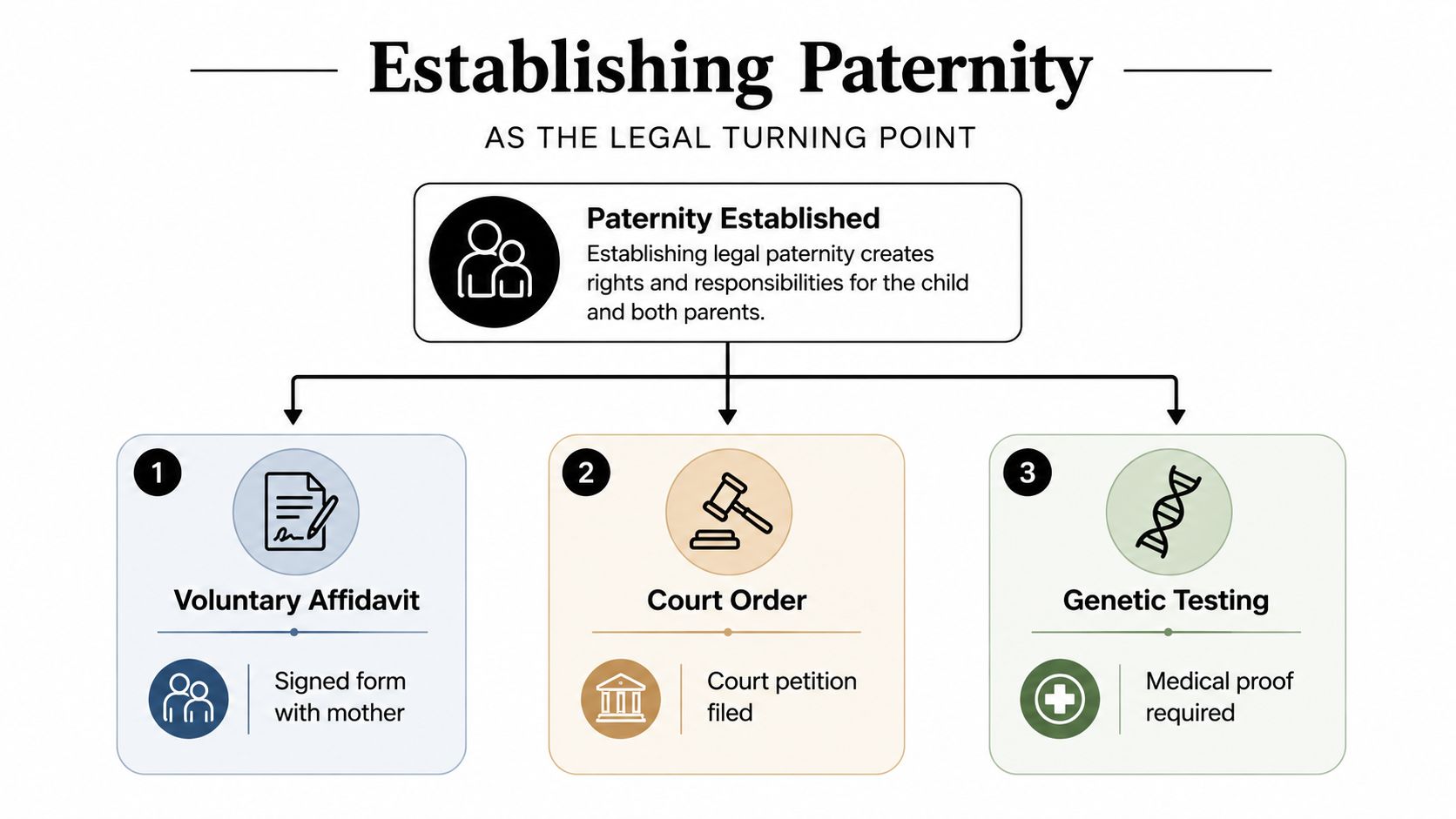
Establishing Paternity as the Legal Turning Point
For unmarried parents, establishing paternity is usually the first legal question. North Carolina recognizes several ways to do it, and the right path depends on whether both parents agree and whether parentage is disputed.
Voluntary acknowledgment
The parents may complete a legally recognized affidavit acknowledging parentage. Federal child welfare guidance explains that when the birth parent was unmarried from conception through birth, the other parent's name isn't entered on the birth certificate unless both parents complete an affidavit acknowledging parentage. A signed acknowledgment can therefore become one of the earliest legal steps affecting the father's status.
The form may be completed at the hospital or later through the appropriate vital-record process, including through the Register of Deeds. Parents should understand what they're signing before completing it. A voluntary acknowledgment can carry legal consequences even though it doesn't itself establish a parenting schedule.
Marriage after the child's birth
Marriage after birth can establish the legal relationship under North Carolina's paternity framework. That doesn't mean marriage is required for custody, and it doesn't automatically create a parenting plan. It provides one recognized route to resolving the parentage issue.
This is separate from divorce residency rules. For example, North Carolina Divorce Residency Requirements addresses the six-month residency rule for filing divorce in North Carolina, not the requirements for starting an unmarried-parent custody case.
A civil paternity action
If the parents disagree, a parent may file a civil paternity action. North Carolina law allows paternity to be established before the child turns 18, according to the legal summary of North Carolina custody laws for unmarried parents. A court may address genetic testing and other evidence relevant to parentage before entering an order.
For example, if a father believes he is the biological parent but the mother disputes it, he can ask the court to determine paternity. The court may consider the parties' evidence and medical proof, including genetic testing when appropriate. Once paternity is established, custody, visitation, and support can proceed under the same general framework applied to other custody cases.
For a focused discussion of the father's position after this milestone, review a father's rights in North Carolina. The central answer is straightforward: establish paternity first, then address custody and visitation.
Legal Custody and Physical Custody Explained
Parents often use “custody” as if it describes one thing. In North Carolina, it helps to separate two related questions: who makes major decisions and where the child lives.
Legal custody concerns important choices about education, medical care, religious upbringing, and other major areas of the child's life. Physical custody concerns the child's living arrangements and daily care. One parent may have primary physical custody while both parents share legal custody.
Two separate maps
Think of legal custody as the decision-making map and physical custody as the sleeping-and-routine map. A child might live primarily with the mother during the school week, spend scheduled time with the father, and still have both parents participate in major educational and medical decisions.
A court may award:
- Joint legal custody: Both parents share significant decision-making authority.
- Sole legal custody: One parent has authority to make those decisions.
- Primary physical custody: The child lives mainly with one parent, subject to the other parent's schedule.
- Joint physical custody: Both parents have substantial periods of physical care, as defined by the order.
The specific terms matter. A parent with visitation isn't necessarily entitled to make every medical or school decision. A parent with joint legal custody may not have the right to change the child's residence without following the order or obtaining court approval.

What changes without an order
Without a custody order, the parents may lack clear, enforceable rules for exchanges, holidays, school communication, and major decisions. A parent who has been following a verbal schedule can't assume the other parent must continue honoring it.
North Carolina's G.S. 50-13.2 governs custody and visitation rights and includes provisions addressing circumstances such as military-parent issues and taking a child out of state. The North Carolina custody statute gives courts authority to set custody and visitation terms. That makes legal advice especially important when one parent proposes moving the child across state lines.
How North Carolina Courts Apply the Best Interest Standard
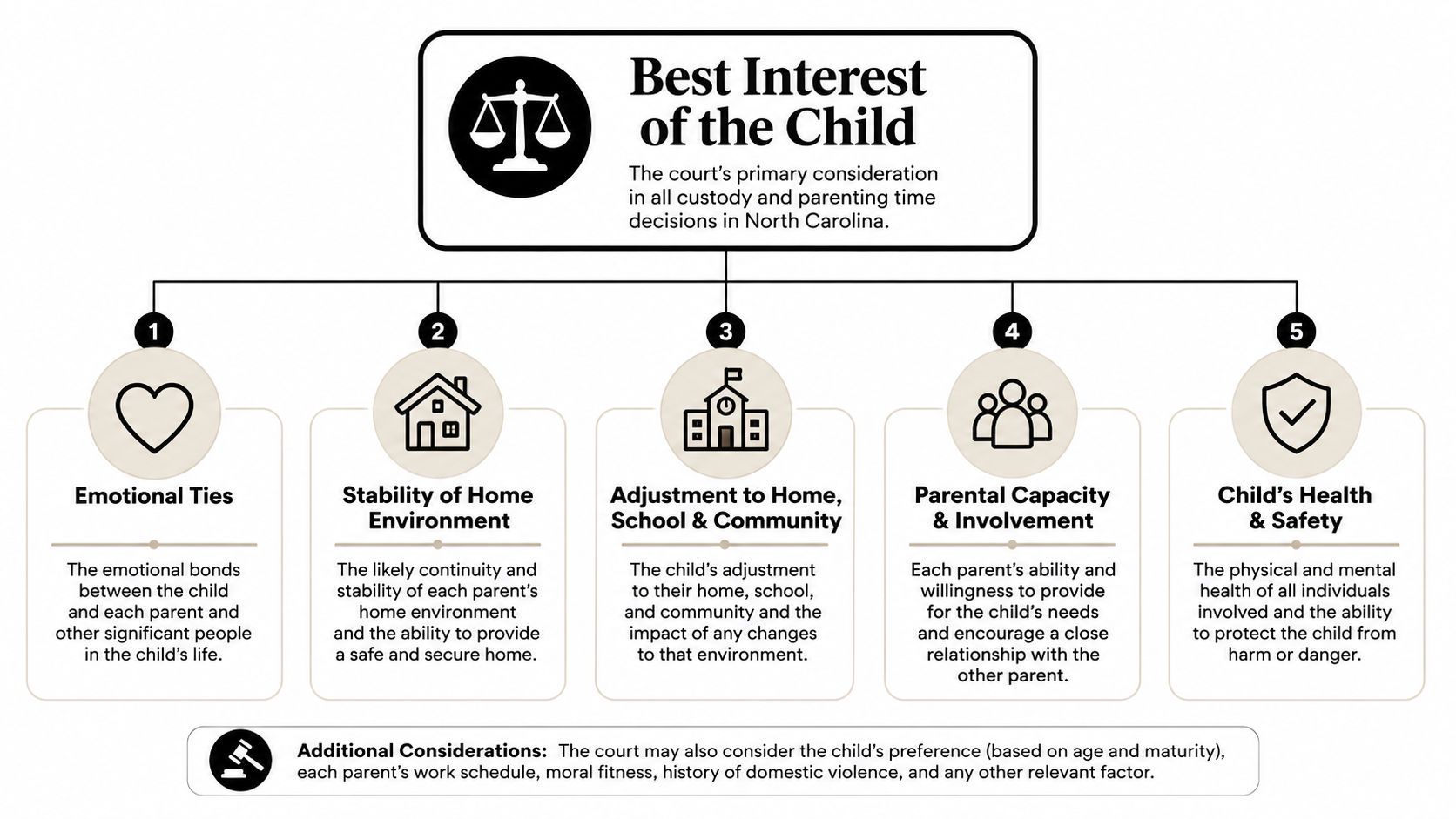
North Carolina courts decide custody based on the best interest of the child, not on an automatic preference for mothers or fathers. The court examines the child's actual circumstances and each parent's ability to support the child's welfare.
Judges may consider the child's relationship with each parent, the stability of each home, each parent's ability to meet medical, educational, emotional, and daily needs, and the child's adjustment to home, school, and community. A child's preferences may matter when the child has enough age and maturity for the preference to be meaningful, but the child doesn't get to decide the case.
Evidence matters more than labels
A parent's criticism of the other parent may carry little weight unless it connects to the child's safety or welfare. Courts can take concerns about domestic violence, substance abuse, neglect, instability, or unsafe people in the home seriously. The court may also address relocation plans, especially if a proposed move would interfere with the other parent's relationship or make the existing schedule impractical.
The statute doesn't create a simple checklist where one factor automatically wins. A parent who works long hours isn't automatically unsuitable, just as a parent who stays home isn't automatically entitled to primary custody. The court weighs the full picture.
A worked example
Suppose the mother has handled most daily care and the child is settled in her home and school. The father recently established paternity and now seeks regular parenting time. He has a safe home, reliable transportation, and a strong relationship with the child, but his work schedule changes frequently.
A judge might preserve the child's school-week routine with the mother while creating a dependable schedule for the father. The order could address decision-making, exchanges, holidays, transportation, and communication. If evidence showed substance abuse or domestic violence, the court might impose protective conditions or limit contact, depending on the facts.
The outcome turns on evidence connected to the child's welfare. Keeping a calendar, saving relevant messages, documenting missed exchanges, and collecting school or medical records can help an attorney present facts instead of general accusations.
Filing for Custody and Navigating the Court Process
Once the parentage issue is resolved, either parent may begin a custody case. The case generally starts in district court, often in the county where the child or a parent resides, but venue and jurisdiction can depend on the facts. A North Carolina family law attorney can help identify the appropriate county and prepare the pleadings.
The usual starting documents
A custody filing commonly includes a complaint for custody and a summons. The filing tells the court what orders the parent is requesting, while service gives the other parent formal notice. Depending on the county and case, parents may also complete parenting questionnaires or related court forms.
The other parent must receive proper service. Informal text messages or an email may not replace formal service requirements. Filing incorrectly can delay the case or create avoidable problems, particularly when the other parent lives outside North Carolina.
Temporary relief and mediation
A parent may request a temporary custody order when the child needs structure or protection while the case is pending. A temporary order can establish an interim schedule, decision-making rules, transportation arrangements, or other conditions. It's a bridge arrangement, not necessarily the final result.
The court may also require custody mediation before a final hearing. Mediation gives parents an opportunity to develop a parenting agreement with help from a neutral mediator. It can reduce disputes over practical details, but parents should understand the proposed terms before signing anything.
For a closer look at interim relief, see how to get temporary custody. If mediation doesn't resolve the dispute, the case proceeds toward a hearing. The judge may receive testimony, documents, communications, school records, medical information, and other evidence before entering a custody order.
How Custody Affects Child Support in North Carolina
A custody order sets the parenting arrangement. Child support addresses the child's financial needs and each parent's responsibility to contribute. These are separate legal questions, yet the custody schedule can affect the support calculation.
Paternity is the practical starting point for an unmarried parent. Before legal parentage is established, a parent may not have enforceable custody rights or a support obligation determined through the court. After paternity is established, the court can address custody and support as related, but distinct, matters.
North Carolina generally calculates support under the state's Child Support Guidelines. The calculation may consider each parent's income, health insurance costs, work-related childcare expenses, and the number of overnights in the actual or ordered schedule. For a closer explanation, see North Carolina child support calculations.
The schedule can change the calculation
If the child lives primarily with one parent and spends regular overnights with the other, the court may apply the parenting schedule together with income and expense information. A substantially different schedule may justify reviewing the support amount. The schedule is one input, not a simple price assigned to each visit.
Accurate records matter. Parents should gather pay records, insurance documentation, childcare invoices, and other financial materials instead of relying on rough estimates. An attorney can help identify which income sources and expenses belong in the calculation.
Child support belongs to the child. A parent generally cannot cancel the other parent's court-ordered parenting time because support is unpaid.
The same rule works in reverse. A parent generally cannot withhold support because the other parent missed a visit. Each obligation requires the appropriate legal process. If the child faces an immediate safety risk, seek prompt legal guidance rather than using support or visitation as a bargaining tool.
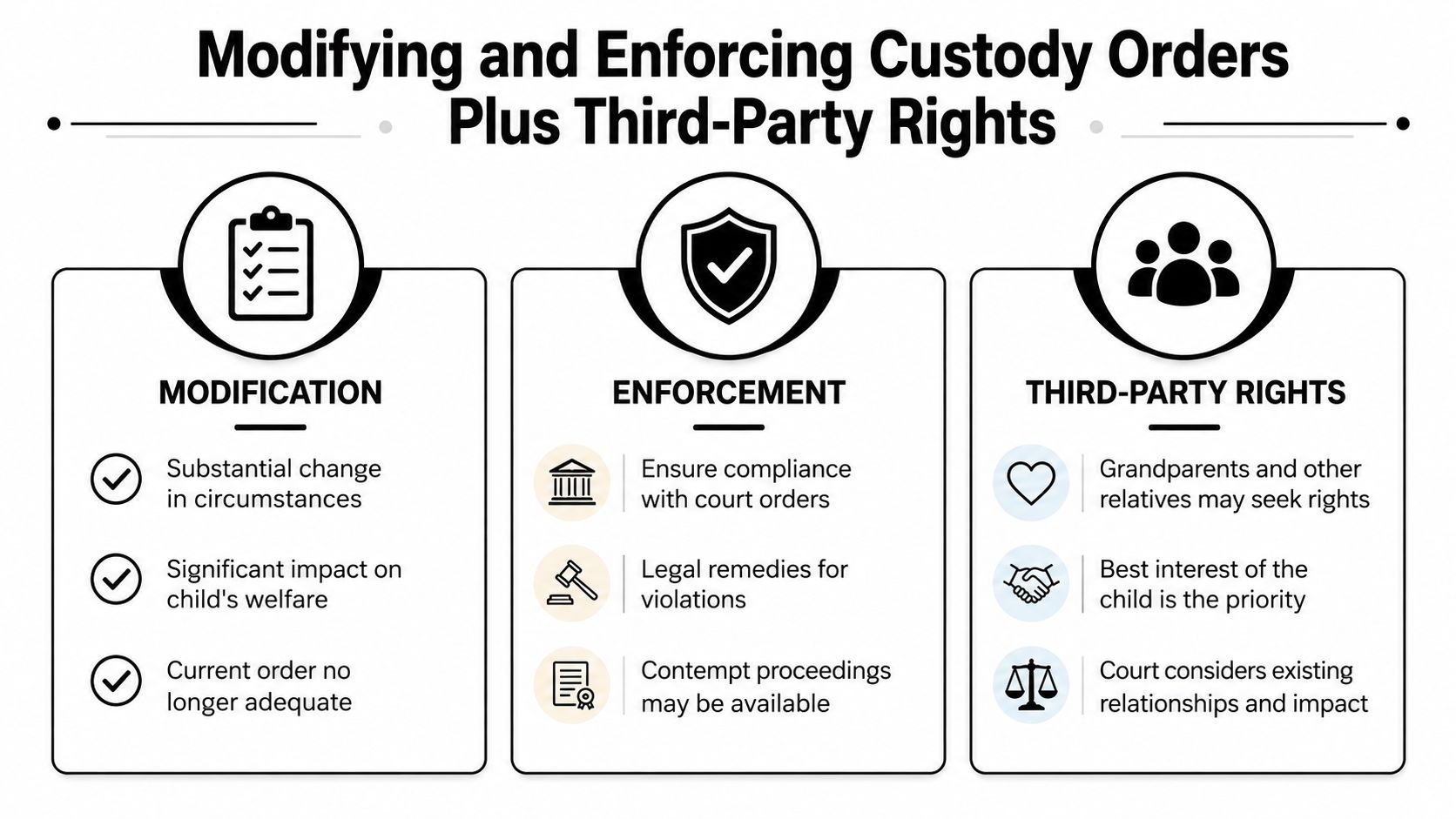
Modifying and Enforcing Custody Orders Plus Third-Party Rights
A custody order can fit the family's circumstances when entered and become inadequate later. For example, a parent may accept a job requiring relocation, the child may develop new educational or medical needs, or a safety concern may emerge. North Carolina modification generally requires a substantial change in circumstances affecting the child's welfare.
When modification may be appropriate
A move isn't automatically enough to change custody. The court looks at how the proposed relocation affects the child, the current schedule, transportation, school, and the relationship with each parent. A parent's serious illness or a significant change in the child's needs may also support a request for modification.
The requesting parent should connect the changed circumstance to the child's welfare. “The other parent is difficult” is usually less useful than specific evidence showing missed medical care, repeated schedule failures, unsafe conduct, or a proposed move that would make the existing order unworkable.
Enforcing the existing order
If the other parent refuses to follow the order, document the violation and review the language carefully. Depending on the circumstances, a parent may file a motion to enforce, request contempt remedies, or seek make-up parenting time. Courts need specific information about what the order required, what happened, and how the violation affected the child or the parenting schedule.
A grandparent or another third party faces a different legal path. A non-parent doesn't receive custody or visitation merely because they've helped raise the child. They generally must satisfy a higher legal standard and show circumstances that justify court intervention, such as a parent's conduct affecting the third party's relationship or the child's welfare.
For example, a grandparent who has provided extensive care may have important facts, but the court still must apply the governing constitutional and custody principles. A third party should avoid assuming that a close relationship alone guarantees visitation or custody.
Common Misconceptions and Your Next Steps in North Carolina
Several beliefs repeatedly create trouble for unmarried parents:
- “Mothers always win custody.” North Carolina courts apply a child-centered custody analysis, not an automatic maternal preference.
- “An unmarried father has no rights unless he goes to court.” Court may be unnecessary if paternity and parenting are resolved cooperatively, but legal paternity remains the key threshold for the father's statutory custody position.
- “Living together creates custody rights.” Cohabitation doesn't replace a legal paternity determination or create a custody order.
- “Leaving the family home means losing the child.” Moving out may affect the practical evidence about daily care, but it doesn't automatically decide custody.
Start by confirming whether paternity was established and obtaining copies of any acknowledgment, birth-record documentation, or court order. Keep a factual parenting record, preserve important messages, gather school and medical information, and organize income, insurance, and childcare records.
Don't make major changes to the child's residence, school, or schedule without understanding the legal consequences. A North Carolina family law attorney can assess whether you need a paternity action, custody filing, temporary relief, negotiated parenting agreement, or enforcement strategy.
The Law Office of Bryan Fagan helps North Carolina parents address paternity, custody, visitation, child support, modifications, and enforcement with practical legal guidance. To discuss your circumstances and available options, visit the Law Office of Bryan Fagan and schedule a consultation.