When you're navigating a separation or divorce in North Carolina, one of the most pressing questions is often, "How will our custody arrangement impact child support?" The answer is simple: your custody schedule isn't just a minor detail—it is the single most important factor that drives the child support calculation. The number of overnights your child has with each parent directly determines which formula the state uses to calculate the final support amount.
You simply cannot separate parenting time from financial obligations in North arolina. The two are fundamentally linked by state law. Understanding this connection is the first step toward anticipating your financial responsibilities and protecting your family's future.
The Direct Link Between Custody Schedules and Child Support Calculations in NC
Parents often ask how custody affects child support, and the answer always comes back to North Carolina’s “income shares model.” This model isn't a one-size-fits-all formula; it relies on specific official worksheets chosen based on your exact parenting schedule.
The most critical distinction is between "primary" and "shared" physical custody, as this determines whether the court uses Worksheet A or Worksheet B. The dividing line is precise.
To use the shared custody calculation (Worksheet B), a parent must have the child for at least 123 nights per year. If your parenting time falls even one night short of this threshold, your case falls into a primary custody scenario, which requires using Worksheet A. This almost always results in a higher child support payment for the non-primary parent.
Real-World Scenario:
Imagine Parent A has the child for 120 nights, while Parent B has the child for 245 nights. Even though Parent A has significant time with the child, they fall short of the 123-night threshold. The court must use Worksheet A, likely leading to a higher child support payment for Parent A than if they had just three more overnights.
Knowing your exact overnight count is the first and most critical step in understanding your potential financial obligation. For a deeper look, you can explore our guide on how child support is calculated with shared custody in NC.
How to Use the NC Child Support Worksheets A, B, and C
When calculating child support in North Carolina, everything hinges on one of three official forms. These aren't just suggestions—they are the required tools used by judges and attorneys across the state. The specific custody schedule you have determines exactly which worksheet applies to your case.
It all comes down to the number of nights the child spends with each parent annually.
- Worksheet A (Primary Custody): This form is used when one parent has the child for fewer than 123 nights during the year. The parent with more time is the "primary custodial parent."
- Worksheet B (Shared Custody): If both parents have the child for at least 123 nights each, you'll use this worksheet. The calculation acknowledges that both parents are shouldering significant day-to-day costs.
- Worksheet C (Split Custody): This worksheet is for less common situations where parents have more than one child and they "split" primary custody—for example, one child lives primarily with Parent A and another child lives primarily with Parent B.
The number of overnight visits is the key that unlocks the entire calculation, as the infographic below illustrates.
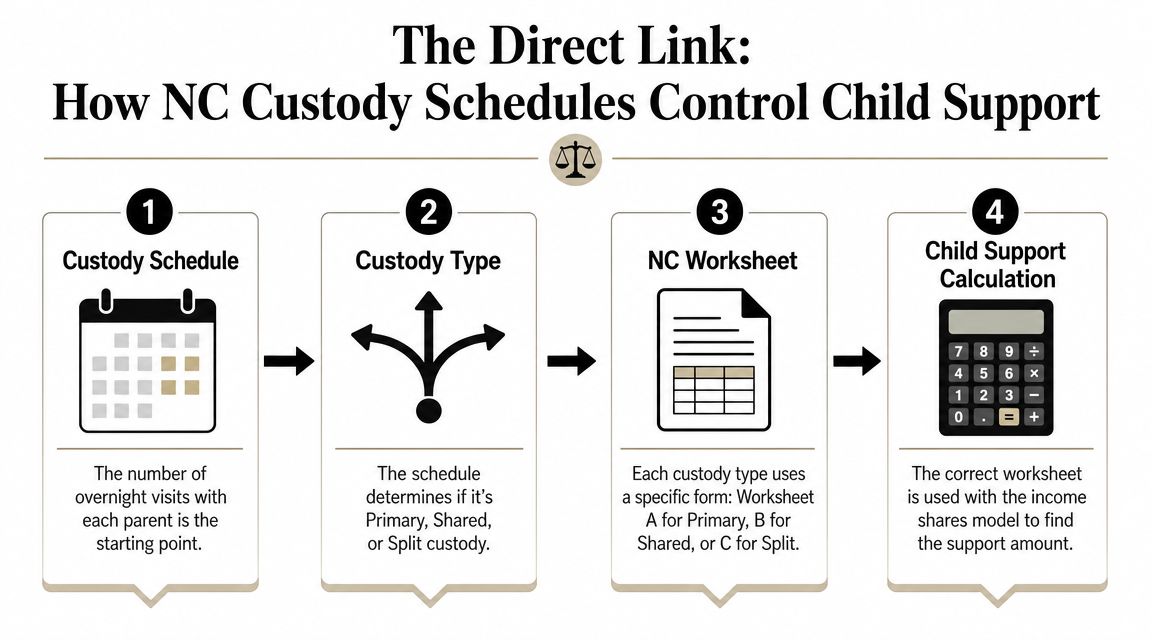
As you can see, you don't get to choose which worksheet you prefer. Your custody schedule makes that decision for you. To get a closer look at these forms and how they work, explore our detailed guide to the NC Child Support Worksheet and its specific rules.
Costs Beyond the Basic Child Support Calculation
A common misconception is that North Carolina's child support calculation ends with incomes and parenting time. In reality, that’s just the starting point. The North Carolina Child Support Guidelines recognize that raising a child involves major expenses beyond basic needs, and it has a system to ensure those costs are shared fairly.
Certain significant expenses are added directly on top of the basic support obligation. These typically include:
- Work-related childcare expenses
- Health insurance premiums paid for the child
- Extraordinary expenses, such as recurring medical treatments, special education needs, or costs for private school if agreed upon.

Think of it this way: if one parent pays the entire $900 per month daycare bill and also pays $250 per month for the child's health insurance, that full $1,150 is added to the total support figure before it's divided. The responsibility for that $1,150 is then split between the parents based on their proportional share of their combined income.
Practical Example:
Let's say Parent A earns 60% of the parents' combined income and Parent B earns 40%.
- The $900 daycare cost is added to the calculation. Parent A is responsible for $540 (60%) and Parent B for $360 (40%).
- The $250 health insurance premium is also added. Parent A is responsible for $150 (60%) and Parent B for $100 (40%).
- If Parent B pays the full premium upfront, they will receive a credit for Parent A's share in the final support transfer.
Overlooking or miscalculating these figures can lead to a support order that is inaccurate by thousands of dollars per year. Meticulous documentation is absolutely essential.
When Can a Judge Deviate from the NC Child Support Guidelines?
While the North Carolina child support worksheets provide a presumptive starting point, they aren’t set in stone. The law recognizes that no two families are exactly alike, and sometimes the standard formula doesn’t fit the reality of a situation.
Under North Carolina General Statute § 50-13.4(c), a judge has the discretion to order a child support amount that is higher or lower than the guidelines suggest. They can do this if they find that applying the formula would be unfair or would not meet the child’s actual needs.
This is not something a judge does lightly. To "deviate" from the guidelines, the judge must provide a clear, written explanation justifying their decision. This means it’s up to you and your attorney to present compelling evidence showing exactly why a different amount is necessary.
The child support calculator produces a presumptive amount, but it’s not the final word. A judge can adjust the payment up or down if the specific facts of your case show that it’s the right thing to do.
Common reasons for deviation include:
- A parent having an exceptionally high income (where the guidelines max out).
- A child with significant special needs requiring expensive therapies or equipment.
- One parent facing substantial travel costs to exercise their visitation time.
A judge can also act if they believe a parent is intentionally underemployed or unemployed to reduce their support obligation. In these cases, the court can "impute" income, basing the support calculation on what that parent should be earning, not what they are currently earning.
Changing Your Child Support After a Custody Order Changes
Just because a child support order is in place doesn’t mean it’s permanent. Life is unpredictable, and North Carolina law provides a way for support orders to change, too.
However, you cannot simply stop paying or change the amount on your own, even if you and the other parent have a verbal agreement. To make any change legally binding and enforceable, you must file a formal Motion to Modify with the court that issued the original order.
Proving a "Substantial Change in Circumstances"
To convince a judge to modify child support, you must prove there has been a “substantial and material change in circumstances.” This isn't a minor inconvenience; it must be a significant event that impacts your finances or your child’s needs.
Common examples that meet this legal standard in North Carolina include:
- A major shift in the custody schedule (e.g., moving from a primary custody arrangement to a 50/50 split).
- An involuntary job loss or, conversely, a major promotion for either parent that causes a 15% or more change in the support amount.
- A change in the child's needs, such as the end of daycare expenses or a new medical diagnosis.
It is absolutely crucial to act quickly. Any modification a judge grants is typically only retroactive to the date you officially filed your motion. Waiting to file can cost you thousands, as you won't get credit for any overpayments or relief from payments you couldn't afford before you took legal action.
You can learn more about the specific steps involved in our guide to child support modification in NC.
Why You Cannot Trade Visitation for Child Support in NC
It's a scenario that often arises from frustration: one parent stops paying child support, so the other retaliates by withholding visitation. Or, a parent who is denied their court-ordered time with their child decides to stop making payments.
While the frustration is understandable, both of these actions are illegal in North Carolina and can result in serious legal consequences, including being held in contempt of court.

North Carolina law treats these as two completely separate and independent legal duties. Think of them as parallel tracks that never cross.
- Child Support: A parent's financial duty to their child.
- Visitation (Parenting Time): A parent's legal right to see their child, as well as the child's right to see the parent.
One obligation simply does not cancel out the other. As the North Carolina State Bar makes clear, a lack of child support is never a legal reason to deny visitation, and being denied visitation is not a valid reason to stop paying support.
Trying to enforce the order yourself can backfire badly. The only proper way to address these violations is to file a Motion for Contempt or a Motion to Enforce with the court.
You can learn more about the state's legal position on child support from the NC State Bar and why handling these issues through the proper legal channels is so critical.
Frequently Asked Questions About NC Custody and Child Support
Navigating the specifics of North Carolina's child support and custody laws can feel overwhelming. Here are clear, straightforward answers to some of the most common questions we hear from families in your situation.
If we have 50/50 custody in NC, does anyone pay child support?
Yes, it's very common for one parent to pay child support even with a true 50/50 custody schedule. This often surprises people. The court's goal is to ensure the child enjoys a reasonably consistent standard of living in both homes. The calculation, which uses Worksheet B for shared custody, looks at both parents' gross monthly incomes. If there's a significant difference in your earnings, the higher-earning parent will almost always have a child support obligation.
How many overnights do I need to reduce child support in NC?
The magic number in North Carolina is 123 overnights per year. Reaching this critical threshold is a game-changer. Once your parenting plan gives you 123 or more nights, the court switches from Worksheet A (primary custody) to Worksheet B (shared custody). This shift almost always results in a lower child support payment because the formula officially recognizes that you are covering a substantial portion of the child’s day-to-day expenses during your parenting time.
Does child support in NC automatically stop when my child turns 18?
Not necessarily, and this is a crucial detail many parents miss. Under North Carolina law (N.C.G.S. § 50-13.4), the support obligation can continue past a child’s 18th birthday. If your child is still enrolled in high school and making good progress toward graduating, support continues. The obligation only terminates when your child either graduates, stops attending school regularly, or turns 20—whichever of these events comes first. This applies unless your separation agreement states otherwise.
Get Strategic Guidance for Your NC Custody and Support Case
Figuring out North Carolina's custody and child support rules is far more complex than plugging numbers into an online calculator. It requires a strategic legal plan developed by an attorney who understands the nuances of the worksheets, the grounds for deviation, and the process for modifications. Our firm is dedicated to providing North Carolina residents with clear, empathetic, and experienced legal guidance.
We don't just explain the law—we build a case focused on protecting your rights and securing a fair outcome that fits your family's unique circumstances. We help you understand how custody affects child support in NC so that every detail, from parenting time to medical expenses, is correctly presented to protect your financial stability and your child’s well-being.
Whether you're establishing a new order, seeking to modify an old one, or in the middle of a difficult dispute, our client-focused approach ensures your side of the story is heard. Don't leave your finances and your child’s future to chance.
Contact the Law Office of Bryan Fagan to schedule a consultation with our North Carolina team and find a clear path forward. You can reach us at https://bryanfaganlaw-nc.com.