You're driving home in North Carolina when blue lights appear behind you. The officer says your speed was dangerous, writes a reckless driving citation, and gives you a court date. You leave thinking you received a serious ticket. In reality, reckless driving in North Carolina can create three separate problems at once: a criminal charge, DMV consequences, and insurance exposure.
The first question isn't whether you can pay the citation. Paying may amount to accepting a conviction, and that conviction can affect your record, license, and insurance long after the court appearance. The right response is to understand the charge, protect evidence, and get advice before making a plea.
What a Reckless Driving Charge Really Means in North Carolina
A North Carolina driver stopped for dangerous speed or aggressive driving may face a criminal charge, not merely a civil traffic infraction. Under G.S. 20-140, the core reckless driving offense is a Class 2 misdemeanor. That classification changes how you should respond from the start.
A conviction can expose you to jail and a fine. The court penalty is only one layer. The same outcome can add DMV points, affect your license, and trigger an insurance surcharge. Paying attention only to the fine can leave you unprepared for the record, driving, and insurance consequences that follow.
Three consequences can stack together
A reckless driving case creates three connected consequences:
- Criminal court: You are defending a misdemeanor charge, not merely disputing a ticket.
- Driver's license: A conviction creates DMV point exposure and may contribute to suspension consequences.
- Insurance: North Carolina's insurance point system can impose a substantial surcharge after conviction.
The statute addresses conduct such as driving carelessly and heedlessly in willful or wanton disregard for safety, or driving without due caution in a way likely to endanger people or property. It also provides more serious consequences when serious injury or serious bodily injury results. The core offense is a Class 2 misdemeanor, while injury-related circumstances can raise the charge to a Class 1 misdemeanor or Class A1 misdemeanor. G.S. 20-140
Practical rule: Do not treat the citation as a bill. Treat it as the starting document in a criminal case.
A reduction or dismissal may improve the criminal outcome, but its effect on DMV points and insurance depends on the final disposition and applicable rules. Review that entire cascade before entering a plea. Have a North Carolina defense attorney examine the citation, alleged speed, driving behavior, traffic conditions, and your existing record together. That review gives you a clearer basis for deciding whether to contest the charge, seek a reduction, or resolve it in another way.
How G.S. 20-140 Defines the Offense
A reckless driving citation can rest on different legal theories. The subsection listed on the citation matters because it identifies the conduct the prosecutor must prove and affects how your defense should be prepared.
Three ways the state may allege reckless driving
Subsection (a) covers driving in a careless or reckless manner without regard to the highway's width, traffic, use, or other conditions. The issue is how you drove and whether your conduct showed disregard for the safety of people or property.
Subsection (b) covers driving on a highway at a speed of more than 80 miles per hour or more than 15 miles per hour over the posted limit, as described in G.S. 20-140. The alleged speed may form the state's main evidence, but the surrounding facts still matter. The citation, measured speed, road conditions, traffic, and officer's observations should all be reviewed.
Subsection (c) addresses aggravated speeding in a school zone or work zone. The location can change the state's theory because the statute treats certain speed-related conduct in those areas more seriously than ordinary speeding.
The statute also addresses cases involving injury or property damage. Those facts can raise the offense from the basic Class 2 misdemeanor level to a more serious misdemeanor, and an injury-related conviction may carry mandatory license revocation under the applicable law. Your lawyer should compare the exact charging language with the evidence instead of assuming every reckless driving case follows the same path.
G.S. 20-140 at a Glance
| Subsection | Conduct Charged | Misdemeanor Class |
|---|---|---|
| G.S. 20-140(a) | Careless or reckless driving showing disregard for safety or conditions | Class 2 misdemeanor |
| G.S. 20-140(b) | More than 80 mph or more than 15 mph over the posted limit on a highway | Class 2 misdemeanor |
| G.S. 20-140(c) | Aggravated speeding in a school zone or work zone | Class 2 misdemeanor |
The subsection affects more than the courtroom. It can shape the criminal charge, the DMV consequences, and the insurance impact that follows a conviction. Bring the citation and any available crash, dashcam, or witness information to a North Carolina defense attorney before entering a plea. The right review starts with identifying exactly what the state says you did.
Penalties, Points, and Insurance Consequences
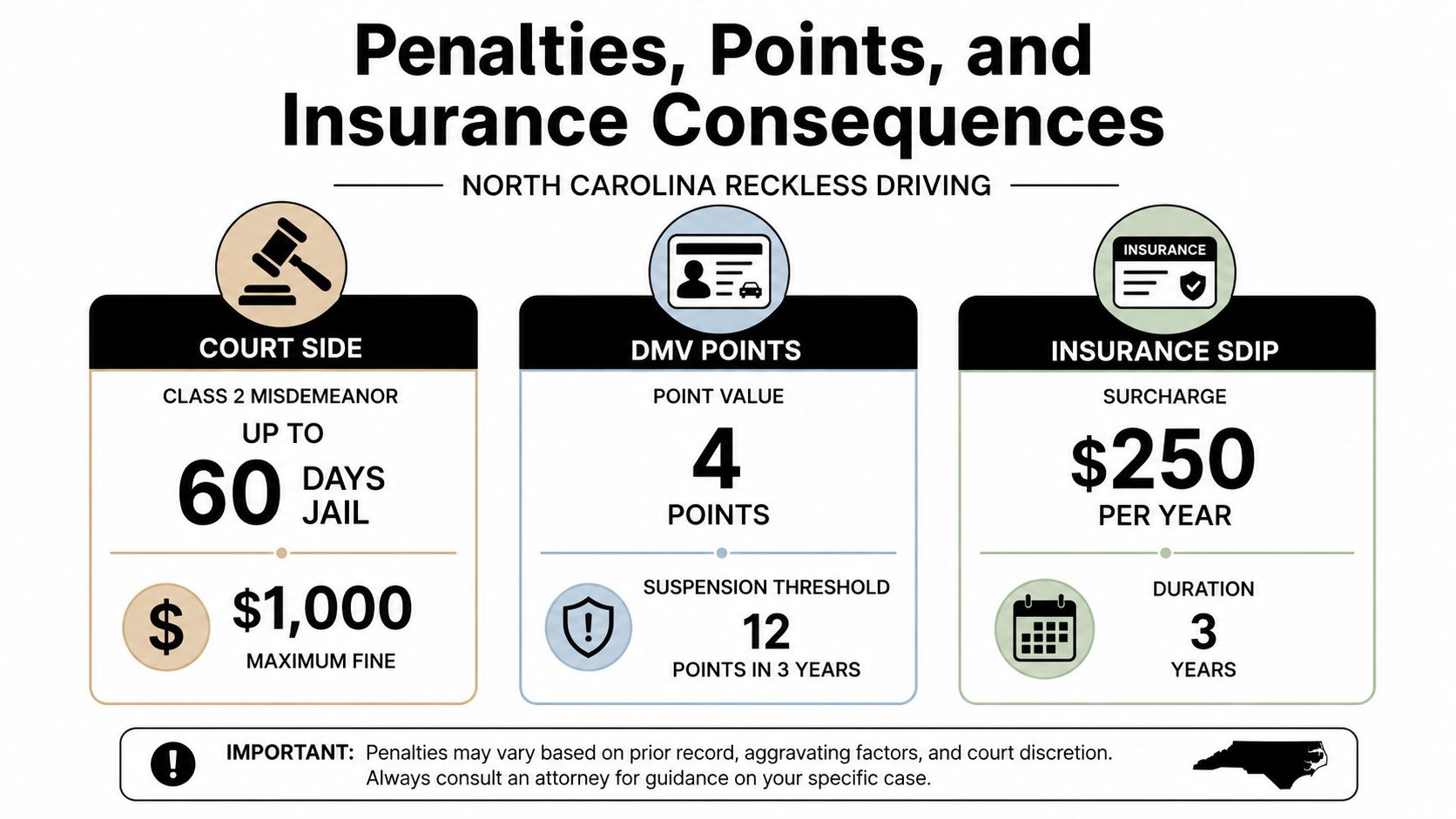
A reckless driving conviction creates three separate problems at once: criminal sentencing, DMV points, and higher insurance costs. For a person with a prior record, a Class 2 conviction can bring up to 60 days in jail and a maximum fine of $1,000. Someone with no prior record faces a lower jail maximum. Review the North Carolina reckless driving law information before treating the citation like an ordinary ticket.
The judge may also order probation, community service, or driving-related conditions. Jail is not automatic, but it remains possible because reckless driving is a criminal charge. The facts, your record, and the way the case is resolved will shape the sentence.
DMV consequences
North Carolina assigns 4 driver's license points to ordinary drivers convicted of reckless driving. The DMV may suspend a license after 12 points within 3 years. Check the North Carolina DMV suspension rules and compare your new charge with your existing record.
Existing convictions can put you closer to suspension than expected. Commercial drivers need separate advice because the North Carolina Driver Handbook lists different CDL-related treatment, including 5 points for reckless driving and 6 points for careless and reckless driving under G.S. 20-140(f).
Insurance adds a third layer. Reckless driving commonly falls into North Carolina's 4-point insurance category, which can trigger an 80% surcharge under the Safe Driver Incentive Plan. That increase can continue affecting your budget after the court case ends.
For context on how criminal sentencing levels affect driving-related cases, review North Carolina DWI sentencing levels. Reckless driving is not DWI, but the same lesson applies: the conviction label affects consequences outside the courtroom. Get the citation, driving record, and insurance information reviewed before entering a plea.
Reckless Driving Compared to Related Traffic Offenses
A reckless driving conviction can stack three problems: a criminal record, DMV points, and insurance consequences. The charge is generally more serious than ordinary speeding because North Carolina treats reckless driving under G.S. 20-140 as a misdemeanor. DWI follows a separate statutory framework and may create different, broader consequences.
| Offense | Statute | Classification | DMV Points | Insurance Risk |
|---|---|---|---|---|
| Reckless driving | G.S. 20-140 | Class 2 misdemeanor, with higher misdemeanor classifications when specified serious injury results | 4 points for ordinary drivers | Insurance-point and surcharge exposure |
| Careless and reckless driving | G.S. 20-140.1 | Depends on the charged conduct and disposition | Separate treatment may apply | Depends on the final conviction |
| Improper driving | North Carolina common law offense | Typically treated as a lesser traffic resolution | Depends on the final disposition | Depends on the final disposition |
| Speeding | G.S. 20-141 | Generally an infraction | Depends on the speed and record | Depends on the final conviction |
| DWI | G.S. 20-138.1 | Criminal offense with separate sentencing rules | Separate DWI consequences apply | Separate insurance consequences may apply |
The difference between an infraction and a misdemeanor matters in practice. An infraction usually does not create the same criminal-record consequences as a misdemeanor. Reckless driving requires a defense strategy for a criminal accusation, not just a plan to pay a traffic ticket.
Why the label matters
A prosecutor may consider reducing reckless driving to improper driving if the evidence does not support the full theory, the conduct appears less aggravated, or the driver's record and circumstances support negotiation. A reduction is not automatic. It also may not eliminate every DMV or insurance consequence, so review the proposed disposition before accepting it.
DWI requires a separate analysis. Evidence of alcohol, drugs, impaired faculties, or dangerous driving connected to impairment may support a charge under G.S. 20-138.1 instead of, or alongside, a reckless driving theory. Do not accept a reckless driving plea until you understand how the decision affects your criminal record, driving record, and insurance coverage.
Common Defenses That Hold Up in Court
A defense must fit the evidence. “I was only keeping up with traffic” rarely answers the statutory question. Counsel should test how the officer measured speed, described the driving, and connected the conduct to actual danger. That matters because a weak defense can leave you facing the full cascade: a criminal record, DMV points, and an insurance surcharge.
A measurement problem can change the case
For example, consider a hypothetical scenario involving a driver accused of traveling at a very high speed on I-40. The defense reviews the officer's training records, examines the speed-estimation method, and checks whether the patrol vehicle's speedometer was properly calibrated. If the officer relied on pacing, counsel can question the distance, duration, traffic conditions, and whether the patrol vehicle maintained a reliable speed.
The driver does not have to prove an alternative speed. The state's evidence must withstand testing. An unreliable measurement method, inconsistent testimony, or missing documentation can give the prosecutor a reason to negotiate a lesser resolution. Any proposed reduction still requires a careful review of its criminal-record, DMV, and insurance effects.
Video can help either side
Now consider a different hypothetical scenario involving a driver accused of weaving through traffic near a construction zone. Dashcam footage shows rapid lane changes around other vehicles, limited spacing, and conduct that appears dangerous. That footage may strengthen the state's case instead of helping the defense.
Counsel can still examine whether the stop was lawful under the Fourth Amendment, whether the officer accurately described the conditions, and whether the evidence proves the charged subsection. A clean driving record and responsible conduct after the citation may support mitigation, but they do not erase unfavorable video or testimony.
The practical question is whether the state can prove every required part of its allegation with admissible evidence. A defense built around sympathy is weaker than one tied to a specific gap in proof.
The following video provides general background for drivers reviewing the practical risks of a North Carolina reckless driving charge.
What to Do After a Reckless Driving Citation or Arrest
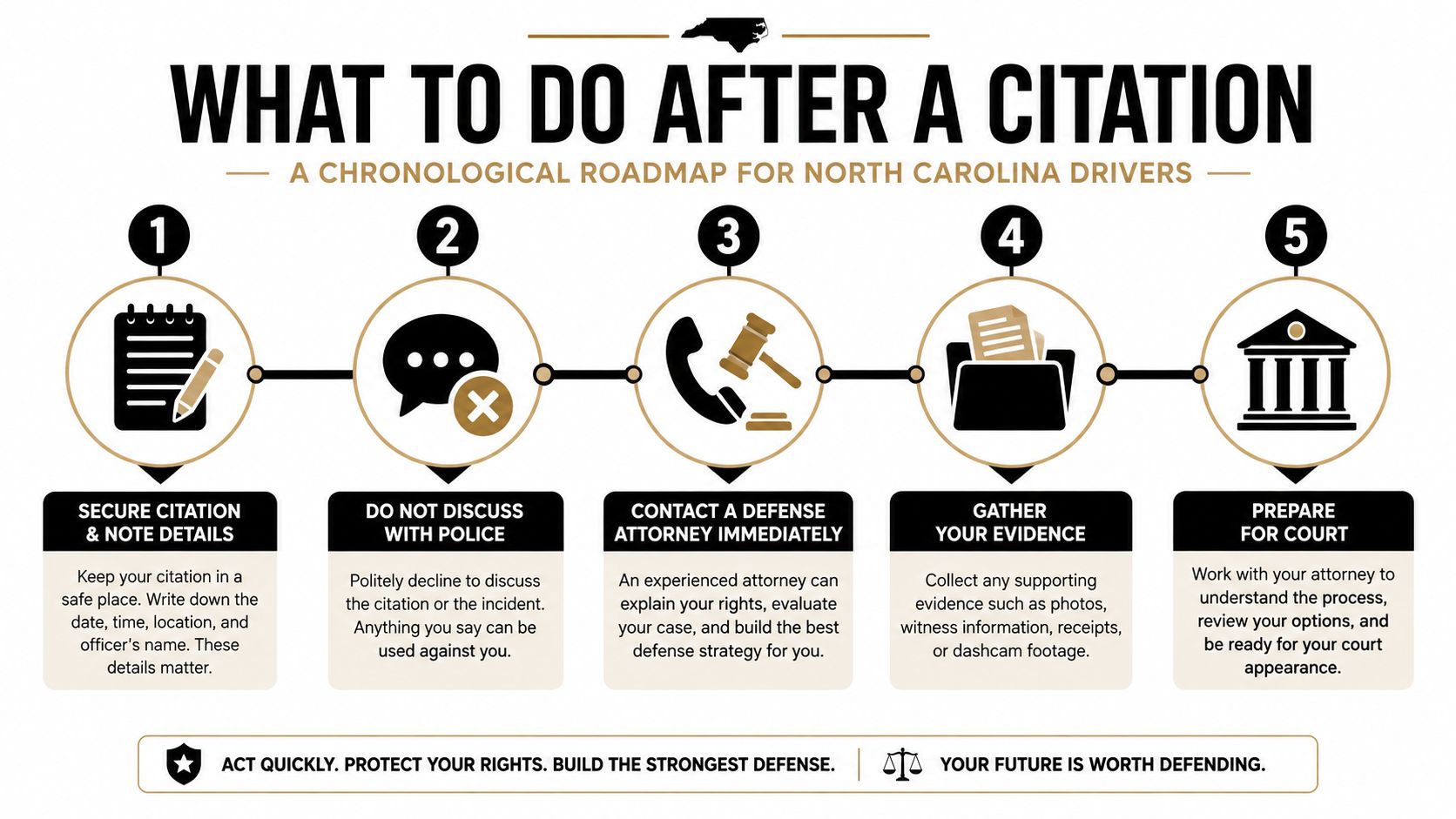
A reckless driving citation can trigger three problems at once: a criminal record, DMV points, and higher insurance costs. Treat the first court date as a deadline, not a routine traffic appearance. Start by securing the citation, identifying the exact statute and subsection, and recording the court date where you will not miss it. Failure to appear can create a separate problem and put your driving privilege at risk.
Follow a practical sequence
- Preserve the citation: Photograph every page and store the original securely.
- Stop discussing the facts with police: Provide required identifying information, but do not volunteer explanations about your speed, traffic, or driving decisions.
- Contact counsel before court: Early review can uncover evidence problems and identify possible reductions before you enter a plea.
- Save evidence: Download dashcam footage, preserve relevant phone-location information, and collect witness contact details while memories remain fresh.
- Review your record: Obtain a certified driving record so counsel can evaluate existing points and prior convictions.
Do not discuss the incident with your insurer unless your policy or an accident requires notice. Casual statements can complicate the insurance issue. Ask counsel what information you must provide and what you should keep private.
Avoid making the situation worse
Drive carefully after the citation. Another conviction can add DMV pressure, increase insurance consequences, and give the prosecutor or judge less reason to view your case favorably. North Carolina also has suspension-related rules for certain combinations of reckless driving and speeding over 55 and up to 80 mph when convictions occur within the relevant period. G.S. 20-16
Bring the citation, insurance information, driving record, and saved evidence to your consultation. Do not wait until court is near. Counsel needs time to investigate, communicate with the prosecutor, and determine whether motions or negotiation can reduce the criminal, DMV, and insurance fallout.
Why Legal Representation Changes the Outcome
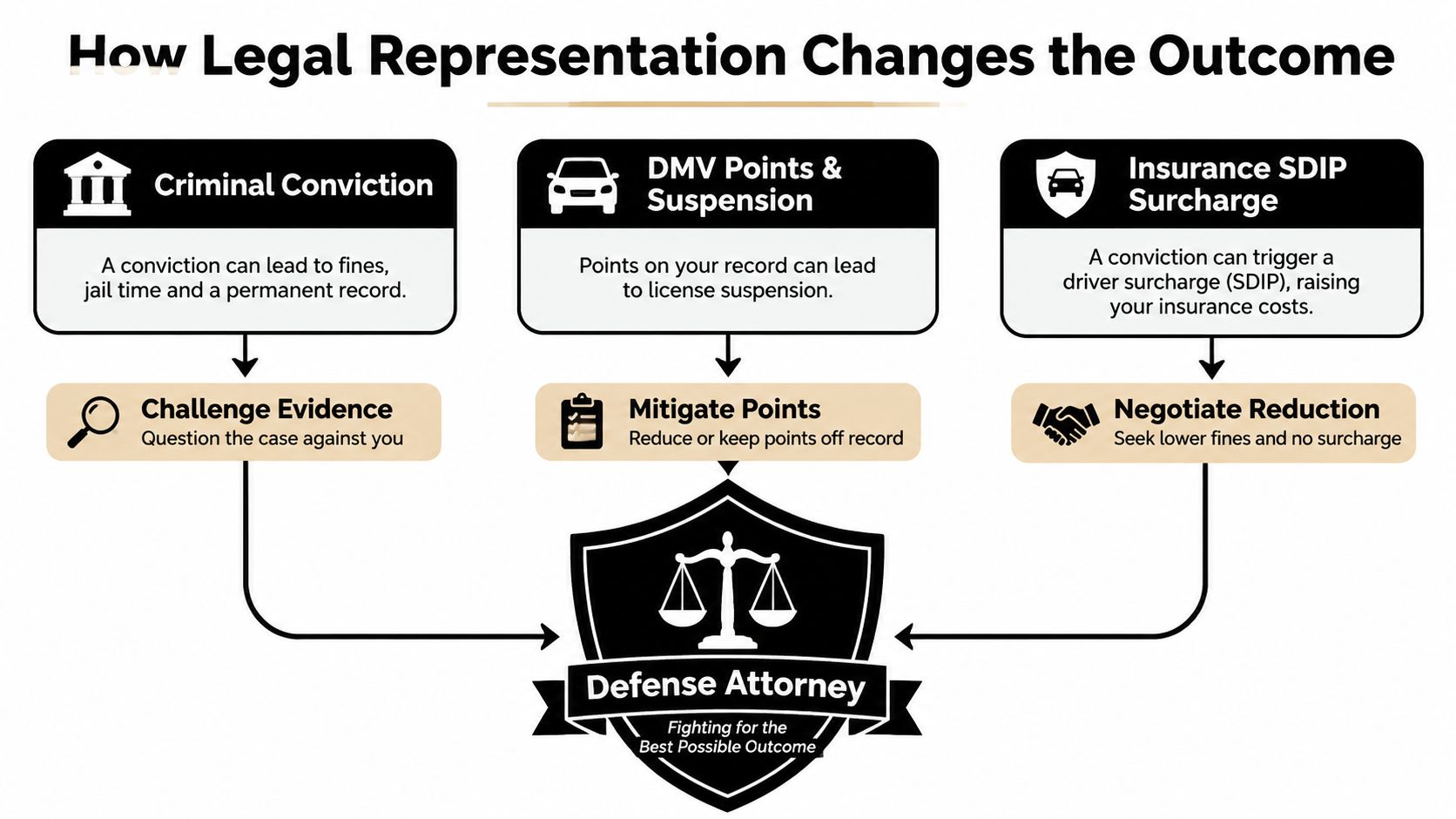
A North Carolina defense attorney should treat reckless driving as a coordinated problem, not an isolated ticket. The first task is to protect the criminal case. That may involve reviewing calibration records, testing pacing testimony, examining dashcam footage, challenging the stop, and negotiating for a lesser disposition when the evidence supports it.
The second task is to evaluate the DMV consequences. Your lawyer needs to know your existing points, whether another conviction is pending, and whether a particular resolution changes your license exposure. North Carolina's DMV system can react to the final conviction, so the language of the negotiated outcome matters.
The third task is insurance planning. A defense lawyer can explain how the proposed disposition may affect insurance reporting and help you avoid making an uninformed plea to end the court appearance. No attorney can promise that a prosecutor, judge, DMV, or insurer will reach a particular result.
Local preparation matters
County procedures, courtroom practices, and prosecutorial policies can differ. A lawyer familiar with Wake, Mecklenburg, Cumberland, and other North Carolina courts can prepare you for the local process while still evaluating the evidence under statewide law.
The Law Office of Bryan Fagan handles North Carolina criminal defense matters, including the strategic review needed when a traffic charge threatens a person's record and driving privileges. The firm also handles unrelated family-law matters, including representation for absolute divorce and related claims through its North Carolina Divorce Lawyer service.
Frequently Asked Questions About Reckless Driving in NC
Is reckless driving a misdemeanor or felony in North Carolina?
The basic offense under G.S. 20-140 is a Class 2 misdemeanor. If the conduct causes serious injury or serious bodily injury, the classification can increase. An accident does not make the charge minor. Have counsel review the exact accusation and resulting criminal exposure.
How long do reckless driving points remain relevant?
DMV points can affect your driving record for 3 years, while insurers may review violation history over a 5-year period. North Carolina traffic penalty information Those systems operate separately from the criminal record, so a conviction can create several layers of consequences. Expungement requires case-specific legal analysis.
Can an out-of-state driver face consequences at home?
Yes. North Carolina may report the conviction through interstate licensing systems and the Driver License Compact. Your home state then decides how the offense affects your license, points, and insurance. Check that state's rules before assuming the North Carolina result ends at the courthouse.
Can reckless driving be reduced to improper driving?
A reduction may be available based on the evidence, your record, and local prosecution practices. It may change the criminal charge while leaving DMV or insurance consequences in place. For example, confirm whether the proposed improper-driving disposition changes the points assessed to your license before you agree to it.
The Law Office of Bryan Fagan offers North Carolina-focused defense representation addressing the criminal case, DMV exposure, and insurance consequences together. Visit Law Office of Bryan Fagan to discuss your citation, court date, driving record, and available options.