
A child comes home with unexplained bruises. A parent disappears for hours while intoxicated with the child in the car. You find messages suggesting the other parent plans to leave North Carolina before the court can act. In those moments, normal custody timelines feel useless.
North Carolina law does have a fast remedy for true emergencies. It’s called an ex parte emergency custody order, and it allows a judge to step in before the other parent is heard, but only in a narrow set of situations. That narrowness matters. Emergency custody NC cases move quickly, but they also face intense judicial scrutiny because the court is being asked to change a child’s situation without the usual notice process.
Parents often assume “emergency” means any serious co-parenting problem. It doesn’t. The law reserves this tool for immediate danger, and judges expect evidence that is specific, current, and credible. If your concern is real, acting fast matters. Acting strategically matters just as much.
When Your Child's Safety is at Immediate Risk
A parent in crisis usually calls after something has already happened. The child says they’re afraid to go back. A school reports troubling behavior. A relative sends photos of unsafe living conditions. Sometimes the warning sign is physical. Sometimes it’s a credible threat that the child will be taken out of state before anyone can stop it.

North Carolina families are not alone in the court system. In a recent reporting period, the state handled 18,521 custody cases, and 2,690 temporary custody matters in domestic violence situations, according to the North Carolina court profile from UNCG and the Administrative Office of the Courts. Most of those were not emergency ex parte cases, but the numbers show how often parents need court intervention to protect children.
What a true crisis often looks like
A true emergency usually has a present-tense problem. The danger is happening now, or it’s about to happen.
Examples include:
- Recent physical harm: The child has fresh injuries and there’s reason to believe returning them would expose them to more harm.
- Sexual abuse concerns: A disclosure, medical concern, or law enforcement involvement points to immediate danger.
- Flight risk: The other parent has made concrete moves to remove the child from North Carolina to avoid court jurisdiction.
A frightening situation can still fall short of emergency custody. Judges separate urgent safety threats from painful but non-emergency parenting disputes.
What usually does not qualify
Parents are often surprised by this part. A missed visitation exchange, a new romantic partner, poor communication, or disagreements over bedtime, schoolwork, or discipline usually won’t support emergency custody by themselves. Those issues may matter in a broader custody case. They just don’t usually justify same-day ex parte relief.
If you’re reading this because you believe your child is in immediate danger, the right question isn’t “Am I upset enough to file?” The right question is “Can I show a judge that the child faces a statutory emergency right now?”
What Exactly Is Emergency Custody in North Carolina
An emergency custody order in North Carolina is a temporary order that can change where a child stays before the other parent receives advance notice. Lawyers call that ex parte, which means one side appears first because waiting could put the child at risk.
This is one of the strongest short-term tools in family court. It’s also one of the hardest to get. Under N.C. Gen. Stat. § 50-13.5(d)(3) as summarized here, a judge may enter that kind of order only if the child faces one of three specific risks, and if the order is granted, the court must schedule a full hearing within 10 days.
North Carolina allows ex parte emergency custody only when a judge finds a substantial risk of bodily injury, sexual abuse, or abduction or removal from the state to evade the court’s jurisdiction.
The three legal grounds in plain English
Bodily injury
This means more than concern that the other parent is careless or makes bad choices. The court is looking for a substantial risk that the child will be physically hurt.
That might involve repeated violence in the home, dangerous impairment while caring for the child, or conditions so unsafe that injury is likely. The focus is not on whether the other parent is flawed. The focus is whether the child is exposed to immediate physical danger.
Sexual abuse
This ground speaks for itself, but courts still require detail. General suspicion is not enough. Judges want facts that explain why emergency action cannot wait for ordinary notice and hearing.
A child’s statement, medical concern, law enforcement report, or other corroborating information may become central here. The request has to connect the facts to an immediate need for court protection.
Abduction or removal from North Carolina
This applies when there is a serious risk the child will be taken out of state to avoid North Carolina court authority. It is not just worry that a parent “might leave someday.”
Courts look for concrete warning signs. Travel plans, direct threats, or conduct showing the parent intends to evade the court all matter more than speculation.
What emergency custody is not
Emergency custody is not a shortcut around a weak custody case. It is not punishment for bad co-parenting. It is not a way to fix late pickups, rude texts, or a household you don’t like.
Common situations that usually do not qualify by themselves include:
- Parenting disagreements: Different rules, routines, or lifestyles.
- Relationship conflict: A new partner or a tense co-parenting dynamic.
- Noncompliance without danger: Missed visits or communication problems, unless they are tied to one of the statutory risks.
Why judges use it sparingly
An ex parte order affects parental rights before both sides are heard. Judges know that. They are balancing child safety with due process, which is why they demand specific facts and a sworn showing of immediate danger.
If the facts fit the statute, emergency custody can protect a child quickly. If they don’t, filing the motion anyway can hurt your credibility from the start.
The Process for Filing an Emergency Custody Motion
Emergency custody NC filings move fast, but the process is more exacting than many parents expect. The court is not looking for a dramatic story. The court is looking for a properly filed request supported by sworn facts.
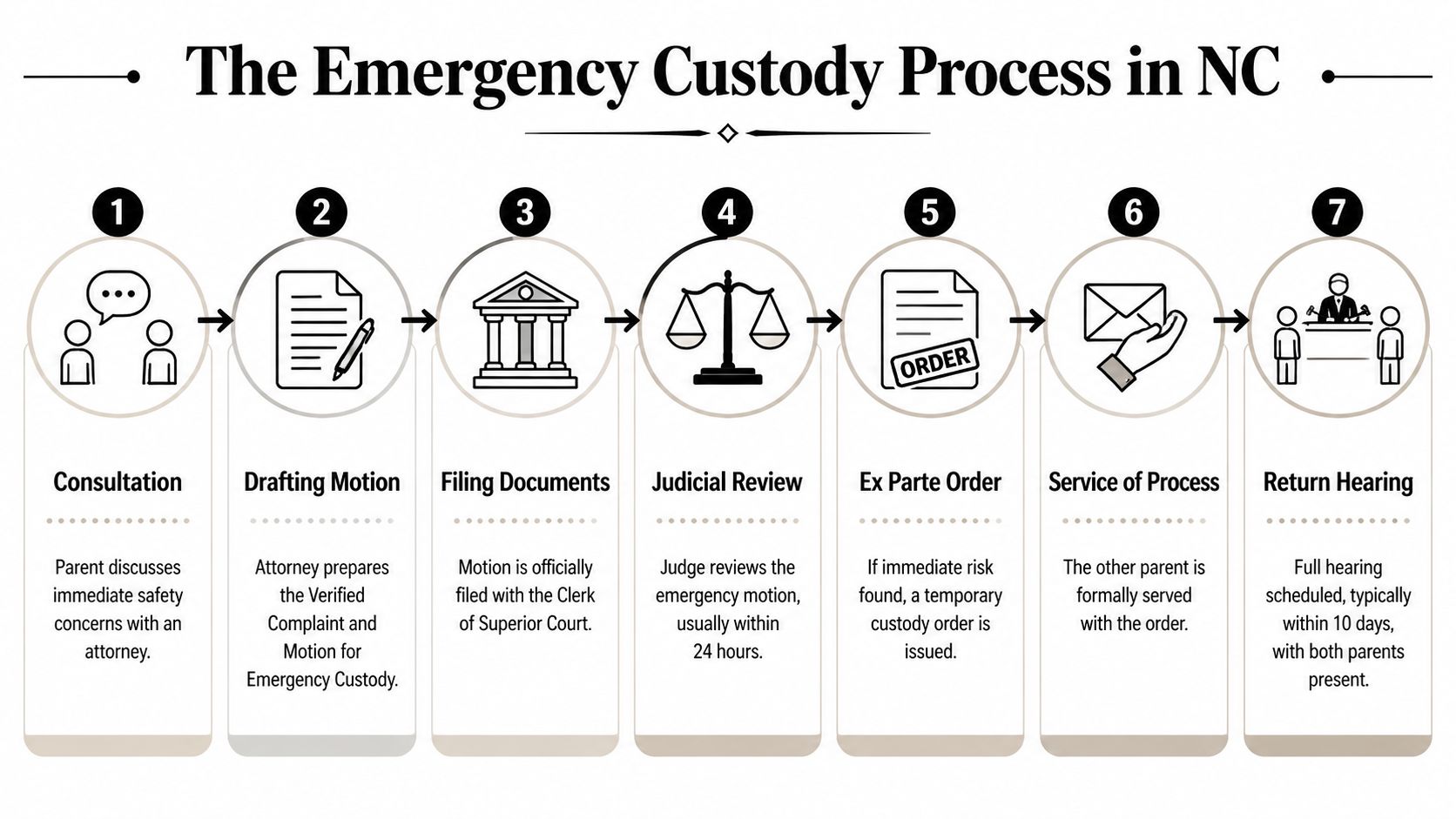
If there is no existing custody case, the emergency request is usually filed with a new custody complaint in district court. If a custody case already exists, the request is usually filed as a motion in that case. Parents who also need a broader overview of short-term custody issues often benefit from reviewing how temporary custody works in North Carolina because emergency relief is only one piece of the larger process.
Step one begins before you reach the courthouse
Start by gathering what you have. Save texts, photos, police paperwork, discharge papers, school messages, and names of witnesses. Write out a clean timeline while events are fresh.
That timeline matters because judges often decide emergency requests from the written filing first. If your facts are scattered, your urgency may be lost.
What you actually file
Most emergency requests involve a custody pleading and a sworn affidavit or verified motion. The affidavit is where parents often go wrong.
A useful affidavit answers basic judicial questions quickly:
- What happened
- When it happened
- Who saw it
- Why the child is unsafe now
- What immediate relief you want
The affidavit must be factual, not argumentative
A strong affidavit says, “On Sunday, the child told me X. I then observed Y. Law enforcement responded, and report number or officer information is attached if available.” A weak affidavit says, “The other parent is unstable and always puts the child at risk.”
Practical rule: Dates, locations, observations, and attached records carry weight. Labels and conclusions usually do not.
Filing and judicial review
After the paperwork is filed with the Clerk of Superior Court, the matter is usually placed before a district court judge for emergency review. Some counties operate more efficiently than others. In some places, filing may be more electronic and centralized. In others, in-person clerk procedures still drive the timeline.
That variation matters. A parent who walks into the wrong office, uses the wrong local form, or misses a county-specific step can lose valuable time even if the underlying emergency is real.
What happens at the ex parte stage
If the judge reviews the papers and finds the statutory emergency standard has been met, the judge may enter a temporary order changing physical custody immediately. Because it is ex parte, the other parent is not there yet to respond.
The order is not the end of the case. It is a short bridge to the next hearing. The other parent still has the right to be served and to appear promptly.
Service and the return hearing
Once an order is entered, service becomes critical. The other parent must receive formal notice of the order and the follow-up court date.
That follow-up hearing is fast and serious. You do not get a long break after obtaining the order. You move almost immediately into the next phase, where both sides will be heard and the court will test whether the emergency showing holds up.
Building a Strong Case with Compelling Evidence
Most emergency custody requests fail for one reason. The parent has fear, suspicion, or anger, but not enough admissible, concrete proof to justify ex parte action.
According to the statutory discussion linked here, judges grant ex parte emergency orders in fewer than 10% of petitions, and they expect substantial evidence such as police reports, medical records, or witness testimony. Vague allegations are routinely rejected.
The court wants proof tied to immediate danger
A judge does not need every fact in the case on day one. The judge does need enough reliable information to conclude that waiting for ordinary process could place the child at substantial risk.
That means your evidence must answer two questions:
- Is the danger real
- Is the danger immediate
A parent may be convinced the other parent is dangerous, but conviction alone doesn’t satisfy the legal standard. The filing has to show what happened, when it happened, and why the child cannot safely wait for a regular hearing.
The best emergency filings read like a timeline supported by records, not like a custody journal filled with grievances.
Evidence checklist for emergency custody filings
| Risk Type | Primary Evidence Examples | Supporting Evidence Examples |
|---|---|---|
| Bodily injury | Police reports, ER or medical records, photographs of recent injuries | School messages about injuries, witness statements, dated texts admitting violence or impairment |
| Sexual abuse | Medical records, forensic or law enforcement documentation, child protective records if available | Therapist or counselor communications, witness statements, dated communications showing access or threats |
| Abduction or removal from the state | Messages threatening to leave, travel records, evidence of concealment or refusal to return the child | Witness statements, recent changes in residence plans, documentation showing efforts to evade court involvement |
| Severe neglect tied to physical danger | Photos of unsafe living conditions, medical records, law enforcement welfare checks | School attendance concerns, family member statements, dated communications showing lack of supervision |
| Domestic violence affecting child safety | Protective order materials, police response records, photos, medical records | Witness statements, child disclosures relayed through proper channels, threatening communications |
What works in an affidavit
Specificity works. Chronology works. Corroboration works.
A persuasive affidavit often includes:
- Recent incidents: Focus on what is happening now, not every bad event in the relationship.
- Attached records: Refer to documents by date and explain why each one matters.
- Direct observations: Separate what you personally saw from what someone else told you.
- Clear requested relief: Tell the judge what immediate custody change you are asking for.
What does not work
Some filings collapse because the parent tries to prove the other parent is generally awful rather than legally dangerous right now.
Common mistakes include:
- Overloading old history: Ten pages about past conflict but little about present risk.
- Using conclusions instead of facts: “Abusive,” “unstable,” and “unsafe” without examples.
- Leaving out attachments: Mentioning records but not filing them.
- Mixing rumor with firsthand facts: Judges notice when a timeline relies heavily on hearsay.
A careful filing can make a difficult case understandable. A rushed filing can make even a serious problem look unproven.
Common Scenarios That Warrant Emergency Action
Parents usually understand emergency custody NC better when they compare their situation to real life patterns. The legal standard is narrow, but it does show up in familiar family crises.

Domestic violence with immediate child exposure
A mother has an active exchange scheduled for the next morning. The night before, police respond to the father’s home after a violent incident involving his partner. The child was present in the house, and there are photos and a report documenting the scene.
That kind of fact pattern may support emergency relief if the filing connects the violence to a current risk of bodily injury to the child. The issue is not limited to the home being chaotic. The issue is that the child may be returning into an active violent environment.
Severe substance abuse that creates physical danger
A father learns that the child was recently driven home by the other parent, who appeared heavily impaired. A neighbor witnessed it. There are messages from the other parent that are incoherent, and the child describes being left unsupervised near a roadway or around dangerous items.
Substance abuse by itself does not automatically justify emergency custody. North Carolina judges usually want to see how the impairment creates an immediate safety threat to the child. Driving while impaired with the child, passing out during supervision, or exposing the child to dangerous conditions can move the case into emergency territory.
Sexual abuse concerns requiring immediate intervention
A child reports inappropriate sexual conduct by someone in the other parent’s home. A medical evaluation is arranged, and law enforcement or child protective authorities become involved.
This is one of the clearest examples of why ex parte relief exists. The filing must still be disciplined and fact-based. It should identify the disclosure, who received it, what follow-up occurred, and why contact cannot safely continue until a standard hearing.
When sexual abuse is suspected, the legal filing should support child protection efforts, not interfere with them. Keep your statements factual and avoid coaching or repeated questioning of the child.
Credible threat of parental kidnapping
A parent receives texts saying, “You’ll never see the child again,” followed by evidence that the other parent has packed belongings, withdrawn the child from school, and made plans to leave North Carolina. The parent then stops responding and refuses to disclose the child’s location.
This can fit the statutory abduction ground because the concern is not theoretical. The threat is tied to concrete conduct showing removal from the state to evade jurisdiction may be imminent.
A grandparent or third party stepping in
Sometimes both parents are unavailable, impaired, violent, or absent, and a grandparent or other caretaker is the person trying to protect the child. In those cases, the same urgency principles apply. The court will still expect proof of immediate danger and a legally proper custody filing.
Third-party emergency requests are often more procedurally sensitive because standing and family history matter. That does not mean they cannot succeed. It means they need especially careful preparation.
After the Order The 10-Day Hearing and Next Steps
Getting an emergency order is not the finish line. It is the start of the next fight.
Under this discussion of North Carolina emergency custody procedure, the order is a temporary bridge to a full hearing that must occur within 10 calendar days, and at that hearing the court applies the best interest of the child standard under N.C.G.S. § 50-13.2 to decide what happens next. If you need a broader sense of how these short-term rulings can evolve, temporary custody orders in North Carolina are the larger framework surrounding many of these cases.
Why this hearing matters so much
At the ex parte stage, only one side had the chance to speak. The return hearing gives the other parent that chance. Judges take this hearing seriously because it is where due process catches up with the emergency order.
The parent who obtained emergency relief must be ready to prove that the risk is ongoing or that temporary restrictions are still necessary. That usually means better organization, better witnesses, and better documentary support than what was submitted in the initial rush.
What the judge may do next
Several outcomes are possible:
- Continue protections in some form: The judge may keep the child where they are for now.
- Modify the arrangement: The court might allow limited contact, supervised time, or different exchange terms.
- Dissolve the emergency order: If the evidence doesn’t hold up, the court can undo the ex parte relief.
- Enter a broader temporary custody order: The case may shift into a more standard temporary custody posture while the larger case proceeds.
How to prepare in the short window
The days before the hearing matter. Parents should gather any new records, organize witness contact information, review the timeline carefully, and avoid emotional communication that could distract from the child safety issue.
Bring the judge back to the child. Courts respond better to disciplined evidence than to understandable outrage.
A parent who treats the emergency order as a final victory often gets blindsided at the return hearing. A parent who treats it as a first step is usually better positioned.
Why You Should Not File for Emergency Custody Alone
Emergency motions look simple from the outside. They are not. They combine strict legal standards, fast deadlines, county-specific procedures, and a written record that may shape the rest of your custody case.

According to this North Carolina emergency custody discussion, over 65% of emergency custody motions filed by self-represented parents are denied or reversed at the 10-day hearing because of insufficient evidence, and procedures vary significantly across North Carolina’s 100 counties. That’s a hard reality for people who assume that telling the judge the truth will be enough by itself.
County rules create problems people don't expect
In one county, filing may depend on local eCourts practices. In another, in-person clerk handling may still shape how quickly a motion reaches a judge. Some counties are particular about formatting, verification, or local scheduling expectations.
A parent can have a serious case and still stumble on process. Missing a local requirement can delay review. Weak drafting can make a dangerous situation sound speculative. Poorly organized attachments can keep the judge from seeing the emergency quickly.
The biggest risk is not just denial
A weak emergency motion can do more than fail. It can damage your credibility in the larger custody case. If a judge concludes that you overstated the facts, used the emergency process to gain an advantage, or filed without sufficient support, that impression can follow you.
That’s why legal help in these cases is not just about paperwork. It’s about judgment. A lawyer helps decide whether the situation fits the statute, what evidence should lead the filing, and how to present the facts without overreaching.
For parents comparing representation options, it helps to speak with a North Carolina child custody lawyer who handles urgent family court matters and understands local court practice.
Good legal guidance changes the quality of the filing
An experienced attorney usually adds value in four places:
- Case screening: Assessing whether the facts fit emergency custody or a different remedy.
- Evidence selection: Choosing the records that prove immediate danger instead of dumping every grievance into the file.
- Affidavit drafting: Framing the timeline in a way judges can follow quickly.
- Return-hearing preparation: Treating the 10-day hearing as a major event, not an afterthought.
This short video offers additional context on why immediate legal strategy matters in custody disputes.
The law gives parents a path to fast protection. It does not forgive avoidable mistakes.
Frequently Asked Questions about NC Emergency Custody
How fast can a judge act in an emergency custody NC case
Courts can review emergency requests very quickly, sometimes the same day, but speed depends on proper filing, local court procedures, and whether the papers show a true statutory emergency. Fast action is possible. Automatic action is not.
What if my emergency custody request is denied
A denial does not always mean the judge thinks your concerns are unimportant. It may mean the facts do not meet the ex parte standard, the evidence is too thin, or the issue belongs in a temporary custody hearing rather than emergency relief.
In that situation, parents often need to pivot quickly to another custody strategy and continue documenting events carefully.
Can I get emergency custody because the other parent keeps violating our schedule
Usually not by itself. Repeated violations may support enforcement, contempt, or a modification request, but emergency custody is reserved for immediate risk of bodily injury, sexual abuse, or abduction from the state.
Can a parent get in trouble for filing
A parent should take the filing seriously. If the motion exaggerates facts, leaves out key context, or uses the emergency process as a tactic in a routine dispute, that can hurt credibility. The safest approach is a restrained, evidence-based filing focused on child safety.
Do I need police reports or medical records to file
Not in every case, but objective records are often what make a filing persuasive. When those records exist, they should usually be gathered and presented carefully. When they do not exist, the affidavit has to be especially clear, specific, and grounded in firsthand facts.
Protect Your Child's Future Schedule a Consultation Today
When a child is in danger, waiting feels unbearable. North Carolina law does allow immediate court action in the right case, but emergency custody is one of the most demanding requests a parent can make in family court.
The trade-off is built into the process. The remedy is powerful because it can work quickly. The burden is heavy because judges will not remove a child from one parent without a tightly supported legal basis. That means facts matter, documents matter, and timing matters.
If you are a North Carolina parent, grandparent, or caretaker dealing with possible abuse, serious neglect, domestic violence, or a real risk that a child will be taken out of state, get case-specific legal advice as soon as possible. A prompt review can help you decide whether emergency custody is appropriate, what evidence should be preserved, and how to avoid missteps that could weaken your position.
Taking action does not mean panicking. It means moving with urgency and discipline.
If your child’s safety may require immediate court intervention, the Law Office of Bryan Fagan can help you evaluate the facts, understand your options under North Carolina law, and prepare a strategic response. Schedule a confidential consultation to discuss your emergency custody concerns and the next steps for protecting your child.