You open a child support packet, see a worksheet full of lines and boxes, and immediately wonder whether one wrong number could affect your child for years. That reaction is normal. In North Carolina, the nc child support worksheet isn't just paperwork. It's the framework the court uses to turn custody and financial information into a support amount that is supposed to be fair to both parents and, above all, workable for the child.
Accuracy matters at every stage. A wrong custody classification, incomplete income information, or missed expense can change the result in a meaningful way. In practice, many disputes don't start because a parent refuses to support a child. They start because one side used the wrong worksheet, counted overnights incorrectly, or failed to document income in a way the court will accept.
North Carolina law expects child support decisions to be grounded in real financial information and the child's actual needs. G.S. 50-13.4 is the statute that gives the court authority over child support. The worksheets are the practical tools used to apply that authority in everyday cases.
Understanding Your Role in the NC Child Support Process
Parents often assume the worksheet is something only lawyers or judges handle. It isn't. The court relies on the information parents provide, and that means your role is active from the beginning. If your numbers are incomplete or poorly documented, the worksheet won't tell a reliable story.
The worksheet serves one core purpose. It organizes the facts the court needs to calculate support under North Carolina's child support system. Those facts usually include each parent's income, the custody arrangement, health insurance costs for the child, and work-related childcare expenses. The form itself may look mechanical, but the quality of the result depends on the quality of the information entered.
A useful way to think about the nc child support worksheet is this:
- Custody drives the form: The number of overnight stays can determine which worksheet applies.
- Income drives the calculation: Pay records, tax returns, and business records often matter more than estimates or memory.
- Expenses shape the final figure: Child-focused costs must be identified clearly and supported with documents.
- Proof matters as much as the number: If you can't back up a figure, expect questions from the other side or the court.
A child support worksheet is only as strong as the records behind it.
Parents also worry that filling out a worksheet locks them into a position forever. It doesn't. It creates a present snapshot based on current circumstances. If income changes, custody changes, or major child-related expenses change, support may need to be revisited. What does matter now is getting the first version right, because early errors can follow a case into mediation, temporary orders, and final hearings.
Good preparation reduces conflict. Gather your pay information, keep your parenting schedule clear, and treat the worksheet as evidence, not a rough draft.
Worksheet A vs Worksheet B Which One Applies to Your Family
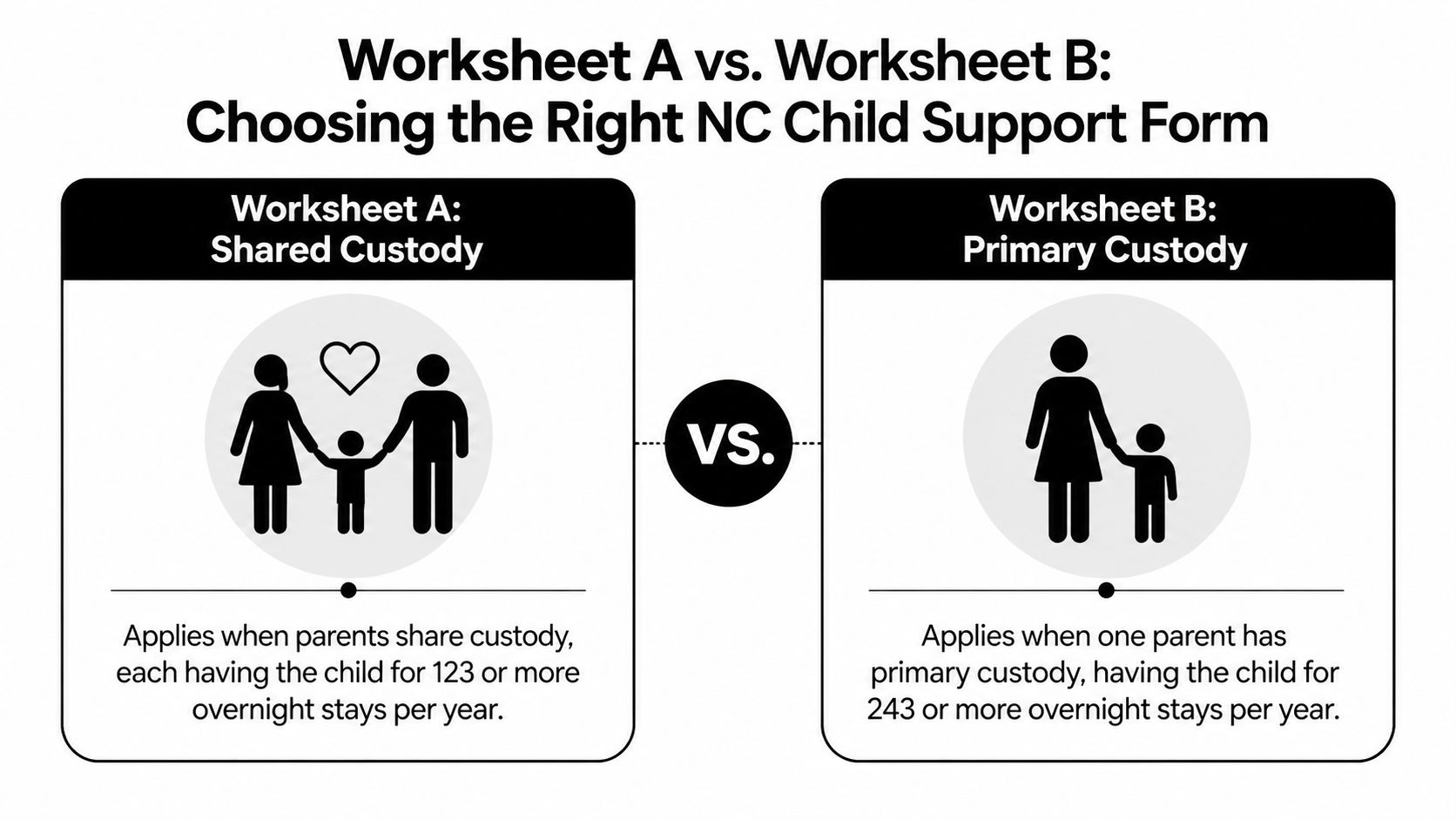
The first major issue is choosing the correct form. In North Carolina, the distinction between Worksheet A and Worksheet B turns on the custody arrangement and overnight counts. Under the North Carolina guidelines, Worksheet A applies when one parent has primary physical custody of all children involved, defined as the child residing with that parent for at least 243 nights per year, and Worksheet B applies when parents share custody of all children and each parent has the child for at least 123 nights per year and both assume financial responsibility during their custody time, as explained in this summary of the North Carolina child support worksheet rules.
The quick comparison
| Worksheet | Custody Arrangement | Overnight Threshold |
|---|---|---|
| Worksheet A | One parent has primary physical custody of all children | One parent has the child at least 243 nights per year |
| Worksheet B | Parents share custody of all children | Each parent has the child at least 123 nights per year |
That sounds simple, but many cases go wrong at this point. Parents often focus on labels such as "joint custody" or "primary custody" from a court order or informal agreement. The worksheet analysis focuses on how the schedule operates. Overnight counts matter.
How this works in real life
Suppose one parent has the child most school nights and the other parent has alternating weekends plus some holiday time. That usually points toward Worksheet A if the primary parent's time reaches the required threshold.
Now consider a schedule where each parent has substantial weekday and weekend time, and both regularly provide meals, transportation, and day-to-day expenses during their parenting time. If each parent reaches the required overnight count, Worksheet B may apply.
The biggest mistake I see in this area is rough counting. Parents estimate. Courts prefer precision. Pull out the calendar and count overnights carefully. Include regular schedules, holiday schedules, and summer schedules. If the order has changed in practice, that creates another issue. The court may ask whether the written order or the actual schedule should control.
Why the worksheet choice matters
Worksheet choice isn't a technical footnote. It can materially affect the support amount because shared custody cases account differently for parenting time and financial responsibility. If a parent falls short of the overnight threshold for shared custody, the case can default back to Worksheet A treatment.
That is why clients should avoid building strategy around assumptions such as "we're close enough" or "we basically share custody." Close isn't the standard. The actual threshold is the standard.
Practical rule: Count first, label second.
North Carolina also uses Worksheet C in split custody situations. That usually comes up when there is more than one child and each parent has primary custody of at least one child. It is less common than Worksheets A and B, but it matters in families with different living arrangements for different children.
Questions to ask before choosing a worksheet
- What does the calendar show: Not what either parent prefers to call the arrangement.
- Are all children on the same schedule: If not, a different worksheet may come into play.
- Who pays day-to-day expenses during parenting time: Shared custody analysis assumes both parents take on financial responsibility.
- Is the written order current: If the actual schedule has drifted away from the order, that needs attention.
For a broader overview of how the state's formulas fit together, this guide to North Carolina child support guidelines is a helpful starting point.
How to Accurately Calculate Income and Expenses on Your Worksheet
Once you've identified the right worksheet, the difficult part begins. Most worksheet disputes are really evidence disputes. Parents may agree that support should be calculated, but disagree sharply about income, insurance, childcare, or whether a claimed figure reflects reality.
A clean worksheet starts with clean records.

Defining and documenting gross income
Under North Carolina child support practice, income usually means more than a base paycheck. Wages are the easy part. Cases become more complicated when a parent receives commissions, bonuses, self-employment income, contract income, or irregular compensation.
Use records, not estimates. For an employed parent, that usually means recent pay stubs, W-2 forms, and tax returns. For a self-employed parent, it often means business tax returns, profit and loss statements, bank records, and records showing ordinary business expenses. The court will look for a reliable picture of actual earnings, not a number selected for convenience.
Consider a fictional example. Jordan works for a salary and receives occasional bonuses. Avery owns a small business with fluctuating monthly revenue. Jordan's worksheet entry may be relatively straightforward if payroll records are consistent. Avery's may require more explanation because business income can look different on paper than it does in practice.
Here is the mistake to avoid. Don't use a single unusually high month or unusually low month in isolation if it doesn't fairly reflect the broader income pattern. The worksheet should be grounded in dependable information.
What to gather before filling in the form
A parent who prepares well usually moves through the process faster and with fewer challenges. Useful records often include:
- Pay records: Recent pay stubs, W-2 forms, and tax returns.
- Business documents: Profit and loss statements, business returns, invoices, and account statements if you're self-employed.
- Benefit information: Documents showing recurring payments or other income sources.
- Expense records: Childcare invoices and insurance statements tied to the child.
A simple folder system helps. Keep one folder for income and another for child-related expenses. If your case becomes contested, your lawyer can turn that file into evidence much more easily.
Health insurance and child-related costs
The worksheet also considers certain expenses tied directly to the child. Health insurance premiums attributable to the child can matter. So can work-related childcare expenses. Parents often know they pay these costs, but they don't always know how to document them.
For health insurance, use plan documents or employer statements that show the child-related premium amount if available. If the statement bundles several people together, be prepared to explain how the child-specific portion is identified. For childcare, use provider invoices, payment histories, and any contract showing the recurring amount and reason for care.
Real-world detail matters. If a daycare expense exists because a parent is working, that is different from a claimed expense that isn't tied to employment. The court wants to see the connection.
A short visual overview can help if you're sorting through these records for the first time:
A working example using one family
Take Jordan and Avery again. Their child attends after-school care on weekdays. Jordan carries health insurance through work and pays the premium for the child. Avery's income varies because client payments don't arrive on the same schedule every month.
A practical approach would look like this:
| Item | Jordan | Avery |
|---|---|---|
| Income proof | Pay stubs and tax forms | Business records and tax returns |
| Child health insurance | Employer benefit statement | Not applicable if not paying it |
| Childcare proof | Provider invoice if paying directly | Provider invoice if reimbursing or sharing |
The worksheet itself will reduce these categories to entries and calculations, but the court process doesn't. If the other parent challenges a number, you may need to explain where it came from, why it is accurate, and how it reflects present reality.
Common errors that create trouble
Some worksheet errors are accidental. Others happen because a parent assumes the court will "figure it out later." That usually increases cost and delay.
- Rounding too aggressively: A close enough number can become the center of a dispute.
- Using outdated documents: Old pay information can misstate current earnings.
- Mixing personal and business expenses: Self-employment cases require careful separation.
- Leaving out recurring child costs: If a legitimate expense isn't documented, it may not be credited properly.
- Treating informal reimbursements as self-proving: If the other parent sometimes pays you back, document it.
If income is irregular, clarity matters more than simplicity.
What works and what doesn't
What works is a worksheet supported by records that can be handed to a mediator, opposing counsel, or a judge without apology. What doesn't work is showing up with handwritten estimates, partial screenshots, and a vague explanation that the numbers are "about right."
Parents sometimes worry that careful documentation makes them look combative. It doesn't. It makes them credible. In child support litigation, credibility often shapes the outcome as much as the arithmetic does.
Navigating High-Income and Low-Income Deviations
Some cases don't fit comfortably inside the ordinary worksheet process. That doesn't mean the worksheet becomes irrelevant. It means the worksheet is no longer the whole story.

High-income cases above the guideline cap
For combined adjusted gross incomes under the guideline cap, the worksheets are presumptively applied. Existing commentary on North Carolina practice identifies an underserved problem in higher-income cases because the standard guideline framework applies under $40,000 per month in combined adjusted gross income, and above that point courts move into a more discretionary analysis of the child's reasonable needs and the family's circumstances, as discussed in this article about high-income child support evidence in North Carolina.
That creates a practical problem for parents. There is no single plug-in formula that solves everything once income rises beyond the guideline ceiling. In those cases, the argument usually shifts from basic worksheet entry to proof. What lifestyle did the child experience before separation? Which expenses are truly child-related? What records make those needs credible rather than inflated?
In high-income cases, the most persuasive evidence is usually organized and specific. General statements such as "our child is used to a certain lifestyle" won't carry much weight by themselves. Courts tend to need detail. Think financial records, expense summaries, account statements, and, in some cases, more specialized financial analysis.
High-income child support cases are rarely won by broad descriptions. They are built through disciplined evidence.
A common mistake in these cases is overreaching. A parent may try to frame nearly every household expense as a child need. Another may minimize obvious lifestyle evidence and insist only bare-minimum expenses count. Neither extreme tends to help. The stronger approach is to separate real child needs from parental preference and document both ordinary and higher-level expenses with care.
Low-income cases and the self-support reserve
At the other end of the spectrum, North Carolina's guidelines recognize that some parents have very limited income. The 2023 North Carolina Child Support Guidelines raised the self-support reserve from $1,012 to $1,133 in monthly gross income and cap low-income obligors at $50 per month, according to the 2023 NC Child Support Guidelines PDF from the School of Government.
This is one of the most misunderstood parts of child support practice. Some parents hear "minimum support" and assume the court will always set a token amount. Others assume low income automatically excuses support altogether. Neither assumption is safe.
The self-support reserve exists because support orders must account for a parent's basic ability to live. But applying it correctly still requires good information. If income fluctuates, especially in gig work, seasonal work, or inconsistent contract work, the documentation issue becomes central again. Parents need records that show what they earn over time.
Practical concerns in deviation cases
These edge cases often produce the hardest negotiations because both sides feel the standard worksheet doesn't capture reality. That feeling may be correct. The answer is still evidence.
Consider these practical points:
- High-income parents need specificity: Lifestyle claims should be tied to records, not broad impressions.
- Low-income parents need consistency: Irregular income must be documented in a way the court can follow.
- Deviations require explanation: If the standard result doesn't fit, the court usually needs a clear reason.
- Presentation matters: Organized exhibits often carry more force than emotional argument.
The worksheet remains the starting place in many cases. It just isn't always the finish line.
From Final Calculation to Courtroom Submission
Completing the worksheet is only part of the job. The next step is turning it into something the court can rely on. That means checking the math, confirming the custody basis, attaching or organizing supporting records, and making sure the form is consistent with the position you're taking in mediation or court.

Before you file
Review the worksheet as if the other parent is trying to challenge every line. Ask yourself whether each number has a document behind it and whether each document is current. Check names, dates, and the custody assumptions used.
A practical filing checklist usually includes:
- Final review: Make sure the worksheet matches the current parenting schedule and financial records.
- Supporting documents: Keep the records that support each major entry in an organized set.
- Copies: Have copies for your own file, for the other party if required, and for court use.
- County filing procedure: File in the proper North Carolina county and follow local rules or clerk requirements.
In mediation and at hearing
The worksheet is not self-authenticating. If the other side contests it, you may need to explain how you arrived at each figure. That is why preparation matters so much. Mediators and judges tend to respond better to a parent who can calmly walk through the numbers than to one who insists the form should speak for itself.
Bring the worksheet, but also bring the records that let you defend it line by line.
If your circumstances change after an order is entered, you may need to revisit support through a modification rather than trying to argue around an old number. This overview of North Carolina child support modification gives a useful starting point for that process.
Presentation matters
A neat, internally consistent packet sends a message. It tells the court you took the process seriously. Sloppy paperwork sends the opposite message, even if your underlying position is strong.
That doesn't mean you need a perfect case file. It means you need a credible one.
Common Questions on North Carolina Child Support
What if the other parent is self-employed and I think income is being hidden
Self-employment cases are often document-heavy because the parent controls more of the paper trail. Bank statements, business records, tax returns, invoices, and expense categories can all become important. If the numbers don't seem to match the person's actual lifestyle or business activity, your lawyer may need to pursue more detailed financial discovery.
The court won't usually act on suspicion alone. It needs evidence that the claimed income is incomplete, inaccurate, or misleading.
Can parents agree to a child support amount different from the worksheet
Sometimes, yes. But private agreement doesn't automatically control what a court will approve. If the agreement is being incorporated into a court order, the court still has an interest in the child's welfare and may examine whether the arrangement is appropriate under North Carolina law.
Many parents make a costly mistake. They assume a cooperative agreement today will prevent future disputes. If the agreement isn't clearly documented and legally sound, it can create more conflict later.
What if our custody schedule changes after support is entered
A custody change can affect support because parenting time often affects the worksheet analysis. If the actual schedule changes in a meaningful way, you may need to seek a formal modification rather than relying on an informal side agreement.
That is especially important when overnights move the case into a different worksheet category. The paperwork should match real life.
Can the court reject my worksheet even if I completed every line
Yes. A fully completed worksheet can still be challenged if the underlying facts are disputed, unsupported, or legally incomplete. Courts look beyond the form. They care about whether the inputs are credible and whether the worksheet used matches the family situation.
A neatly filled-in worksheet is a start. It isn't a substitute for proof.
Protect Your Family’s Future with Strategic Legal Guidance
Child support cases feel mathematical, but they are rarely simple. The nc child support worksheet asks for numbers, yet every number comes from a real-life question about parenting time, income, expenses, and credibility. If any of those pieces are off, the result can be off too.
That is why thoughtful legal guidance matters. A lawyer doesn't just fill in blanks. A lawyer helps identify which worksheet applies, where financial proof is weak, when a deviation argument may be necessary, and how to present the final position in a way a North Carolina court can use. That is especially important in self-employment cases, shared custody disputes, and the higher-income or lower-income situations that standard guides often barely address.
If you're dealing with a new support case, a contested worksheet, or a support issue that no longer fits your family's reality, it makes sense to get case-specific advice before you commit to numbers that may follow you for a long time. You can learn more about working with an NC child support attorney when you need strategic guidance specific to North Carolina practice.
North Carolina parents deserve a support arrangement built on accurate facts, not assumptions. Careful preparation now can protect your finances and your child's stability later.
If you need help with child support, custody-related worksheet issues, or a support modification in North Carolina, schedule a consultation with the Law Office of Bryan Fagan. The firm helps North Carolina families evaluate the right worksheet, prepare financial evidence, and build a clear strategy for court or negotiation.