
If you're searching how is child support calculated in NC, you're probably not asking out of curiosity. You're trying to budget for rent, groceries, school costs, and the next month of your life while your family is changing. Most parents I speak with want the same thing. They want to know what the court will look at, what number matters most, and whether the result will feel fair.
That uncertainty is hard. It gets worse when someone says child support is “just a formula,” because in North Carolina the formula matters, but so do the facts you plug into it. A small change in overnight schedules, business income, childcare costs, or who carries health insurance can change the result in a very real way.
Navigating Your Financial Future During Separation in NC
A common situation looks like this. One parent has moved out, the children are splitting time between homes, and both parents are trying to make sense of who pays what. One person assumes support will be based only on salary. The other assumes equal love for the child means equal financial responsibility. North Carolina law doesn't use either shortcut.
Instead, the court uses structured North Carolina Child Support Guidelines. Those guidelines are designed to bring consistency to a stressful process. That matters because child support isn't supposed to be a guessing game or a punishment. It's supposed to allocate financial responsibility in a way that reflects the child's needs and each parent's financial ability.
Why parents get confused so quickly
Most confusion starts in three places:
- Income isn't just paycheck income. Overtime, bonuses, self-employment earnings, disability income, and other sources may matter.
- Custody labels don't control the worksheet. What matters is often the actual number of overnights.
- The worksheet total isn't always the final order. Childcare, insurance, and unusual expenses can change the number.
Child support cases often feel emotional, but the court still needs documents, schedules, and reliable numbers.
That is why two parents with the same child can walk into court with completely different expectations. One parent may think a rough online estimate is enough. The other may not realize that a parenting plan sitting close to a worksheet threshold can shift the calculation.
A practical way to approach the process
If you're trying to get your arms around this, start with the facts the court is likely to focus on:
| Issue | Why it matters |
|---|---|
| Income from all sources | It forms the starting point of the calculation |
| Number of overnights | It determines which worksheet applies |
| Childcare costs | These may be added into the calculation |
| Health insurance for the child | The paying parent may receive credit |
| Special needs or unusual expenses | These may support an adjustment |
Parents usually feel better once they see that there is a system. The hard part isn't that North Carolina has no rules. The hard part is that the rules require accurate inputs. When those inputs are disputed, child support becomes a legal issue, not just a math problem.
Understanding North Carolina's Income Shares Model
A parent sits in my office and says, “I do not understand why the worksheet cares about both incomes if the child lives mostly with the other parent.” That question gets to the heart of North Carolina's system.
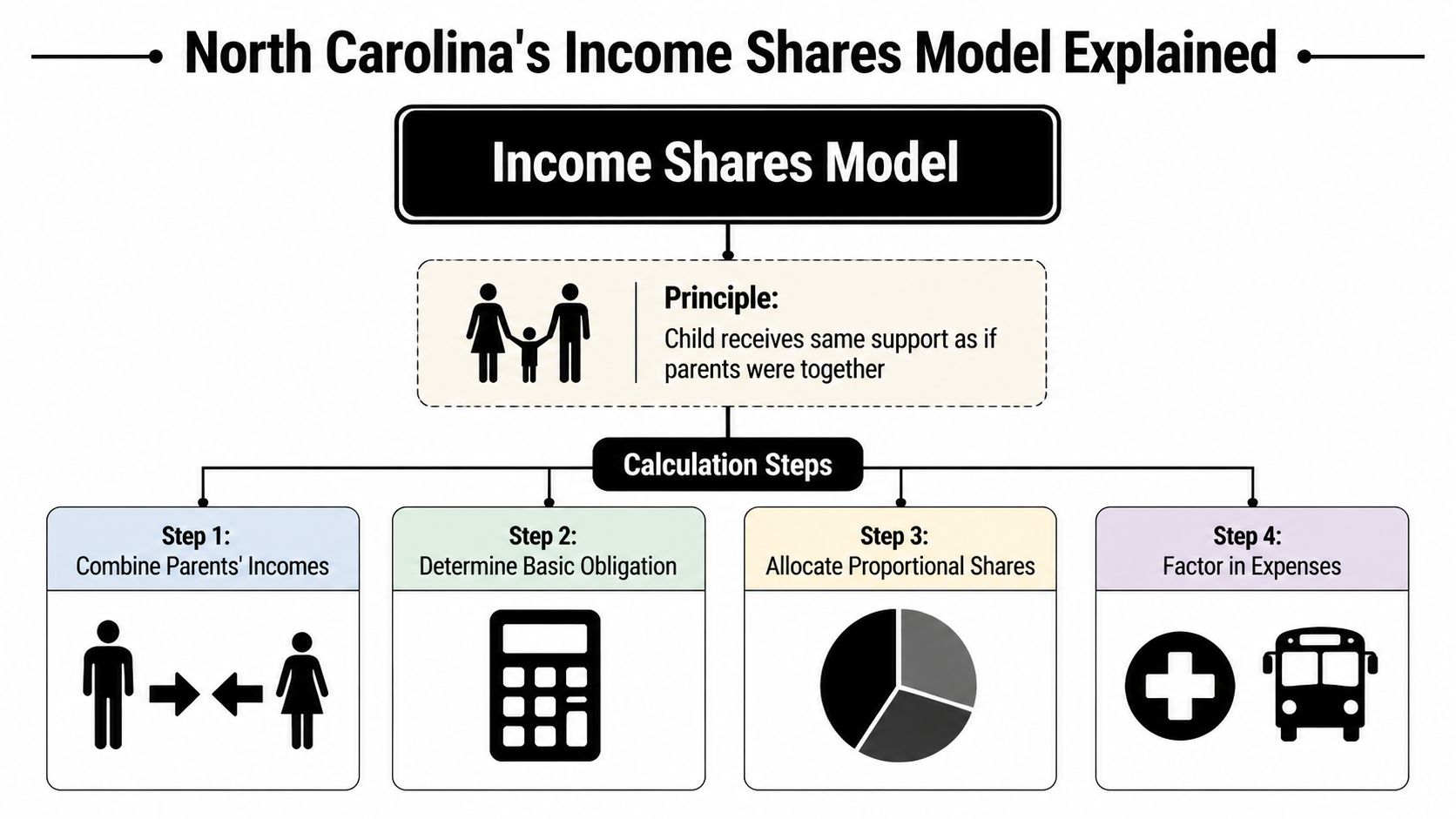
North Carolina uses an income shares model. The model starts from a simple idea: a child should receive support from both parents in roughly the same proportion the child would have received if the parents were still raising the child in one household. The court first looks at the parents' combined income, then assigns each parent a share of the support amount based on that parent's portion of the total income. The guideline worksheets generally apply up to a combined monthly income of $40,000, and cases above that level often require a different analysis, as noted in Marshall Taylor's discussion of North Carolina child support calculations.
Why North Carolina uses this model
The model works like a family budget split according to income. If one parent brings in a larger share of the money, that parent usually carries a larger share of the support obligation. If the parents earn closer to the same amount, the support burden is usually divided more evenly.
That matters because child support in North Carolina is built around the child's standard of support, not a flat rule applied to only one parent's paycheck.
A lot of confusion comes from treating the worksheet like a calculator that spits out a number for every family. It does not work that way in real life. The worksheet reflects the idea that the child is tied to both financial households. That is why the same child can produce a different result when a parent is self-employed, has income that rises and falls, or has a parenting schedule near a worksheet cutoff. The formula stays the same. The facts fed into it change.
A simple way to see the concept
Start with two parents whose incomes are not equal. If Parent A earns about 60% of the combined income and Parent B earns about 40%, the worksheet usually assigns the basic support obligation in those same proportions. That does not automatically mean Parent A writes a check for 60% in every case. The actual result depends on the parenting arrangement and other allowable adjustments. But the percentage share is the engine under the hood.
That is the "why" behind the numbers. The court is trying to spread child-related costs between the parents in a way that tracks their actual earning power.
Where parents get tripped up
The concept is easy to follow. The hard part is seeing how ordinary life details can change the final number.
A self-employed parent may show strong gross receipts but also claim business expenses. A parent paid by commission may have a high month followed by a weak one. A parent with an overnight schedule close to a guideline threshold may see the calculation shift because the schedule changed on paper or in practice. Those are not side issues. They affect the inputs that drive the result.
So if you are trying to estimate child support, focus less on getting a quick number and more on getting the right facts into the worksheet. In North Carolina, the fairness of the result depends on the accuracy of the story behind the math.
What Counts as Gross Income for Child Support in NC
A parent can feel blindsided here. One person says, "I only bring home this much each month," while the worksheet starts from a higher number. That gap usually comes from the difference between net pay and gross income.
For child support in North Carolina, gross income generally means income before taxes and other routine payroll deductions. The court is trying to measure each parent's real ability to contribute to the child's support, so it looks wider than a paycheck stub's take-home line. If you want a plain-language overview of the broader North Carolina child support guidelines, that framework helps. The hard part in actual cases is deciding what money should count and what should not.
Income is broader than salary alone
A W-2 wage is only one piece of the picture. Gross income may also include money from commissions, bonuses, self-employment, contract work, rental property, investments, disability benefits, retirement income, and alimony received in the proper circumstances.
The reason is practical. Child support is based on available financial resources, not just the label attached to the payment.
That is why two parents with the same take-home pay can still have different gross-income figures. One may receive regular bonuses. The other may have investment distributions or side-business income. On paper, both households may feel similar month to month. Under the guidelines, they are not always treated the same.
Why self-employment cases get complicated fast
Self-employment often creates the biggest disagreement because gross receipts are not the same as usable income. A business owner may bring in substantial revenue, but the court still has to sort out which business expenses are legitimate for child support purposes.
Tax law and child support law do not always ask the same question. A deduction that helps on a tax return does not automatically reduce income for support. For example, the court may look closely at vehicle costs, meals, travel, or other expenses that partly benefit the parent personally.
A simple example shows why this matters. Suppose a parent earns money through a small construction business. The tax return shows a modest profit after deductions. The bank records show steady deposits, and some "business" expenses appear to cover personal living costs. In that situation, the dispute is not just about accounting. It is about what the parent actually has available to support the child.
Clear records matter here. Profit and loss statements, general ledgers, business bank statements, 1099s, and tax returns often carry more weight than rough estimates or broad claims that "the business had a bad year."
Irregular income still counts
Some parents are paid in a straight salary. Many are not.
If you work on commission, receive seasonal income, pick up overtime, or earn performance bonuses, the court may need a fuller view than one recent pay period. The point is to reach a fair number that reflects actual earning patterns, not a single unusually good or unusually bad month.
This is one place where people get frustrated. A parent may say, "That bonus is not guaranteed." That may be true. But if bonuses have shown up regularly over time, they can still affect the calculation because they are part of the parent's real financial pattern.
Deductions are narrower than many parents expect
Parents often assume the court will subtract ordinary bills before calculating support. Usually, it does not work that way. Mortgage payments, rent, credit card balances, car loans, and household expenses may be very real pressures, but they are not usually the kind of deductions that reduce gross income under the guidelines.
The allowed adjustments are narrower and tied to specific family obligations.
| Potential deduction area | General role in the calculation |
|---|---|
| Prior child support obligations | May reduce available income for the current worksheet |
| Other children living in the home | May affect the adjusted income analysis |
That narrower approach reflects the purpose of the guidelines. The court is not building a full household budget for each parent. It is identifying income in a consistent way so support can be calculated from the same starting rules.
If a parent earns less by choice, the court may look past the current number
Reported income is not always the end of the story. If a parent is voluntarily unemployed or underemployed in bad faith, the court may impute income. In plain English, that means the court may use an earning level based on the parent's ability and work history rather than the lower amount the parent is currently reporting.
These cases are very fact specific. A genuine layoff, a medical issue, or a reasonable career change may be viewed very differently from a deliberate decision to cut income to avoid support. Judges often look at work history, education, prior earnings, job opportunities, and credibility.
If your income dropped, be ready to show why with documents, not just explanations. If you believe the other parent is understating income, specific records usually matter more than suspicion.
Choosing Your Worksheet Worksheet A, B, or C
A common point of confusion comes up after parents gather pay stubs, tax returns, and childcare records. They assume the hard part is finished, then learn that the support amount can change sharply based on one question: which worksheet fits the parenting schedule?

That is why the parenting calendar matters so much. The court is not just asking who is called the custodial parent in an agreement. The court is asking how the child spends nights during the year, because overnights help show which household is paying for more of the child's day-to-day needs directly.
If you want a broader overview of the official framework, Bryan Fagan's page on North Carolina child support guidelines gives a useful starting point. In practice, the worksheet choice often turns on details that parents underestimate, such as summer rotations, holiday exchanges, and whether a "50/50" plan is equal on paper.
Worksheet A for primary custody
Worksheet A usually applies when one parent has the child for most of the year and the other parent has fewer overnights. In plain English, this is the standard primary-custody model. One home handles most school nights, most routine expenses, and most of the week-to-week structure.
A typical example is a child living with one parent during the school week, while the other parent has alternating weekends and some holiday time. In that setup, the parent with fewer overnights often pays support through Worksheet A.
Worksheet A is the most direct formula of the three. The court starts with each parent's income, finds the basic support amount from the guideline schedule, and assigns each parent a share. Because one parent is already covering more of the child's daily expenses in that home, the other parent's share is usually paid as monthly support.
Worksheet B for shared custody
Worksheet B applies when the child spends a substantial number of overnights with each parent, allowing the calculation to reflect real life more closely. If both homes are feeding the child, keeping clothes on hand, paying utility bills, and maintaining bedrooms for the child, the formula changes to account for that.
As Smith Debnam's explanation of Worksheet B in North Carolina explains, Worksheet B uses a shared-custody approach that compares each parent's support responsibility and then offsets the difference. That is why shared custody does not automatically mean zero child support. If one parent earns much more, that parent may still owe support even with a fairly even schedule.
The reason is straightforward. Parenting time and income are both part of the picture. More overnights can reduce the transfer amount because that parent is paying more costs directly during his or her parenting time. But overnights do not erase an income gap.
This is also where schedule drafting can have a very real financial effect. A plan that sounds roughly equal in conversation may not cross the overnight threshold once you count school nights, summer weeks, and holidays carefully. For parents with rotating work schedules, especially nurses, firefighters, and self-employed parents who trade weekdays for weekends, the exact calendar can matter more than the label "joint custody."
The overnight count can change the worksheet, the method of calculation, and the final monthly number.
A short video can help if you're trying to visualize how parenting schedules affect support:
Worksheet C for split custody
Worksheet C is used when there are two or more children and each parent has primary physical custody of at least one child. This is less common, but it appears more often than people expect in families with teenagers who end up living primarily in different homes.
For example, one child may live mainly with Mother and another may live mainly with Father. The court does not treat that family the same way it would treat a single shared-custody arrangement. Instead, it compares the support obligations across both households and offsets them.
Parents are often surprised by Worksheet C because it reflects two separate primary-custody arrangements happening at the same time. The result can feel counterintuitive unless you focus on the why behind the math. Each home is functioning as the primary home for a different child.
Why the worksheet choice changes the number
The worksheet is the frame around the calculation. Income still matters, but the worksheet decides how that income is applied.
| Worksheet | Typical use | Why it changes the result |
|---|---|---|
| A | One parent has primary physical custody | The formula assumes one household covers most routine daily costs directly |
| B | Both parents have a shared overnight schedule | The formula accounts for both homes paying direct child-related expenses during parenting time |
| C | Each parent has primary custody of at least one child | The formula offsets support across separate primary-custody arrangements |
Life circumstances directly affect the final child support amount in a very practical way. A parent with fluctuating self-employment income may already face disputes about what monthly income should count. Add a shared schedule that is close to the overnight cutoff, and even small factual disagreements can change the worksheet and the result. The same is true when parents verbally follow one routine but their court order says something different.
Precision helps. Count actual overnights carefully. Read the custody order closely. If the schedule has changed from what is written, that issue should be addressed directly rather than assumed away.
Factoring in Childcare, Health Insurance, and Extraordinary Expenses
A lot of parents reach this point and think the hard part is over. The worksheet has produced a base support number, so the case should be settled. Then daycare, insurance, counseling, tutoring, or a recurring medical bill enters the conversation, and the number changes again.
That shift often surprises people because child support is not built only around income. It also tries to account for real costs tied to raising this particular child in this particular family.

Why these add-on costs matter
The basic obligation is the starting point. Then the worksheet may add certain expenses that exist outside ordinary day-to-day household spending. The common examples are:
- Work-related childcare
- The child's health insurance premium
- Certain extraordinary child-related expenses
The reason is practical. A parent may be paying for after-school care so they can keep a job. Another parent may carry the child's health insurance through an employer plan. If the worksheet ignored those costs, the final number could look fair on paper while missing a large part of the child's actual monthly needs.
How the math usually works
Use a simple example. If the parents' incomes are split 60/40, those added child-related costs are usually divided in the same general proportion, and the parent already paying a listed expense may receive credit for it on the worksheet.
That is the part many parents miss.
A parent can be paying daycare directly and still owe support, or receiving support and still be expected to share in daycare or insurance through the formula. The court is trying to assign each parent a fair share of the full child-related cost picture, not just tally up who paid a bill first.
Childcare is included for a specific reason
Work-related childcare usually counts because it allows a parent to work or look for work. That "why" matters. Daycare used so a parent can maintain employment is treated differently from optional babysitting, convenience care, or general household help.
This issue becomes more fact-sensitive when income is not steady. A self-employed parent may have irregular work hours and changing childcare needs from month to month. A parent who works overtime only during part of the year may see childcare costs rise and fall with that schedule. In those situations, records matter because the court will want to know whether the expense is recurring, necessary, and tied to employment.
Health insurance is narrower than some parents expect
The worksheet generally focuses on the child's portion of the health insurance premium. That distinction matters in real cases. If a parent has family coverage through work, the court usually does not treat the entire premium as the child's cost. The relevant figure is the amount attributable to insuring the child.
Parents often get tripped up here because payroll deductions can be hard to read. If the coverage level changed after the child was added, that difference may help show the child's actual premium cost. If the paperwork is unclear, ask for a benefits summary or employer breakdown rather than guessing.
Extraordinary expenses require proof and context
Some children's needs do not fit neatly into the standard worksheet assumptions. A child may need specialized tutoring, recurring therapy, unreimbursed medical treatment, or services related to a disability. Those expenses can affect the support analysis, but they usually need to be documented carefully and tied to the child's needs.
Courts are looking for more than a label.
A judge will usually want to know what the expense is, why it is necessary, how often it occurs, what portion insurance covers, and which parent has been paying it. The clearer the paper trail, the easier it is to show that the expense is real and ongoing rather than temporary or discretionary.
Examples may include:
- Special education or specialized tutoring tied to a documented need
- Therapy, counseling, or treatment related to a medical condition or disability
- Other unusually necessary child-specific expenses supported by records
Why real-life details can change the final number
This part of the calculation shows why child support is never just a plug-in-the-box exercise. Two parents can have the same incomes and the same custody schedule, but end up with different support numbers because one child has high daycare costs, another has regular therapy expenses, or one parent pays the child's insurance premium through payroll.
That is especially true in cases involving fluctuating income. A parent with variable self-employment income may also have variable childcare costs. A parent with seasonal work may pay different amounts over the course of the year. Those facts do not automatically change the rules, but they can change the numbers fed into the worksheet.
Keep the documents that explain the expense
Save daycare contracts, payment receipts, insurance summaries, premium breakdowns, invoices, and reimbursement records. If a cost changes over time, keep a month-by-month log.
Good records do more than keep you organized. They help show the court why the number should reflect the actual cost of caring for your child, not an estimate pulled from memory.
Deviating from the Guidelines and High-Income Scenarios
A parent can do the worksheet correctly and still end up in a case where the guideline number does not fit the family.
That usually surprises people. They expect child support to work like a tax table. Put in the incomes, select the custody schedule, add the approved expenses, and get the answer. In many cases, that is close to how it works. But North Carolina also allows the court to look past the guideline amount when that number would be unfair considering the actual situation.
The guideline figure is the starting point, not the end of the analysis. For families within the usual guideline range, the court generally begins with the worksheet result and treats it as the presumed proper amount. A parent who wants a different number has to show why the usual calculation does not match the child's needs or the parents' actual financial circumstances.
That matters because life does not always fit neatly inside a formula.
A self-employed parent may show modest taxable income on paper while also receiving business-paid benefits that reduce personal living costs. Another parent may earn a large year-end bonus or commission that makes monthly income look inconsistent. A family may have a parenting schedule that works in practice very differently from what the labels suggest. Those details can change how persuasive a deviation request is because they help explain the "why" behind the numbers.
Deviation turns on proof
Judges do not change the guideline amount because one parent feels the number is too high or too low. They look for evidence that the presumptive amount would be unjust or inappropriate under the facts of that case.
That evidence often includes:
- A child's needs that the worksheet does not fully capture
- Income patterns that make a straight monthly figure misleading, such as self-employment, bonuses, commissions, or seasonal work
- A financial picture that looks different after closer review, including in-kind benefits or expense arrangements that affect actual ability to pay
- A parenting arrangement with practical effects on day-to-day costs that the standard worksheet result does not fairly reflect
The common thread is specificity. Bank records, profit and loss statements, payroll history, testimony about recurring needs, and a clear explanation of the family's routine usually matter more than broad claims about fairness.
High-income cases require a different kind of argument
Once family income rises beyond the range where the standard guidelines comfortably fit, the case often becomes less mechanical. The court may focus more directly on the child's reasonable needs, the parents' ability to provide support, and the standard of living the child would have experienced if the household had remained intact.
That does not mean the higher-earning parent pays whatever the other parent requests. It also does not mean the court ignores the child's accustomed lifestyle. The point is fit. The judge is trying to reach a support amount grounded in the child's actual circumstances, not a number pulled from a worksheet that was designed for more typical income patterns.
High-income cases often require better financial storytelling. If one parent owns a business, receives irregular distributions, or has compensation tied to equity, the court may need a fuller picture than a pay stub can provide. If the child has expenses tied to school, activities, travel, or medical needs, those costs should be tied back to the child's reasonable needs rather than presented as a wish list.
Why this section matters in real life
Two parents can have similar annual earnings and still face very different child support outcomes if one is paid steadily through wages and the other is paid through a business with fluctuating cash flow. The same is true when a custody schedule exists on paper, but the actual overnights and daily expenses fall differently in practice.
That is why deviation cases are document-heavy and fact-specific. If your support amount no longer fits the reality of your case, or if the other parent is asking the court to depart from the guideline figure, it helps to understand the process for modifying child support in North Carolina.
Online calculators can give a rough estimate. They cannot show the court why your family's particular facts should lead to a different result.
North Carolina Child Support FAQ
Can child support be modified in North Carolina
Yes. A child support order can be modified when there has been a substantial change in circumstances since the existing order was entered. That might involve a meaningful income change, a shift in the child's needs, or a different custody schedule. If you're dealing with an older order or a major life change, this page on child support modification in North Carolina is a useful starting point.
The practical step is simple. Don't rely on informal agreements or text messages. If support should change, ask about filing for a formal modification.
Does child support end when a child turns 18
Not always. In North Carolina, support can continue past age 18 if the child is still enrolled in a primary or secondary school program, with the obligation typically continuing until graduation under the applicable rule. Because the exact timing can depend on the facts, parents should review the language in the court order instead of assuming payments stop automatically.
If you're close to that point, calendar the date and confirm the terms before stopping payment.
What happens if a parent doesn't pay child support
A valid child support order is enforceable. If a parent falls behind, the other parent can ask the court to enforce the order. Depending on the facts, enforcement can involve contempt proceedings and other collection tools.
The important point is this: self-help usually creates more problems. Keep records of missed payments and seek legal advice before taking action.
Can parents agree to a different amount
Sometimes, yes. Parents may reach an agreement, but if they want that agreement to be legally enforceable, it should be reviewed and incorporated into a proper court order. A private side agreement that never becomes part of an enforceable order can create serious problems later.
The court's focus will remain the child's welfare. If an agreed amount doesn't adequately address that, a judge may refuse to approve it.
Do equal overnights mean nobody pays support
No. Shared parenting time does not automatically erase support. If incomes are different, one parent may still owe support even under a shared-custody worksheet. Parenting time is one factor. Income remains a major factor too.
That point surprises many parents, especially those who assume a near-equal schedule ends the financial analysis.
Protect Your Rights with a North Carolina Family Law Attorney
By the time most parents reach this stage, they realize the child support worksheet is only part of the problem. The larger issue is whether the inputs are right. Income may be irregular. A self-employed parent may claim deductions the other parent disputes. A parenting schedule may sit close to a worksheet threshold. Insurance, daycare, and unusual child-related needs may need to be documented carefully.
Those details shape the outcome. A calculator can't cross-examine the other side's numbers, organize business records, or present a persuasive argument for deviation. It can't tell you whether a proposed custody schedule changes the worksheet in a way that affects long-term support.
If you're dealing with a support dispute, a modification request, or a case where the numbers don't seem to reflect reality, legal guidance matters. The North Carolina child support lawyer page from Bryan Fagan explains the type of representation available when support, custody, and financial documentation intersect.
A good attorney won't promise a specific outcome, because no ethical lawyer should. What a lawyer can do is identify the correct worksheet, test the claimed income figures, gather the right records, and help present your position clearly. In child support cases, that can make a meaningful difference.
If you need help understanding how is child support calculated in NC for your situation, Law Office of Bryan Fagan can help you review your income documents, parenting schedule, and potential support exposure or entitlement under North Carolina law. Schedule a consultation to discuss your circumstances and your next steps.