When a family court order lands in your hands, the first reaction is often simple and painful: this isn't fair.
Maybe the judge named the other parent primary custodian when you thought the evidence favored you. Maybe the support ruling feels disconnected from your finances. Maybe the property division seems lopsided. In that moment, many people search for one thing: how to appeal a family court decision in North Carolina.
That instinct is understandable. But in North Carolina, an appeal isn't a do-over. It isn't a chance to bring in new witnesses, add new documents, or ask a different court to reconsider who seemed more believable. The appellate court reviews whether the trial court made a legal mistake that matters under North Carolina law.
Received a Disappointing Ruling? Understanding Your Next Steps
A common situation looks like this. A parent leaves court after a custody hearing convinced the judge missed key facts. They replay the testimony all night, remember every unfair interruption, and focus on everything they wish they had said differently. By the next morning, they want to appeal immediately.
That emotional response is normal. It also isn't the legal standard.

In North Carolina family cases, the first question isn't whether the ruling feels wrong. The first question is whether the judge committed a reversible legal error. That distinction is the hardest part for most clients, especially in custody, child support, alimony, and equitable distribution cases.
Unfair doesn't always mean appealable
Suppose a judge hears two parents testify and believes one parent's version of events more than the other's. Even if you strongly disagree, the Court of Appeals usually won't re-weigh witness credibility. Trial judges see the testimony live. Appellate judges read a record.
By contrast, if the trial court applied the wrong legal rule, failed to make findings required by statute, or entered an order that isn't supported by the record in a legally significant way, that may create a real appellate issue.
Many people want review of the outcome. The appellate court reviews the legal work that produced the outcome.
Start with the order, not your frustration
The practical first step is to get the signed written order and read it carefully with counsel. The wording matters. Findings of fact, conclusions of law, and the relief granted all matter. In North Carolina custody litigation, for example, understanding when to involve counsel early often affects the record that later exists for any appeal. That's one reason some families look first at guidance on when to hire a custody lawyer in North Carolina.
If you're considering whether to appeal a family court decision, shift your focus from "the judge got it wrong" to "what specific legal error appears in this order and in the record?" That change in mindset saves time, preserves options, and keeps you from pursuing an appeal based only on disappointment.
Can You Appeal? Grounds and Critical NC Deadlines
You leave court upset, read the order that night, and feel sure the judge got it wrong. That reaction is common. It also is not the legal test the North Carolina Court of Appeals will apply.
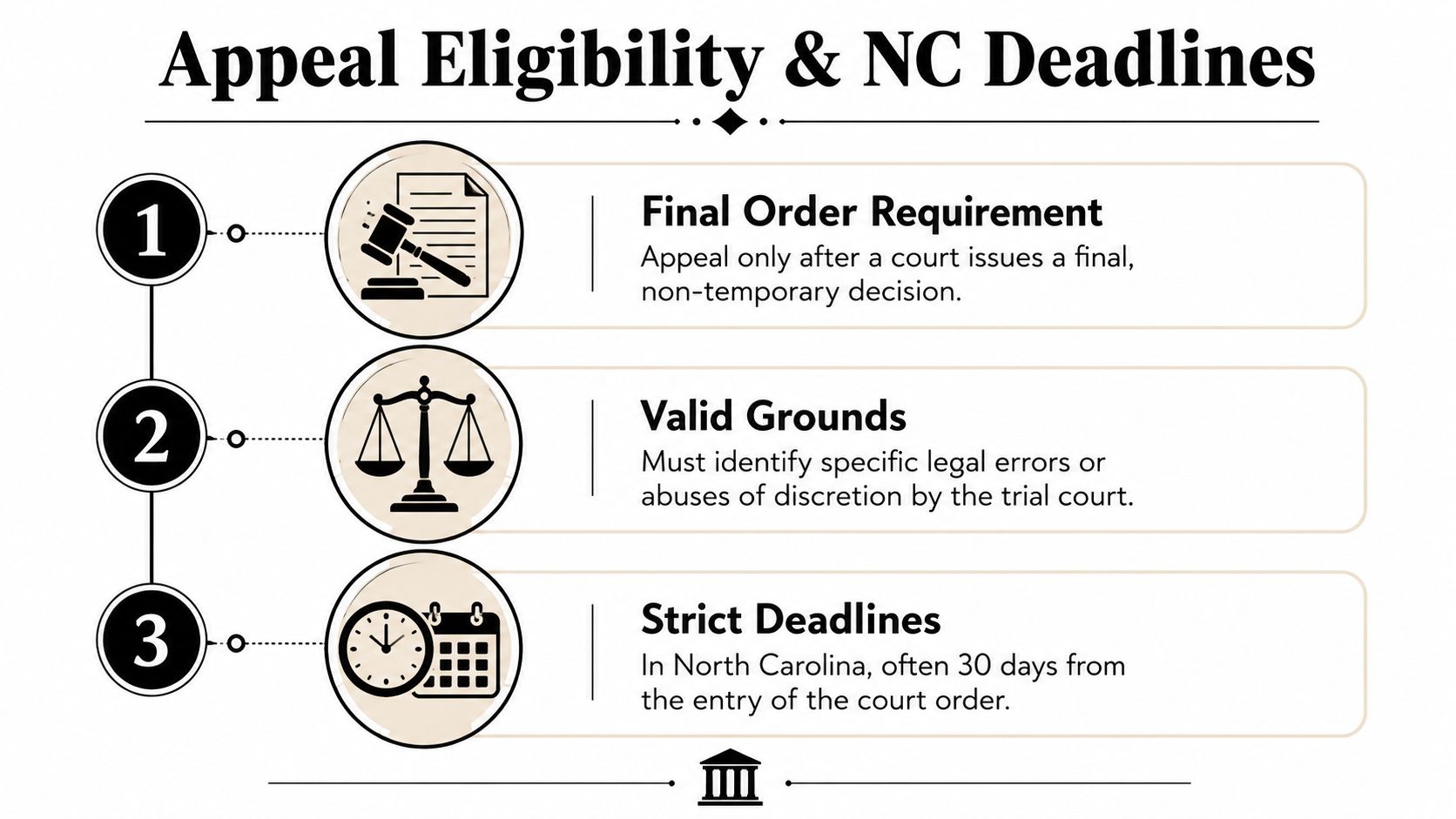
The first questions are narrower. Is this order appealable now? Is there a legal error the appellate court can review? Was the deadline met? If the answer to any one of those is no, the appeal may fail before the court ever reaches the merits.
Final orders matter
In North Carolina, an appeal usually comes from a final judgment or order, not every ruling entered during the life of the case. Family court creates confusion here because temporary custody, temporary support, and other interim rulings can have a major effect on daily life while still not being the kind of order that supports an immediate appeal.
That distinction matters in practice. A temporary custody ruling may feel just as damaging as a final one, especially if parenting time was cut back. Even so, the better course is sometimes to prepare for the next hearing, fix the record, or ask whether a custody modification in North Carolina fits the facts better than an appeal.
Clients do not like hearing that. It is still true.
Grounds for appeal are narrower than unfairness
A North Carolina appeal has to focus on reversible legal error. That usually means something concrete in the order or the trial process, such as:
- applying the wrong statute or legal standard
- failing to make findings the law requires
- entering findings that do not support the conclusions reached
- making a discretionary ruling that goes beyond what the law allows
What usually does not work is a complaint that the judge should have weighed the testimony differently or reached a fairer result. In custody and support cases, trial judges have broad discretion. Appellate courts often defer to that discretion unless the ruling breaks a legal rule in a way the record shows clearly.
A useful way to frame it is this. "I was not believed" is usually not an appellate issue. "The court skipped a required finding" may be.
One recurring trap appears in divorce cases. If equitable distribution or alimony claims were not properly filed before the divorce became final, an appeal may not bring those claims back. That is why Don't Lose Your Rights: Filing Claims Before NC Divorce Is Final deserves prompt attention when divorce is pending alongside financial claims.
After you've reviewed the order, it helps to hear the process explained plainly:
The deadline problem that ends appeals fast
Deadlines in appellate practice are unforgiving. In many North Carolina civil cases, the notice of appeal must be filed within 30 days after entry of the judgment or order being appealed. Missing that deadline can end the case, even if the legal issue is strong.
This is one of the hardest parts for clients. Stress, confusion, and post-hearing exhaustion are real. The rules do not bend for any of that.
Get the signed order immediately. Confirm the date it was entered. Have appellate counsel review whether the order is final, whether the issue was preserved, and whether the clock has already started. Waiting a few weeks to decide whether the ruling still feels unfair can cost you the right to seek review at all.
Building Your Case for the Appellate Court
You may leave court convinced the result was plainly wrong. The Court of Appeals asks a narrower question. What in this record shows a legal error the trial court was not allowed to make?

That difference matters more than clients expect. Appellate judges do not re-try custody, support, alimony, or property cases from scratch. They review the materials the trial court had and decide whether the judge applied the right law, made findings supported by the evidence, and stayed within the court's discretion.
In practical terms, your appeal is built on the record on appeal. That usually includes the written order, the transcript, the filed motions and pleadings, and exhibits that were admitted. If a document was never offered, an objection was never made, or a point was never clearly presented to the trial judge, the appellate court may have no way to address it.
What the appellate court actually reviews
Clients often want to add the text message they found after trial, the school record that explains everything, or the fuller story they did not get to tell in court. That is understandable. It is also usually outside the scope of an appeal.
The Court of Appeals generally reviews:
- The written order entered by the trial judge
- The transcript of the hearing or trial
- Filed pleadings, motions, and other papers included in the record
- Admitted exhibits and other materials allowed by the appellate rules
That is why a strong appeal often starts with a hard review of what happened below, not a fresh retelling of what feels unfair now.
Preservation often decides what can be argued
A surprising number of appeals rise or fall on preservation. The legal problem may be real, but if trial counsel did not object, request a ruling, or ask for a required finding, the issue can be limited or lost.
Here is how that plays out:
| Trial event | Appellate impact |
|---|---|
| Counsel objects to inadmissible evidence and gets a ruling | The issue may be preserved for review |
| No objection is made | The argument may be waived or much harder to raise |
| Counsel requests a required finding and the court omits it | That omission may become a stronger appellate point |
This is one of the hardest conversations in my practice. A client may be focused on whether the judge believed the wrong witness. The better appellate question is often whether the order contains findings that support the ruling, whether those findings are backed by competent evidence, and whether the legal standard used was correct.
If the issue is not in the record, the appellate court usually cannot fix it.
Practical work that strengthens an appeal
Once notice has been filed, the case becomes document-heavy and rule-driven. Careful assembly matters. Small mistakes in the record can create real problems later.
A disciplined review usually includes:
- Ordering the transcript promptly from the authorized source.
- Pinpointing the exact ruling at issue with cites to the transcript, exhibits, or order.
- Separating unfair facts from legal error so the appeal focuses on arguments the Court of Appeals can decide.
- Checking whether findings support the conclusion and whether the conclusion matches the governing statute or case law.
- Preparing the record on appeal correctly under the North Carolina Rules of Appellate Procedure.
Clients do not always like this phase because it can narrow the case. That is not a weakness. It is how good appellate work is done. A shorter, legally supportable issue is usually stronger than a long list of grievances the court has no authority to remedy.
Crafting Your Argument The Appellate Brief
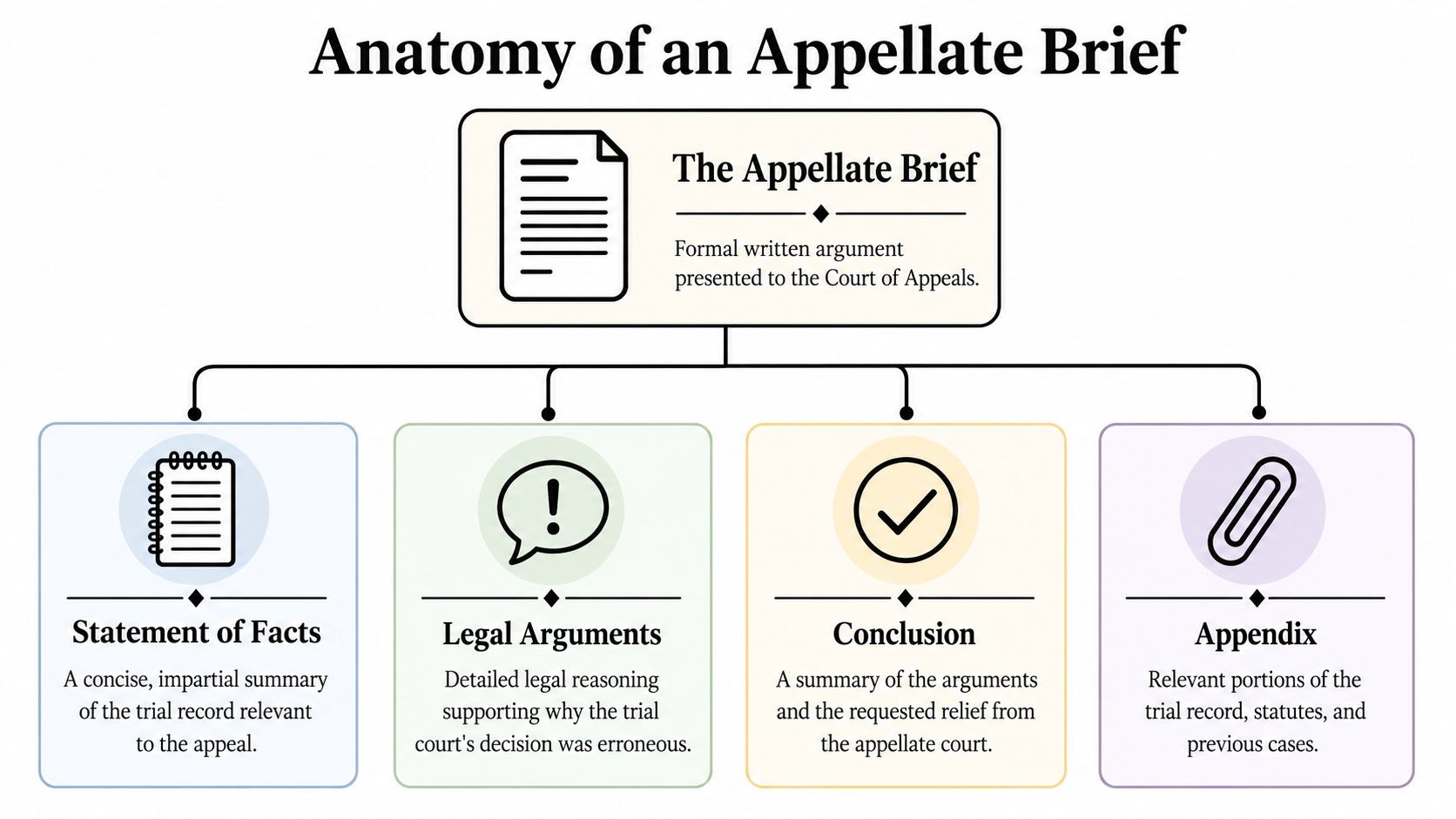
The appellate brief is where good instincts become real legal work. It is the document that tells the North Carolina Court of Appeals what the trial court did, why it was legally wrong, where that error appears in the record, and what remedy the appellate court should order.
Complaints don't win appeals
A client version of the case usually begins with the human reality. "The judge ignored everything I said." "My ex lied." "The result makes no sense."
Those concerns may be sincere. They still don't form an appellate argument by themselves.
A real appellate argument must identify a reversible legal error. One recognized framework is that the appellant must show a substantial mistake such as use of a wrong legal principle, a finding unsupported by the evidence, failure to consider a relevant factor, consideration of an irrelevant factor, or a clearly wrong discretionary result, as described in the Family Court appeal guidance from the Federal Circuit and Family Court of Australia. That framework tracks the same practical reality North Carolina clients face. The brief must prove legal error, not re-argue feelings about the facts.
What a stronger argument looks like in North Carolina
Here is the difference.
Weak appellate point:
"The custody ruling was unfair because the judge didn't understand my bond with my child."
Stronger appellate point:
"The custody order should be vacated because the trial court failed to make findings sufficient to show how the ruling served the child's best interests under N.C. Gen. Stat. § 50-13.2."
That second argument gives the Court of Appeals something to review. It names a North Carolina statute. It points to the structure of the order. It frames the issue as legal error.
The same pattern appears in other family cases:
- Child support issue: The order doesn't contain findings necessary to support the calculation used.
- Equitable distribution issue: The court classified property incorrectly under North Carolina law.
- Alimony issue: The order omits necessary findings on dependency, supporting spouse status, or relevant statutory factors.
For readers who want context on the underlying custody standard, Child Custody in North Carolina addresses how North Carolina courts decide custody under the best interests standard. That matters because many appeals fail when a party attacks the result without connecting the argument to findings, law, and record support.
The brief has to do several jobs at once
A strong appellate brief usually does all of the following well:
- States the facts carefully. Not slanted beyond recognition, but framed around the issues that matter.
- Pins each argument to the record. Assertions without record support don't carry weight.
- Uses North Carolina authority. Statutes, cases, and procedural rules should drive the analysis.
- Asks for a specific remedy. Affirm, reverse, vacate, or remand are not interchangeable.
A persuasive brief doesn't say, "Please reconsider." It says, "This ruling cannot stand for this legal reason shown in this part of the record."
The appellate judges usually decide the case from the written work first. Oral argument, if it happens, comes later. The brief is where credibility is built.
The Final Steps Oral Argument and Potential Outcomes
By the time a case reaches oral argument, the judges have usually read the briefs and reviewed the record materials relevant to the issues. This surprises clients who expect a courtroom replay of trial. Oral argument is much narrower.
What oral argument really is
In the North Carolina Court of Appeals, oral argument is typically a focused question-and-answer session between the judges and the lawyers. No new witnesses testify. No new exhibits come in. The lawyer doesn't get to start over.
A custody appeal gives a useful example. If the issue is whether the trial court made legally sufficient findings under the best interests standard, the judges may ask where in the order those findings appear, whether the appellant preserved the issue, and what remedy is appropriate if the findings are inadequate.
Oral argument is not your chance to tell the whole story again. It's counsel's chance to answer the panel's hardest legal questions directly.
What the court can do
The basic outcomes are straightforward, even if the path to them isn't.
| Outcome | What it means | Example |
|---|---|---|
| Affirm | The trial court's order stands | A custody order remains in place |
| Reverse | The appellate court determines the trial court was wrong in a way that changes the result | A property classification ruling is overturned |
| Remand | The case goes back to the trial court for further action | The judge must make additional findings or hold further proceedings |
Sometimes a remand is the most realistic outcome. For example, if a trial court entered a custody order without adequate findings, the Court of Appeals may send the matter back for additional proceedings rather than award custody outright to the appellant.
That matters for expectations. Even a successful appeal may not end the dispute. It may send you back to district court with clearer rules for what happens next.
Frequently Asked Questions About NC Family Court Appeals
Below are direct answers to questions North Carolina clients ask all the time when deciding whether to appeal a family court decision.
| Question | Answer |
|---|---|
| Can I present new evidence on appeal? | Usually no. The appellate court reviews the record created in the trial court. If something important happened after entry of the order, that may point toward a motion or modification request rather than an appeal. |
| Does filing an appeal stop the family court order? | Not automatically in many situations. You may need separate relief to stay enforcement, and whether that is available depends on the type of order and the procedural posture. |
| Can I appeal a temporary custody order in North Carolina? | Often, the answer is more complicated than people expect. Temporary orders and interlocutory rulings raise special appellate issues. You need a case-specific review of whether the order is immediately appealable. |
| How long will a family law appeal take? | It depends on the transcript, record preparation, briefing schedule, and the appellate court's calendar. Appeals are not quick. You should plan for a process that requires patience and close attention to deadlines. |
| Do I need a different lawyer for the appeal? | Not always, but appellate work is specialized. Trial skill and appellate skill overlap, yet they are not the same. Many clients benefit from having an attorney who regularly handles North Carolina appellate procedure review the case. |
Two misconceptions that cause trouble
Some clients assume an appeal is cheaper than continuing trial-level litigation. Sometimes it is. Sometimes it isn't. Transcript preparation, record assembly, and appellate briefing can be substantial.
Others assume the Court of Appeals will fix anything that seems unjust. It won't. The court fixes legal errors that were preserved and properly presented.
Navigate Your North Carolina Appeal with Confidence
You leave court convinced the judge got it wrong. That reaction is common. It is also where many appeal decisions go off track, because feeling wronged is not the same as having a reversible legal error.
The North Carolina Court of Appeals does not rehear your family case or decide which side seems more sympathetic. It reviews the written order, the record, the transcript if one exists, and the legal issues that were properly preserved. That difference matters. It shapes whether an appeal has real value or only adds cost, delay, and stress.
A sound appellate evaluation starts with candor. The question is not whether the ruling felt unfair. The question is whether the trial court made a material legal mistake that gives the appellate court a basis to intervene.
Trial work and appellate work require different skills. At trial, counsel builds facts, questions witnesses, and makes objections in real time. On appeal, counsel works from a closed record, identifies the standard of review, and frames a legal argument that fits North Carolina appellate rules. A lawyer can be strong in one setting and less effective in the other.
If you are deciding whether to appeal, collect the order, key filings, notices, and transcript information immediately. Then get a focused review of the case. Ask one direct question: is there a preserved legal issue here that could change the result?
Sometimes the honest answer is no. Clients do not like hearing that, but it can save them from spending money on an appeal that was never likely to succeed. In other cases, the answer may be yes, but only if action starts quickly and the procedural steps are handled with care.
If you are also deciding who should review the case, this guide on how to find the right North Carolina divorce lawyer can help you assess whether the attorney has the right experience for a family law matter with possible appellate issues. The Law Office of Bryan Fagan handles North Carolina family law matters, including divorce, custody, support, and property disputes that can lead to appellate review.
A careful consultation often prevents two expensive mistakes. Filing an appeal based on frustration alone. Letting a strong issue die because no one acted before the deadline.