You are getting ready for school pickup, and the other parent sends a text saying the schedule has changed. Or you learn they want to move with the child. Or court papers arrive, and suddenly an argument that felt manageable starts carrying legal consequences.
That is the point when many parents ask, when should I hire a custody lawyer in NC?
Usually, the answer is earlier than you think. In North Carolina, custody cases often turn on timing, documentation, and the pattern of each parent's decisions before a judge ever hears testimony. A delay can hurt your position if the other parent is withholding parenting time, making major decisions alone, planning a relocation, or creating a record that does not reflect what is really happening in your home.
North Carolina courts decide custody based on the child's best interests, not a preset 50/50 formula. Judges look closely at stability, judgment, follow-through, communication, and each parent's role in the child's daily life. In serious cases, the court can restrict a parent's custodial rights. That makes early legal advice a practical step, not an overreaction.
Hiring counsel does not automatically increase conflict. In many cases, it helps contain it. A lawyer can help you respond without damaging texts, protect evidence before it disappears, and make informed choices before a temporary routine starts looking like the status quo.
The question isn't whether your case feels dramatic enough for a lawyer. It is whether one of the trigger events has happened that puts your time with your child, your decision-making authority, or your credibility at risk.
Navigating Your North Carolina Custody Case
It often starts on an ordinary weeknight. You expect your child back after dinner, but the other parent says they are keeping an extra overnight because "this schedule works better." A few days later, you learn a school issue was handled without you. Then someone mentions a possible move. At that point, the question is no longer whether the situation feels tense. The question is whether the facts are shifting in a way that could hurt your position if you wait too long to get advice.
In North Carolina, custody cases are built from patterns. Judges look at who has been making day-to-day decisions, who gets the child to school, who follows through on medical care, and which parent is reducing conflict instead of feeding it. Under N.C. Gen. Stat. § 50-13.2, the court decides custody based on the child's best interests. That standard gives the judge wide discretion, which means small decisions can carry real weight once a case is filed.
Why early action matters in North Carolina
Parents often wait because they want to keep things civil or avoid spending money too soon. I understand that instinct. Sometimes that restraint helps. Sometimes it gives the other parent time to create a new routine, gather one-sided records, or push you into reacting badly by text or email.
The practical issue is timing. If parenting time is being limited, major decisions are being made without you, or the child's living arrangement is changing without a clear agreement, the case may already be moving from a family conflict into a legal problem.
Some situations call for especially fast action. If there are immediate safety concerns, threats to remove the child, or conduct that may justify urgent court involvement, speak with counsel about whether an emergency custody lawyer in NC is needed.
The right way to evaluate your risk
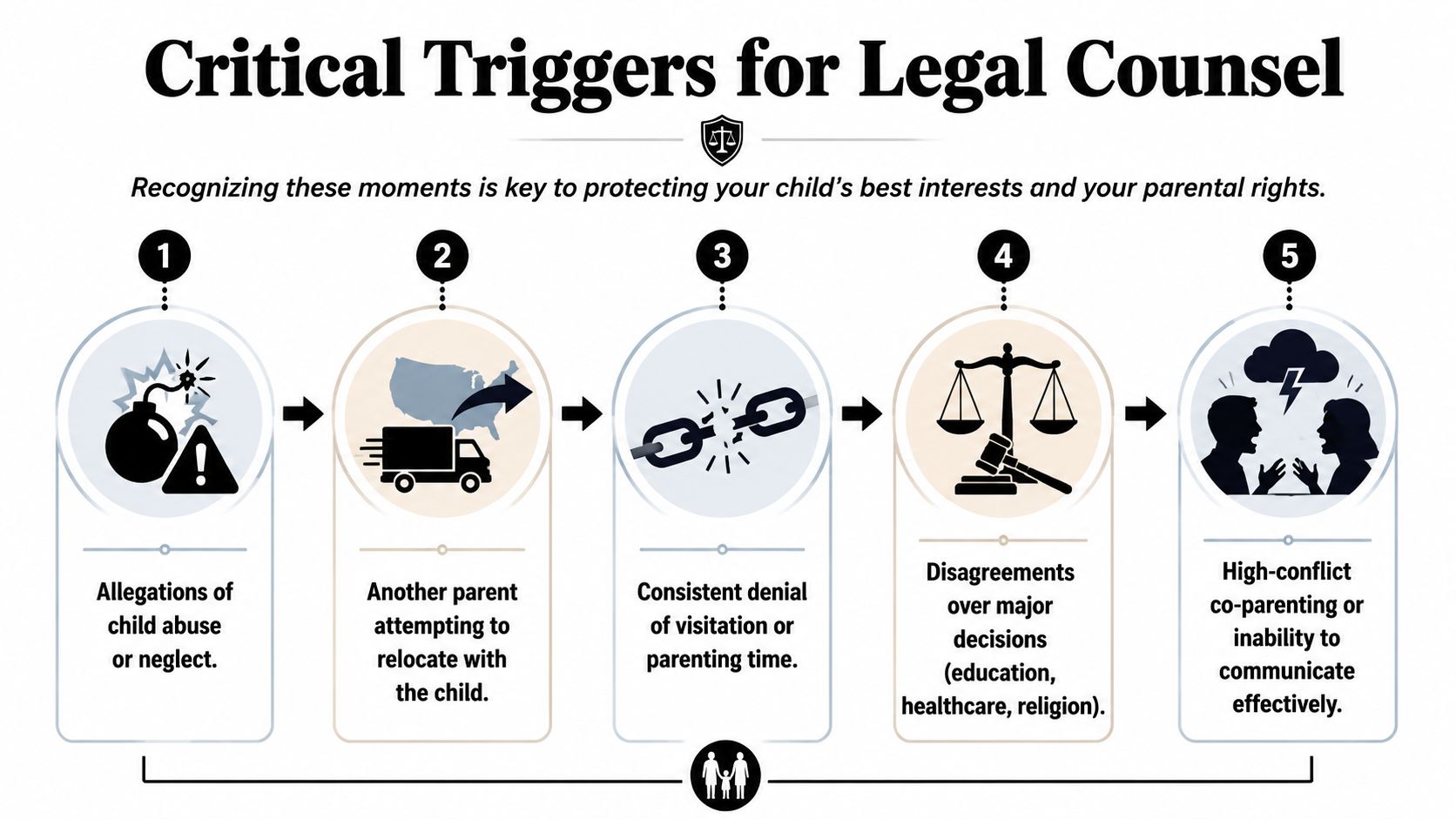
A better question than "Can I handle this myself?" is whether one of these facts is already putting pressure on your rights as a parent:
- The schedule keeps changing without real agreement. Repeated extra nights, canceled visits, or long gaps in parenting time can turn into an accepted pattern if you do not address them properly.
- Important decisions are happening without you. School enrollment, medical treatment, counseling, and extracurricular commitments matter in both legal and physical custody disputes.
- A move is being discussed or planned. Relocation can change school, travel time, and the child's routine fast.
- Someone is making accusations. Claims involving abuse, neglect, substance use, or unsafe conditions should never be handled casually.
- Another adult is stepping into the parenting role. New partners, grandparents, or other caregivers can affect both the facts and the court's view of stability.
If one of those trigger events is already in play, getting legal advice early is usually a sound decision. That does not mean filing suit that day. It means protecting your credibility, your parenting time, and your options before the situation hardens into evidence the court will later rely on.
Critical Triggers That Signal You Need a Lawyer
A parent is at your door with papers from the courthouse. Or you learn your child may be moved to another county before school starts. Or a text thread that used to be tense suddenly includes threats, police, or DSS. Those are not moments to "wait and see." In North Carolina custody cases, a few trigger events change the case fast and often put one parent at a procedural disadvantage if counsel is not involved early.
You've been served with custody papers
Once you are served with a complaint, motion, notice of hearing, or a request for temporary relief, the case has moved out of the "we can probably work this out" stage. Court deadlines apply. So do local rules, filing requirements, and the practical reality that your first response often sets the tone for the rest of the case.
I tell parents this all the time. A rushed answer, a careless affidavit, or silence can do real damage. Even if the claims against you are exaggerated, the court only sees what is properly filed and supported. A lawyer helps you assess what has been requested, what must be answered now, and what position protects you later.
A move is on the table
Relocation is one of the clearest signs you need legal advice before anyone packs a bag. That includes your move, the other parent's move, or even a "temporary" plan to stay with family that starts changing school, daycare, transportation, or exchange logistics.
North Carolina judges look closely at stability, continuity, and the child's actual routine. If one parent creates a new status quo and the other parent does not respond promptly, that new arrangement can become harder to undo. If the move may happen soon or the child may be withheld, review what may justify urgent action with an emergency custody lawyer in NC.
Abuse, neglect, substance use, or domestic violence has entered the case
This is a legal and factual turning point.
Once allegations involve child abuse, neglect, substance abuse, unsafe living conditions, or domestic violence, parents need more than good intentions. They need a disciplined response. The court will focus on evidence, timing, credibility, and immediate risk to the child.
You should get counsel quickly if:
- You need to raise a safety concern. The facts must be presented clearly, with records, witnesses, messages, photos, or other proof where available.
- You have been accused of unsafe conduct. An emotional response, angry texts, or self-help decisions usually make the case worse.
- DSS, law enforcement, or criminal charges are involved. Those proceedings can affect what happens in district court, and statements made in one setting can create problems in another.
Judges do not decide custody based on who is more upset. They decide based on admissible facts and the child's best interests.
The other parent is violating an existing order
A custody order only helps if it is enforced. If the other parent is denying visits, refusing exchanges, cutting off communication, or making unilateral schedule changes, get advice before the pattern becomes normal.
Some parents wait because they want to look reasonable. That instinct is understandable. It can also backfire. Repeated violations usually require a specific legal response, such as a motion for contempt, a motion to enforce, or in some situations a request to modify the order. The right choice depends on the language of your current order and the proof you have preserved.
A third party is stepping into the case
Parents are often surprised by how quickly a custody dispute changes when a grandparent, relative, or other caregiver becomes central to the child's day-to-day life. That issue comes up in cases involving addiction, mental health crises, incarceration, military deployment, extended separations, or a long period where someone else has been providing most of the care.
North Carolina law does allow some third-party claims in limited circumstances. The details matter. So does timing. If a grandparent is threatening to file, already caring for the child, or asking for formal rights, you should not treat that as a side issue. It can affect standing, strategy, and the facts the judge hears about parental fitness and the child's current home life.
Temporary hearings are coming up fast
Many parents underestimate temporary hearings because the label sounds short-term. In practice, temporary custody arrangements often shape negotiations, school plans, holiday schedules, and the court's first impression of the family.
If a hearing is approaching, counsel can help you decide what evidence belongs in front of the judge, what requests are realistic, and what arguments are likely to distract from your strongest points. That kind of preparation matters. In custody court, early impressions are hard to reverse.
The Strategic Benefits of Early Legal Counsel
Many parents wait until the case feels unmanageable. By then, the damage usually isn't dramatic. It's procedural. Missed deadlines. Unhelpful text messages. Informal routines that become the new normal. Evidence that wasn't saved when it mattered.
Early legal counsel changes that.

Early advice helps you protect the facts
The strongest custody cases are usually built from ordinary details. School pickup records. Medical communications. Calendars. Photos. Messages showing who handled day-to-day care and how each parent communicated.
A lawyer helps you identify what matters before it disappears into a lost phone, deleted email chain, or vague memory. That's especially important when a parent expects the issue to "work itself out" and doesn't document anything until much later.
It lowers the chance of avoidable mistakes
Parents under stress often make understandable but harmful choices. They move out too quickly. They withhold parenting time to "teach a lesson." They agree to a temporary schedule that later becomes hard to unwind.
Those are not moral failings. They're strategic mistakes.
Client-facing reality: The best time to get advice is often before you take the action that feels obvious.
This short video gives a useful overview of why timing and preparation matter in custody disputes:
Lawyers often improve the odds of settlement
There is measurable evidence that representation affects custody outcomes. In a survey of recently divorced parents, 86% of cases where both parents had attorneys settled out of court, compared with 63% when only one parent had an attorney. The same survey found that cases with attorneys on both sides produced joint physical custody at the highest rate, 82%, according to Custody X Change's survey summary on attorney involvement and custody outcomes.
That doesn't mean a lawyer guarantees agreement. It does mean early representation is often associated with more negotiated outcomes and fewer cases drifting into avoidable conflict.
It gives you a framework for cost and risk
A practical way to think about hiring a lawyer is this: the cost question shouldn't be limited to legal fees. It should include the cost of doing something careless in a case involving your child.
If you're dealing with one minor scheduling disagreement and both parents exchange drafts calmly, you may need limited legal guidance. If the issue involves relocation, safety allegations, unstable housing, or a parent who ignores boundaries, waiting gets expensive in a different way.
What a North Carolina Custody Lawyer Does for You
By the time many parents call my office, they have already made a few avoidable mistakes. They agreed to a temporary schedule over text without thinking about how it would look later. They sent angry messages that will end up in an exhibit notebook. They assumed the judge would split time down the middle. North Carolina custody cases do not work that way.
A custody lawyer starts by sorting facts that matter from facts that only feel important in the moment. In North Carolina, judges decide custody based on the child's best interests. That standard is broad, but it is not random. The court will pay attention to caregiving history, the child's routine, each parent's judgment, the ability to support the child's relationship with the other parent, and any facts affecting safety, stability, school performance, or medical care.
That early analysis changes how the case is built. A lawyer helps you present the right facts in a form the court can use, instead of walking into mediation or a hearing with a stack of screenshots and no clear theory.
Applies North Carolina law to the facts you will have to prove
Good legal advice in a custody case is not abstract. It is specific to your county, your judge's expectations, and the evidence you can gather.
That often means identifying issues such as:
- Caretaking patterns: Who gets the child up, fed, to school, to appointments, and through homework and bedtime?
- Decision-making history: How have major choices about school, counseling, medical care, and activities been handled?
- Stability concerns: Is either home dealing with frequent moves, untreated substance abuse, unsafe supervision, or repeated conflict in front of the child?
- Practical scheduling: What custody schedule fits the child's age, school calendar, distance between homes, and the parents' work demands?
Those details matter because North Carolina courts want workable orders, not vague promises. If your proposal does not make sense on a calendar, it will be harder to defend.
Prepares the case before court gets involved
A large part of custody work happens outside the courtroom. In many North Carolina counties, parents must attend custody mediation through the court before a judge hears the case, unless there is a valid reason to waive it. What happens before mediation often determines whether you walk in prepared or cornered.
A lawyer drafts the complaint, answer, counterclaims, motions, and proposed parenting terms with a purpose. The wording matters. So does the timing. If there is an emergency issue, such as interference with contact, threats to remove the child, or serious safety concerns, counsel can decide whether the facts justify immediate court action or whether a rushed filing will hurt more than help.
Lawyers also organize evidence in a way judges and mediators can follow. That includes school records, medical records, calendars, photographs, witness information, and communications that show a pattern. Random messages rarely win cases. Clear patterns do.
Controls communication and reduces preventable damage
Parents under stress often create bad evidence without realizing it. A lawyer helps stop that.
Sometimes the best move is to limit communication to a parenting app or short written exchanges about the child only. Sometimes it is smarter to make one clear settlement proposal and then go quiet. Sometimes you need a firm response because the other parent is testing boundaries and building a record of your silence. Strategy depends on the facts.
This is one reason many parents speak with a North Carolina child custody lawyer before the conflict gets worse. Early advice can protect your position before habits, messages, and informal arrangements become harder to explain.
Negotiates terms that can be enforced later
A weak custody agreement creates future disputes. I look for the gaps that lead parents back to court six months later.
A sound parenting plan should address more than alternating weekends. It should spell out exchange times and locations, holiday rotation, transportation, phone contact, school breaks, extracurricular activities, travel, notice requirements, and who makes which decisions. If one parent has a history of late pickups, missed visits, or unilateral decisions, the wording needs to account for that reality.
Specific terms do not create conflict. They prevent it.
Represents you when settlement fails
Some cases settle in mediation. Some should. Others need a judge to decide them because one parent is unreasonable, hiding information, making false accusations, or refusing a child-focused schedule.
At that stage, your lawyer's job is to prepare testimony, cross-examine witnesses, make proper objections, and keep the case focused on facts the court can rely on. Judges hear custody disputes every week. They are not persuaded by broad claims that a parent is "difficult" or "toxic" unless the evidence shows how that conduct affects the child.
The point is simple. A custody lawyer does not just appear at the hearing. Counsel builds the record, protects your credibility, and puts your case into a form a North Carolina judge can act on.
How to Prepare for Your Initial Consultation
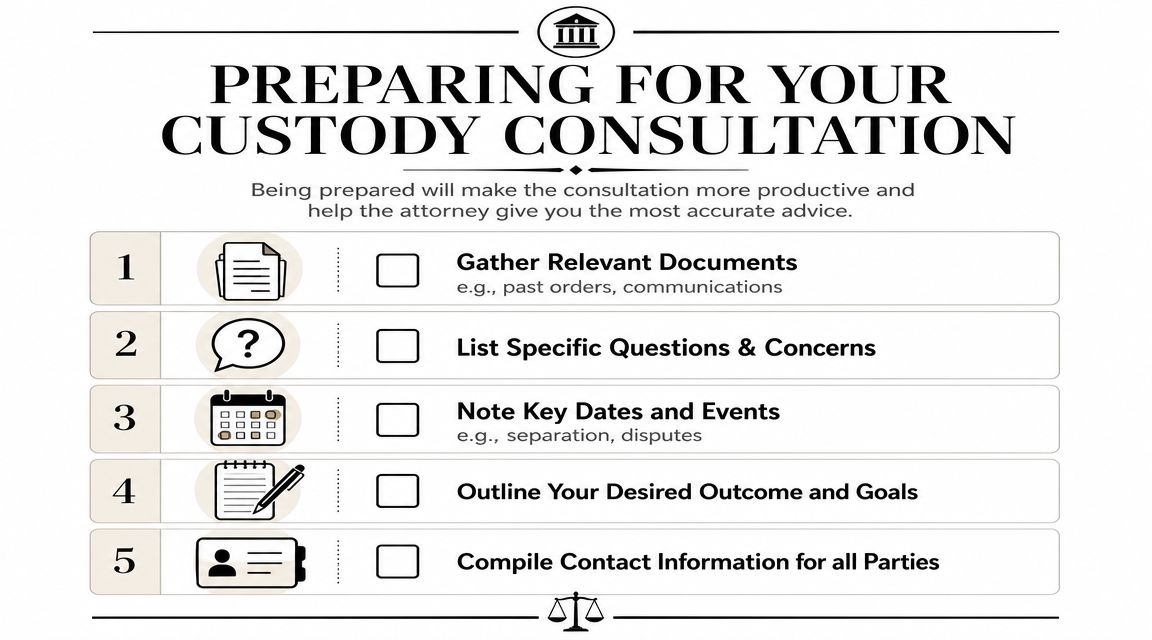
A custody consultation is more productive when you arrive with facts, not just frustration. You don't need a perfectly organized binder, but you do need enough information for a lawyer to spot the risks, deadlines, and likely next steps.
Bring documents that show where things stand
Start with the papers that define the current situation.
- Court documents: Any complaint, motion, summons, notice of hearing, or existing order.
- Written agreements: Separation agreements, parenting plans, or signed informal arrangements.
- Communications: Relevant texts, emails, parenting app messages, and school or medical exchanges.
- Basic records: School reports, appointment information, calendars, and anything showing the child's routine.
If there's a lot of communication, don't print hundreds of pages at random. Pull the messages that show a pattern.
Prepare a short timeline
Write down the key dates in simple order. Separation. Moves. Schedule changes. Missed visits. School changes. Any incident that led to the current dispute.
A timeline helps a lawyer understand the pace of the conflict and whether the case involves an emerging problem or an established status quo.
Bring a timeline that is factual, not emotional. "He missed pickup on three dates" is more useful than "He never cares."
Know your goals before you walk in
You don't need a polished legal theory. You do need to know what outcome you're seeking.
Ask yourself:
- What schedule do I believe is best for my child right now?
- What are my biggest safety or stability concerns?
- Am I trying to prevent a move, enforce an order, or create the first formal custody arrangement?
- What result would let us function without constant conflict?
If you're weighing representation, reviewing a page about a child custody lawyer in North Carolina can help you frame questions about scope, process, and next steps before the meeting.
Understanding Legal Costs and Alternatives
A lot of parents call my office after weeks of trying to save money by handling everything themselves, only to find out they now need a lawyer to fix preventable problems. Cost is a fair concern. It should be. Custody litigation in North Carolina can get expensive, especially once the case involves emergency motions, repeated court dates, school or medical disputes, or a parent who will not follow temporary agreements.

What you're usually paying for
Most North Carolina custody lawyers bill by the hour and require an upfront retainer. In plain terms, the retainer is a deposit. The lawyer bills against it as work is completed.
The final cost usually turns on what the case requires. Drafting a clear consent order after productive negotiations takes far less time than preparing for mediation, responding to allegations, reviewing hundreds of messages, handling discovery, and trying the case before a district court judge. Organization matters too. A parent who brings a clean timeline, relevant records, and focused concerns usually pays for less sorting and less guesswork.
When mediation helps, and when it does not
North Carolina courts often require custody mediation before a judge will hear the dispute, unless the case qualifies for an exemption. Mediation can work well if both parents are capable of discussing schedules, school decisions, holidays, transportation, and communication rules in a practical way.
It is a mistake, though, to treat mediation as a substitute for legal advice. Mediated terms can create future trouble if they are vague, incomplete, or silent on issues that predictably cause conflict. I regularly see disputes grow out of loose language about pickup times, summer vacation selection, makeup time, extracurricular costs, and who gets final decision-making authority.
A lawyer may not need to attend every stage for every family. Sometimes limited representation makes sense. That can include reviewing a proposed parenting agreement, preparing you for mediation, drafting a consent order, or handling one hearing instead of the entire case.
The trade-off between cost now and cost later
The better question is not whether you can pay for counsel today. It is whether you can afford the consequences of signing a weak agreement, missing a filing deadline, showing up unprepared for mediation, or letting the other parent create a status quo that later becomes harder to change.
That trade-off is especially important in custody cases because early decisions can shape the rest of the case. If your main concern is budget, ask direct questions about scope, billing practices, and what work you can do yourself to reduce fees. Ask whether the lawyer offers limited-scope help, whether a consent order is realistic, and what events would make the case more expensive.
If you want a better sense of fee structures before you hire anyone, review this guide to North Carolina child custody lawyer cost. It can help you ask sharper questions and compare options in a practical way.
Frequently Asked Questions About NC Custody Lawyers
Common NC Custody Questions
| Question | Answer |
|---|---|
| Should I hire a lawyer before filing for custody in NC? | If the case is contested, high-conflict, or likely to involve major decisions about parenting time, relocation, or safety, yes. Getting advice before filing often helps you avoid strategic mistakes in the first round of documents and negotiations. |
| Do I need a lawyer if we mostly agree? | Not always for every step, but legal review is still wise if you want a clear, enforceable arrangement. Parents often agree on broad ideas and disagree later on details like holidays, exchanges, school decisions, or travel. |
| Can I wait until mediation fails? | Sometimes, but waiting can be risky if the dispute involves a proposed move, denied parenting time, abuse allegations, or a fast-changing routine. In those situations, legal advice before mediation is usually the safer choice. |
| What if the other parent already hired a lawyer? | You should strongly consider getting counsel too. Once one side has legal guidance, the case usually moves more formally, and casual responses can put the unrepresented parent at a disadvantage. |
A few misconceptions worth clearing up
Some parents think hiring a lawyer makes them look aggressive. It doesn't. In most cases, it shows that you're taking the matter seriously and want to handle it correctly.
Another common misunderstanding is that a judge will automatically split time equally. North Carolina doesn't use an automatic 50/50 rule. The court focuses on the child's welfare and the facts presented.
If you're unsure whether your situation is serious enough, that uncertainty alone is often a reason to schedule a consultation.
Secure Your Family's Future with a Strategic Advocate
Custody cases are rarely just about legal rights on paper. They're about school mornings, holiday routines, medical decisions, and your day-to-day role in your child's life. The earlier you get sound legal advice, the more options you usually have.
If you're dealing with a contested custody issue in North Carolina, don't wait for the situation to get worse before you act. A focused consultation can help you understand your risks, your options, and the next smart step.
If you're facing a custody dispute, relocation issue, enforcement problem, or urgent parenting conflict in North Carolina, schedule a consultation with Law Office of Bryan Fagan. The firm works with North Carolina families on child custody and related family-law matters, helping clients evaluate trigger events, protect their parental rights, and build a practical strategy based on the facts of the case.