Your child is sleeping down the hall, and you're sitting at the kitchen table searching terms like “sole custody vs joint custody NC” because you need a real answer, not a slogan. You may be worried about the other parent's drinking, their schedule, the constant arguments, or whether asking for sole custody will make you look unreasonable. You may also be afraid that if you agree to joint custody, your child's life will feel unsettled and chaotic.
That tension is normal. Custody decisions in North Carolina affect where your child lives, who makes major decisions, how holidays work, and what happens when the other parent stops cooperating. For most parents, this isn't about “winning.” It's about building a workable plan that protects a child's stability.
I've seen parents come in believing they must choose between being generous and being safe. That's rarely how North Carolina courts look at it. Judges focus on whether a custody arrangement serves the child's welfare in real life. A parent can be loving and still have a schedule that doesn't support shared physical custody. A parent can have substance issues and still receive some form of custodial rights if the court believes the risk can be managed. A parent can ask for sole custody and lose credibility if the evidence doesn't support it.
Navigating the Crossroads of Child Custody in North Carolina
A common North Carolina custody case starts with two parents who both love their child but can't agree on what “stable” means. One parent wants a week-on, week-off schedule. The other says the child needs one primary home because school mornings have already become a mess. One parent says the other is controlling. The other says they cannot rely on last-minute cancellations anymore.
That's where custody law becomes personal. Terms like sole custody and joint custody sound simple, but they carry very different day-to-day consequences. They affect who decides on school enrollment, who handles medical care, who keeps the child on a weekday routine, and how much communication the parents must maintain.
In North Carolina, the right answer usually isn't the arrangement that feels most fair to the adults. It's the arrangement the court believes will best protect the child's needs, routine, safety, and relationships.
The strongest custody position is usually the one tied to evidence, not emotion.
If you're reading this because you're separated, thinking about separating, or already in a dispute, focus on one question: what arrangement can you carry out consistently? Judges pay attention to that. They look past labels and examine whether the proposed schedule works with school, transportation, childcare, communication, and the child's overall well-being.
Before looking at what courts tend to do, it helps to get the language right. Many custody disputes get harder because the parents are arguing about different things without realizing it.
The Legal Foundations of Custody in North Carolina
North Carolina divides custody into legal custody and physical custody. Those are separate concepts, and many parents confuse them at the start.
Legal custody and physical custody mean different things
Legal custody means the right to make major decisions for a child. That usually includes education, non-emergency medical care, and religion.
Physical custody means where the child lives and which parent handles day-to-day care.
A parent can have joint legal custody while one parent has sole physical custody. That's not unusual. It means both parents share major decision-making, but the child primarily lives with one parent.
A parent can also have sole legal custody and sole physical custody, although that tends to be reserved for cases where shared authority would create serious problems for the child.
What sole and joint actually mean in practice
Sole custody means one parent has primary authority in the category at issue. If it's sole legal custody, one parent makes major decisions. If it's sole physical custody, the child primarily lives with one parent.
Joint custody means the parents share authority or time. But in North Carolina, joint custody does not automatically mean a 50-50 schedule. It can mean shared decision-making, shared parenting time, or both, in many different forms.
That matters because many parents walk into court believing “joint” equals equal time. North Carolina law doesn't require that.
Practical rule: Don't assume “joint custody” guarantees equal overnights. The actual court order controls the schedule.
North Carolina custody decisions are governed by N.C. Gen. Stat. § 50-13.2(a). Under that statute, courts decide custody based on the best interests of the child. The law allows sole custody when evidence shows joint custody would endanger the child's physical or emotional well-being, including situations involving documented domestic violence or substance abuse, as reflected in the discussion of joint versus sole custody under North Carolina's best-interest standard.
For a broader overview of how courts apply that standard, Child Custody in North Carolina discusses how North Carolina courts decide custody under the best interests framework.
The vocabulary matters because the remedy matters
If your real concern is that the other parent makes reckless medical decisions, you may be arguing about legal custody. If your concern is missed school drop-offs, unsafe housing, or no reliable weekday routine, you may be arguing about physical custody.
Those are different problems, and they call for different solutions. A good custody strategy starts by identifying which part of custody is in dispute.
How NC Courts Decide Using the Best Interest Standard
A parent can walk into court asking for joint custody because it sounds fair, then leave with a schedule that looks nothing like 50-50. Another parent can ask for sole custody and learn that the judge is willing to share decision-making, but not weeknight overnights. That happens because North Carolina courts do not decide custody by label. They decide it by function.
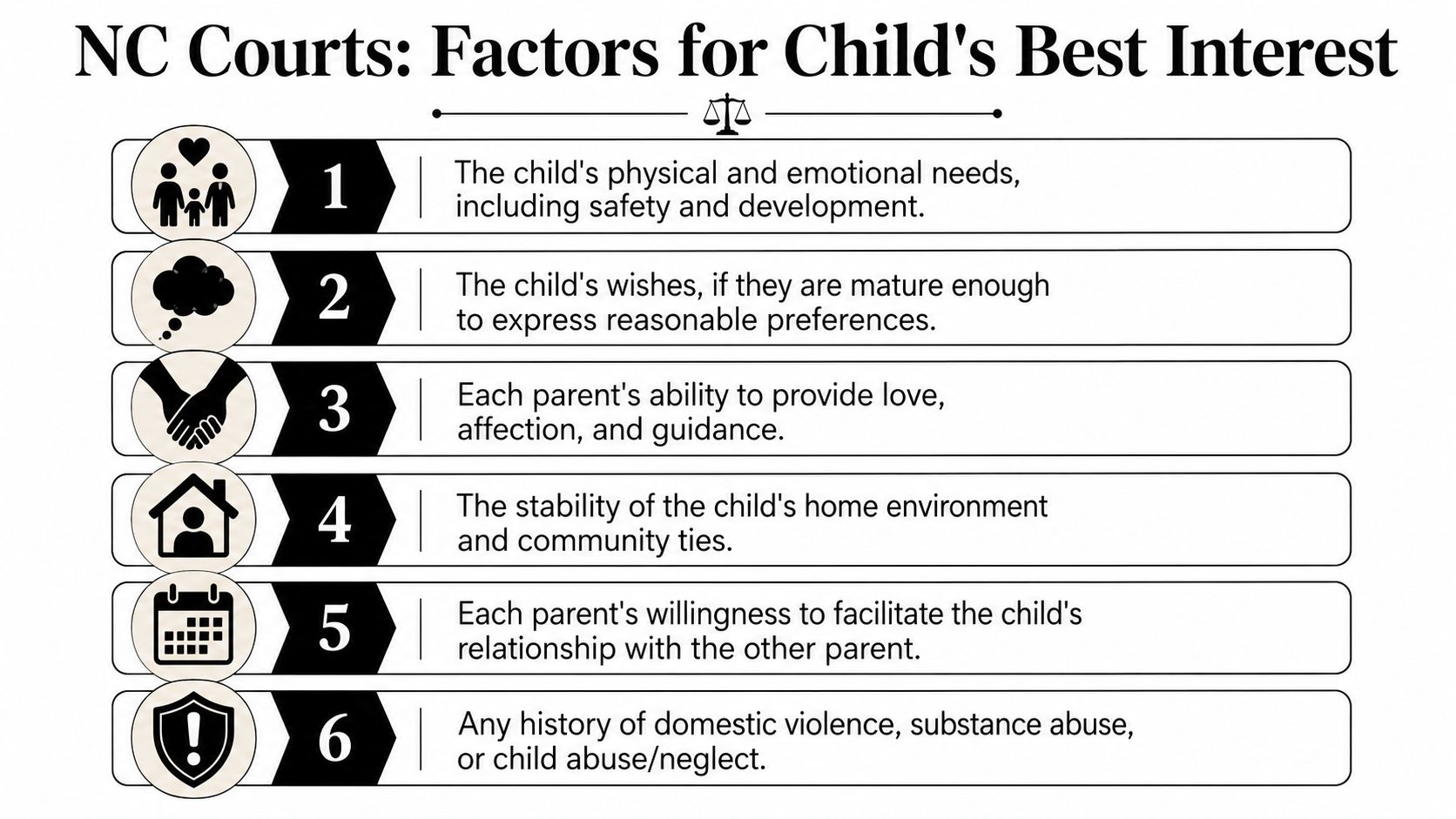
Under N.C. Gen. Stat. § 50-13.2(a), the court must enter a custody order that serves the child's welfare and best interests. In real cases, that standard turns on practical questions. Who gets the child to school on time. Who follows through with therapy, medication, and parent-teacher meetings. Which parent can put together a schedule that works every week, not just on paper. If you want a closer look at how courts apply that rule, this guide on the best interest of the child in NC is a useful starting point.
What judges often focus on in real cases
North Carolina judges have broad discretion, but the same facts tend to carry weight again and again.
- Safety first: Domestic violence, abuse, neglect, unsafe living conditions, and active substance use can push a case away from joint custody quickly, especially if the problem affects supervision, transportation, or the child's emotional stability.
- The parent's actual track record: Judges look for proof of who has handled homework, doctor visits, school communication, meals, and bedtime. A parent who says, “I can do more now,” still has to address what the pattern has been.
- Ability to co-parent: Joint legal custody works better when parents can exchange information, make decisions, and keep the child out of adult conflict. Repeated hostility, refusal to communicate, or using the child as a messenger can undermine a request for joint decision-making.
- Stability: Judges care about school continuity, transportation, childcare coverage, and whether the child has a dependable routine.
- Support for the child's relationship with the other parent: A judge will notice whether a parent is protecting the child for a legitimate reason or trying to shut the other parent out.
I often tell parents that custody hearings are won and lost in the details. General claims about being the better parent rarely carry the day. Specific facts do.
North Carolina courts also examine whether the proposed plan is workable. A schedule that requires constant swaps, last-minute babysitters, or long school-night drives may look equal to the parents and still look unhealthy to the court.
The court process often makes more sense after you see how lawyers and judges talk through these issues:
Work schedules, conflict, and substance use often drive the outcome
These are three of the most common pressure points in custody cases.
A demanding job does not make someone a bad parent. But if one parent works rotating shifts, frequent overnights, or unpredictable weekends, the judge may question whether a joint physical schedule is realistic. Courts usually want a plan the child can live with consistently. If Grandma, a new partner, or paid childcare will handle large parts of that parent's custodial time, the court may ask why the child should not spend more of that time with the other parent instead.
Parental conflict matters for the same reason. Joint custody can work after a difficult breakup, but not every case is suited for it. If parents cannot agree on school, medical care, counseling, or exchange logistics without repeated blowups, a judge may decide that one parent needs final decision-making authority in certain areas. In some cases, the court will still order substantial time with both parents while limiting shared legal custody.
Substance use is another issue courts treat seriously. The key question is not moral judgment. It is whether the problem affects parenting. Missed pickups, impaired driving, unsafe supervision, failed drug screens, untreated addiction, or repeated alcohol-related incidents can change the custody analysis fast. A parent dealing with substance abuse may still receive parenting time, but the court may require safeguards such as supervised visits, treatment compliance, or step-up provisions before expanding custody.
A strong custody proposal matches the child's routine and the parent's real availability.
Evidence that helps and evidence that hurts
Parents often expect the court to respond to emotion. Judges respond better to organized, credible proof.
Helpful evidence may include:
- Documented routines: Calendars, attendance records, childcare plans, and school communications that show who handles the child's day-to-day needs.
- Communication records: Messages or emails that show cooperation, repeated conflict, or refusal to share information.
- Third-party records: Medical, counseling, school, or agency records, if they are relevant and admissible.
- Specific incidents: Dates, witnesses, police reports, photographs, treatment records, and other concrete proof carry more weight than broad accusations.
What hurts a case is often just as important. Exaggeration hurts. Vague claims hurt. So does asking for a custody arrangement that your own schedule, housing, or history cannot support.
If you already have an order and circumstances have changed, Modifying Custody and Support Orders in NC explains when North Carolina courts will revisit custody and support.
Comparing Sole and Joint Custody Day-to-Day Impact
A custody label matters less than the life it creates for your child. That's why parents searching “sole custody vs joint custody” need to look past the courtroom terms and ask what daily parenting will require.
Sole Custody vs. Joint Custody. A Practical Comparison
| Aspect | Sole Custody | Joint Custody |
|---|---|---|
| Major decision-making | One parent has final authority if the order grants sole legal custody | Parents share major decisions if the order grants joint legal custody |
| Daily routine and scheduling | Usually more centralized and predictable in one primary home | Requires a detailed schedule and reliable exchanges |
| Co-parenting communication | Can reduce decision deadlock if one parent has sole legal authority | Works best when parents can communicate consistently and respectfully |
| School and medical logistics | Often simpler when one home handles most weekday responsibilities | Requires both parents to stay informed and involved |
| Conflict management | May reduce repeated disputes in high-conflict cases | Can become difficult when parents cannot agree on basic issues |
| Flexibility for relocation | Still subject to court review if it affects the child | Shared schedules can be harder to maintain after a move |
The strongest practical differences
Under sole legal custody, one parent can make major choices without getting stuck in repeated deadlock. That can be helpful when the other parent is absent, obstructive, or unsafe. It can also create resentment if the excluded parent feels shut out and continues to challenge decisions.
Under joint legal custody, both parents remain involved in major issues. That can work very well when they exchange information promptly and respect each other's role.
Under joint legal custody, a disagreement about schooling may require mediation, negotiation, or a return to court. Under sole legal custody, one parent usually has final authority.
Physical custody creates an entirely different set of daily demands. Sole physical custody often means one home handles school nights, homework flow, and routine doctor visits, while the other parent may have scheduled visitation or parenting time. Joint physical custody requires stronger scheduling discipline. If one parent is frequently late, changes weekends without notice, or fails to communicate, the arrangement can break down quickly.
What tends to work and what usually fails
Joint custody tends to work better when parents live reasonably close, keep similar expectations about school and discipline, and can communicate without dragging the child into the middle. It usually struggles when every exchange becomes an argument or when one parent treats the schedule as optional.
A separation agreement can sometimes reduce that friction before a hearing by setting clear expectations. Separation Agreements in North Carolina addresses how a separation agreement can resolve property, support, and custody issues.
For parents considering a shared arrangement, this overview of joint custody in NC can help frame the discussion.
How children may respond to each arrangement
A major reason courts remain open to joint custody is that healthy involvement from both parents can benefit children. A meta-analysis summarized in this PubMed record on child adjustment in joint versus sole custody found that children in joint physical or joint legal custody showed better psychosocial outcomes than children in sole-custody settings, including fewer behavioral and emotional problems, higher self-esteem, stronger family relationships, and better school performance.
That doesn't mean joint custody is always better. It means joint custody often helps when the arrangement preserves meaningful relationships without exposing the child to chaos or danger.
The court isn't choosing the arrangement that sounds modern. It's choosing the one that can be carried out safely and consistently.
If the parents can't communicate, can't manage exchanges, or can't shield the child from hostility, sole custody may offer the child more peace. If both parents are reliable and engaged, joint custody may preserve the child's bond with both homes in a healthy way.
When Sole Custody or Joint Custody Is More Likely Awarded
A parent in Charlotte works 12-hour hospital shifts. The other parent has a more predictable schedule, but exchanges turn into arguments, school information does not get shared, and there is a recent DUI allegation. In a North Carolina courtroom, the label alone does not decide the case. The judge will look closely at whether a joint arrangement can work for this child, in this family, with these facts.
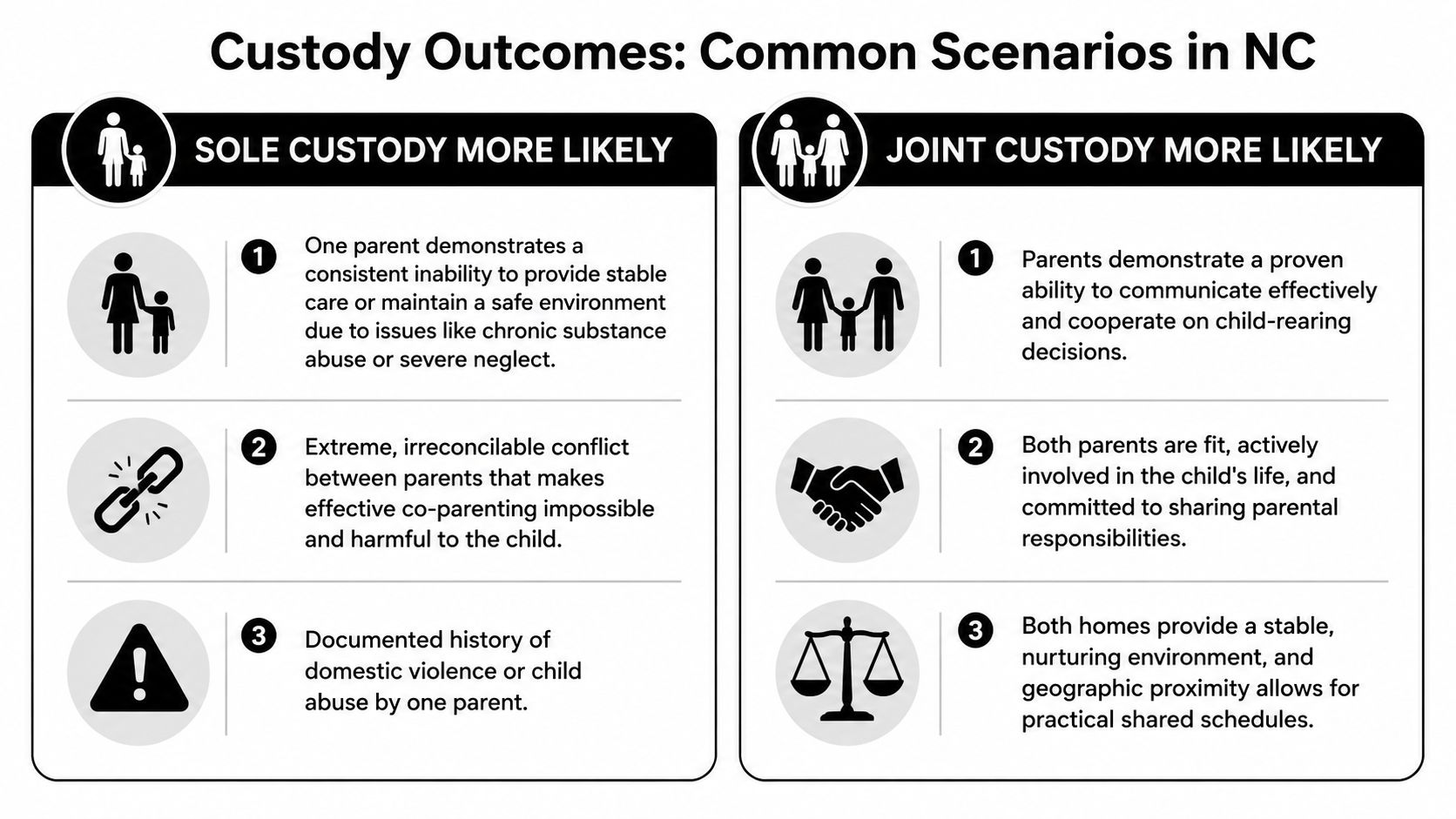
Situations that often point toward sole custody
North Carolina judges often move toward sole legal custody, sole physical custody, or primary custody with strict limits on the other parent's time when shared parenting would expose the child to instability, conflict, or safety problems. The question is practical. Can both parents carry out the arrangement without putting the child in the middle?
Facts that often push a case in that direction include:
- Domestic violence or credible threats of violence: A judge may limit contact, require supervised visitation, or place decision-making with one parent if the evidence shows a risk to the child or the other parent.
- Serious parenting unreliability: Repeated missed exchanges, leaving a young child without proper supervision, failing to get the child to school, or ignoring medical needs can weigh heavily against a shared schedule.
- High conflict that affects the child: Some parents are both loving and involved, but they cannot communicate without constant blowups. If joint decision-making is likely to produce repeated disputes over school, doctors, therapy, or basic scheduling, the court may decide one parent needs final authority.
- Work schedules that make equal sharing unrealistic: A parent who travels constantly, works rotating overnights, or depends on third parties for most of the child's care may still have meaningful custodial time. That does not always support true joint physical custody.
I often tell parents this. Courts do not reward a custody label. They reward a plan that can be carried out consistently.
Substance use cases turn on proof and current functioning
Substance use allegations get a lot of attention, but the court will not decide custody based on suspicion alone. Judges in North Carolina usually want specifics. Was the parent impaired while caring for the child? Was there impaired driving with the child in the car? Has DSS been involved? Is there a treatment record, a relapse pattern, or clean testing that supports a different picture?
A past addiction does not automatically lead to sole custody. Ongoing misuse that affects parenting often does.
That distinction matters. A parent in treatment, following recommendations, testing clean, and showing stable day-to-day parenting may still receive significant custodial rights. A parent with recent overdoses, alcohol-related incidents, unsafe supervision, or denial in the face of clear evidence is in a much weaker position. Judges focus on how the issue affects the child's safety and routine, not on the accusation by itself.
Situations that often support joint custody
Joint custody is more likely when both parents are active, dependable, and able to make the child's life run without constant court intervention. In practice, that usually means more than both parents loving the child. It means they can exchange the child on time, share school and medical information, make ordinary decisions without turning each one into a fight, and maintain homes that are safe and appropriate.
Judges also look at the child's actual schedule. If the parents live reasonably close, the child can get to school reliably from either home, and both parents have work hours that allow them to parent directly, joint physical custody becomes more realistic. If one parent has handled most appointments, school communication, and daily care for years, that history can matter too, especially for younger children.
Joint legal custody can still work even when a 50-50 schedule does not. Many North Carolina cases end with one parent having primary physical custody while both parents share major decision-making. That is still joint custody under NC law, and for many families it is the arrangement that fits real life best.
If you are trying to assess what a judge is likely to do, stop asking which option sounds fair in the abstract. Ask which arrangement your evidence supports. Calendars, school records, medical records, text messages, police reports, treatment records, and witness testimony usually matter more than broad claims about who is the better parent. If circumstances later change, this guide on modifying a North Carolina custody agreement explains the next steps.
Modifying a Custody Order and Planning Your Next Steps
A custody order can stop fitting a child long before it expires on paper. A parent takes a night-shift job. A child starts struggling in school. Exchanges keep breaking down because the parents cannot communicate without conflict. In my experience, those are the facts that usually bring families back to court in North Carolina.
North Carolina courts do not modify custody just because one parent is unhappy with the current arrangement. The parent asking for a change must usually show a substantial change in circumstances that affects the child's welfare. That can include relocation, repeated interference with the schedule, a meaningful change in work hours, untreated substance use, new safety concerns, or a child's medical or educational needs changing in a way the current order no longer handles well.
The practical question is simple. What has changed, and how is that change affecting your child?
What to do if the current order no longer fits
Start building proof before you file anything. Judges hear broad complaints every day. What helps in court is a timeline, missed exchanges, school attendance records, medical records, messages showing refusal to cooperate, and notes that connect the problem to the child's routine, health, or stability.
Be careful to separate modification from enforcement. If the order still makes sense but the other parent keeps violating it, the issue may be contempt or another enforcement remedy, not a custody change. If the facts show both problems, repeated violations can also become part of the modification case because they may affect the child's welfare.
North Carolina judges tend to focus on function, not labels. If a parent's new schedule means the child is spending most overnights with someone else, that matters. If joint decision-making has turned into constant deadlock over school, therapy, or medical care, that matters. If substance use was once under control and now is causing missed pickups or unsafe supervision, that matters even more.
For a more detailed look at the process, this guide on modifying a North Carolina custody agreement is a good starting point.
Your North Carolina Child Custody Questions Answered
Do we have to go to court for custody in North Carolina
Not always. Many parents resolve custody through negotiation, mediation, or a consent order. But if you can't reach a workable agreement, a judge may need to decide the case.
At what age can a child choose which parent to live with in NC
North Carolina doesn't give a child a fixed age at which they get to choose. A judge may consider a mature child's preference, but it's only one factor and not the controlling one.
Is a parenting agreement legally binding in North Carolina
It can be, but only if it's properly drafted and, in many situations, incorporated into a court order or otherwise made enforceable. An informal text-message agreement is usually a poor substitute for a clear written document.
Can a parent get sole custody just because the other parent works long hours
Not automatically. But if the work schedule creates repeated childcare gaps, school disruption, or instability, the court may treat that as an important factor.
Protecting Your Family's Future in North Carolina
Custody cases are hard because they force parents to make long-term decisions in the middle of short-term stress. The label matters less than whether the arrangement protects your child's routine, safety, and relationships in a way the court can trust.
If you're weighing sole custody vs joint custody in North Carolina, don't build your case around what sounds fair in the abstract. Build it around facts. Show the child's needs, your parenting history, your schedule, your communication pattern, and why your proposal will work on school mornings, medical appointments, and difficult weekends.
No article can tell you exactly how a judge will view your facts. But a careful legal review can identify weaknesses early, gather the right evidence, and help you avoid asking for an arrangement that looks strong on paper and collapses in practice.
If you need guidance on a custody dispute, modification, or parenting plan in North Carolina, schedule a consultation with the Law Office of Bryan Fagan. The firm works with North Carolina families on custody issues, including how courts apply the best interests standard, what evidence matters, and what legal options may fit your specific situation.