A lot of parents ask this question at the worst possible moment. The child is supposed to go for visitation in a few hours. Something feels off. Maybe the other parent sounded intoxicated on the phone. Maybe your child came home upset after the last visit. Maybe there has been a new argument, a new threat, or a new incident that makes you think, “I can't send my child into that situation.”
That instinct to protect your child is real, and North Carolina courts understand that safety concerns can arise fast. But the legal answer is still difficult. In most cases, you can't unilaterally decide to stop court-ordered visitation. If there is an existing custody or visitation order, that order controls until a judge changes it.
That does not mean you are powerless. It means you need to respond in a way that protects both your child and your position in court. The difference matters. A parent who acts carefully, documents the problem, and seeks immediate court relief is in a much stronger position than a parent who refuses visits and hopes the judge will understand later.
The practical question usually isn't just can a parent deny visitation in North Carolina. The central question is this: when is a temporary refusal tied to a real safety issue, and what should you do next so the court sees it as protection rather than defiance? That is where strategy matters.
What works is evidence, prompt action, and a clear request for court intervention. What usually backfires is self-help, angry messages, vague accusations, and a pattern of blocking visits without filing anything.
Introduction A Parent's Difficult Choice
You may be standing in the kitchen with a packed bag by the door, looking at the clock, and wondering whether to send your child to a scheduled exchange. That moment feels personal and urgent. The law, however, looks at it through a different lens.
For most parents, the short answer is no, you can't unilaterally deny visitation that a court has already ordered. But that short answer leaves out the part that matters most. North Carolina family cases often turn on details. What happened. When it happened. What proof exists. What you did immediately after.
If your concern is ordinary frustration, poor communication, lateness, or conflict between adults, denying visitation is usually a mistake. If your concern is a specific safety event, the analysis changes. Even then, the safest path is not to “cancel” visitation on your own. The safest path is to treat the situation as a legal emergency that requires documentation and quick court action.
Parents often think they have only two choices:
- Send the child no matter what and hope nothing bad happens
- Refuse the visit completely and deal with court later
There is often a third path. You can document the concern, communicate carefully, and move for emergency relief, supervised visitation, modification, or another court-managed protection.
Practical rule: If you believe a visit is unsafe, think in terms of asking the court for protection, not claiming a private right to rewrite the schedule.
That distinction can protect your credibility. It can also protect your child.
The Core Legal Principle Why Court Orders Control Visitation in NC
A custody order is the rulebook for co-parenting. Once a North Carolina judge signs it, neither parent gets to edit it alone.
North Carolina family law treats visitation as something the court decides under the child's best interests. Under North Carolina's public family-law guidance, a parent generally cannot unilaterally deny court-ordered visitation, and ordinary visitation is expected to be “reasonable,” with restrictions generally reserved for extraordinary circumstances such as abuse, according to the North Carolina State Bar's child custody and visitation guidance.
That point is easy to miss when emotions are high. Parents often feel that because they know the child best, they should be able to override the schedule when they think it makes sense. Courts don't see it that way. A judge has already made a legal determination about custody and visitation. Until the judge changes that determination, both parents are expected to follow it.

What a visitation order means in real life
Think of the order as a binding set of operating rules. It may cover pick-up times, holidays, transportation, phone contact, and decision-making authority. If the order says the other parent has parenting time this weekend, your disagreement with that arrangement does not cancel it.
That matters for two reasons:
| Issue | What many parents assume | How the court usually sees it |
|---|---|---|
| Child doesn't want to go | The parent can skip the visit | The parent must still make reasonable efforts to comply |
| Other parent is difficult | Visitation can be withheld until behavior improves | The remedy is enforcement or modification through court |
| New concerns arise | A parent can “pause” visits indefinitely | A parent should seek prompt court review |
Judges care a great deal about which parent follows the order and which parent treats it as optional. If you want to understand how courts approach that broader best-interest analysis, this overview of how judges decide custody in North Carolina is a helpful companion.
Why personal judgment is not enough
Parents often say, “I was just doing what I thought was best.” That explanation may be sincere, but sincerity alone won't excuse violating a court order.
The better way to frame the issue is this:
- The current order remains valid
- A new safety concern may justify court intervention
- You need facts and a filing, not just a feeling
When parents understand that sequence, they make better decisions. They stop asking whether they personally can cancel visitation, and start asking what evidence they need to request a lawful change.
A judge is far more likely to listen to a parent who says, “I documented the incident and filed immediately,” than to a parent who says, “I decided the order no longer applied.”
When Can Visitation Be Legally Restricted or Denied
A parent gets a call from school. The child has marks on an arm, seems frightened, and says something happened during the last visit. In that moment, the legal question is not abstract. It is whether the concern is serious enough to justify a short-term refusal while you get the court involved right away, or whether denying the visit would put you in violation of the order.
North Carolina courts can limit, supervise, or deny visitation, but they do so based on evidence tied to safety. Ordinary co-parenting conflict usually will not support that result. Credible abuse, domestic violence, dangerous substance use, serious neglect, or another clear risk may.
North Carolina law also recognizes a narrow statutory situation in which a parent convicted of certain serious sex offenses, where the child was conceived through that offense, cannot claim custody or visitation rights, as summarized by WomensLaw's North Carolina custody overview.
Abuse or a direct safety threat
Physical abuse, sexual abuse, severe neglect, or a direct threat to the child's safety can justify immediate court involvement and, in some cases, a very short-term refusal to turn the child over until a judge can review the situation.
Judges usually look for specifics. What happened, when did it happen, who observed it, what did the child say, and what proof exists now?
Possible court responses include:
- Supervised visitation when contact may continue under monitoring
- Restricted exchanges to reduce danger between the adults
- Temporary limitations while the court sorts out the facts
- Denial of visitation in the most serious cases
The strongest cases are built quickly. If a child comes home with visible injuries, get medical care if needed, take photographs, preserve texts, note exact statements, and identify witnesses. A parent who can show a concrete incident and prompt action stands in a much better position than a parent who makes broad accusations weeks later.
Domestic violence and unsafe exchanges
Domestic violence often changes the visitation analysis even if the child was not the direct victim. Courts may focus on the risk during exchanges, the child's exposure to violence, threats against the other parent, and whether normal visitation can happen safely at all.
Sometimes the right answer is not to stop contact outright. It is to ask for tighter conditions, such as:
- Supervised exchanges at a neutral site
- Third-party transportation
- Communication limited to written apps or messages
- Supervised visitation until the court has more information
This is a practical judgment call. If the danger is tied to the handoff itself, a parent may need immediate protective measures. If the concern is serious but not immediate, the safer legal course is usually to keep following the order as closely as possible while filing to change it.
Substance use that creates immediate danger
Substance use matters when it affects the parent's ability to care for the child safely. Courts are less interested in suspicion than in conduct you can describe clearly.
Facts that tend to carry weight include an impaired parent arriving for pickup, intoxicated driving, the child being left unsupervised, drug activity happening around the child, or a recent incident that directly shows poor judgment during parenting time.
A quick comparison helps:
| Situation | How a judge may view it |
|---|---|
| Parent smells like alcohol and is slurring speech at pickup | Possible immediate danger, especially if the parent plans to drive |
| Parent has a past history of substance issues but no current incident | Usually a modification issue, not automatic grounds to deny today's visit |
| Child reports being left alone while the parent used substances | Serious neglect concern that may support urgent court action |
If you believe the other parent is impaired at exchange, focus on proof and safety. Use witnesses if available. Keep communications short and factual. If there is real danger, seek emergency relief fast.
When a child says no
A child's refusal, by itself, usually does not give a parent the right to cancel visitation. Children resist visits for many reasons, including fear, anger, loyalty conflicts, discipline differences, new schedules, or a simple preference for one household.
North Carolina does not give children a fixed age at which they can choose whether to comply with a visitation order. Judges may give more weight to an older child's preferences, but the court still decides based on the child's best interests. As noted earlier in the article, the parent is still expected to make reasonable efforts to comply unless the order is changed.
That is where many parents get exposed. If a teenager refuses to get in the car, the court may ask what the parent did before giving up. Calm encouragement, notice to the other parent, documentation of repeated problems, and a prompt request for court guidance all matter.
An older child may have a stronger voice. The child still does not control the order.
A short-term refusal may be defensible in a narrow emergency
Some parents need a practical rule for the next hour, not a lecture. Here it is. A temporary refusal is more likely to be defensible when all four of these facts are present:
- A new and specific safety event happened
- The risk is immediate, not speculative
- You can document the event
- You seek emergency or prompt court action without delay
For example, if the other parent arrives visibly impaired to drive the child, or the child discloses fresh abuse with supporting physical signs, a parent may have a stronger argument for refusing that visit while taking immediate steps to get judicial review.
By contrast, a contempt problem often starts with a different pattern. The concerns are old, there is no new emergency, little has been documented, and the parent decides on their own that visits will stop until further notice.
That difference matters. Judges are often deciding whether your conduct looked protective and temporary, or controlling and unilateral.
The High Cost of Taking Matters Into Your Own Hands
Self-help feels fast. In family court, it often becomes expensive.
When a parent denies visitation without court permission, the other parent may respond with an enforcement action or a motion for contempt. North Carolina sources note that repeated violations of a custody order can lead to contempt of court, attorney's fees, counseling, make-up parenting time, or even modification of custody, according to this discussion of custody-order violations in North Carolina.
A judge may also start asking a broader question: which parent is more likely to support the child's relationship with the other parent? That question can shape future custody decisions in ways many parents don't expect.
A quick visual summary helps show how fast a single decision can snowball.
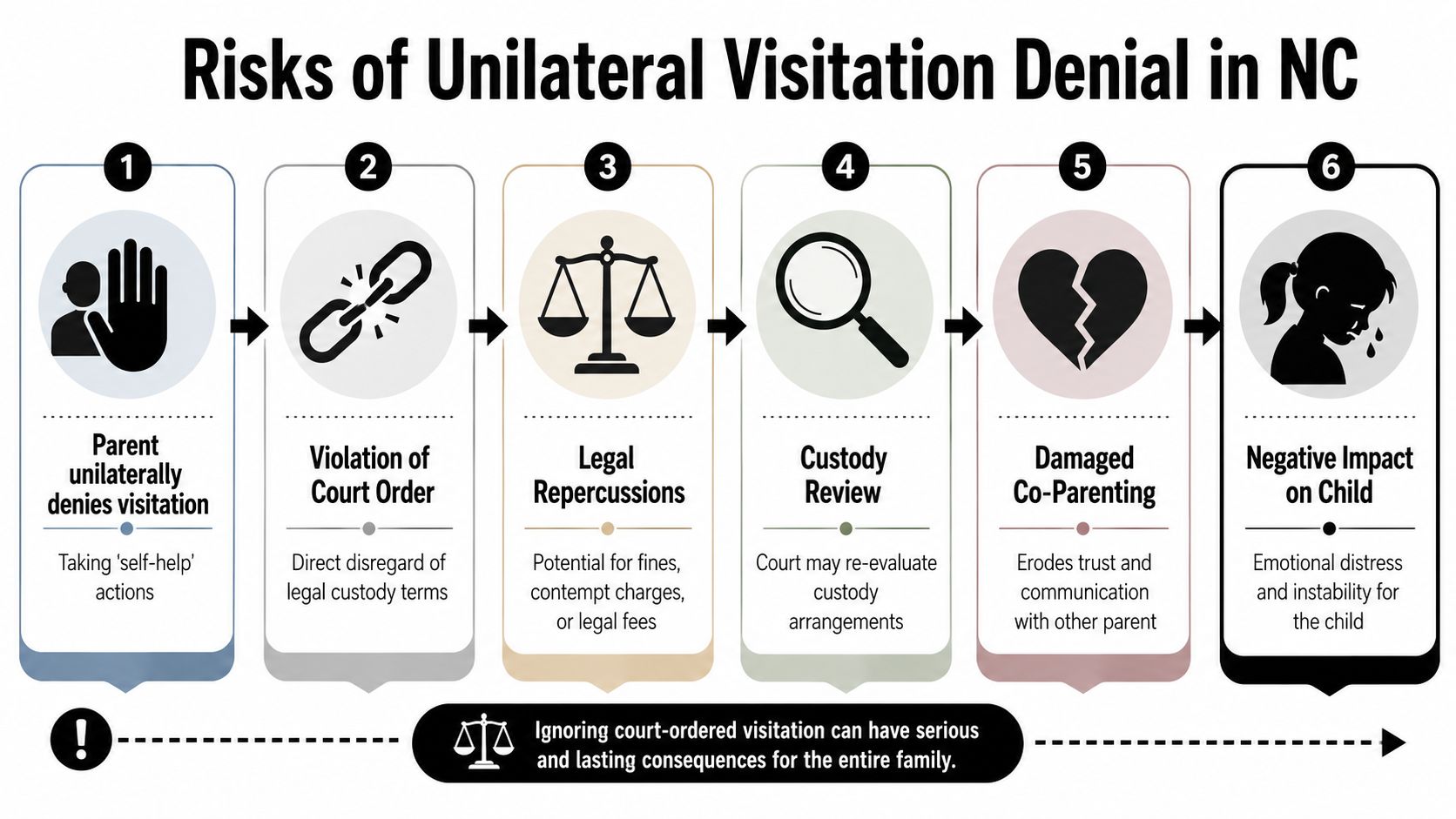
What judges may do when visitation is blocked
The consequences are not limited to a warning. Depending on the facts, the court may order:
- Make-up parenting time so the missed visits are restored
- Payment of the other parent's attorney's fees
- Counseling or co-parenting requirements
- Contempt findings
- A custody review that changes the schedule going forward
For many parents, the most damaging consequence is not the formal sanction. It is the loss of credibility. If your messages are hostile, your evidence is thin, and your refusal looks retaliatory, the judge may stop seeing you as the parent trying to protect the child and start seeing you as the parent creating instability.
This video addresses how courts view violations of custody orders and why a legal response usually works better than retaliation.
A common way parents damage their own case
A familiar pattern goes like this. One parent is frustrated by late pickups, rude messages, and constant conflict. Then one weekend, that parent decides the other parent isn't getting the child until “things change.” No emergency motion is filed. No narrow safety incident is documented. The messages become increasingly angry.
By the time the case reaches court, the focus has shifted. Instead of examining the other parent's behavior, the judge is looking at the blocked visitation.
If you're dealing with ongoing noncompliance from the other side, a more productive starting point is learning what to do if the other parent violates a custody order in NC rather than trying to even the score yourself.
The Right Way How to Legally Address Visitation Concerns in NC
A hard visitation call usually happens fast. Exchange is in an hour. Your child says something troubling, or the other parent shows up acting in a way that raises real concern. At that point, the question is not just whether you can say no. The primary question is what you do in the next few hours to protect the child without damaging your case.
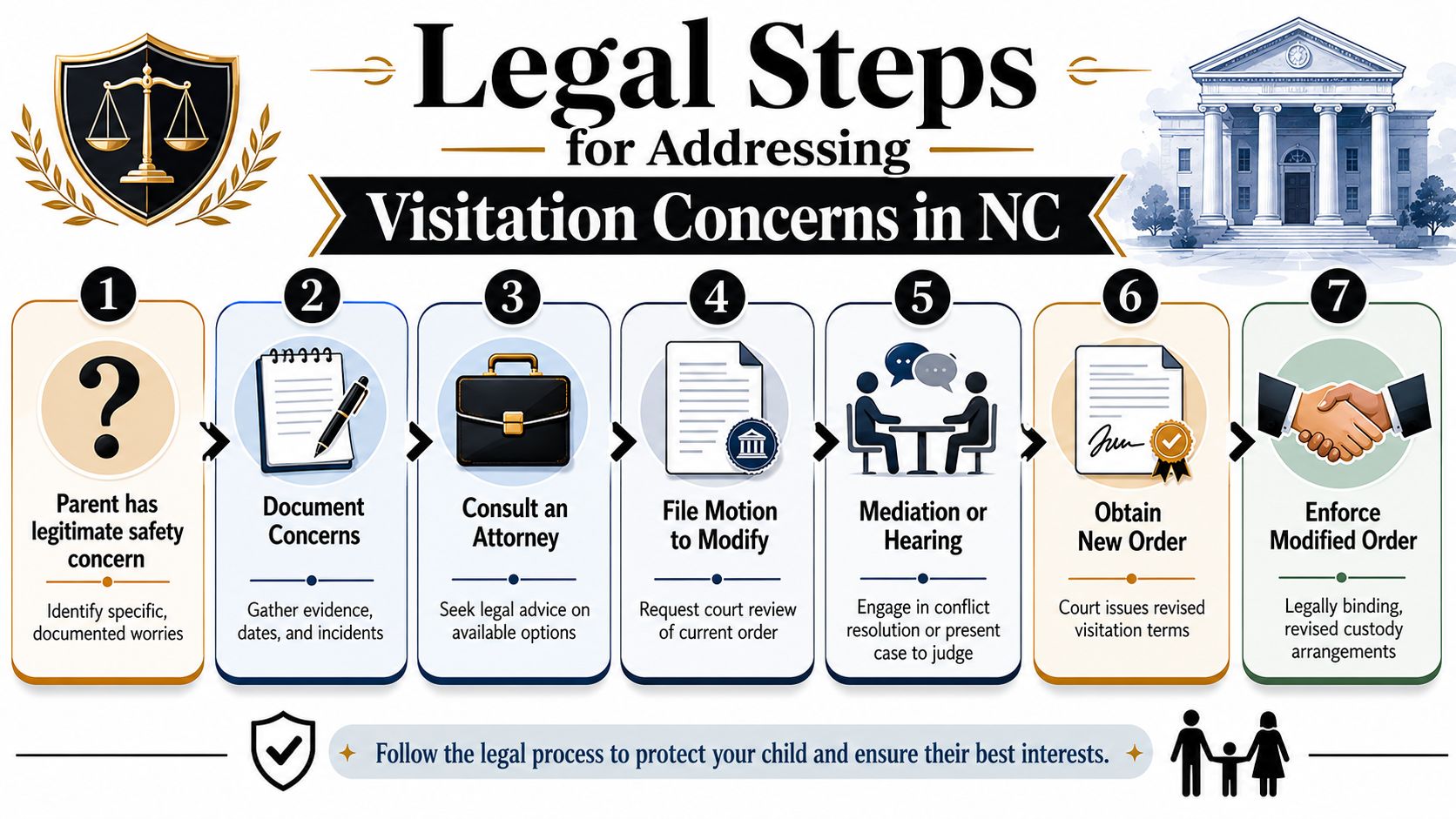
North Carolina judges usually respond best to parents who make narrow decisions, preserve evidence, and ask the court for prompt relief. If a temporary refusal is based on an immediate safety concern, your next move matters as much as the refusal itself. A parent who blocks visitation and then does nothing often looks very different from a parent who blocks one exchange, documents the reason, and files quickly for court intervention.
Start by separating urgency from frustration
Every visitation problem feels urgent to the parent living through it. Legally, though, there is a difference between a situation that may justify a short-term refusal and one that still requires compliance while you seek a change.
A temporary refusal is easier to defend when the concern is immediate and specific. Examples include apparent intoxication at pickup, credible threats, serious untreated mental health symptoms creating present danger, or facts suggesting the child may not be returned safely. General distrust, old arguments, missed child support, rude texts, and parenting disagreements usually do not justify denying court-ordered time.
That distinction is where many cases turn.
Build a record a judge can use
If you may need emergency relief, start creating a clean factual record right away. Write down what happened, when it happened, who saw it, what the child said, and what you personally observed. Save texts, voicemails, photos, school emails, medical records, and any police or DSS paperwork if it exists.
The strongest notes are plain and specific. “Unsafe” is a conclusion. “He arrived late, slurred his words, and stumbled while walking to the car” gives the court something concrete to evaluate.
Keep your communication the same way. Short. Neutral. Focused on the child.
Match the problem to the right court request
Parents often get into trouble by asking for the wrong thing. A serious one-time incident may call for emergency relief. A continuing pattern may support a modification request. A safety concern that does not require cutting off contact entirely may justify supervised visitation or a safer exchange plan.
Here is the practical framework I give clients:
| If the problem is… | The court response may be… |
|---|---|
| Immediate danger tied to an upcoming exchange | Emergency motion or other urgent request for temporary relief |
| A recurring pattern affecting the child's welfare | Motion to modify custody or visitation |
| Contact is appropriate, but not without safeguards | Supervised visitation, neutral exchange location, or other conditions |
| The other parent is violating the existing order | Enforcement or contempt proceedings |
If the facts support a longer-term change, this guide on how to modify a custody agreement explains the basic process.
What to do in the first 24 hours
The first day matters. Judges often look closely at whether your response was measured and child-focused.
A sound first-day plan usually looks like this:
- Protect the child first. Keep the child calm and in a safe place.
- Write down the facts immediately. Include times, statements, and witnesses.
- Preserve every communication. Screenshot texts and save voicemails.
- Send one careful message if needed. State the specific concern and avoid insults or legal threats.
- Get legal advice quickly. Delay weakens an argument that the situation required immediate action.
- File if the concern is serious enough to justify withholding. Court action should follow quickly, not weeks later.
That last point is the part many articles miss. If you deny one visit because you believe the child faces an immediate risk, you should be prepared to explain why you acted and what you did next to put the issue before the court. The refusal alone is rarely the whole story.
What helps your position, and what hurts it
Judges see patterns. They notice the difference between a parent trying to solve a safety problem and a parent using safety language to control access.
Facts that often help include:
- Specific observations tied to a recent incident
- Third-party records or witnesses
- A limited response proportionate to the risk
- Fast action to seek court review
- Requests for practical protections instead of blanket restrictions
Facts that often hurt include:
- Vague allegations with no dates or proof
- Refusing visits over old complaints without a current trigger
- Angry messages that sound punitive
- Keeping the child from the other parent for an extended period without filing anything
- Asking for extreme relief when a narrower fix would address the problem
A parent can make a defensible short-term decision in a true emergency. A parent creates legal exposure by turning that decision into a self-made custody rewrite. The safest course is to treat any refusal as temporary, document it carefully, and get the matter in front of a judge as quickly as the facts require.
A Note on Grandparent and Third-Party Visitation
The rules discussed above mainly concern disputes between legal parents. Grandparents, stepparents, and other relatives usually stand on different legal ground.
A parent with court-recognized rights starts from a very different position than a third party seeking visitation. That distinction matters because people often assume a grandparent can enforce time with a child the same way a parent can. In North Carolina, that is often not the case.

Why parental rights carry more weight
North Carolina courts generally give substantial weight to a fit parent's decisions about a child's upbringing, including decisions about who has access to the child. That means a grandparent usually does not have the same automatic ability to demand parenting time that a parent under a custody order has.
In practical terms, the difference looks like this:
- Parent versus parent dispute. The court is allocating rights and responsibilities between people who already have recognized parental status.
- Grandparent or third-party claim. The court first has to examine whether that non-parent has a legal basis to seek visitation at all.
Common misunderstanding in family disputes
A frequent scenario is this: one parent says, “If I can deny the other parent's visitation, I can also stop the grandparents whenever I want.” Another says, “Grandparents have rights, so they can insist on visits.” Both statements can oversimplify the law.
Third-party visitation questions often depend on the family structure, the current custody posture, and whether there is an open custody case. Intact families are treated differently from separated or litigating families. Because the analysis is highly fact-specific, parents should be careful not to assume that rules applying to court-ordered parental visitation transfer neatly to grandparents or other relatives.
If this issue is part of your case, it deserves separate legal review. The answer often turns on standing, procedure, and the exact posture of the family case, not just on what seems fair.
Frequently Asked Questions About NC Visitation
These questions usually come up when a parent has to make a fast decision with imperfect information. The safest answer depends on one detail: are you dealing with a routine dispute, or a real safety problem that calls for immediate court action?
Can I deny visitation because the other parent is behind on child support
No, in most cases. North Carolina treats child support and visitation as separate obligations. If the other parent is not paying support, the remedy is enforcement through the court, not withholding the child.
Parents get into trouble here because the instinct feels understandable. Courts still view it as violating the visitation order.
At what age can a child refuse visitation in North Carolina
There is no automatic age at which a child gets to override a court order. A judge may give more weight to an older child's wishes, but the order remains in effect unless the court changes it.
That creates a hard reality for parents. "My child does not want to go" is often not enough by itself to justify refusing visitation. If the resistance is persistent, serious, or tied to specific concerns, document what is happening and bring it back to court instead of treating the child's preference as the final decision.
What if the other parent shows up and I think they are impaired
This is one of the few situations where a temporary refusal may be defensible, but only if you act carefully and treat it like an emergency, not a personal dispute. Focus on what you observed: the smell of alcohol, slurred speech, unsteady walking, confusion, drug paraphernalia, or statements from witnesses.
Then take the next step right away. Preserve texts, call law enforcement if the situation is unsafe, and speak with a lawyer about emergency relief or a motion to modify. A parent who blocks one visit because of a documented, immediate safety concern stands in a very different position from a parent who starts canceling visits based on suspicion alone.
Can I just let the child decide whether to go
Usually no. Courts expect parents to make reasonable efforts to comply with the order, even when exchanges are difficult.
That does not mean forcing a terrified teenager into a car without addressing the reason. It means the parent should respond like a parent and not like a bystander. Try to identify the cause, document the incidents, communicate in a measured way, and ask the court for help if the problem continues. Saying, "I left it up to the child," can sound to a judge like the parent stopped enforcing the order.
What if my custody order was entered in another state
Do not assume North Carolina can replace that order just because you and the child now live here. Interstate custody cases can involve separate jurisdiction rules about which state keeps authority to enforce or modify the order.
That matters before you deny a visit, file a motion, or make a side agreement. A quick legal review of the existing order can prevent a mistake that creates enforcement problems in more than one state.
What if there is no court order yet
The analysis changes if no custody or visitation order is in place. Without an order, the question is less about contempt and more about parental rights, immediate risk, and whether a parent should file for custody, temporary orders, or emergency relief.
This is often where parents make avoidable mistakes. They rely on verbal schedules, text-message agreements, or pressure from the other parent, then assume those arrangements will protect them later. If the conflict is escalating, get a court order in place before the situation gets harder to control.
Your Next Steps Protecting Your Child and Your Rights
If you're asking whether can a parent deny visitation in North Carolina, you're probably not looking for a technical answer. You're trying to decide what to do under pressure, with your child caught in the middle.
The safest takeaway is this. Don't rely on self-help when the issue is serious enough to affect your child or your custody case. If there is no real emergency, follow the order and address the problem through court. If there is a real safety concern, act with discipline. Document it. Communicate carefully. Seek immediate legal advice. File for the protection you need.
Parents often damage good cases by acting too broadly, too emotionally, or too late. They also miss opportunities when they assume the only options are total compliance or total refusal. North Carolina courts can tailor solutions. Supervised visitation, exchange restrictions, modification, and emergency relief may all be available depending on the facts.
You do not need to guess your way through that decision. A focused legal review can help you determine whether your concern supports a temporary emergency response, a modification request, an enforcement action, or a more measured strategy. The right move is the one that protects your child while preserving your credibility with the court.
If you're dealing with a visitation problem in North Carolina and need a practical legal strategy, schedule a consultation with the Law Office of Bryan Fagan. The firm works with North Carolina parents on custody, visitation, enforcement, and modification issues, and can help you assess the facts, protect your child, and choose the next step that makes legal sense.