When you have a North Carolina custody order and life prompts a move, you're likely facing a critical question: Do I have to go back to court?
If your planned relocation is significant enough to disrupt the current custody schedule, the answer is almost always yes. You will need to seek a custody modification due to relocation in NC. This process is not about measuring miles on a map; it's about demonstrating to a North Carolina court how the move serves your child's best interests.
When Your Move Requires a Custody Modification in NC
Life is dynamic. A new job offer, an opportunity for higher education, or the need to care for family can all prompt a desire to move. For parents sharing custody in North Carolina, a planned relocation is more than a personal decision—it's a legal event that often requires changing your existing custody order.
One of the most persistent misconceptions is the "50-mile rule." To be clear: no such rule exists in North Carolina law.

Our courts don't focus on a specific distance. The legally significant factor is the impact of the move on the current parenting schedule. A relocation becomes a legal matter when it makes the established custody arrangement impractical or impossible to maintain. A 20-mile move across town is unlikely to trigger a modification, but a 70-mile move from Raleigh to Fayetteville almost certainly will.
Understanding the Two-Part Legal Standard in North Carolina
When a judge evaluates a relocation case, they apply a crucial two-part legal test established by North Carolina law. This standard prioritizes the child's welfare above the parents' wishes.
-
Part One: Has there been a substantial change in circumstances? The parent requesting the court's intervention—whether to allow or prevent the move—must first prove that a "substantial change in circumstances" has occurred since the last custody order was entered. A proposed long-distance relocation is almost universally recognized by NC courts as a substantial change.
-
Part Two: Is the move in the child's best interest? Once a substantial change is established, the court proceeds to the most important question: Is modifying the custody order to permit the relocation in the best interest of the child?
This two-step process, outlined in North Carolina General Statute N.C. Gen. Stat. § 50-13.7, is the bedrock of every relocation case in our state. The court isn't simply approving a parent's life change; it's making a deliberate decision based on the child's stability, education, and relationships with both parents.
A Real-World Scenario
Let’s examine a common situation we encounter in our practice to see how this plays out.
Scenario: A mother in Raleigh has primary physical custody of her 10-year-old son. The father, who also lives in Raleigh, has visitation every other weekend. The mother receives a fantastic job offer in Asheville—a significant career advancement that promises a better quality of life for her and her son.
This is a textbook "substantial change." The four-hour drive between Raleigh and Asheville makes the every-other-weekend schedule unworkable.
The court must now determine if allowing the move and crafting a new custody schedule is truly in the child's best interest. A judge would analyze numerous factors, including:
- The moving parent's motive: Is the move for a legitimate reason (e.g., a better job, closer to family support) or is it intended to frustrate the other parent's relationship with the child?
- The benefits for the child: What advantages does the new location offer? A superior school, unique educational programs, or a safer neighborhood?
- The impact on the child's current life: What would the child leave behind? A strong network of friends, supportive extended family, and success in current school and extracurricular activities?
- The potential for a new schedule: Can a new visitation plan be created that preserves and fosters the child's strong relationship with the non-relocating parent? This might involve longer summer and holiday visits in place of frequent weekends.
Ultimately, the judge's decision will hinge on the child's welfare, not the parent's career goals. If you are facing a potential move, your success will depend on building a compelling case that demonstrates why your plan is genuinely what's best for your child.
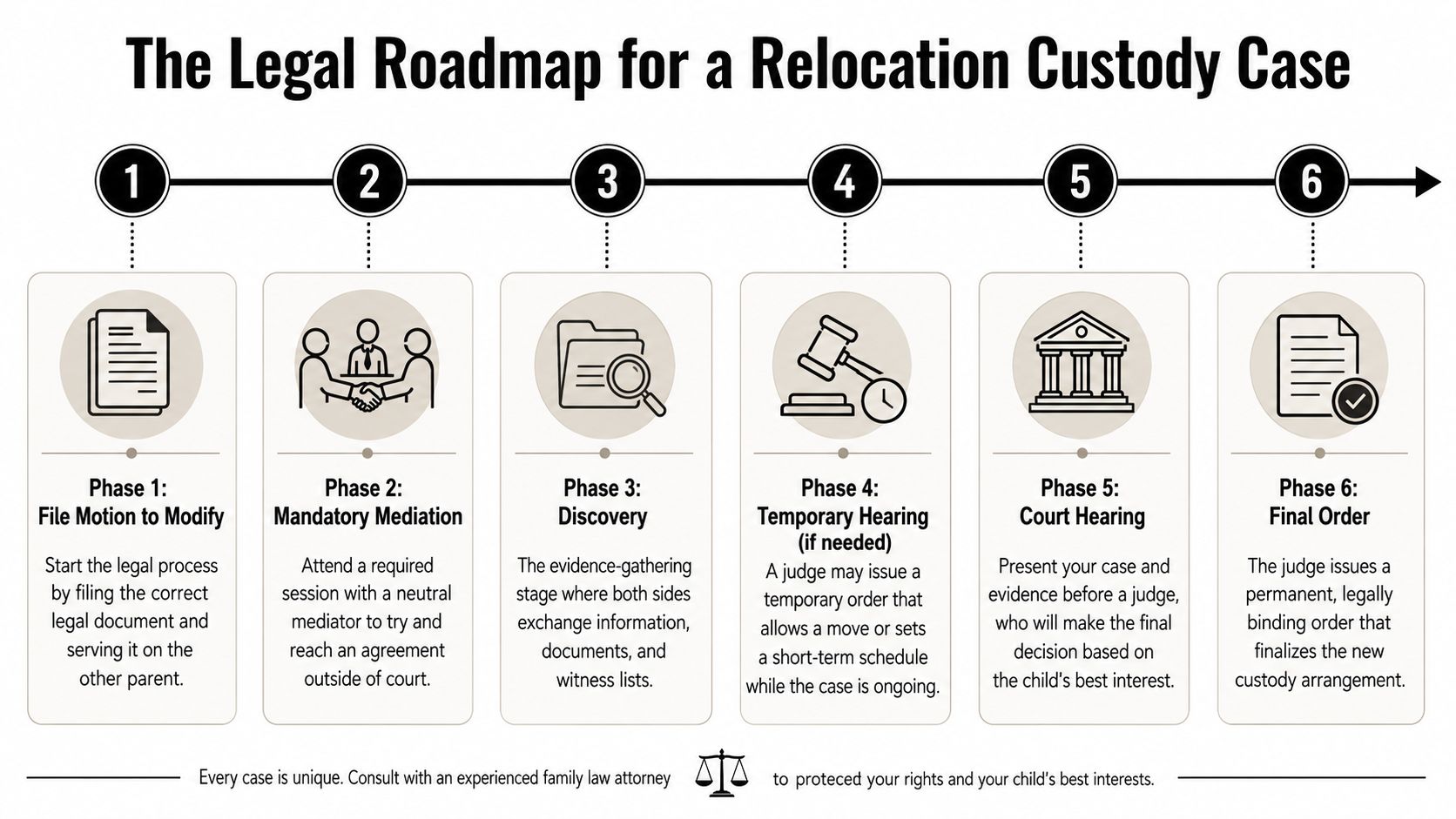
The Legal Roadmap for a Relocation Custody Case
When a parent plans to relocate, the process of modifying a North Carolina custody order follows a clear path through our state's court system. Understanding these steps can demystify the process and help you prepare for what lies ahead.
The process begins when one parent files a Motion to Modify with the court. This legal document initiates the case by explaining the "substantial change in circumstances" (the planned move) and formally asks a judge to update the current custody order.
After filing, the motion must be properly "served" on the other parent, usually by a sheriff's deputy or certified mail. This provides formal, legal notice that a custody modification action has commenced.
The Mandatory Mediation Step
In most North Carolina counties, you and the other parent will be required to attend mandatory custody mediation before your case can proceed to a hearing. This is a crucial and often productive step. Mediation is a private, confidential meeting facilitated by a trained, neutral third-party mediator.
The mediator’s role is not to impose a decision but to help you and the other parent communicate effectively and explore potential compromises. If you can agree on a new parenting plan that accommodates the relocation, that agreement can be drafted into a "Consent Order." A judge will then sign it, making it a new, legally binding court order. This is often the fastest, most amicable, and least expensive way to resolve a relocation dispute.
Key Takeaway: In most NC counties, mediation is a required first step. It is not optional. It is designed to empower parents to find their own solutions outside the adversarial setting of a courtroom.
What Happens If Mediation Fails
If you cannot reach an agreement in mediation, the case proceeds toward a court hearing. This is when the formal legal process, beginning with a phase called discovery, gets underway.
Discovery is the formal evidence-gathering stage where both sides can request information from the other. Common discovery tools include:
- Interrogatories: Written questions that the other parent must answer in writing, under oath.
- Requests for Production of Documents: Formal requests for specific documents, such as a new job offer letter, school information for the new location, or financial statements.
- Depositions: In-person interviews where a parent or key witness answers questions under oath before a court reporter.
The purpose of discovery is to ensure that both sides have access to the same information and to prevent surprises at trial. It allows each parent to build their strongest case for the final hearing. For a deeper dive into changing court orders, you can learn more about the custody modification process in NC in our comprehensive guide.
Temporary Orders vs. Final Rulings
From filing the initial motion to a final trial, a relocation case can take many months. What happens to the child in the interim? In some situations, a parent may need an immediate, short-term solution and will ask the court for a temporary hearing.
For example, if a parent has a job offer in another state with a non-negotiable start date, they cannot wait six months for a final decision. Their attorney may ask a judge to issue a temporary order that allows the move and establishes a temporary custody schedule while the case proceeds.
A temporary order, if granted, is not a final victory. It is a placeholder. The main event is the final custody trial, where the judge will hear all the evidence from both sides and issue a permanent, legally binding order. This final order will replace all previous orders and will definitively decide if the relocation is approved and what the custody arrangement will be moving forward.
Building a Winning Case: What Evidence a Judge Needs to See
In a North Carolina courtroom, good intentions are not enough to win a relocation case. When you ask a judge to approve or deny a custody modification due to relocation in NC, the decision will be based on one thing: credible, persuasive evidence.
Whether you are the parent proposing the move or the one opposing it, your success depends entirely on the proof you present. Simply telling a judge the move is a "great opportunity" is insufficient. You must show them with a well-organized case built on documents, research, and a clear narrative.
Evidence for the Parent Proposing Relocation
If you are the parent asking to move with your child, the burden of proof is on you. Your task is to paint a detailed picture for the judge, demonstrating that the move is a well-planned step that is genuinely in your child's best interest.
Think of it as presenting a portfolio for your child's future. You must gather concrete evidence that the move will improve their life. Key documents include:
- The Reason for Your Move: A copy of your new job offer letter detailing salary and benefits, proof of enrollment in an academic program, or medical records necessitating a move to be near family support.
- The New Home and Community: Provide more than just an address. Show photos, a signed lease or purchase agreement, and research on the neighborhood's safety, parks, libraries, and community resources.
- Educational Opportunities: Go beyond the school's name. Provide school report cards, brochures for special programs, and a list of extracurricular activities that align with your child's interests.
- A Detailed Post-Move Budget: Demonstrate to the judge that you have thought through the financial implications. A clear budget proves you can afford the move and provide a stable home in the new location.
Perhaps the most critical piece of evidence is your plan for keeping the other parent actively involved in the child's life. Judges are far more likely to approve a move when they see a parent who has made a genuine effort to preserve the other parent's relationship with the child.
A vague promise to “make sure the kids see their dad” will not persuade a judge. A winning plan includes a proposed visitation calendar with specific dates for holidays and summer, calculated travel costs (including flights or mileage), and a clear proposal for who will pay for travel. This level of detail shows respect for the other parent's role and a genuine commitment to co-parenting.
Evidence for the Parent Opposing Relocation
If you are fighting to keep your child in their current community, your goal is to show the judge the potential harm the move could cause. Your evidence should focus on demonstrating the child's stability, continuity, and deep roots in North Carolina.
Your case must illustrate that uprooting your child would be detrimental to their well-being. Focus on gathering proof such as:
- Proof of the Child’s Community Ties: Collect photos of your child with close friends. Obtain letters from teachers or coaches detailing their involvement and success in school or sports. Present report cards showing they are thriving where they are.
- Evidence of Your Involvement: Document your consistent, active role in your child's life. Show school volunteer records, photos from parent-teacher conferences, or a calendar detailing your attendance at games, recitals, and doctor’s appointments.
- The Child’s Support System: A child's world extends beyond their parents. Seek testimony or letters from grandparents, aunts, uncles, and other close family members who live nearby and are an active, loving part of your child’s life.
The evidence-gathering phase, known as Discovery, is a critical stage that occurs long before you see a judge. Whether you are proposing or opposing the move, preparing your evidence from day one is essential to building a strong case.
All this evidence is presented to help the judge apply the "best interest" standard. To learn more about this crucial legal test, you can explore what constitutes the best interest of the child in NC in our detailed guide. The strength of your evidence is what gives your arguments weight in court.
Navigating Interstate Moves and Custody Jurisdiction
Moving within North Carolina is complex, but moving across state lines introduces another layer of legal complexity governed by the Uniform Child Custody Jurisdiction and Enforcement Act (UCCJEA). This mouthful of a law has a simple purpose: to prevent parents from "forum shopping" by moving to a new state in hopes of finding a more favorable court.
The UCCJEA is a nationwide agreement, adopted by North Carolina and nearly every other state, that establishes clear rules for determining which state court has the legal authority—or jurisdiction—to decide a child custody case.

This uniform law prevents the chaotic scenario of having conflicting custody orders from judges in different states for the same child.
Understanding the Home State Rule
The cornerstone of the UCCJEA is the "home state" rule. This rule dictates that the state with jurisdiction to decide a custody matter is the child's home state.
What is the "home state"? Under North Carolina law, it’s the state where the child lived with a parent for at least six consecutive months immediately before a custody case is filed.
If your original custody order was issued by a North Carolina court and your child has lived here for the past several years, North Carolina is the home state. This gives our courts exclusive, continuing jurisdiction to modify that order. Even if you move, you cannot simply file for a custody change in your new state. A custody modification due to relocation in NC must be initiated here because North Carolina retains authority over the case.
The Severe Consequences of Moving Without Permission
Some parents mistakenly believe they can move first and ask for forgiveness later. This is an extremely dangerous gamble that can have devastating legal consequences.
Moving a child across state lines without either a signed consent order from the other parent or a court order can be viewed by a judge as an act of bad faith, or worse, parental kidnapping. The other parent can file an emergency motion, and the court has the power to order the immediate return of the child to North Carolina. Such a unilateral action can destroy your credibility with the court and severely damage your chances of ever having the relocation approved.
The Value of a Proactive Relocation Clause
The best way to address a potential move is to plan for it from the beginning. When negotiating your initial custody agreement, you can include a "relocation clause" that outlines a clear procedure for what happens if one parent needs to move.
A well-drafted relocation clause should specify:
- A Notice Requirement: A rule that a parent must provide written notice (e.g., 60 or 90 days) before any planned move beyond a certain distance.
- Information Sharing: A requirement to provide details about the new address, school information, and the reasons for the move.
- Dispute Resolution: A process for handling disagreements, such as mandatory mediation before filing with the court.
- Travel Cost Allocation: An agreement on how parents will split future travel expenses for visitation.
Having this clause doesn't grant automatic permission to move, but it establishes an agreed-upon roadmap that can prevent significant conflict and legal fees down the line. If your order lacks a relocation clause, you must follow the standard legal process: obtain the other parent's written consent or file a motion with the court.
Frequently Asked Questions About Custody Modification and Relocation in NC
When you’re considering a move as a parent in North Carolina, the "what-ifs" can feel overwhelming. These are the kinds of questions that can keep you up at night, and we hear them from parents every day. Here are some answers to common questions about handling a custody modification due to relocation in NC.
Can my ex stop me from moving if I don't have a job lined up yet?
Yes, a North Carolina judge can absolutely prevent you from moving if your plans are not concrete. A court’s decision isn’t about whether you have a good reason to want to move; its entire focus is on whether relocating is truly in the child’s best interest.
A move based on a hope or possibility—what a judge would call "speculative"—is rarely viewed favorably. Courts want to see a well-thought-out plan. A parent who presents a confirmed job offer, a signed lease, and research on local schools is in a far stronger position than a parent who simply wants to move to a new city to "look for work." You must be prepared to show the judge exactly how the move will tangibly benefit the child.
What if our custody order is silent on relocation?
If your current custody order doesn’t mention relocation, you are not automatically free to move. North Carolina's custody laws—including the critical requirement to prove a "substantial change in circumstances"—still apply in full. The absence of a relocation clause does not give you a green light.
Attempting a long-distance move without the other parent's written consent or a new court order is an extremely risky gamble. The other parent can file an emergency motion demanding a judge order the child's immediate return. Taking unilateral action can severely damage your credibility with the court and harm your case from the start.
Does the judge actually care what my child wants?
Yes, but the weight a judge gives to a child’s preference depends entirely on their age and maturity. The "best interest" standard in North Carolina allows a judge to consider the reasonable preference of a child who is of "sufficient age and maturity" to express a logical opinion.
There is no magic age—like 12 or 14—where a child's wishes suddenly become the deciding factor. As a practical matter, judges tend to give more consideration to the opinions of mature teenagers than those of younger children. Even then, the child’s preference is just one of many factors the court will analyze. It is never the sole determinant in a judge's decision.
Do I have to go to court to move?
Not always. If you and the other parent can work together to reach an agreement on the move and a new parenting schedule, you can avoid a contested court battle. This is the ideal scenario for everyone, especially for your child.
That agreement must be formalized in a legal document called a Consent Order. This document lays out the new custody and visitation terms, is signed by both parents, and is then submitted to a judge for their signature. Once the judge signs it, the Consent Order becomes a new, legally enforceable court order. This is by far the fastest, most cooperative, and most cost-effective way to handle a custody modification due to relocation in NC.
Schedule a Consultation with a North Carolina Family Law Attorney
A potential custody modification due to relocation in NC is one of the most high-stakes and stressful situations a parent can face. The legal path is complex, the deadlines are strict, and the emotional toll is significant. Now is the time for clear, strategic action. The court's decision will permanently shape your family's future, and trying to navigate this process alone is an enormous risk.
Your relationship with your child is your highest priority. A custody modification case is not the place to gamble. Investing in experienced legal counsel is a direct investment in protecting that relationship. A procedural misstep or a poorly presented case can lead to an unfavorable outcome that is difficult, if not impossible, to undo.
Our team is deeply familiar with North Carolina's relocation laws and the specific procedures in local courts across the state. We are committed to protecting your parental rights and fighting for the best possible outcome for you and your child. A generic online article can only provide general information; you need advice tailored to the specific facts of your case.
When you're ready to take the next step, we are here to help. We invite you to schedule a confidential consultation with our firm to discuss your case. Let us help you understand your options and map out a clear plan to secure your family's future. For those whose move may also trigger financial changes, it is vital to understand the law; you can read about the process for a child support modification in NC for more information.
Don't face this challenge by yourself. At the Law Office of Bryan Fagan, our experienced attorneys are here to provide the guidance you need. Schedule a consultation with us today to discuss your rights and create a plan to protect your relationship with your child. Learn more and get in touch at bryanfaganlaw-nc.com.