If you're facing a child custody case in North Carolina, it's easy to feel overwhelmed and confused. At the heart of every single child custody law in North Carolina is one guiding principle: what is in the best interests of the child. Our goal is to cut through the legal jargon, provide clear explanations, and give you the clarity you need to move forward confidently.
Understanding North Carolina Child Custody in 2026
When parents separate, figuring out custody arrangements is often the most difficult and emotional part of the journey. North Carolina law, specifically the statutes found in Chapter 50 of the North Carolina General Statutes, provides a structured path for making these decisions. However, navigating court procedures can be tough alone. The court's objective is always to ensure the child has a stable, safe, and supportive home, but how a judge reaches that conclusion involves many different factors.
Think of this guide as your roadmap. We’ll break down the core concepts of legal and physical custody in plain English, using practical examples to show how they apply to real families in North Carolina.
The Focus on the Child's Well-Being
The court’s entire mission is spelled out in North Carolina General Statute § 50-13.2. This law requires every custody decision to be based on what will "best promote the interest and welfare of the child." This isn't just legal language—it's a powerful directive that means a judge won't automatically prefer one parent over the other based on gender or income.
Instead, the court will take a comprehensive look at each parent’s ability to provide a nurturing and stable environment. Some of the key things a judge will evaluate include:
- The stability and safety of each parent's home.
- Each parent’s ability to provide for the child’s physical, emotional, and developmental needs.
- The existing relationship and bond the child has with each parent.
- Any history of domestic violence, substance abuse, or other issues that could impact the child's safety.

North Carolina's Shared Parenting Landscape
It's also important for parents to know where North Carolina stands on shared parenting. A recent report from the National Parents Organization gave North Carolina a 'D' grade for its shared parenting laws, highlighting some structural challenges.
For example, the law creates a "cliff effect" for child support calculations. A non-primary parent must have the child for at least 123 overnights per year to qualify for a shared custody child support worksheet. This can financially penalize a parent who has significant time with their child but falls just short of that specific number. You can read more about the findings on North Carolina's shared parenting report card.
A judge’s decision is based on the total picture of your family's life. Presenting a clear, evidence-based case that highlights your strengths as a parent is absolutely essential. An experienced family law attorney can help you gather the right documentation and tell your story effectively in court. We never guarantee outcomes, but thorough preparation is key.
The Two Pillars of NC Custody: Legal and Physical
When parents first start talking about custody, their focus almost always lands on one thing: where the child is going to live. While that’s a huge piece of the puzzle, North Carolina law actually splits custody into two separate and distinct categories: legal custody and physical custody.
Understanding these two pillars is a critical first step for any parent navigating the custody process in North Carolina. Think of it this way: raising a child well requires both big-picture, long-term planning (legal custody) and the hands-on, day-to-day work (physical custody). The law reflects that reality by separating those responsibilities.
What Is Legal Custody?
Legal custody is the right and responsibility to make major, long-term decisions for your child. It’s like being a member of the "board of directors" for your child’s life. This authority covers the big choices that will shape their future.
Typically, legal custody decisions involve things like:
- Education: Which school will your child attend? Do they need special education services?
- Healthcare: Making non-emergency medical or dental decisions and choosing doctors.
- Religious Upbringing: Deciding on the child’s religious instruction.
In the vast majority of North Carolina cases, courts strongly prefer to award joint legal custody. This means both parents share the power to make these decisions, promoting communication and cooperation.
Real-World Scenario: Maria and David have joint legal custody of their daughter, Sofia. They live in different school districts. Maria cannot unilaterally decide to enroll Sofia in her district's school without discussing and agreeing with David. They must confer and make the decision together.
Sole legal custody, where just one parent has all decision-making power, is rare. A judge will usually only order it in serious situations where one parent is deemed unfit or unable to make sound decisions, perhaps due to substance abuse, a history of domestic violence, or significant mental health issues.
What Is Physical Custody?
Physical custody determines where the child lives and who handles their day-to-day care. This is the parent who acts as the "day-to-day manager," taking care of daily routines like meals, homework, bedtimes, and transportation.
A court can set up physical custody in a couple of primary ways:
- Primary Physical Custody: The child lives with one parent for the majority of the time, and the other parent (the non-custodial parent) has a visitation schedule.
- Joint Physical Custody: Both parents have the child for substantial periods. This doesn't have to be a perfect 50/50 split.
Common Misconception: Many people believe that "joint custody" automatically means a 50/50 time split. In North Carolina, 'joint physical custody' can describe many different schedules, from a 60/40 split to a true 50/50 arrangement. The focus is always on creating a schedule that is stable, consistent, and in the child’s best interest, not on achieving mathematical equality.
For instance, one parent might have what primary physical custody means and be responsible for the school week, while the other parent has the child every other weekend and for a dinner visit mid-week. Even with that schedule, both parents could still share joint legal custody, meaning they must decide together on big things like changing schools.

Ultimately, the physical custody schedule is one of the most critical parts of any custody order. It not only shapes your daily involvement in your child’s life but also directly impacts how child support is calculated.
Understanding the "Best Interests of the Child" Standard in North Carolina
When a North Carolina judge makes a custody decision, their ruling is guided by the "best interests of the child" standard. This isn’t just a vague idea; it's the legal principle defined in North Carolina General Statute § 50-13.2 that directs all custody outcomes.
Think of it as the court’s compass. Its only job is to point toward the arrangement that will best allow a child to thrive in a safe, stable, and nurturing environment.
Unlike some states with rigid checklists, North Carolina gives judges significant discretion. They are empowered to consider any and all facts that affect a child’s well-being. This means there's no single factor—not who makes more money, who has a bigger house, or who the child seems to prefer on a given day—that guarantees a win. Instead, the judge examines the complete picture of each parent’s life and their ability to care for the child.
What Does a Judge Actually Look For?
While the law is intentionally broad, judges consistently zero in on a few key areas when applying the "best interests" standard. Building a strong case means providing clear, credible evidence showing your strengths as a parent.
A judge will carefully weigh factors such as:
- A Stable and Consistent Home: This is about more than just four walls and a roof. Judges look for a home environment that is predictable, calm, and free from chaos. Evidence of a clean and safe living space, a dedicated room for the child, and consistent daily routines carries weight.
- Meeting the Child's Developmental Needs: The court will consider your child's specific age, maturity, and unique emotional, educational, and physical needs. For a toddler, the focus might be on which parent can best manage developmental milestones. For a teenager, it could be which parent is more involved in their school and extracurricular activities.
- The Parent-Child Bond: A judge wants to understand the quality of each parent’s relationship with the child. Who does the child turn to for comfort? Who helps with homework? This is often shown through the testimony of teachers, friends, and family who have seen your bond firsthand.
- Each Parent's Fitness: This broad category looks at anything that could negatively impact a parent's ability to care for a child. A history of domestic violence, substance abuse, criminal charges, or untreated mental health conditions can seriously damage a parent's case. Conversely, showing you've taken steps to address past problems, like completing counseling, can demonstrate responsibility.
A Crucial Point to Remember: The "best interests" standard is not about punishing a parent. It is entirely forward-looking. A judge's sole mission is to determine which arrangement is best positioned to promote the child's future health, happiness, and overall well-being.
The table below breaks down the key factors a North Carolina judge will consider. Understanding these is the first step in building a strong case.
Key "Best Interests" Factors in NC Custody Cases
| Statutory Factor (N.C.G.S. § 50-13.2) | What It Means in Plain English | Examples of Supporting Evidence |
|---|---|---|
| Acts of Domestic Violence | Whether violence has occurred between the parents or in the child’s presence. | Police reports, restraining orders, medical records, photographs, and witness testimony from neighbors or family. |
| Safety of the Child | Which parent can provide a safe and secure environment, free from harm or neglect. | A clean and child-proofed home, testimony about responsible supervision, and a lack of criminal history. |
| Parents' Caregiving Abilities | The history of who has been the primary caregiver for the child’s daily needs. | Testimony about who handles meals, baths, homework, and doctor's visits; school and medical records listing a primary contact. |
| Child's Developmental Needs | Each parent's ability to provide for the child’s physical, emotional, and educational needs at their current age. | Report cards, teacher emails, proof of involvement in extracurricular activities, and plans for childcare or schooling. |
| Child's Preference | The wishes of a child who is mature enough to express a reasonable preference. | In-chambers interview with the judge, or testimony from a custody evaluator or therapist (direct testimony in court is rare). |
| Parent-Child Relationship | The strength of the emotional bond and interaction between each parent and the child. | Photos and videos of positive interactions, witness testimony from friends or family, and your own testimony about shared activities. |
| Willingness to Co-Parent | Each parent's willingness to support and encourage the child's relationship with the other parent. | Copies of respectful emails/texts about co-parenting, flexibility with schedules, and encouraging phone calls with the other parent. |
Presenting a compelling case requires more than just telling the judge you are a good parent; you have to show them with concrete evidence for each of these factors.
The North Carolina Custody Process Step by Step
Understanding the journey of a child custody case can make the entire experience feel more manageable. The North Carolina court system follows a structured path designed to encourage agreement while preparing for a judicial decision if one is needed. Knowing what to expect at each turn helps reduce stress and lets you focus on building the strongest possible case for your child's future.
Let’s walk through the process, from the very first filing to a potential trial.
Step 1: Filing the Initial Custody Complaint
The process officially kicks off when one parent files a “Complaint for Custody” with the Clerk of Court in the county where the child lives. This legal document formally asks the court to step in and create a custody arrangement. The parent who files is the Plaintiff, and the other parent is the Defendant.
This complaint must then be officially “served” on the Defendant, a step usually handled by a sheriff’s deputy. This ensures the other parent has legal notice of the lawsuit and the opportunity to respond.
Real-World Scenario: Sarah and Mark have separated. Their son, Leo, lives with Sarah in Mecklenburg County. Sarah files a Complaint for Custody in Charlotte, asking for primary physical custody and joint legal custody. A sheriff's deputy then delivers the paperwork to Mark at his home, officially starting the case.
Step 2: Mandatory Mediation
Once a custody case is filed in North Carolina, the law requires parents to attend mandatory mediation before they can proceed to a full custody trial. This is a critical, non-confrontational step aimed at helping you and the other parent create your own custody agreement outside of the courtroom.
A neutral, court-appointed mediator guides a confidential discussion. The mediator’s job isn’t to make decisions for you but to help you find common ground.
Key points about NC custody mediation:
- It’s Required: You cannot skip this step and go straight to a final hearing for permanent custody.
- It’s Confidential: Nothing you say in mediation can be used against you in court if you don’t reach an agreement.
- It Empowers Parents: This is your best chance to craft a personalized Parenting Agreement that you both believe serves your child’s best interest.
If you reach a full agreement, the mediator drafts a Parenting Agreement. Once signed by a judge, it becomes a legally binding court order. If you can't agree, the mediator simply reports an "impasse" to the court, and your case moves forward.
This helpful infographic illustrates the general flow of a custody case in North Carolina.
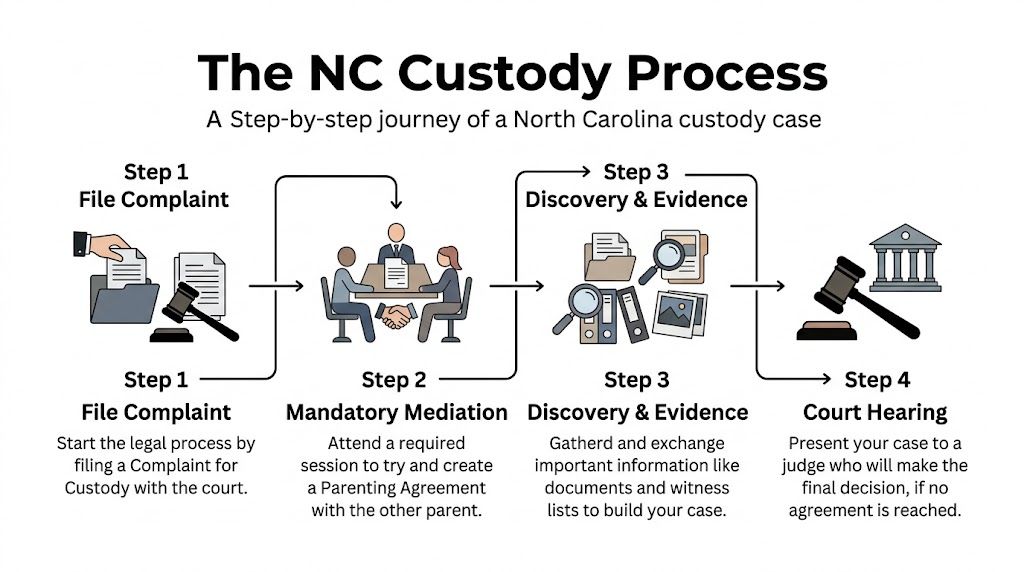
As the infographic shows, mediation is a pivotal early step that can lead directly to a final resolution, bypassing the need for a costly and stressful court battle.
Step 3: Discovery and Temporary Orders
If mediation doesn't resolve your case, the process moves into a more formal stage of evidence gathering called discovery. This is where you and the other parent, through your attorneys, can legally request information and documents relevant to the case. This might include financial records, emails, text messages, or lists of potential witnesses.
While this is happening, you might need the court to make short-term decisions about the custody schedule or child support while you wait for a final hearing. This is done by filing a motion for a temporary custody hearing. A judge will hear the motion and can issue a temporary order that stays in place until the final trial.
The purpose of discovery is to ensure both sides have all the relevant facts before going to court. This prevents surprises at trial and helps each party understand the strengths and weaknesses of their case, which can often lead to a settlement.
Step 4: The Path to a Permanent Custody Hearing
If all attempts at settlement fail, your case will be scheduled for a permanent custody hearing. This is the trial where both sides present evidence, call witnesses, and make legal arguments before a District Court Judge. After hearing all the testimony, the judge will issue a final, permanent custody order based on the "best interests of the child" standard. This order will remain in effect unless a parent can later prove a "substantial change in circumstances" that justifies modifying it.
Modifying or Enforcing Your NC Custody Order
A North Carolina child custody order is designed to provide a stable, predictable routine for your child. But life rarely follows a straight line. Jobs change, parents relocate, and children’s needs evolve as they grow.
The law gives parents two powerful tools: the ability to modify a custody order to fit new realities, and the power to enforce it when the other parent won’t follow the rules.
How to Modify a North Carolina Custody Order
To ask a judge to modify a permanent custody order, you must first prove that a “substantial change in circumstances” has happened since the last order was put in place. This can’t just be a minor inconvenience. The change must be significant, and it must directly impact the welfare of your child.
A judge will only consider changing a custody order if they are convinced the new situation has a real effect on the child's life. The court's focus, as always, is on what is best for the child.
Common situations that may rise to the level of a substantial change include:
- Parental Relocation: One parent is planning a move far enough away that the current custody schedule becomes unworkable.
- Change in a Parent's Fitness: A parent develops a substance abuse problem, is convicted of a crime, or introduces the child to an unsafe living situation.
- Change in the Child's Needs: The child develops new medical or educational needs that one parent is better positioned to manage.
- Failure to Follow the Order: One parent repeatedly and intentionally ignores the custody schedule, interfering with the other parent's time.
If a judge finds that a substantial change has occurred, they will re-evaluate what is in the "best interests of the child" to decide what the new custody order should look like. You can learn more by exploring our detailed article on how to modify a custody agreement.
What Happens When a Parent Violates a Custody Order?
When the other parent doesn’t hold up their end of the bargain—by refusing to return your child on time, for example—you have legal options. The main tool for enforcing an order is a Motion for an Order to Show Cause, also known as a contempt motion.
Filing this motion forces the other parent to come to court and explain to the judge ("show cause") why they shouldn’t be held in contempt for deliberately violating a court order.
If a judge finds a parent in civil contempt, they can compel compliance by:
- Ordering the parent to pay your attorney’s fees.
- Awarding make-up visitation time.
- Imposing fines.
- In serious or repeat cases, ordering jail time until the parent agrees to comply.
It is crucial to document every violation. Keep a careful log with dates, times, and a summary of what happened. This evidence is the foundation for enforcing your rights under the child custody laws in North Carolina.
Frequently Asked Questions About NC Custody Law
Facing a custody case brings a lot of questions. Here are clear, straightforward answers to some of the most common concerns we hear from parents in North Carolina.
Does North Carolina law favor mothers in custody cases?
No. This is a common myth, but it's false. North Carolina General Statute § 50-13.2(a) explicitly states that a judge cannot favor one parent over the other based on gender. The court's decision must be based strictly on which parent is best able to promote the child’s welfare. The focus is on parenting abilities and stability, not gender.
At what age can my child decide who to live with in NC?
There is no "magic age" in North Carolina where a child gets to make the final decision. A judge may listen to the preference of a child they find to be of "sufficient age and maturity," but this is just one of many factors. The judge always has the final say on what is in the child’s best interests, even if it goes against the child's stated preference.
What is the difference between a Separation Agreement and a Custody Order?
This is a critical distinction. A Separation Agreement is a private contract between you and the other parent. While legally binding, enforcing it can be more difficult. A Custody Order is issued by a judge and carries the full weight of the court's authority. If a Separation Agreement is "incorporated" into a court order (often called a Consent Order), it becomes just as enforceable as an order from a judge, giving you stronger tools—like a contempt motion—if the other parent violates the terms.
Get Help Navigating Your North Carolina Custody Case
Reading about child custody laws in North Carolina is a great first step, but applying that knowledge to your family's unique circumstances requires skill and experience. Having a knowledgeable family law attorney by your side is essential.
An attorney does more than file paperwork. They help you build your case, present compelling evidence, stand up for your child's best interests in court, and provide the confidence you need to move forward during a stressful time.
A common mistake is waiting too long to get legal advice. Involving a lawyer early can help you avoid critical missteps and build the strongest possible case from day one.
If you’re a parent in North Carolina facing a child custody issue, you don’t have to figure it all out by yourself. The steps you take now can lay the foundation for a stable, positive future for your family. A dedicated child custody lawyer in NC can make all the difference.
Don't go through this challenging time without a strong advocate in your corner. The team at the Law Office of Bryan Fagan is committed to helping North Carolina families find solutions.
Schedule a consultation with us today to discuss your specific situation and learn how we can help protect what matters most to you.