In North Carolina, the court filing fee for an absolute divorce is $225, but that isn't the primary concern when inquiring about cost. A simple uncontested divorce may cost only a few thousand dollars in attorney's fees, while litigated cases often reach $12,000 to $14,500 when even one issue goes to trial.
Individuals often start this process with the same fear: "I can handle the legal part if I have to, but I don't know how I'm supposed to pay for it." That's a fair concern. Divorce affects housing, parenting, retirement, debt, and monthly cash flow all at once, so legal cost can feel like one more crisis layered on top of everything else.
The most useful way to think about divorce lawyer North Carolina cost is this: the filing fee is fixed, but the final bill is driven by conflict and complexity. If you and your spouse agree on the key terms, the process is usually more manageable. If you fight over custody, support, or property, the cost rises because the work rises.
North Carolina law also shapes timing and strategy. For example, an absolute divorce generally requires a period of separation before filing under North Carolina law. But the legal issues tied to that divorce, such as equitable distribution, child custody, child support, and spousal support, often determine whether your case stays uncomplicated or becomes expensive.
Understanding the Real Cost of a North Carolina Divorce
The first number many people see is the filing fee. That number matters, but it doesn't answer the bigger question. The main cost comes from how much legal work your case requires, how many issues are disputed, and whether anyone has to ask a judge to decide those issues.
A statewide review of North Carolina divorce costs reported average full-scope attorney costs of about $9,700 to $11,800, with uncontested cases averaging about $3,500 to $4,200, cases with one dispute averaging about $5,100 to $6,200, cases with two disputes averaging about $8,800 to $10,600, and cases with one issue going to trial averaging about $12,000 to $14,500 according to North Carolina divorce cost data published by Lawyers.com.
That spread tells you something important. This isn't a one-price service. It's a legal process with moving parts, and each disputed part creates more attorney time, more documents, more negotiation, and sometimes more court appearances.
Why two divorces can cost very different amounts
Take two examples.
One couple has already separated, agrees the marriage is over, has no custody fight, and has already worked out property division. That case usually stays on the lower end of the cost range.
Another couple disagrees about where the children should live, whether one spouse should pay support, and how to divide retirement accounts. Even before trial, that case may require document requests, settlement conferences, mediation, court preparation, and hearings. The cost rises because the attorney's work rises.
Practical rule: The cheapest divorce isn't the one with the lowest hourly rate. It's the one with the fewest unresolved issues.
What clients often misunderstand
Many people assume legal fees are mostly about how long a lawyer has practiced or what city the office is in. Those things can matter, but they usually matter less than the posture of the case.
The better question is not "What's your rate?" It's "What is likely to be disputed in my case?" In North Carolina, common cost drivers include:
- Child custody disagreements: Parenting schedules, decision-making authority, and holiday arrangements often require detailed negotiation.
- Property division disputes: Equitable distribution can become expensive when assets are hard to value or trace.
- Support claims: Alimony and child support issues can increase motion practice and financial analysis.
- Trial risk: Once a case moves toward a hearing, preparation costs increase quickly.
If you're trying to budget, start with the facts of your case, not a generic online estimate.
Decoding Your Lawyer's Bill Hourly Rates Retainers and Flat Fees
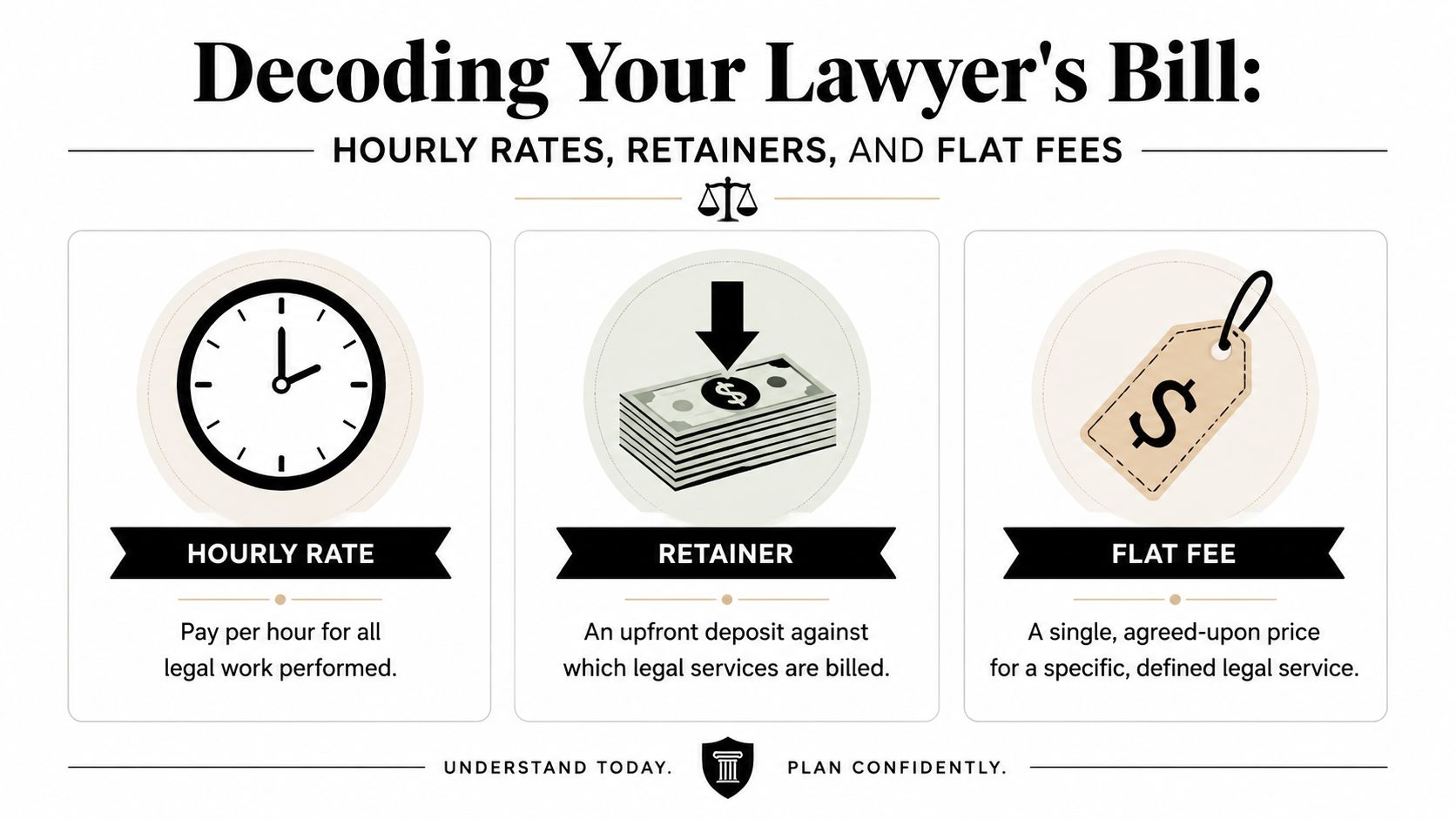
Most North Carolina divorce clients will see one of three billing structures: hourly billing, a retainer, or in limited situations a flat fee. If you understand the difference at the beginning, you avoid a lot of confusion later.
Hourly billing
In contested family cases, lawyers often bill by the hour. That means you pay for the time spent on legal work, which can include drafting pleadings, reviewing records, preparing for mediation, negotiating with opposing counsel, court appearances, and communicating with you about strategy.
One North Carolina pricing source reports that traditional firms average about $320 per hour for individual and family cases, and consultations can cost up to $200 for a 60 to 90 minute meeting, according to North Carolina legal pricing benchmarks.
That doesn't mean every lawyer charges the same amount or that every case should cost the same. It means the number of hours used becomes a major factor.
A short, focused email with one clear question costs less than five separate emails sent over three days. A well-organized document drop costs less than asking your lawyer to piece together missing bank statements one month at a time.
Retainers
A retainer is usually an upfront deposit. Think of it as a fund the lawyer bills against as work is performed.
Clients sometimes assume a retainer is the total cost of the case. It usually isn't. In many North Carolina family cases, especially contested ones, it's just the amount required to begin work.
Here is the practical difference:
| Billing term | What it usually means | Common client mistake |
|---|---|---|
| Retainer | Upfront deposit held and billed against | Thinking it's the final bill |
| Hourly rate | Charge for time spent on the case | Focusing only on the rate, not total hours |
| Flat fee | One price for a defined task | Assuming every divorce qualifies |
If you're comparing firms, ask what events cause the retainer to be replenished and what work is included.
Flat fees and limited-scope work
A flat fee is more common when the legal task is narrow and predictable, such as preparing paperwork for a straightforward uncontested divorce. It can work well when the facts are stable and there is little chance the matter will turn into a dispute.
But flat fees have limits. If a spouse stops cooperating, refuses to sign, or raises new claims involving custody or property, a simple matter can stop being simple.
For readers evaluating options for representation, the North Carolina divorce lawyer page from the Law Office of Bryan Fagan outlines the kinds of family law matters that often affect how billing is structured.
A good fee conversation doesn't just ask what the lawyer charges. It asks what work the lawyer expects the case to require.
The Full Financial Picture Beyond Attorney Fees
Attorney's fees are only part of the expense. Many people underestimate divorce costs because they budget for the lawyer and overlook the outside expenses that come with moving a case through the North Carolina court system.
The clearest fixed cost is the court filing fee. In North Carolina, the base court filing fee for an absolute divorce is $225, commonly broken into a $150 District Court fee plus a $75 absolute divorce fee. If the sheriff serves the papers, that adds $30, and a request to restore a former name adds $10, as explained in this North Carolina divorce filing fee overview.
Costs that don't show up in the first conversation
Those filing costs are real, but they are only a starting point. Other expenses can include:
- Service costs: If formal service is needed, that adds to the court-side expense.
- Mediation fees: If the case includes disputes, mediation may be required or strategically useful.
- Document preparation: Some clients need extra help organizing or preparing formal paperwork.
- Third-party experts: Appraisers, business valuation professionals, or custody-related experts can become necessary in more complex matters.
A more realistic budget example
Suppose someone says, "The filing fee is only a few hundred dollars, so maybe the whole divorce won't be too bad." That assumption often falls apart once there is disagreement over property, support, or parenting.
For example, if one spouse seeks alimony, the legal work often expands to detailed financial disclosure, document review, and negotiation. A reader trying to understand that piece of the case may find it useful to review North Carolina alimony laws alongside the cost discussion, because support claims often affect both strategy and spending.
Budgeting insight: Court costs are predictable. Human conflict is not. That's why legal budgets should leave room for negotiation, delay, and problem-solving.
Why this matters early
When clients build a realistic budget from the start, they make better choices. They gather records sooner, decide which issues matter, and avoid spending heavily on low-value fights.
That's also why the phrase "divorce lawyer North Carolina cost" can be misleading if it's treated as a single number. In practice, it is a combination of legal fees, court fees, service costs, and dispute-related expenses.
What Really Drives North Carolina Divorce Costs Up
The main driver of divorce cost in North Carolina isn't the filing fee, and it usually isn't the consultation charge. It's contested issues. Every unresolved issue creates work, and every layer of work adds time to the case.
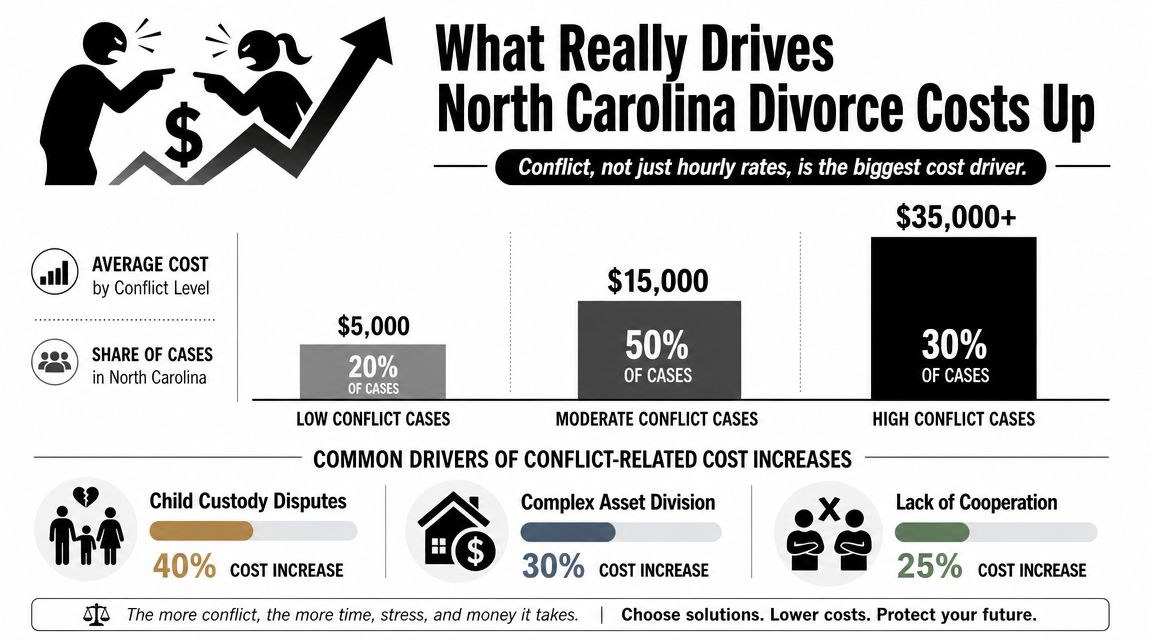
The North Carolina cost data cited earlier shows the pattern clearly. Cases cost far less when they stay uncontested, and they become much more expensive when one or more issues remain disputed or go to trial. That happens because the lawyer isn't just "being in the case" longer. The lawyer is doing different work: preparing motions, conducting discovery, reviewing financial evidence, negotiating settlement proposals, preparing witnesses, and appearing in court.
Custody fights change the economics of a divorce
Child custody disputes are often the most emotionally difficult and the most expensive to litigate. Parents rarely argue over a single line in a calendar. They argue over school choice, exchanges, holidays, communication, relocation, medical decisions, and what arrangement serves the child's best interests.
That kind of dispute can require:
- Detailed parenting proposals
- Review of school, medical, or counseling records
- Mediation sessions
- Temporary hearings
- Trial preparation if settlement fails
Even when parents are acting in good faith, custody litigation takes time because the facts are personal and the stakes are high.
Property division gets expensive when assets are complicated
North Carolina follows equitable distribution, which means marital property and debt must be identified, valued, and distributed under state law. "Equitable" doesn't always mean equal, and the legal work becomes more demanding when the marital estate includes retirement accounts, real property, closely held businesses, restricted stock, or disputed separate property claims.
A couple with one house, one bank account, and broad agreement may resolve property issues efficiently. A couple with a business, multiple accounts, inherited assets, and arguments over classification can spend far more because each item has to be analyzed and supported.
For readers facing large estates or business interests, high net worth divorce issues in North Carolina often show why complexity, not just hostility, can increase cost.
Trial posture changes everything
Many budgets break during this phase. Settlement discussions can be difficult, but trial preparation is different. Once a hearing is likely, your lawyer has to prepare evidence, outline testimony, organize exhibits, anticipate objections, and build a persuasive presentation for the judge.
This video gives additional context on the practical realities that can affect divorce cases:
A short table makes the point:
| Case posture | Cost pressure | Why it rises |
|---|---|---|
| Agreement on major issues | Lower | Less drafting, less negotiation, fewer hearings |
| One or more disputed issues | Moderate to high | More attorney analysis and back-and-forth |
| Issue set for trial | Highest | Intensive preparation and court time |
The fastest way to increase a divorce bill is to leave several issues unresolved and ask the court to sort them out for you.
What works and what doesn't
What works is narrowing the dispute. If custody is the only real issue, treat it that way instead of fighting over every household item on principle. If property can be resolved by exchange of documents and a focused negotiation, do that before filing motions that force everyone into a more expensive posture.
What doesn't work is using the case as a place to revisit the entire history of the marriage. Judges decide legal issues. They don't bill by emotional importance, but your lawyer's time can still be consumed by it.
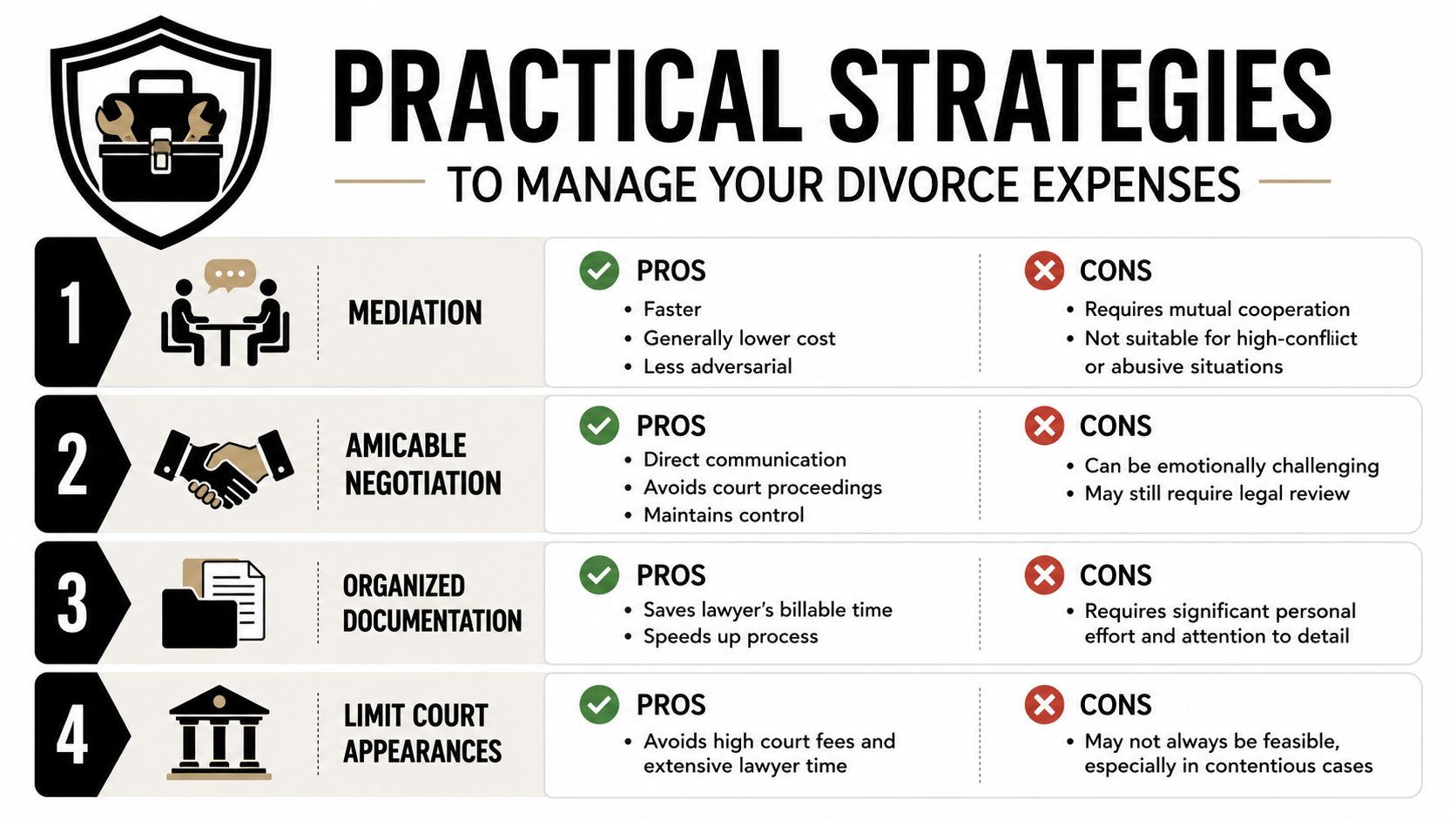
Practical Strategies to Manage Your Divorce Expenses
You can't control everything in a divorce, but you can control more than often assumed. Cost management starts with behavior, not magic. Organized clients usually spend less than disorganized clients. Focused clients usually spend less than reactive clients.
Use your lawyer for legal judgment, not document hunting
One of the easiest ways to reduce fees is to gather the key records early and keep them organized. That may include tax returns, pay stubs, account statements, mortgage records, retirement information, and any existing court orders.
If your attorney has to request basic records from you repeatedly, the bill climbs with very little strategic benefit.
A practical approach looks like this:
- Build one clean folder: Sort financial records by account and date.
- Create a timeline: Note separation date, filing date, major financial events, and parenting changes.
- Keep communications concise: Combine questions into one message when possible.
- Separate legal issues from emotional processing: Friends, counselors, and support groups serve a different role than legal counsel.
Choose the right process for the right case
Not every divorce belongs in a courtroom from day one. In many cases, mediation or negotiated settlement can save substantial time and money because the parties stay focused on solutions instead of motions practice.
That doesn't mean compromise at any cost. It means being strategic. If your spouse is engaging in good-faith negotiation, a settlement-focused process often makes financial sense. If there is intimidation, hidden information, or refusal to participate forthrightly, formal litigation may be necessary.
Here is a simple comparison:
| Approach | Often works best when | Main trade-off |
|---|---|---|
| Mediation | Both spouses can exchange information and negotiate | Requires cooperation |
| Direct negotiated settlement | The issues are defined and counsel can narrow disagreements | Progress may stall without structure |
| Litigation | One party won't cooperate or urgent relief is needed | Higher cost and less control over outcome |
Don't fight over low-value issues
Clients sometimes spend large amounts of attorney time contesting items that matter emotionally but don't justify the legal expense. That doesn't mean the feelings aren't real. It means the legal strategy should match the financial reality.
If you're deciding whether to dispute an issue, ask:
- Does this affect my children, long-term support, or a significant asset?
- Can this issue be resolved with a practical compromise?
- Is the likely cost of the fight out of proportion to the value of winning it?
That question alone can save substantial money.
Ask whether attorney's fees may be available
This is the strategic side of cost that many articles miss. In North Carolina, fee assistance may be available when a requesting party acts in good faith and cannot financially pay, and attorney fees may sometimes be requested as part of a larger award, according to this North Carolina family law fee discussion.
That matters in real life. If one spouse controls most of the income or access to funds, the cost issue isn't just "Can I hire a lawyer?" It may also be "Can the court require the other side to contribute?" In some custody, support, or related disputes, that question can materially affect bargaining power and the ability to stay in the case.
If your spouse has far more financial control, talk with your lawyer early about whether attorney's fees should be requested. Waiting too long can weaken the strategy.
This is also where North Carolina statutes and case-specific facts matter. Fee-shifting isn't automatic. A judge usually has to apply the legal standard to the facts in your case, and outcomes depend on the claim involved and the evidence available. But asking the question early is often wise.
Frequently Asked Questions About NC Divorce Costs
Is a consultation always free in North Carolina
No. Some family law firms offer free consultations, and some charge for them. One North Carolina pricing source reports that consultations can cost up to $200 for a 60 to 90 minute meeting, as noted earlier. The better question is what you'll get from that meeting: case assessment, fee structure, likely dispute points, and next-step planning.
Can I handle my own divorce to save money
Sometimes, but the risk depends on the case. A very simple absolute divorce with no property, custody, or support issues may be manageable for some people. A case involving children, retirement accounts, alimony claims, or contested property usually carries much more risk.
The common mistake is assuming "simple divorce" means "simple legal consequences." In North Carolina, missing a claim or mishandling timing can create expensive problems later.
Will the court make my spouse pay my attorney's fees
Sometimes, but not automatically. In some North Carolina family law matters, a party acting in good faith and lacking the ability to pay may seek fee assistance. Whether fees are available depends on the type of claim, the facts, and the judge's decision.
Does the filing fee cover everything
No. The filing fee covers filing the divorce action itself. It doesn't cover attorney time, mediation, document preparation, service beyond the base filing amount, or other dispute-related expenses.
Is an uncontested divorce always cheap
Usually cheaper, yes. Always cheap, no. Even a case that starts out amicable can become more expensive if one spouse changes position, delays paperwork, or raises new disagreements about support or property.
Take Control of Your Case with a Clear Financial Strategy
A North Carolina divorce becomes more manageable when you stop looking for one flat number and start looking at the main cost drivers. Billing structure matters. Court fees matter. But the largest factor is usually how many issues remain unresolved and whether the case moves toward trial.

Clients put themselves in a better position when they do three things early: get organized, identify what is most important, and choose a strategy that fits the case instead of escalating every disagreement. In many divorces, that approach lowers cost and improves decision-making at the same time.
If you're weighing divorce lawyer North Carolina cost right now, don't make the mistake of budgeting only for the filing fee or comparing lawyers on hourly rate alone. The better approach is to assess your likely dispute points, your documentation, your short-term cash flow, and whether attorney's fees might become part of the legal strategy.
North Carolina law gives you options, but good options usually depend on acting early and planning carefully. A clear legal and financial strategy won't remove the stress of divorce, but it can keep that stress from turning into avoidable expense.
If you're considering divorce or already dealing with custody, support, or property disputes, schedule a consultation with the Law Office of Bryan Fagan. A confidential meeting can help you understand the likely cost drivers in your case, identify where settlement may be realistic, and build a North Carolina-specific plan that protects your finances as well as your legal rights.