In North Carolina, the court filing fee for an absolute divorce is $225, and service usually adds $30 through the sheriff or about $7 by certified mail. The harder question is lawyer cost, and in practice that can range from a modest flat fee in a simple uncontested matter to a much larger hourly bill in a contested case, because the final price depends on what you and your spouse are fighting about.
The inquiry into how much a divorce lawyer costs in NC is probably not driven by curiosity. You're trying to figure out whether you can afford to move forward, whether you need full representation, and whether one disagreement is about to turn a manageable case into a very expensive one.
That anxiety is normal. Individuals often don't walk into divorce with a clear budget, and North Carolina law doesn't make cost a single fixed number. Some cases are mostly paperwork. Others involve custody, support, business interests, retirement issues, and repeated court appearances. Those are different legal jobs, and they are billed differently.
We help clients separate the fixed costs from key cost drivers. The filing fee is easy to identify. The legal work is where the range opens up. If you understand what increases time, hearings, negotiation, and document review, you can make better decisions early and avoid spending money in the wrong places.
Navigating the Financial Uncertainty of a North Carolina Divorce
A common situation looks like this. One spouse has already moved out, the other is trying to hold the household together, and both are wondering how much money will disappear into the process before anything is final. That uncertainty can be worse than the bill itself because you can't plan around a number nobody has explained.
North Carolina gives you at least one concrete starting point. The state court filing fee for an absolute divorce is $225, and service adds $30 if the sheriff handles service, according to this North Carolina divorce cost overview. That means the administrative floor is relatively low.
What catches people off guard is that the filing cost is rarely the main issue. Legal fees usually become the largest part of the expense, especially when there is disagreement about children, property, or support.
The question behind the question
When people ask, "How much does a divorce lawyer cost in NC," they usually mean one of two things:
- Paperwork cost: "What will it take to get an uncontested absolute divorce filed and finished?"
- Representation cost: "What will it cost to protect me if my spouse and I disagree about important issues?"
Those are not the same purchase.
Most divorce cost confusion comes from mixing up a simple filing with a contested family law case.
A straightforward absolute divorce with full agreement is usually far more predictable. A disputed case is not. If your spouse contests custody, seeks alimony, refuses to disclose finances, or argues over property division, your lawyer has to do more than prepare forms. The lawyer has to investigate facts, build positions, negotiate terms, prepare for hearings, and sometimes litigate.
Why two NC divorces can cost very different amounts
Two couples may both be "getting divorced" in North Carolina, but their legal needs can be miles apart.
One couple may have no children, no real dispute over assets, and a separation period that is already complete under N.C. Gen. Stat. § 50-6, which governs absolute divorce after one year of separation. Another couple may be fighting over parenting schedules, possession of the home, and whether one spouse should receive support under Chapter 50.
Those cases don't cost different amounts because lawyers are arbitrary. They cost different amounts because the amount of legal work is different.
How NC Divorce Lawyers Structure Their Fees
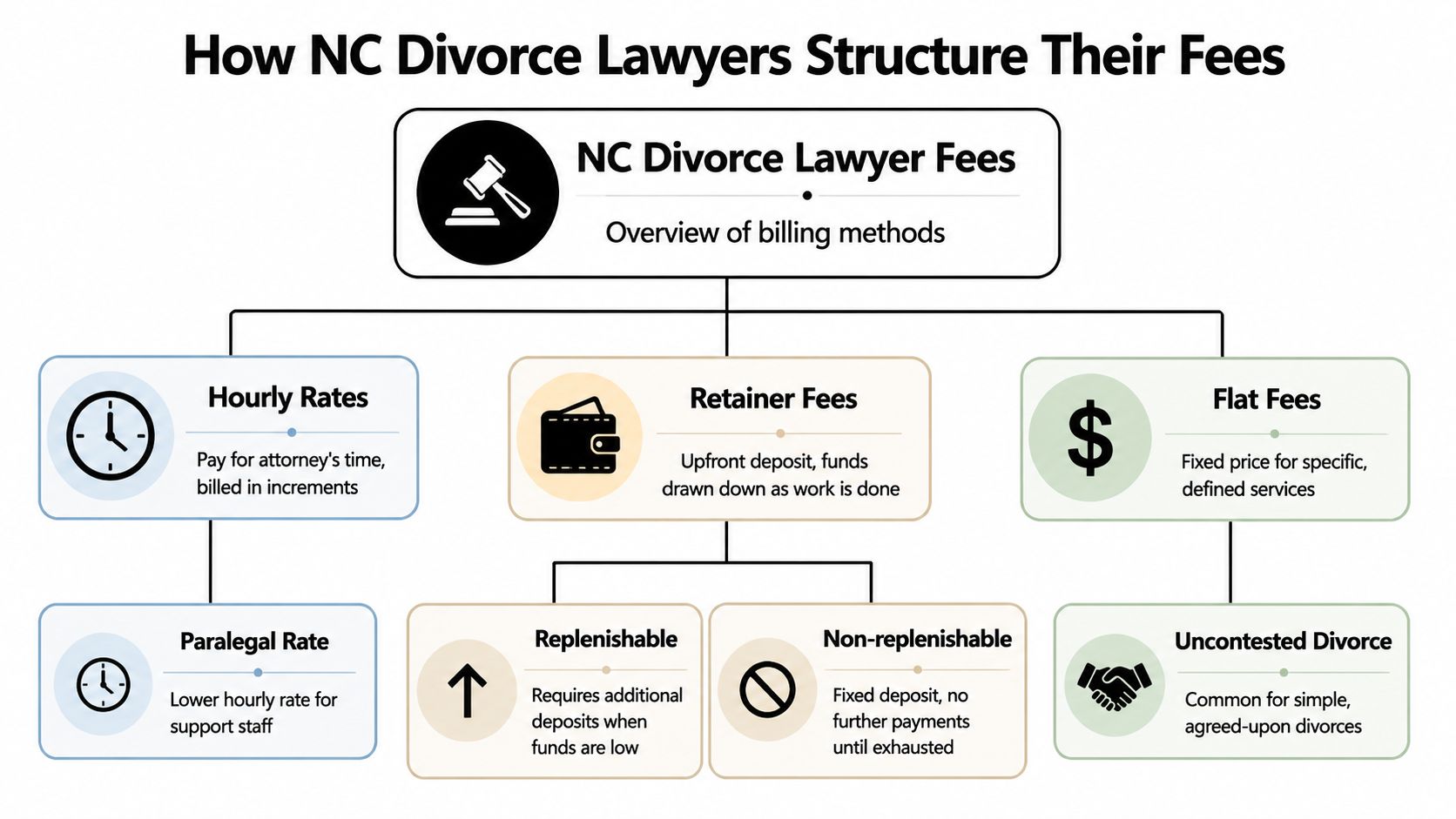
The biggest billing mistake clients make is assuming every divorce lawyer charges the same way. In North Carolina family law, the fee structure usually depends on whether the case is predictable or open-ended.
Hourly billing in contested cases
Many contested divorce and related family law matters are billed by the hour. Reported hourly rates for North Carolina divorce lawyers average around $300 to $550, with major metro areas such as Charlotte and Raleigh commonly landing in the $400 to $550 per hour range, while rural counties may be closer to $200 to $300 per hour, as summarized in this North Carolina attorney rate guide.
That range matters because hourly billing means every major task affects the total bill. Time may include:
- Client meetings and strategy sessions: Reviewing goals, facts, and risks.
- Document drafting: Complaints, answers, motions, affidavits, and settlement terms.
- Negotiation work: Calls, emails, proposal review, and revisions.
- Court preparation: Organizing exhibits, witness prep, and hearing appearances.
If your case is likely to involve disputes, it's smart to review what a North Carolina divorce lawyer handles before you compare quotes. A lower rate doesn't always mean lower total cost if the case is managed inefficiently.
What a retainer actually means
A retainer is often misunderstood. It functions as a prepaid account for legal work. You deposit funds up front, and the lawyer bills time and expenses against that balance as work is completed.
Some retainers must be replenished when the balance drops. Others are limited to a defined stage of work. The terms should be in your fee agreement, and you should read that agreement carefully before hiring anyone.
Practical rule: Ask whether the retainer is replenishable, how often you will receive billing statements, and what happens if the initial deposit is exhausted before the case is over.
Retainers are common in contested matters because nobody can accurately predict every motion, hearing, or settlement turn at the outset.
Flat fees in simple matters
A flat fee is more common when the legal task is narrow and predictable. That often means a simple uncontested divorce, especially when the separation period is complete, service is straightforward, and there are no active disputes tied to the filing.
Flat fees can work well when the lawyer is acting more like a careful paperwork guide than a courtroom litigator. They usually do not fit cases where the scope may expand without warning.
Three questions help clarify whether a flat fee is realistic:
- Are all major issues already resolved in writing?
- Will anyone need to file motions or appear for disputed hearings?
- Is the lawyer handling only the divorce filing, or also custody, support, and property issues?
If the answer to the second question is yes, hourly billing is usually the more realistic model.
Sample Budgets Uncontested vs Contested Divorce in NC
The best way to understand divorce cost is to compare two very different cases. Not with made-up promises, but with the actual work each path requires.
One spouse may need a lawyer mainly to move a completed separation and clean paperwork through the system. Another may need someone to manage deadlines, draft motions, negotiate parenting issues, and prepare for court. The budget changes because the task changes.
Case A with broad agreement
Consider a couple with no minor children, no active fight over property, and no argument about whether the one-year separation requirement under N.C. Gen. Stat. § 50-6 has been met. They need the complaint prepared correctly, service completed, and the matter finalized without unnecessary delay.
In that setting, cost usually stays closer to the lower end because the lawyer's role is limited and defined. The legal work is narrower. There are fewer calls, fewer letters, and usually no discovery fight over financial records.
This is the kind of case where a person is often shopping for efficiency. They don't need a trial lawyer for every issue. They need accurate filing, proper service, and a clean path to judgment. For readers comparing likely expenses, our discussion of NC divorce cost is often most useful when you're in this category.
Case B with real conflict
Now consider a different situation. The spouses disagree about who keeps the house, one person is asking for spousal support, and they cannot agree on a parenting schedule. The absolute divorce itself may still be straightforward, but the family law issues surrounding it are not.
That case can become expensive quickly because the lawyer isn't just filing papers. The lawyer may need to review bank records, draft claims, respond to claims, negotiate temporary arrangements, prepare affidavits, attend hearings, and push the case toward settlement or trial.
One unresolved issue can change the cost path of the whole case. Custody, alimony, or property division often does it.
A contested case also tends to generate work in waves. A hearing date gets set. A new dispute emerges. A financial document raises another question. The budget becomes harder to predict because the case no longer follows a simple filing track.
Uncontested vs Contested Divorce in North Carolina
| Factor | Uncontested Divorce | Contested Divorce |
|---|---|---|
| Primary legal need | Filing, service, and finalizing the divorce | Ongoing advice, negotiation, motions, and hearings |
| Attorney billing style | Often flat fee or limited scope | Usually hourly with a retainer |
| Court involvement | Minimal | Often repeated and issue-specific |
| Document volume | Relatively light | Often extensive |
| Stress level | Lower when both spouses cooperate | Higher because decisions remain unresolved |
| Cost predictability | More predictable | Less predictable |
| Common pressure point | Getting paperwork right | Managing conflict without runaway fees |
A practical budgeting mindset
If you're trying to estimate your own case, don't ask only whether the divorce is contested. Ask what is contested.
A disagreement about a pick-up time can sometimes be negotiated in a few calls. A disagreement about business valuation, alimony, or where the children will spend school nights usually requires much more work. That distinction matters more than the label alone.
The Key Factors That Drive Up Divorce Costs in North Carolina
The biggest driver of divorce cost isn't the divorce filing itself. It's conflict attached to legally significant issues. A single dispute over custody, alimony, or property division can move a case from basic paperwork into a much more expensive litigation track, as discussed in this North Carolina divorce cost analysis.

Child custody disputes
Custody fights are expensive because they are fact-intensive and emotionally charged. Under N.C. Gen. Stat. § 50-13.2, the court decides custody based on the best interests of the child. That standard sounds simple, but proving what serves a child's best interests often takes substantial preparation.
The work may involve calendars, school records, medical information, witness statements, and repeated negotiation over schedules and decision-making authority. Parents who are hurt, angry, or afraid often send a high volume of messages and expect immediate legal response. That time adds up.
Property division with complexity
Equitable distribution in North Carolina is governed by N.C. Gen. Stat. § 50-20. If the marital estate is straightforward, dividing it may be manageable. If it includes a business, professional practice, multiple accounts, disputed debts, or questions about separate versus marital property, the legal work becomes more detailed.
Lawyers may need to trace funds, review account histories, compare valuations, and sort out whether an asset was acquired before marriage, during marriage, or with mixed funds. Even clients who are willing to settle can spend a lot if their financial picture is disorganized.
A short example makes the point. If both spouses agree that one keeps the car and the other keeps a bank account, that's relatively direct. If they argue over whether one spouse used marital money to increase the value of a separate asset, the analysis becomes much more involved.
Alimony and high-conflict behavior
Spousal support disputes can also drive fees because they pull in income, earning capacity, budgets, lifestyle issues, and allegations about marital conduct. Temporary support requests may require quick action. Long-term support issues often require careful documentation.
The most expensive cases are often not the ones with the largest estates. They're the ones where conflict controls every decision.
High-conflict conduct multiplies cost in ways clients don't always expect. Constant emergency calls, refusal to produce documents, shifting settlement positions, and unnecessary motions force more attorney time into the case. Sometimes the legal issue is manageable, but the behavior around it isn't.
Smart Strategies to Reduce Your North Carolina Divorce Costs
You can't make every divorce inexpensive. You can make many divorces more efficient.
That starts with choosing the right process. If you use litigation for problems that could be resolved in negotiation, your budget usually suffers. If you try to force a cheap paperwork solution onto a case that really needs legal strategy, you can create even bigger costs later.

Choose process before conflict chooses it for you
Mediation is often one of the most practical ways to control cost when both spouses are willing to exchange information and negotiate in good faith. Instead of paying lawyers to fight every point in court, you pay for structured problem-solving.
If you're considering that route, review how divorce mediation in North Carolina works and whether it fits your situation. Mediation isn't right for every case, especially where there is intimidation, concealment, or severe imbalance, but it can be an efficient tool when communication is possible.
Collaborative approaches and negotiated settlements also help when both sides want a durable agreement more than a symbolic win.
Spend legal time where it matters
Clients often lower costs by being disciplined about what requires attorney involvement and what doesn't.
- Organize documents early: Gather account statements, tax returns, debt records, deeds, and employment information before your lawyer has to chase them.
- Use one clear communication channel: A concise email with grouped questions is usually cheaper than multiple fragmented messages.
- Separate legal issues from emotional processing: Your lawyer should understand the emotional stakes, but therapy, coaching, or trusted personal support may be a better place for repetitive venting.
- Focus on outcome, not punishment: Trying to "teach your spouse a lesson" is one of the fastest ways to increase fees.
A well-prepared client usually spends money more effectively than a reactive one.
Here is a helpful overview for people thinking about efficient case planning:
Understand the limits of free and low-cost options
For people with limited income, North Carolina does offer some relief, but it is important to understand what that relief covers. Indigent filers may seek a fee waiver, and Legal Aid of North Carolina offers free simple-divorce clinics, but legal aid generally does not handle contested issues like alimony or equitable distribution, as explained in this discussion of low-cost divorce options in North Carolina.
That means "low cost" may only solve the filing step. It may not solve the dispute.
One practical option some people overlook is limited-scope representation. In appropriate cases, a lawyer can handle a specific task such as document review, a hearing, or settlement drafting, rather than every stage of the matter. The Law Office of Bryan Fagan also provides consultation-based planning and family law representation for North Carolina clients who need to match legal strategy to budget and case complexity.
Frequently Asked Questions About NC Divorce Costs
Can a judge order my spouse to pay my attorney's fees
Sometimes, yes. In North Carolina, attorney's fees may be available in certain family law disputes, but not automatically in every divorce-related case. For child custody and child support matters, N.C. Gen. Stat. § 50-13.6 allows fee awards in some circumstances. For dependent spouse support claims, N.C. Gen. Stat. § 50-16.4 may apply.
The key point is that fee shifting depends on the type of claim, the facts, and the court's findings. You shouldn't assume the other side will pay your lawyer, and you also shouldn't assume the court can't help. Ask about this early.
What does a retainer cover
A retainer usually covers future legal work, not a guaranteed total price for the entire case. Your lawyer bills against that deposited amount as tasks are completed. If the matter becomes more involved, you may need to replenish the retainer depending on the fee agreement.
Ask for direct answers on three points: how work is billed, how often invoices are sent, and whether unused funds are refundable under the contract terms and applicable ethics rules.
Is a do-it-yourself divorce safe in North Carolina
For a very simple absolute divorce, it may be workable for some people. But "simple" is narrower than often assumed. If there are children, retirement assets, real estate, support claims, or unresolved property issues, a DIY approach can create expensive mistakes.
Absolute divorce under N.C. Gen. Stat. § 50-6 ends the marriage, but it can also affect rights if related claims are not handled correctly and timely. People often save money on the front end only to spend more later fixing avoidable problems.
If your case includes children, support, or meaningful property questions, the cost of bad assumptions can exceed the cost of early legal advice.
Does the absolute divorce itself resolve custody and property division
No. In North Carolina, an absolute divorce is only one part of the broader family law picture. Child custody, child support, equitable distribution, post-separation support, and alimony are separate issues that may need separate claims, agreements, or court orders.
That distinction matters because someone may think they are hiring a lawyer for "the divorce" when they really need advice about several connected matters.
Conclusion Get a Clear Financial Strategy for Your NC Divorce
The cost of a North Carolina divorce isn't mysterious once you look at the moving parts. The filing side is relatively easy to identify. The legal fee side depends on whether your case stays narrow or expands into conflict over children, support, or property.
That distinction matters more than any one headline number. A simple case can often be managed efficiently. A contested case needs strategy, discipline, and realistic budgeting. The earlier you identify which path you're on, the easier it is to control unnecessary expense.
If you're weighing whether to hire a lawyer, don't focus only on the cheapest entry point. Focus on the kind of representation your situation requires. Paying for too little help can be expensive. Paying for work your case doesn't need can be expensive too.
A good consultation should give you more than a price quote. It should help you understand what issues are driving your cost, what can likely be resolved outside court, and where it makes sense to spend money to protect your future.
If you're facing divorce in North Carolina and need a clearer picture of likely legal fees, next steps, and cost-saving options, schedule a consultation with Law Office of Bryan Fagan. We can help you evaluate whether your case is likely to remain a straightforward filing or develop into a contested family law matter, then build a strategy that fits your priorities and budget.