Before you can even think about the paperwork, you must confirm you are eligible to file for divorce in North Carolina. Getting this wrong from the start is a common and costly mistake that can derail your entire case.
The process hinges on two foundational rules under North Carolina law: a one-year physical separation and at least six months of residency by you or your spouse. These aren't just suggestions; they are non-negotiable legal requirements. Understanding them is the first and most critical step in your journey.
Confirming Your Eligibility to File for Divorce in NC
Starting a divorce is overwhelming. The last thing you need is to have your case dismissed on a technicality, forcing you to start over and costing you valuable time, money, and emotional energy.
Let’s get this right from the beginning. North Carolina law is very clear about its residency and separation rules.
The Six-Month Residency Rule
For a North Carolina court to have the authority (or "jurisdiction") to grant your divorce, at least one spouse must have a tangible connection to the state. North Carolina General Statute § 50-6 lays it out plainly: one of you must have resided in North Carolina for at least six consecutive months immediately before filing the divorce complaint.
- Who must be a resident? Only one of you. For example, if you’ve lived in Raleigh for two years but your spouse moved to South Carolina eight months ago, you still meet the requirement and can file in Wake County.
- What does "residency" mean? It’s more than just a P.O. box. Residency means you intend for North Carolina to be your permanent home. Evidence like a North Carolina driver's license, voter registration, owning property, or holding a local job all help establish your residency.
If neither you nor your spouse meets this six-month rule, the court simply cannot hear your case.

The One-Year Separation Requirement
This is where many people get tripped up. North Carolina requires you and your spouse to live “separate and apart” for one full year—that’s 365 days—before you can file for an absolute divorce. Crucially, at the time of separation, at least one of you must have intended for the separation to be permanent.
Practical Example: Living "separate and apart" means living in two different homes. Sleeping in separate bedrooms under the same roof does not count as legal separation in North Carolina. The law requires a complete physical separation.
The clock for your one-year separation begins on the exact day one of you moves out with the intent to end the marriage. Be warned: resuming the marital relationship, even briefly, can reset that clock to zero. Misstating this date on your paperwork is a fatal flaw that will get your case dismissed. You can learn more about the nuances in our guide on what is legal separation in NC.
For instance, if your spouse moved out on March 15, 2025, the very earliest you could file your divorce complaint is March 16, 2026. Filing a single day too soon will invalidate your entire effort. Before you touch a single form, be absolutely certain that you’ve met both of these legal requirements.
How to Get the Right North Carolina Divorce Papers
Once you’ve confirmed you meet North Carolina’s residency and separation requirements, the next step is tackling the paperwork. This is where your divorce moves from a plan to a legal process, and getting the details right is non-negotiable.
Accuracy on these forms isn't just a suggestion; it’s what keeps your case moving. A single mistake can lead to frustrating delays or even cause the Clerk of Court to reject your filing entirely.
Let’s walk through the essential documents for a straightforward, uncontested absolute divorce in North Carolina. While the stack of papers can look intimidating, understanding the purpose of each form makes the process much more manageable.
The Core Documents for a Simple NC Divorce
For an uncontested divorce based on one year of separation, you’ll generally need to file three key documents. You can find the official, most current versions on the NC Courts website. It's vital to use their forms, as outdated versions will not be accepted.
- Domestic Civil Action Cover Sheet (AOC-CV-751): Think of this as the cover letter for your entire filing. It’s the top sheet that tells the court clerk what kind of case you’re starting ("Absolute Divorce") and provides basic details about you and your spouse.
- Complaint for Absolute Divorce: This is the legal heart of your divorce. In this document, you (the Plaintiff) formally ask the court to grant a divorce from your spouse (the Defendant). It lays out the specific facts that make you eligible for a divorce under North Carolina law.
- Summons (AOC-CV-100): This form is the official legal notice to your spouse. It informs them that you have filed a divorce lawsuit and that they have 30 days to file a formal response with the court.
A Practical Example of Completing the Complaint
Let's consider a real-world scenario. Sarah and Tom are a couple in Wake County. They officially separated on April 10, 2025, when Tom moved into his own apartment. Now, in April 2026, Sarah is ready to file for divorce.
When Sarah sits down with the Complaint for Absolute Divorce, every detail matters.
- The Parties: She’ll list her full name and current address as the Plaintiff and Tom’s full name and current address as the Defendant. It’s a common error for people to mix these roles up.
- Jurisdiction: The form requires her to state that she has lived in North Carolina for more than six months and that she's filing in Wake County, where she resides.
- The Grounds for Divorce: This is the most critical part of the Complaint. Sarah must clearly state that she and Tom have lived continuously separate and apart for at least one full year right before she filed. She must list the exact date of separation: April 10, 2025.
Crucial Tip: Filing with the wrong separation date is one of the fastest ways to get your case dismissed. If you file even a single day before you’ve been separated for 365 days, your filing is invalid. You’ll lose your filing fee and have to start all over again.
Avoiding Common but Costly Paperwork Mistakes
The clerk's office is there to process paperwork, not to give you legal advice. Their job requires them to reject any filing that doesn’t meet the proper legal standards. A simple mistake can send you right back to the beginning.
Here are some of the most common pitfalls to avoid:
- Incorrect Separation Date: As mentioned, this is an automatic game-over for your filing. Double- and triple-check your calendar to confirm the one-year mark has passed.
- Forgetting to State the Grounds: You can’t just ask for a divorce; you have to explicitly state why you are entitled to one under North Carolina law. This means writing that you have been separated for one year with the intent for that separation to be permanent.
- Failing to Verify Your Complaint: Your Complaint for Absolute Divorce is a sworn statement. You must sign it in front of a notary public. If it’s not notarized, the clerk cannot accept it.
Taking the time to carefully review every line of your divorce papers can save you weeks of delay and the frustration of a rejected filing. While these forms may seem straightforward, a single mistake can derail the process.
How to File and Serve Your Divorce Papers in NC
With your completed divorce forms in hand, you’re moving from the planning stage to taking real action. This involves two critical parts: formally filing the paperwork with the court and legally notifying your spouse.
Getting these steps right is non-negotiable. Any misstep here can cause frustrating delays or even lead to your case being dismissed, forcing you to start all over again.
First, you’ll take your original, notarized documents—the Complaint, the Summons, and the Civil Action Cover Sheet—to the Clerk of Court’s office in the county where you're filing. This is almost always the county where you live. You'll hand everything over, and the clerk will stamp your documents, assign a case number, and officially open your divorce file.
Paying Court Fees or Requesting a Waiver
Initiating a lawsuit, including a divorce, comes with a cost. In North Carolina, you’ll have to pay a filing fee right when you submit your papers. As of early 2026, this fee is generally $225.
However, court costs are set by the state legislature and can change. It’s always a good idea to check your local county court's website for the most current fee before you go.
If that fee represents a genuine financial hardship, you have another option. You can file a "Petition to Sue as an Indigent" (Form AOC-G-106). This is a formal request asking the court to let you proceed without paying the fees. You will need to provide detailed information about your income, expenses, and property to show that you can’t afford the cost. A judge will then decide whether to grant the waiver.
The Critical Step of Serving Your Spouse
Once your case is filed, you are legally required to "serve" your spouse with a copy of the paperwork. This is called Service of Process, and it’s a cornerstone of our legal system. It provides official notice of the lawsuit, giving your spouse the opportunity to respond.
You cannot just hand the papers to your spouse yourself. Service must be done in a legally recognized way. In North Carolina, you have three main options:
-
Service by Sheriff: For an additional fee (usually around $30), you can have the Sheriff's Department in the county where your spouse lives or works personally deliver the Summons and Complaint. This is often the most reliable method, as the Sheriff files a formal document with the court confirming service was completed.
-
Certified Mail, Return Receipt Requested: You can mail the documents to your spouse using certified mail. The most important part is the green "return receipt" card. Your spouse must sign it upon delivery, and that signed card becomes your proof of service, which you must then file with the court.
-
Acceptance of Service: If your divorce is amicable, this is the simplest route. Your spouse can voluntarily sign an "Acceptance of Service" form (AOC-CV-304), which states they have received the papers. It must be signed in front of a notary public and then filed with the clerk.
Choosing the right method depends on the level of cooperation with your spouse. Acceptance of Service works beautifully when things are amicable, but Service by Sheriff provides undeniable proof when communication is strained. These procedural details are critical to keeping your case moving smoothly. For more on trends, you can explore detailed North Carolina divorce statistics.
This visual guide breaks down the essential tasks for preparing your documents before you head to the courthouse.
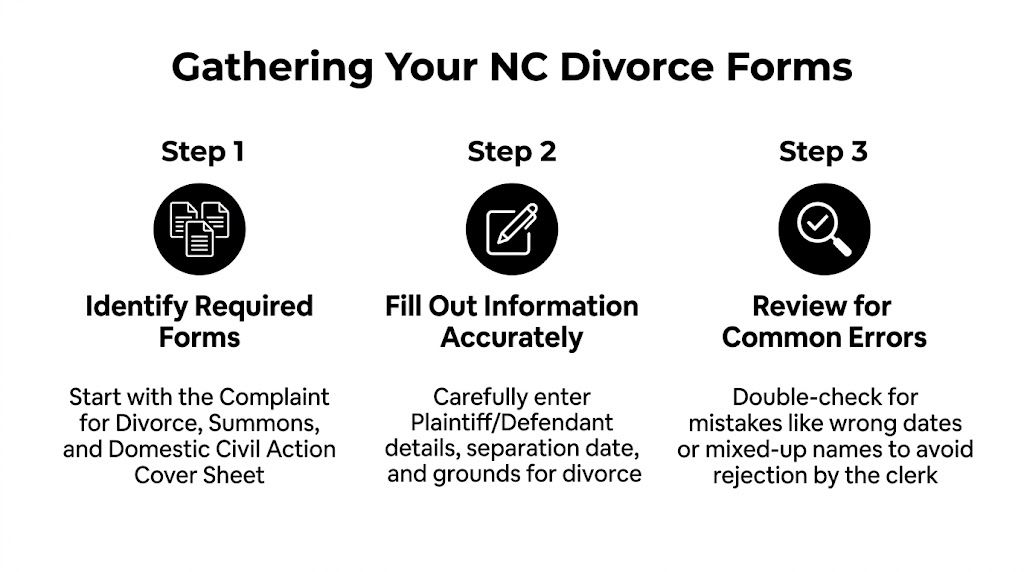
Following this three-part process—identifying the correct forms, filling them out with care, and reviewing them for common errors—is the best way to prevent your filing from being rejected.
What to Expect After You File for Divorce in NC
After the work of preparing, filing, and serving your divorce papers, you’ve entered a new phase. This is often a waiting period, and knowing the typical timelines and what happens next can provide much-needed peace of mind.
Once your spouse has been officially served, a legal clock starts ticking. They now have a specific window of time to respond to the court.
The 30-Day Response Window
Under North Carolina law, your spouse—the Defendant—has 30 days from the day they were served to file a formal response. This document, called an "Answer," is their chance to either admit or deny the facts you laid out in your Complaint.
In a simple, uncontested divorce, the Answer is usually straightforward. Your spouse will likely admit to the key facts, such as your date of separation. It's also common for them to request an additional 30-day extension to respond, giving them up to 60 days total. This is a standard and legally permitted delay.
What If They Don’t Respond? If the 30-day period (or any granted extension) passes without an Answer, you can still move forward. This is called proceeding by "default." It doesn't stop the divorce; in many ways, it simplifies things because the court can assume your spouse does not contest the facts you've presented.
The Path to a Final Judgment
Whether your spouse files an Answer or not, the process moves toward a final divorce decree. For a standard uncontested absolute divorce in North Carolina, the entire journey from filing to final judgment typically takes between 45 and 90 days.
Here’s a quick look at the final steps involved:
- File for Summary Judgment: Once the response window has closed, your attorney will usually file a "Motion for Summary Judgment." This asks the judge to grant the divorce without a full trial, based on the argument that there are no disputed facts.
- The Court Hearing: One of the biggest misconceptions is that you have to appear in court. For a simple, uncontested case, that’s often not true. In most situations, your attorney can attend the brief hearing on your behalf.
- The Final Divorce Judgment: The judge will review all the paperwork. If everything is in order, the judge will sign the Final Judgment of Divorce. This is the official document that legally ends your marriage.
It is absolutely critical to remember that this timeline is for a simple, absolute divorce only. If you and your spouse have unresolved issues like property division or alimony, those must be handled before the divorce is finalized. While filing the papers is a key step, you can learn more about the financial side by reviewing our guide on the complete cost of divorce in North Carolina.
The Single Biggest Mistake in a North Carolina Divorce
Filing for divorce on your own might seem like a straightforward way to save money and move forward quickly. It’s a powerful temptation, especially when you just want the process to be over. But what looks like a simple step can easily become the most expensive financial mistake of your life.
Here's a critical fact about North Carolina divorce law: a final divorce decree does only one thing. It legally ends your marriage. That's it. It does not automatically divide your house, your 401(k), or your debts. It doesn't award alimony.
In fact, finalizing your divorce can permanently wipe out your right to ever ask for them.
The Point of No Return: Equitable Distribution & Alimony
This isn't a scare tactic; it's a harsh legal reality under North Carolina law. The moment a judge signs your final divorce decree, any legal claim you have to equitable distribution (the division of marital property) and alimony vanishes forever.
You only have two ways to preserve these crucial financial rights:
- You must have a fully executed Separation Agreement and Property Settlement signed by both you and your spouse.
- You must have a formal lawsuit for Equitable Distribution and/or Alimony already filed and pending with the court before the judge grants the divorce.
If you finalize your divorce without one of these two things in place, there is no do-over. The door closes permanently on your right to claim your share of the marital assets.
How This Plays Out in Real Life
I’ve seen this devastating scenario play out far too many times. Imagine a spouse who has spent 20 years as a homemaker, supporting their partner's career. They’ve built a life together—a paid-off house, a healthy retirement account, and other investments, all of which are considered marital property.
Ready to move on, they download the divorce forms online, fill them out, and get a final divorce judgment, figuring they can "work out the house and retirement stuff later."
The second that ink is dry on the decree, they have unknowingly forfeited their legal right to their share of the marital home, retirement funds, and any spousal support. In an effort to handle a "simple" divorce, they may have walked away from hundreds of thousands of dollars they were legally entitled to.
This is without a doubt the single greatest danger of a DIY divorce in North Carolina. The process for getting the decree itself looks simple, but it hides a legal trap with devastating and irreversible consequences.
Protecting Your Financial Future Is an Investment
Hiring an experienced family law attorney isn't just another expense—it's an investment in your financial security. A knowledgeable lawyer ensures all your financial rights are protected before that final divorce decree is ever signed.
Here’s what a lawyer does to protect you:
- Drafts a Rock-Solid Separation Agreement: This legal contract details everything, from who keeps the house and how debts are paid to how retirement accounts are divided and whether spousal support is appropriate.
- Files the Right Claims at the Right Time: If you and your spouse can't agree, your attorney will file the necessary claims for equitable distribution and alimony to preserve your rights with the court.
- Navigates the Process Correctly: Your lawyer ensures every form is filed correctly and every deadline is met, preventing simple procedural errors that could jeopardize your entire future.
The cost of a consultation to understand your rights is a tiny fraction of what you stand to lose. You only get one chance to do your divorce right. Before you take any action, speaking with an experienced North Carolina divorce lawyer is the most important step you can take to protect yourself.
FAQ: Common Questions About North Carolina Divorce Papers
Can I file for divorce completely online in NC?
While you can download all the necessary forms from the official NC Courts website, North Carolina does not yet have a statewide system for filing your entire divorce online. An "eCourts" system for electronic filing is rolling out county by county, but if your county is not yet on the platform, you will still need to file original, physical paperwork in person with the Clerk of Court.
What if I can’t find my spouse to serve the papers?
This is a stressful but solvable problem. North Carolina law requires you to make a diligent, good-faith effort to locate and personally serve your spouse. If you’ve documented these attempts and still can’t find them, your attorney can ask the court for permission to use an alternative method called Service by Publication, which involves publishing a notice in a newspaper. This process is complex and has strict rules, so it is best handled by an experienced attorney to avoid having your case dismissed.
Do I need a Separation Agreement before filing for divorce?
Legally, no, you are not required to have a Separation Agreement just to file the Complaint for Absolute Divorce. However, as a practical matter, it is a catastrophic mistake to finalize your divorce without one. Under NC law, once the divorce decree is signed, you permanently lose your right to ask the court to divide marital property (equitable distribution) or award alimony. Resolving these financial matters before the divorce is final is essential to protecting your future.
Get the Clarity You Need to Move Forward
Navigating North Carolina divorce law is about more than just filling out forms—it's about understanding your rights and avoiding costly pitfalls that can affect you for years to come. At the Law Office of Bryan Fagan, we provide strategic, client-focused representation to help North Carolina residents protect their financial future.
If you are considering divorce, the most important step you can take is to understand your legal rights and options. Schedule a consultation with our experienced team to ensure your rights are protected every step of the way. Contact us today to get the guidance you need for this critical journey.