
TL;DR: In a typical divorce timeline north carolina case, an uncontested divorce usually takes about 13 to 14 months from separation to final decree, while a contested case with property or custody disputes often takes 18 to 36 months or longer. The one-year separation period is the main reason, but what you do during that year often determines whether the case moves efficiently or drags on.
When people first call about divorce, the question usually isn't just whether they can file. It's how long their life will feel stuck in limbo. They want to know when the house issue will be settled, when a parenting schedule will feel stable, and when they can stop waiting for the next legal step.
North Carolina makes that timeline especially important because our law builds delay into the process. That delay can be frustrating, but it also gives you time to prepare. Used well, the separation year can reduce conflict, shorten the post-filing phase, and protect your position on property, custody, and support.
Navigating Your North Carolina Divorce Journey
Divorce in North Carolina follows a structured path, but it doesn't always feel orderly when you're living through it. You may be dealing with a move, children asking hard questions, joint bills that still need to be paid, and a spouse who may or may not cooperate. A clear timeline helps because it turns a vague crisis into a sequence of legal and practical steps.
North Carolina residents are still navigating this process in large numbers. The state's divorce rate declined from 3.7 per 1,000 residents in 2011 to 2.7 in 2023, and the state still sees about 32,862 divorces annually, according to North Carolina divorce statistics summarized by Doyle Divorce Law. That means a lot of families are asking the same questions you're asking now.
Why the timeline matters so much
The timeline affects more than your calendar. It affects:
- Housing decisions: Should you rent now, stay temporarily with family, or wait before moving?
- Parenting routines: Children's schedules often need structure long before the divorce judgment is entered.
- Financial planning: Property division, support claims, and debt responsibility don't sort themselves out.
- Emotional strain: Uncertainty usually causes more stress than the paperwork itself.
A divorce case also has two tracks at once. One track is the legal requirement to qualify for divorce. The other is the work of resolving everything tied to the end of the marriage. Those tracks don't always move at the same speed.
The clients who feel most in control are rarely the ones with the simplest facts. They're usually the ones who start planning early.
A practical way to think about the process
Most North Carolina divorce matters fall into one of two categories.
| Path | What it usually means |
|---|---|
| Uncontested | The spouses agree on the major terms or are able to settle them without trial. |
| Contested | There is disagreement about property, custody, support, or even the basic facts needed to move the case forward. |
That distinction matters because the same one-year waiting rule applies to both, but everything after filing looks very different.
The Foundation of Every NC Divorce The One-Year Separation Rule
North Carolina doesn't let most spouses file for absolute divorce right away. Under N.C. Gen. Stat. § 50-6, spouses must live separate and apart for one continuous year before filing for absolute divorce. Under § 50-8, at least one spouse must also have lived in North Carolina for six months before filing.

This is one of the longest waiting periods in the country. In practical terms, an uncontested divorce in North Carolina usually takes 13 to 14 months from separation to final decree, while contested matters involving custody or property often last 2 to 3 years, as outlined in North Carolina divorce timeline guidance.
What separate and apart actually means
This rule creates confusion because many people think emotional separation counts. It doesn't. In North Carolina, spouses must maintain separate residences. Living in different bedrooms under the same roof is not enough.
At least one spouse must also intend the separation to be permanent when it begins. That intent matters. If the move-out is temporary, or if the facts suggest the couple was only taking a short break, the separation date can become a dispute later.
For readers who want a closer look at how this works, North Carolina's one-year separation rule deserves careful attention because small factual mistakes can create major delays.
What can reset the clock
The one-year period must be continuous. If the spouses reconcile, the clock can restart. The same problem can arise when one spouse later argues that the separation was never permanent in the first place.
A common example is this: one spouse rents an apartment, but the couple continues spending large amounts of time together in a way that blurs whether they were living apart. Another example is moving back in together even briefly to "see if things can work." That may have personal value, but it can also create legal uncertainty.
Practical rule: If you're counting toward the one-year requirement, treat the separation date as a fact you may need to prove later, not just a date you remember.
Why this waiting period changes strategy
This waiting period isn't just dead time. It often determines whether the post-filing phase is simple or expensive.
If you spend that year gathering records, identifying assets and debts, and working toward a written agreement, you may be able to file as soon as you're eligible and move efficiently. If you spend that year arguing informally, mixing finances, and leaving everything undocumented, the filing date may arrive with almost nothing ready.
Three practical consequences usually matter most:
- In-home separation won't qualify. That misconception causes avoidable delays.
- Reconciliation can undo progress. Even a brief reunion can complicate the timeline.
- Preparation during separation can shorten everything after filing. The law requires the wait, but it doesn't require disorganization.
The Uncontested Divorce Timeline The Smoothest Path Forward
An uncontested divorce is the closest thing to a simpler outcome in North Carolina. It doesn't mean the marriage ended without stress. It means the legal issues are either resolved or narrow enough that the court doesn't need to referee a long fight.
In North Carolina, over 90% of divorces settle before trial, often through negotiation or mediation. When the parties have a detailed separation agreement, the period from filing the complaint to the final decree can be under 60 days, according to guidance on uncontested divorce timing in North Carolina. That doesn't erase the one-year separation requirement. It means the part after filing can move quickly if the groundwork is done.
What makes a case truly uncontested
A case is only smooth when the major issues have already been addressed. That often includes:
- Property division: Who keeps the house, retirement accounts, vehicles, bank funds, and personal property.
- Debt allocation: Mortgages, credit cards, personal loans, and tax issues.
- Custody and parenting terms: Regular schedules, holidays, decision-making, and transportation.
- Support questions: Child support and, where relevant, spousal support.
If even one of those categories is unresolved, the label "uncontested" can fall apart quickly.
For people considering a lower-conflict path, uncontested divorce in North Carolina is often worth exploring early, especially during the separation year.
What the post-filing process usually looks like
After the one-year separation period is satisfied, the basic path usually looks like this:
- File the complaint for absolute divorce in the proper county.
- Serve the other spouse through an approved method.
- Wait for the response period. North Carolina procedure gives the defendant a 30-day response window.
- Set the matter for hearing if everything is in order and no dispute requires broader litigation.
- Obtain the judgment of absolute divorce.
When the paperwork is complete and the settlement terms are already in place, the court's role is much narrower. That's why some cases move from filing to decree in a short period.
Uncontested vs. Contested Divorce in North Carolina at a Glance
| Factor | Uncontested Divorce | Contested Divorce |
|---|---|---|
| Main feature | Agreement on major issues | Disagreement on one or more major issues |
| Post-filing pace | Often efficient if paperwork is complete | Slower due to discovery, motions, and hearings |
| Court involvement | Limited | Extensive |
| Stress points | Drafting a clear agreement and proper filing | Financial disclosure, custody disputes, valuation fights |
| Best strategy | Prepare the agreement during separation | Build evidence early and expect phased litigation |
What works and what doesn't
What works is specificity. A good agreement addresses real-world details. Who refinances the mortgage. How holidays rotate. When a retirement transfer will be completed. Who keeps which debt.
What doesn't work is a vague handshake deal. If the agreement says you'll "work out custody later" or "split assets fairly," you've preserved conflict, not prevented it.
A short case usually starts with a detailed agreement, not with optimism alone.
The Contested Divorce Timeline Navigating Delays and Disputes
A contested divorce takes longer because disagreement triggers procedure. Once spouses dispute custody, support, valuation, or disclosure, the case moves through formal stages. Each stage creates deadlines, cost, and opportunities for delay.
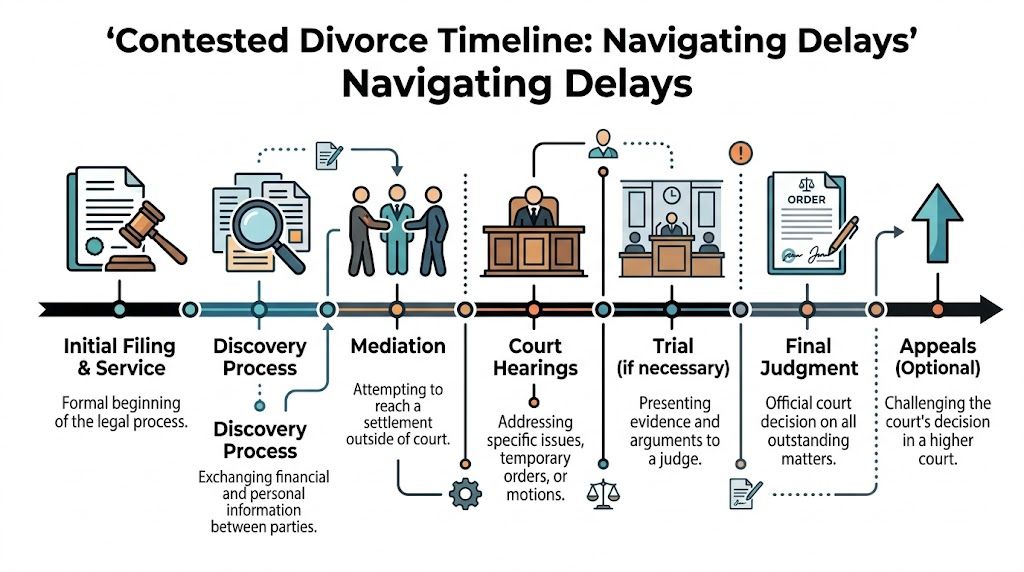
In contested North Carolina divorce cases, the discovery phase averages 2 to 6 months. If one side fails to disclose assets and the other has to pursue motions to compel, that can add 3 to 4 months. At the same time, mandatory mediation resolves 70% to 80% of cases before trial, according to North Carolina contested divorce timeline guidance.
Where contested cases gain time
The delay usually isn't caused by one giant event. It comes from stacked stages.
Pleadings and initial positions
After filing and service, each spouse states legal claims and defenses. These legal claims and defenses, such as property division claims, alimony claims, and custody requests, require careful framing. A rushed or incomplete pleading can create strategic problems later.
If there are urgent issues, one side may also ask for temporary orders involving possession of property, support, or parenting arrangements. Those requests can stabilize the situation, but they add hearings and preparation.
Discovery and financial investigation
Discovery is the part many clients underestimate. It is the formal exchange of information through tools like interrogatories, document requests, subpoenas, and depositions.
This phase often expands when the marital estate is complicated. Common problem areas include:
- Business ownership: A closely held business may need valuation work and a review of income records.
- Retirement and investment accounts: Statements have to be gathered and traced.
- Cash flow disputes: One spouse may claim far less income than the records suggest.
- Missing assets: Suspicion of hidden funds can push the case into motion practice.
If one spouse is slow to produce records, the court may need to intervene. That creates another round of briefing, scheduling, and waiting.
Why custody disputes change everything
Property fights can be document-heavy. Custody disputes are different. They involve calendars, school routines, communication records, witness credibility, and the court's evaluation of the child's best interests.
A custody dispute can slow a case because parents often need structure immediately, while the final outcome takes longer to develop. Temporary arrangements may be entered first. Mediation may follow. If settlement fails, the court may hear evidence much later.
A common real-world pattern looks like this: the parents agree that the children need stability, but they disagree over school-week overnights, holiday allocation, or decision-making authority. That sounds narrow, yet those details can keep a case active for months because they affect daily life.
Some of the longest cases are not driven by unusual wealth. They're driven by ordinary parenting disagreements that no one narrowed early.
Mediation and the pressure point before trial
North Carolina courts often require mediation in custody and property disputes. Many cases settle here because discovery has finally clarified the strengths and weaknesses of each side.
Mediation works best when the parties arrive with documents, realistic expectations, and decision-makers ready to compromise. It works poorly when a spouse treats mediation as a place to vent rather than negotiate.
Three approaches usually help:
- Bring organized financial records. A mediator can't bridge numbers no one has pinned down.
- Separate legal goals from emotional grievances. The court addresses legal claims, not every hurt.
- Know your fallback position. A spouse who can't define acceptable terms usually leaves without progress.
Trial and final resolution
If mediation fails, the case may move to trial. Trial preparation is substantial. Witnesses have to be prepared, exhibits organized, and legal issues narrowed enough for the judge to decide.
Trials also create uncertainty. A judge may divide property equitably, not necessarily equally. A judge may select a custody schedule neither party proposed in full. Once the court rules, there may still be follow-up work to implement transfers, draft orders, or enforce compliance.
Below is a simple view of where delay tends to accumulate.
| Stage | Typical source of delay |
|---|---|
| Service and response | Trouble serving papers, incomplete filings, slow communication |
| Discovery | Missing documents, business records, hidden-asset suspicions |
| Temporary hearings | Scheduling and preparation for urgent support or custody issues |
| Mediation | Negotiating around unresolved facts or unrealistic demands |
| Trial setting | Court calendar congestion and issue complexity |
In practice, contested cases often move faster when one spouse stops trying to "win everything" and starts identifying which issues matter.
How to Proactively Shorten Your Divorce Timeline
The one-year separation rule frustrates people because it feels passive. It doesn't have to be. The spouses who use that year well usually enter the filing stage with a strong position, clarity, and fewer surprises.

One of the most common mistakes is failing to document the start of separation. North Carolina courts may expect clear proof such as lease agreements or utility bills in separate names. If the separation date becomes disputed, the filing can be challenged and the 12-month clock can reset, as discussed in guidance on documenting separation in North Carolina divorce cases.
Start by proving the separation date
People often remember the date they consider "the breakup," but the court needs more than memory if the other side disagrees.
Useful records often include:
- Housing documents: Lease agreements, closing documents, or landlord correspondence.
- Utility records: New service in one spouse's name at a separate address.
- Written communications: Emails or texts confirming the separation and move.
- Third-party support: People who can verify when the separate living arrangement began.
If your case may involve pushback, treat this like evidence preservation. Save documents now. Don't assume you'll find them easily later.
Build the file before you need it
The fastest way to slow a divorce is to begin document gathering after litigation starts. During separation, collect the records that would matter if your spouse disputed finances tomorrow.
A practical file often includes:
- Income records: Pay stubs, tax returns, bonus information, and self-employment records.
- Asset records: Bank statements, retirement statements, mortgage records, vehicle information, and business documents if relevant.
- Debt records: Credit card balances, personal loans, tax obligations, and other liabilities.
- Parenting records: School information, childcare schedules, medical details, and calendars showing who handles what.
This is also the stage when many families benefit from a settlement-focused process. In the right case, working with a collaborative divorce attorney can reduce unnecessary positional conflict and help spouses solve problems before a lawsuit hardens them.
Case management insight: The earlier you organize records and define your goals, the fewer expensive surprises appear after filing.
Use the separation year to make decisions, not just endure it
Many people spend the separation year in a loop of partial conversations. They talk about the house one week, parenting the next, and support a month later. Nothing gets finalized because everything stays verbal.
A better approach is to work through decisions in writing. For example:
- List every major asset and debt.
- Mark what is agreed, disputed, or unknown.
- Create a proposed parenting structure if children are involved.
- Identify whether support is likely to be an issue.
- Bring the unresolved points to counsel or mediation before filing eligibility arrives.
If you'd like a quick visual overview of how to think through preparation, this video is a helpful starting point:
What shortens the timeline and what usually extends it
| Helps move the case | Usually slows the case |
|---|---|
| Documented separation date | Arguments about when separation began |
| Organized financial records | Scrambling for missing statements |
| Specific written proposals | Informal verbal understandings |
| Early legal advice | Waiting until after a problem escalates |
| Focused negotiation | Reopening settled issues repeatedly |
The mandatory wait is fixed. Your preparation during that wait is not.
Life After Divorce Timelines for Modification and Enforcement
The final divorce judgment ends the marriage, but it doesn't end every legal issue. Child custody, child support, alimony, and compliance with court orders can continue to matter long after the divorce itself is final.
Modification after divorce
When life changes substantially, an existing order may need to change too. That often comes up when a parent relocates, a child's needs shift, income changes, or a parenting arrangement that once worked no longer does.
In practical terms, modification cases usually involve these steps:
- Review the current order carefully: The exact language matters.
- Identify the change in circumstances: General frustration isn't enough.
- File the appropriate motion or claim: The court needs a legally recognized basis to act.
- Prepare updated evidence: Financial documents, school records, calendars, and communications often matter.
These cases rarely move overnight. They take time for filing, service, scheduling, and court review. If the other side contests the request, the process may involve negotiation, mediation, or a hearing.
Enforcement when someone doesn't comply
Enforcement becomes necessary when one party ignores an existing order. Common examples include unpaid support, refusal to transfer property, interference with custody terms, or failure to follow a court-approved agreement.
The practical mistake many people make is waiting too long while the noncompliance gets worse. If your former spouse isn't following the order, preserve the evidence. Save payment records, missed exchange details, communications, and any written notices you sent.
Court orders only help when they're clear enough to enforce and documented well enough to prove a violation.
A strategic view of post-divorce issues
Post-judgment disputes often move more efficiently when the original divorce paperwork was detailed. Clear deadlines, precise transfer terms, and workable parenting language reduce future fights. Vague terms create future litigation.
That is why timeline planning at the divorce stage matters even after the judgment is entered. A rushed agreement can save time today and cost much more time later.
North Carolina Divorce Timeline FAQ
How long does an uncontested divorce take in North Carolina
The total timeline is typically driven by the required one-year separation. Once that period is complete and the case is properly prepared, the post-filing portion can move relatively quickly. The smoothest cases are the ones where the parties already resolved property, parenting, and support issues before filing.
Can we live in the same house and still meet the separation requirement
No. North Carolina requires spouses to live separate and apart, which means separate residences. Separate bedrooms in the same home won't satisfy the requirement for absolute divorce.
What if my spouse won't agree on the separation date
That issue can become very important. If the date is disputed, the court may look for objective proof such as housing records, utility records, written communications, and witnesses who can verify when separate residences began. That is why early documentation matters so much.
Does filing for divorce also divide property automatically
No. Ending the marriage and resolving property rights are related, but they are not the same thing. Equitable distribution, custody, support, and alimony issues need to be addressed properly and on time. A divorce judgment can end the marriage while leaving other disputes active if they haven't already been settled or preserved.
What usually makes a North Carolina divorce take longer
A case usually stretches out when spouses disagree about custody, support, or finances, when records are incomplete, or when one side fails to disclose information. Delay also builds when people rely on verbal understandings instead of written terms, or when they wait too long to get legal advice.
Take Control of Your Future and Your Timeline
North Carolina's divorce process has fixed legal requirements, but your experience of that timeline is not fixed. Good preparation can keep an uncontested case efficient. Early strategy can narrow a contested one. Either way, the separation year should be treated as working time, not empty time.
If you're dealing with questions about separation, custody, support, or property division, legal advice early in the process can prevent mistakes that are hard to undo later. A realistic plan usually saves more stress than rushed filing ever does.
North Carolina residents facing divorce deserve clear guidance, careful planning, and honest expectations. The right approach won't guarantee a perfect outcome, but it can help you move forward with more control and less uncertainty.
If you're ready to talk through your divorce timeline north carolina concerns, schedule a consultation with the Law Office of Bryan Fagan. The firm helps North Carolina residents evaluate separation dates, filing strategy, custody and support issues, and property division so they can move forward with a practical plan suited to their specific circumstances.