
You may be at the point where one of you has moved out, or you’re trying to figure out whether you need to move out first. Maybe the marriage has been breaking down for months, but the legal side still feels murky. Clients often come in thinking separation is one form, one court filing, or one conversation. In North Carolina, it’s not that simple, and it’s also not as mysterious as people fear.
A common situation looks like this: one spouse sleeps in the guest room, they stop acting like a married couple, they split some bills, and they tell friends they’re separated. Then they learn that none of that may start the divorce clock. That misunderstanding can cost time, money, and bargaining power.
The practical reality is that separation requirements in NC turn on facts, dates, and proof. The most important of those facts is the date of separation. That date often becomes the anchor point for divorce timing, property issues, support claims, and strategic decisions that follow. If you get that part wrong, later steps become harder.
Navigating the First Steps of Separation in North Carolina
When people first start looking into separation, they’re usually balancing legal questions with immediate life problems. Who stays in the house? How do the bills get paid? What happens with the children this week, not six months from now? Those concerns are real, and they affect the legal strategy from the beginning.
North Carolina handles separation differently than many people expect. There is no formal court-filed legal separation status you obtain just by filing paperwork. Separation is a factual condition. In plain English, that means your circumstances matter more than a label.
A spouse can begin a separation by moving out with the intent that the separation be permanent. That creates both opportunity and risk. It gives a person a path forward without waiting for the other spouse’s permission, but it also means the details of how the move happens matter.
For readers trying to sort out the mechanics, this overview of how to file for separation in NC can help frame the first decisions.
Separation in North Carolina often starts before any case is filed. That’s why early decisions matter so much.
The issue many basic explainers miss is that the separation date does more than mark the beginning of time apart. It often becomes the timeline reference point for later property analysis, support planning, and the eventual divorce filing. If you’re entering this process, you need more than a definition. You need a plan for how your facts will look on paper if they’re challenged later.
The Two Pillars of NC Separation Law Intent and Physical Separation
North Carolina law requires two things at the same time. You must live apart, and at least one spouse must mean for the separation to be permanent. If one of those pieces is missing, the separation may not count.
Under North Carolina separation requirements discussed here, N.C. Gen. Stat. § 50-7 requires two concurrent elements: physical residence in separate dwellings with no shared premises and intent by at least one spouse that the separation be permanent.

Physical separation means different residences
This is the part that trips people up most often. Living in separate bedrooms in the same home doesn’t satisfy the rule. It usually doesn’t matter if you’ve stopped sharing meals, stopped wearing rings, or told family the marriage is over. If you’re still under the same roof, the separation requirement usually hasn’t started.
Think of it this way. North Carolina isn’t measuring emotional distance. It’s measuring whether the spouses are living as separate households.
That’s why “we’re still in the same house, but we live separate lives” is usually not enough. Courts look for separate dwellings, not informal arrangements inside one dwelling.
Intent has to be real and provable
Intent sounds abstract, but it has practical signs. If one spouse moved out because of a short cooling-off period, a temporary job assignment, or a trial pause with no decision to end the marriage, that can create problems. The law looks for intent that the separation be permanent.
You do not need both spouses to agree. One spouse’s intent can be enough. That matters in difficult marriages where one person is ready to move forward and the other refuses to cooperate.
For a plain-English explanation of that broader concept, see what legal separation means in NC.
Practical rule: If you’re still sharing one home, you should assume the clock has not started.
A real-world example
Assume a husband moves into an apartment in Raleigh after months of conflict. He changes his mailing address, takes personal belongings, and tells his spouse the marriage is over. The wife disagrees and wants reconciliation. Even so, the intent element can still be met because North Carolina only requires permanent intent from one spouse.
Now change one fact. Instead of moving out, he stays in the finished basement, uses a separate bathroom, and they divide groceries. That may feel like a separation, but it usually won’t qualify under North Carolina law.
The difference is not emotional. It’s factual. Separate home, separate residence, permanent intent.
Understanding the Critical Timelines for NC Divorce
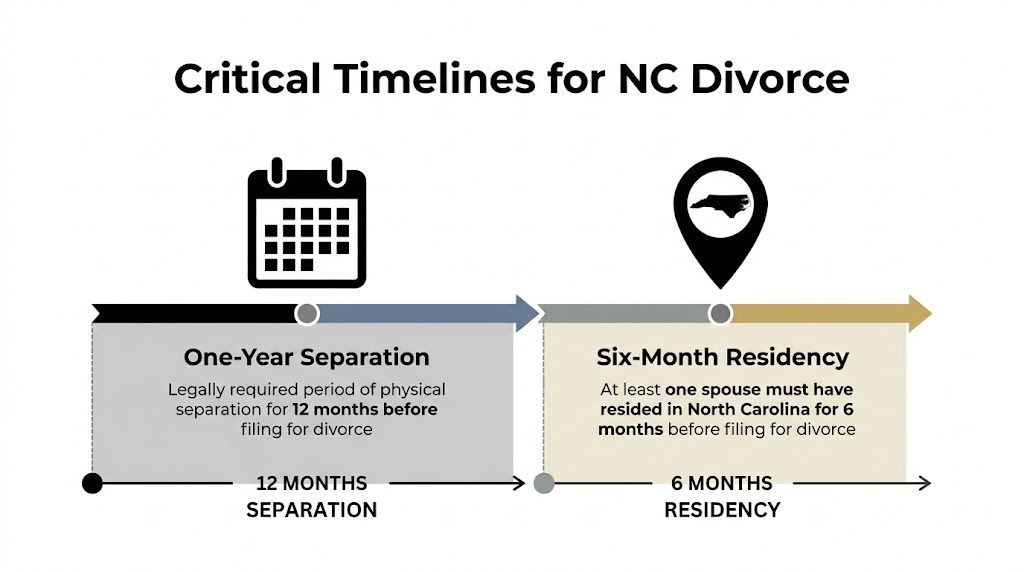
The legal timeline in North Carolina runs on two separate clocks. One clock tracks the separation period. The other tracks residency. Both must be satisfied before a party files for absolute divorce.
Under North Carolina divorce separation rules summarized here, N.C. Gen. Stat. § 50-6 requires a one-year physical separation period before filing for absolute divorce, and at least one spouse must have lived continuously in North Carolina for six months before the divorce complaint is filed.
The one-year clock
The separation period must be continuous. The issue is not merely whether enough time passes on a calendar. The issue is whether the spouses remain separated in a way the law recognizes for that full period.
That means clients should be careful about conduct that blurs the separation. If the facts later suggest the marital relationship resumed, the timeline may be disputed. Even a strong case can become more expensive when the date itself is in question.
If you want a focused explanation of that timeline, this guide to the one-year separation rule in NC is useful.
The six-month residency clock
Residency is different. This is the court’s authority to hear the divorce. At least one spouse must have resided continuously in North Carolina for six months before the filing date.
That creates strategic issues for couples who relocate. A person may be clearly separated but still need to wait for North Carolina residency to mature before filing here.
How the two clocks interact
Consider this example. A couple separates while living outside North Carolina. Months later, one spouse moves to North Carolina and plans to file here. Even if the separation period is already underway, that spouse still must satisfy the state’s residency requirement before filing in North Carolina.
Or take the reverse. A couple has been physically apart for a long time, but the spouse planning to file has not yet completed the required North Carolina residency period. The divorce complaint may still be premature.
A clean timeline on paper saves legal fees later. Courts don’t reward rough estimates on separation dates or residency periods.
Why timing affects more than filing
The divorce filing date is only one issue. The broader strategic point is that your separation date often shapes later arguments about finances and rights. North Carolina treats the date of separation as an important cutoff in equitable distribution analysis for classifying marital and separate property, as discussed in the earlier source on separation requirements.
That’s why timing errors are rarely isolated. If the date is fuzzy, other disputes become easier for the other side to raise.
The Role of a North Carolina Separation Agreement
A separation itself is a factual status. A separation agreement is different. It is a contract between spouses that can settle major issues while you are living apart. In many cases, practical protection is built within it.

Under North Carolina law on binding separation agreements, these agreements must be in writing, signed by both spouses, and notarized to be enforceable. The same source explains that property division terms are typically final and non-modifiable, while child custody and support terms can be modified upon a substantial change in circumstances.
What a good agreement actually does
A strong agreement addresses the problems clients are dealing with in real time. That often includes:
- Property division. Who keeps the house, whether it will be sold, how accounts are handled, and how debts are assigned.
- Support terms. Whether one spouse will pay post-separation support or alimony, and under what conditions payments end.
- Parenting structure. Where the children stay, how exchanges work, holiday schedules, and decision-making rules.
- Household operations. Insurance, car payments, taxes, and responsibility for ongoing expenses.
Without a written agreement, many couples operate on assumptions. Those assumptions often fall apart once conflict increases, a new relationship begins, or one spouse realizes an informal promise won’t be enforced.
Why the date of separation matters inside the agreement
This is where strategy matters. A separation agreement doesn’t just solve present logistics. It often locks in rights and expectations that trace back to the date of separation.
For example, if spouses disagree about whether a bank account was still marital property on a certain date, the date of separation becomes more than a background fact. It becomes the pivot point for the dispute. A carefully drafted agreement can reduce that uncertainty by clearly identifying the separation date and tying key obligations to it.
That’s one reason boilerplate forms often disappoint people. They may look complete, but they usually don’t reflect the actual pressure points in a North Carolina case.
What works and what doesn’t
What usually works is a document drafted after full financial disclosure, specific to the family’s actual assets, debts, and parenting issues. What often doesn’t work is downloading a generic form, changing a few names, and assuming it covers North Carolina law.
A common example is a couple who agrees verbally that one spouse will keep the retirement account while the other keeps more cash. Months later, one spouse changes position. If the terms were never properly documented, the disagreement can become expensive.
Another example involves custody language. Parents may write something broad like “we’ll split time fairly.” That sounds peaceful, but it often creates conflict because it avoids details on school weeks, transportation, vacations, and decision-making.
For people weighing whether to handle the drafting themselves or involve counsel, the choice often comes down to complexity and risk. The Law Office of Bryan Fagan offers North Carolina family law services that include strategy around separation, support, custody, and property issues, which is the kind of coordinated legal work many clients need once they realize these issues overlap.
Here is a short video that touches on separation-related planning:
When to get the agreement done
Clients often ask whether they should “wait and see” before putting terms in writing. In many cases, delay creates risk. Memories change, finances move, and goodwill doesn’t always last.
The best time to clarify financial and parenting expectations is when both spouses still have enough stability to negotiate carefully.
That doesn’t mean every case needs immediate settlement. It does mean you should evaluate early whether a written agreement will protect you better than an informal arrangement.
How to Document and Prove Your Date of Separation
The date of separation isn’t just a line on a form. It’s a fact you may have to prove. If the other spouse disputes it, a judge will want evidence, not just your memory of when things changed.
The strongest proof usually comes from ordinary records created at the time of the move, not records assembled later for litigation. That’s why documentation should start immediately.
What to gather right away
The goal is to show two things clearly: separate residences and a definite change in living arrangements. Useful records often include:
- Housing records. A lease, rental agreement, mortgage paperwork, or another document showing a new residence.
- Utility records. Bills in your name at the new address.
- Mail and identification updates. Change-of-address confirmation, updated driver’s license, tax documents, or employer records.
- Financial records. Bank or credit card statements showing transactions tied to the separate address or separate living expenses.
- Communication records. Messages or emails confirming one spouse moved out and that the separation was intended to be permanent.
Why contemporaneous proof matters
A client may remember that the separation started “around the middle of March.” That isn’t ideal if the other side claims it happened later. A lease start date, utility activation, or written communication from that week gives the court something concrete to evaluate.
In practice, the best evidence is usually boring evidence. It’s routine, dated, and hard to explain away.
A practical checklist for clients
Use this checklist as soon as the separation begins:
| Document type | Why it helps |
|---|---|
| Lease or housing agreement | Shows when separate residence began |
| Utility bill at new address | Confirms actual occupancy |
| Mailing address update | Supports a change in household |
| Bank statement | Shows separate financial activity |
| Written communication | Helps establish permanent intent |
If you have to prove separation later, documents created in real time will usually carry more weight than a reconstructed timeline.
One strategic point people miss
Documentation is not only about divorce filing. It also protects your credibility when finances, possession of the home, or parenting claims become contested. If your position on the date is clear and supported, your attorney has a firmer foundation for every later argument tied to that timeline.
Common Pitfalls That Can Derail Your Separation
Most separation problems don’t come from dramatic courtroom moments. They come from casual decisions that seemed harmless at the time. People try to keep things friendly, keep costs down, or avoid conflict. Then those choices create legal uncertainty.

Mistakes involving the living arrangement
The first major mistake is assuming partial separation counts. It usually doesn’t. If you are still sharing one residence, even with separate rooms and separate routines, you may not have started a valid separation period.
Another problem is becoming too casual after the move-out. If spouses begin spending nights together regularly or otherwise blur the line between separate households and a resumed relationship, that can create a factual dispute over whether the separation remained continuous.
Mistakes involving agreements and disclosure
The next category is avoidable contract trouble. These are common examples:
- Relying on verbal promises. A spouse says, “I’ll cover the mortgage,” or “You can keep that account.” If it isn’t put into a valid written agreement, those promises may be difficult or impossible to enforce.
- Signing before full financial disclosure. If one spouse doesn’t fully understand the assets, debts, or income picture, a supposedly final property deal can become vulnerable.
- Using generic online templates. Forms that aren’t built for North Carolina family law often leave out required formalities or fail to address issues that later become central.
Mistakes involving timing and behavior
People also underestimate how quickly small facts become exhibits. A changed address that wasn’t updated. Shared utility accounts that stayed in place. Social media posts suggesting reconciliation. None of these facts decides a case by itself, but together they can weaken a clean separation narrative.
A practical example: spouses separate, one rents an apartment, but they keep rotating in and out of the marital home informally and never define who lives where. If litigation follows, that messy pattern can invite a challenge to the claimed separation date.
Friendly arrangements aren’t the same as legally clear arrangements.
What works better
What usually works is consistency. Separate residences. Consistent records. Clear written terms. Thoughtful communication. Full disclosure before signing any final property terms.
What doesn’t work is treating separation as informal until a court date appears. By then, the facts are already fixed, and some mistakes can’t be undone cleanly.
Frequently Asked Questions About NC Separation
Many clients have one specific question that keeps them stuck. The answers below address some of the most common concerns tied to separation requirements in NC.
Quick answers to common questions
| Question | Answer |
|---|---|
| Can we be separated while living in the same house in North Carolina? | Usually no. North Carolina requires spouses to live in separate dwellings, not simply separate bedrooms or parts of the same residence. |
| Do I have to file something with the court to become legally separated? | No. North Carolina treats separation as a factual status, not a court-created status. The facts of where you live and whether the separation is intended to be permanent matter more than filing a separation case. |
| Does my spouse have to agree to the separation? | No. One spouse can create a valid separation by moving out and intending the separation to be permanent. Mutual agreement can help with logistics, but it isn’t required to begin separation. |
| Can we make our own separation agreement? | You can try, but it must meet North Carolina requirements to be enforceable. A valid agreement generally needs to be in writing, signed by both spouses, and notarized. Property terms are often treated as final, so mistakes can be costly. |
| Why is the date of separation such a big deal? | Because it often becomes the timeline reference point for later legal issues, especially property questions and the eventual divorce filing. If the date is disputed, the rest of the case can become more difficult. |
A few practical clarifications
Clients also ask whether moving out for a short period “counts” if they later decide to work on the marriage. The answer depends heavily on the facts. If the separation was not continuous or the relationship resumed in a way that undercuts permanent separation, the timeline can become disputed.
Another common question is whether a separation agreement settles everything forever. Not always. In North Carolina, property terms in a valid agreement are typically treated as final, while child-related terms may still be changed if circumstances materially shift. That distinction matters when parents assume every provision is equally fixed.
The concern behind most FAQ questions
Most of these questions are really about control. People want to know whether they can protect themselves without starting an immediate court fight. Often, the answer is yes, but only if they handle the basics correctly: the living arrangement, the documentation, and the written terms.
Clients usually don’t need more legal jargon. They need a workable timeline and clean proof.
If your facts don’t fit the standard pattern, that’s exactly when individualized legal advice becomes most valuable. Separation law sounds simple from a distance. In real cases, small factual differences matter.
Take Control of Your Future Schedule a Consultation Today
North Carolina separation law is strict where it matters most. The state cares about actual living arrangements, real intent, and clear timelines. If you miss those details early, the problems don’t stay small. They spread into property disputes, support issues, parenting conflicts, and delays in filing for divorce.
The key point is straightforward. Your date of separation is not just a date. It is often the central timeline marker for everything that follows. If that date is unclear, unsupported, or legally flawed, you may spend far more time and money fixing the problem later.
A strong approach usually includes three things. First, establish a living arrangement that satisfies North Carolina law. Second, document the separation carefully with records created at the time. Third, decide whether a written separation agreement should address property, support, and custody before conflict grows.
No article can tell you exactly how your facts will be viewed in court. A spouse may contest the date. Financial records may reveal issues you have not considered. Parenting schedules that look workable now may fail once school, travel, or new partners complicate the situation. That is why legal guidance is often most valuable at the beginning, not after the case becomes reactive.
If you’re considering separation, already living apart, or unsure whether your current arrangement qualifies under North Carolina law, schedule a confidential consultation. A focused legal review can help you identify the correct separation date, avoid common mistakes, and decide what actions will best protect your rights, your finances, and your relationship with your children.
If you need guidance on separation requirements in NC, property issues tied to the date of separation, or a North Carolina separation agreement, contact the Law Office of Bryan Fagan to schedule a consultation and discuss a strategy specific to your situation.