Twelve months ago, you may have moved out of the marital home, signed a lease, opened a new bank account, and started answering hard questions from children, family, or friends. Now the calendar says the one-year mark is here, and you want to finish the process. That’s usually when a new kind of stress begins.
Many North Carolinians reach this point and assume an absolute divorce is just paperwork. Sometimes it is straightforward. Sometimes a single mistake changes everything. A missed filing can cost you property rights. A poorly timed reconciliation can force you to start the separation period over.
Divorce remains common in this state, even as overall rates have declined. North Carolina’s divorce rate fell from 5.1 per 1,000 residents in 1990 to 3.2 in 2021 and an estimated 2.7 in 2025, while remaining slightly above the national average according to this North Carolina divorce rate overview. Behind those numbers are real people trying to close one chapter without creating a new legal problem.
If you're searching for answers about absolute divorce north carolina, start with this principle: ending the marriage is one legal step, but protecting your money, home, retirement, and support rights is a different task. Both matter.
Your North Carolina Divorce Journey Begins Now
A common situation looks like this. A spouse in Raleigh, Charlotte, or a smaller county has lived apart from their husband or wife for over a year. They’ve told friends, “We’ve been separated forever, so I guess I can file now.” That part is often true. What they usually don’t know is what the court requires, what forms begin the case, and what rights can disappear if they rush to get the judgment signed.
This stage often brings two emotions at once. Relief because the waiting period is nearly over. Anxiety because legal terms start showing up fast, and the court process feels impersonal at a time when life already feels unsettled.
An absolute divorce is the court order that legally ends the marriage. It sounds simple. In practice, it works best when you treat it like a checklist with deadlines, not just a form.
Two issues trip people up more than almost anything else in North Carolina. One is the separation requirement itself, especially when a couple has brief reconciliation attempts. The other is the rule that claims for property division and alimony can be lost forever if they are not properly preserved before the divorce becomes final.
The safest approach is to think of divorce in North Carolina as two tracks at once. One track ends the marriage. The other protects everything that still needs to be decided.
What Is an Absolute Divorce in North Carolina
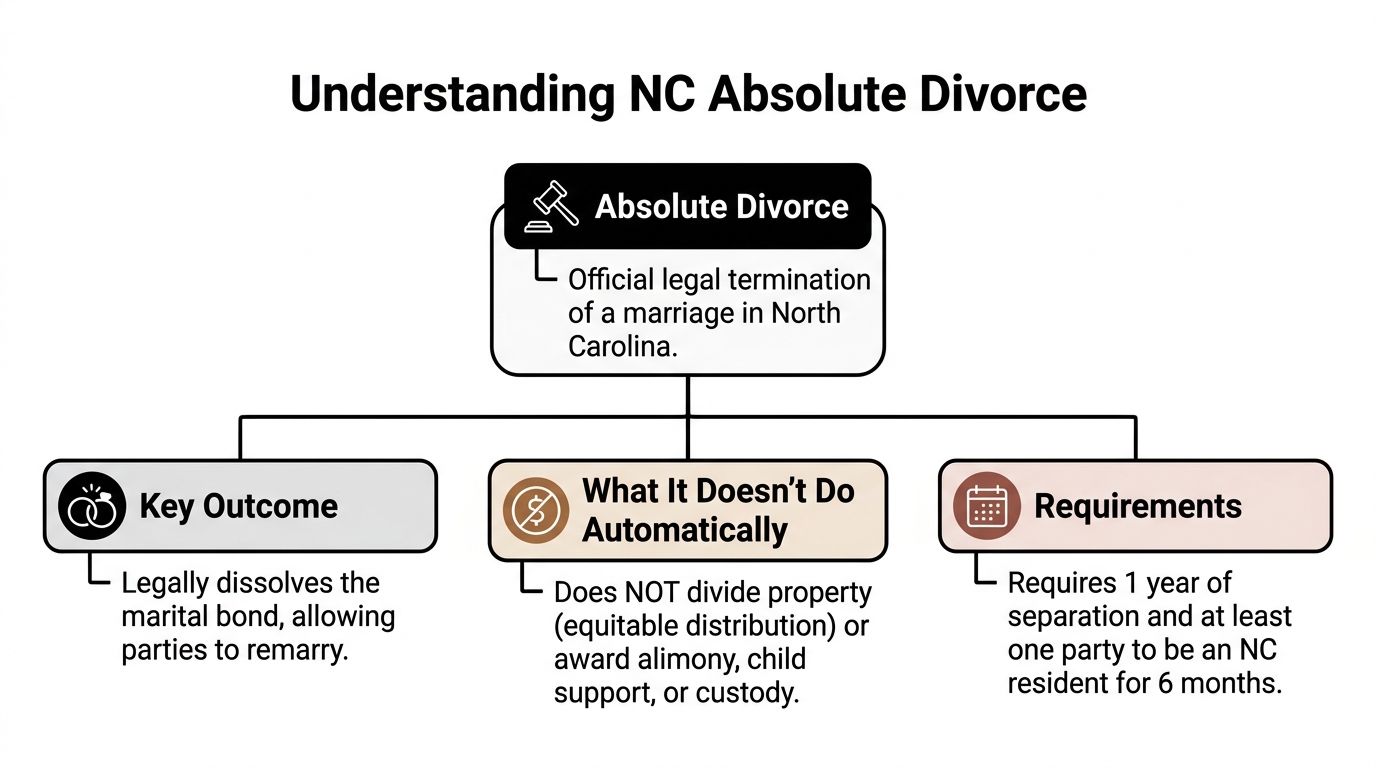
In North Carolina, absolute divorce means the court has legally dissolved the marriage. Once the judge signs the judgment, your marital status ends immediately.
That’s different from being separated. North Carolina does not require a formal “legal separation” filing just to begin living apart. It’s also different from divorce from bed and board, which is a fault-based court action that does not end the marriage.
The two basic requirements
North Carolina law sets out two threshold requirements for an absolute divorce under Chapter 50. According to the North Carolina Judicial Branch explanation of separation and divorce, spouses must complete a one-year-and-a-day separation period before filing for absolute divorce, must live in separate residences, and at least one spouse must intend the separation to be permanent. One spouse also must have lived in North Carolina for at least six months before filing.
Those requirements sound short on paper, but each word matters.
- Separate residences means separate homes. Living in different bedrooms under one roof usually won’t satisfy the statute.
- One uninterrupted year means the separation period has to run continuously.
- Intent matters because at least one spouse must view the separation as permanent, not temporary.
- Residency matters because the court needs authority to hear the divorce case.
What absolute divorce does and does not do
Many people get confused at this point.
An absolute divorce does end the marriage. It allows the parties to remarry. It changes legal status from married to divorced.
An absolute divorce does not automatically divide property, assign debts, award alimony, decide custody, or set child support. Those issues may be related to the divorce, but they are not automatically handled by the divorce judgment itself.
A practical example helps. Suppose a couple owns a house, retirement accounts, vehicles, and credit card debt. The judge can sign an absolute divorce judgment that ends the marriage without deciding who keeps the house, how retirement gets divided, or whether either spouse will pay support. Those are separate legal issues unless they have already been resolved by agreement or properly filed claims.
No-fault means misconduct is not required
Most North Carolina absolute divorces proceed on a no-fault basis. That means you don’t have to prove adultery, abandonment, or other marital misconduct just to obtain the divorce itself. The law focuses on the completed separation period and residency requirement.
Practical rule: If you're asking, “Can I get divorced without proving my spouse did something wrong?” the answer is usually yes for absolute divorce. The legal question is usually whether you meet the statutory requirements.
Why the terminology matters
Clients often say, “We’ve been legally separated for a year.” Usually what they mean is that they have been living apart. In North Carolina, that distinction matters because the court cares about the facts of separation, not just the label people use in everyday conversation.
If you use the term absolute divorce north carolina, think of it this way:
| Term | What it means in North Carolina |
|---|---|
| Separation | Living apart in separate homes with at least one spouse intending it to be permanent |
| Absolute divorce | Final court order ending the marriage |
| Divorce from bed and board | Court-ordered separation based on fault, not a final dissolution of marriage |
That basic framework helps everything else make more sense.
The Step-by-Step Filing Process for NC Absolute Divorce
A common self-filed divorce starts like this: a spouse waits a year, downloads forms, files the case, and assumes the hardest part is over. Then one of two problems appears. Either the separation date was reset by a reconciliation that seemed minor at the time, or the divorce is granted before property division or alimony claims were properly preserved. Those mistakes can be expensive, and one of them cannot be undone after the divorce judgment is entered.
The court process itself is usually straightforward. The danger is that it looks simpler than it is. If you want a broader overview of the paperwork and timeline, this guide on how to file for divorce in North Carolina can help alongside the step-by-step explanation below.

Step one is confirming that you are actually eligible to file
Before any form is signed, confirm the two foundation facts. At least one spouse must meet North Carolina's residency requirement, and the spouses must have lived separate and apart for at least one continuous year.
That word continuous matters.
Separation in North Carolina works a bit like a stopwatch. Once spouses begin living apart with the intent that the separation be permanent, the clock starts. If they resume the marital relationship, even for a period that feels informal or uncertain, the clock may reset. Self-represented filers often focus on the first move-out date and overlook a later reconciliation. If the date in the complaint is wrong, the case can be delayed, challenged, or denied.
Step two is preparing the filing packet carefully
For many absolute divorce cases, the initial packet includes a Complaint for Absolute Divorce, a Summons, and military status paperwork required by the Servicemembers Civil Relief Act.
The complaint tells the judge why the court has authority to grant the divorce. It usually includes:
- Basic marriage information
- An allegation that one spouse meets the residency requirement
- The date of separation and a statement that the separation has been continuous for at least one year
- A request for an absolute divorce
This is also the moment to pause and ask a harder question. Have equitable distribution, postseparation support, or alimony claims already been resolved by agreement, or formally asserted in time? Filing for divorce without answering that question is like closing the final file in a case before checking whether money claims are still inside. The divorce can end the marriage while also cutting off rights you expected to deal with later.
Step three is filing in the proper county
The documents are filed with the Clerk of Superior Court in the correct county, usually in District Court. Filing opens the lawsuit. It does not end the marriage, and it does not protect every related claim automatically.
Clerks can often explain filing mechanics, such as where to submit paperwork and what fees apply. They cannot tell you whether your separation date is legally safe, whether a reconciliation restarted the one-year period, or whether a property or alimony claim must be filed before the divorce becomes final.
Step four is serving your spouse the right way
After filing, the defendant must be served according to the Rules of Civil Procedure. Service is the formal notice required for the court to act.
North Carolina permits service by approved methods such as sheriff service, certified mail, or other authorized means under the rules. Informal notice does not replace service. A text message, email, or hand-delivered copy at a child exchange may prove your spouse knew about the case, but that is different from proper service.
Procedure matters here because defective service can stop the case even when every other fact is true.
Step five is waiting through the response period
Once service is completed, the defendant generally has 30 days to file an Answer.
During that period, several things can happen:
- No answer is filed. The case may proceed on an uncontested track.
- An answer is filed admitting the allegations. The case may still remain relatively simple.
- An answer denies a required fact. The court may need evidence about separation, residency, or service before entering the divorce.
A simple example helps. If the complaint says the spouses separated on March 1, but the defendant says they reconciled for several weeks in July and then separated again later, the central issue is no longer just paperwork. The court may need testimony because the one-year separation period may have restarted.
Step six is requesting the divorce judgment
If service is valid and the response period has passed, the plaintiff asks the court to enter the divorce. In some counties that happens through motion practice and supporting documents. In others, a brief hearing may still be required. Either way, the judge must be satisfied that the legal requirements were met.
This is the point where the second major trap becomes urgent. Before the judge signs the divorce judgment, make sure any claim for equitable distribution or alimony has already been preserved the right way if it has not been fully settled. After the divorce is final, those claims may be lost.
A practical timeline view
| Stage | What happens |
|---|---|
| Confirm eligibility | Check residency, separation date, and whether any reconciliation reset the one-year clock |
| Prepare papers | Draft the complaint, summons, and required supporting documents |
| File with clerk | Open the case in the proper county |
| Serve spouse | Use a valid method of service under North Carolina rules |
| Wait for response | Allow time for an answer or other response |
| Request judgment | Ask the court to enter the divorce after the rules have been satisfied |
A careful filing is usually safer than a fast one. In North Carolina divorce practice, the two mistakes that cause the most long-term damage are often not dramatic courtroom disputes. They are a miscalculated separation period and a final divorce entered before financial claims were protected.
Uncontested Divorce Versus Contested Hearings Explained
People often use the phrase “contested divorce” to mean the spouses disagree about everything. In an absolute divorce case, that isn’t always what the court means.
For the narrow issue of ending the marriage, the main dispute is usually whether the statutory requirements have been met. If they have, one spouse usually cannot block the divorce by a refusal to cooperate.
What an uncontested divorce usually looks like
An uncontested absolute divorce often happens when the defendant is properly served and does not file a formal answer within the allowed time. The plaintiff then asks the court to proceed.
That’s why many people call it a “simple divorce.” The legal issue is limited. The court is mostly checking whether the required facts are true and whether procedure was followed.
If you want a more focused overview of that route, this page on uncontested divorce in North Carolina gives a useful summary of the simpler path.
What makes a hearing contested
A hearing becomes contested when the defendant files a response denying a necessary fact. The dispute usually centers on things like:
- The separation date
- Whether the spouses lived separate and apart
- Whether the residency requirement is met
- Whether the separation was uninterrupted
This is important because “contested” does not always mean a dramatic courtroom battle about blame. In many cases, it means one side says the legal clock hasn’t fully run.
Side-by-side comparison
| Issue | Uncontested path | Contested path |
|---|---|---|
| Response from spouse | No formal answer, or no dispute about required facts | Formal answer denies a required fact |
| Main court focus | Confirm paperwork, service, separation, and residency | Hear evidence about disputed facts |
| Typical complexity | Lower | Higher |
| Reason for delay | Usually procedural cleanup if any | Fact dispute requiring testimony or proof |
A common misunderstanding
A spouse may say, “I won’t sign the papers, so you can’t get divorced.” In North Carolina, that is often not how absolute divorce works. A spouse’s refusal to sign is not the same as a legal defense.
The stronger question is whether the plaintiff can prove the elements the law requires. If the answer is yes, the court may still grant the divorce.
Many absolute divorce hearings are not about who caused the marriage to end. They are about whether the court has enough proper evidence to end it now.
Even so, the divorce itself can be simple while the surrounding issues are not. Property division, support, and custody disputes may still be active even when the marriage termination is uncontested.
Protect Your Rights Preserving Claims Before Divorce Is Final
This is the issue that causes some of the worst financial mistakes in North Carolina family law.
An absolute divorce ends the marriage. It does not automatically preserve claims for equitable distribution or alimony. If those claims are not properly pending before the judgment of absolute divorce is entered, you can lose them permanently.
According to Hello Divorce’s North Carolina divorce overview, claims for equitable distribution and alimony must be formally filed and pending with the court before the judgment of absolute divorce is granted, or those rights are permanently forfeited.
Why this rule surprises people
Many spouses assume the court will “deal with everything” once divorce is filed. That assumption is dangerous.
North Carolina treats the divorce itself and the financial claims around divorce as separate legal matters. If you ask only for absolute divorce and get the judgment signed, the marriage ends. If you never filed for equitable distribution or alimony before that point, the court may no longer have authority to award them later.
This catches self-represented people because the divorce complaint feels like the main event. Financial rights can seem secondary until it’s too late.
What equitable distribution means
North Carolina uses equitable distribution for marital property division. Broadly speaking, that means the court divides marital property in a fair way, often around an equal split but subject to legally relevant factors. If you need a plain-language overview, what is equitable distribution gives a practical explanation of how property division works in North Carolina.
Property issues can include:
- The home and equity
- Retirement accounts
- Vehicles
- Bank accounts
- Debt accumulated during the marriage
- Business interests or other complex assets
Alimony or post-separation support involves a separate set of support rights. Those rights also can be lost if not preserved before the divorce becomes final.
A real-world example of the trap
Consider a long marriage where one spouse handled childcare and the home while the other built retirement accounts and career income. The couple separates. The lower-earning spouse files for absolute divorce on their own because they want closure and assume property and support can be sorted out later.
If the judge signs the divorce judgment before an equitable distribution or alimony claim is pending, that spouse may have given up the right to ask the court for those remedies. The legal finality can be devastating.
That’s why timing matters. Filing for divorce too soon is one problem. Filing only for divorce, without preserving related claims, is another.
How people usually protect these claims
The exact strategy depends on the case, but in broad terms, people protect their rights by making sure the financial claims are properly raised and pending before the absolute divorce judgment is entered.
That can happen through pleadings in the lawsuit or through an enforceable agreement drafted with care. The key point is not the paperwork label. The key point is that the claim must be legally preserved before the marriage is dissolved.
Checklist before you seek the final judgment
- Identify all marital assets and debts: Don’t assume you can sort this out after the divorce is entered.
- Review support issues carefully: If alimony may be relevant, treat the deadline seriously.
- Confirm the court file reflects pending claims: What you intended to raise and what is filed are not always the same.
- Avoid a rush to “just get divorced”: Quick closure can create long-term loss.
Critical point: If property division or alimony might matter in your case, treat the absolute divorce hearing as the end of your chance to preserve those court claims unless they are already pending.
Why legal advice matters most here
A person can often complete a simple divorce filing alone. A person cannot safely assume that “simple” means “risk free.”
The more assets, debt, income disparity, or retirement value involved, the more dangerous this procedural trap becomes. Even in modest estates, losing the right to seek a fair division can affect housing, savings, and long-term security.
Common Pitfalls That Can Delay or Derail Your Divorce
A lot of trouble in absolute divorce north carolina cases comes from assumptions that sound reasonable in everyday life but don’t work in court. “We were mostly separated.” “My spouse knew I filed.” “We tried to work things out for a weekend, but that shouldn’t count.” Those are exactly the kinds of facts that can create delay.

The reconciliation trap
One of the least understood issues involves reconciliation during the separation period. According to Rosen’s discussion of absolute divorce details in North Carolina, North Carolina courts historically treated even isolated sexual relations during the one-year separation as possible condonation, which could nullify the separation period and require the parties to restart the statutory countdown.
That surprises many people because they view a brief attempt to reconnect as personal, not legal. But the separation requirement turns on facts, and reconciliation facts can matter.
A simple example shows the risk. A couple lives apart for almost a year. Near the end of that period, they spend a weekend together and attempt to reconcile. If the issue is raised later, that event may create a dispute about whether the separation remained uninterrupted.
If there has been any attempted reconciliation during separation, tell your lawyer before filing. What feels minor at home can become central in court.
Improper service can stall the case
Another common problem is defective service. A plaintiff may file everything correctly and still hit a wall because the spouse was not served in a legally valid way.
Watch for these errors:
- Using informal delivery: Handing over papers yourself may not satisfy service rules.
- Relying on actual notice: Your spouse’s awareness of the case is not the same as valid service.
- Skipping proof: The court usually needs the record to show how service happened.
When service is challenged, the case may need to be re-served or refiled.
Dates and forms matter more than people expect
North Carolina family law forms are specific. Using outdated forms, copying internet language from another state, or guessing at the separation date can create avoidable problems.
Three date mistakes show up often:
- Using the move-out date when separation really happened later
- Using an anniversary date that feels easier to remember but isn’t accurate
- Ignoring periods of resumed cohabitation or attempted reconciliation
A judge doesn’t need perfect storytelling. The judge needs legally sufficient facts supported by credible evidence.
Don’t overlook estate planning after separation or divorce
Many people focus on court filings and forget related planning. Separation and divorce can affect beneficiary choices, decision-making documents, and the practical structure of your estate plan.
Even when the divorce is moving forward, review items like:
- Your will
- Powers of attorney
- Healthcare directives
- Beneficiary designations where applicable
Those issues aren’t part of the divorce judgment itself, but they can shape what happens if an emergency occurs before the case is fully over.
Frequently Asked Questions About NC Absolute Divorce
How long do I have to be separated before filing for absolute divorce in North Carolina
In North Carolina, you generally need to live separate and apart for one year and one day before the court can grant an absolute divorce. At least one spouse must also have lived in North Carolina for six months before the case is filed.
The part that trips people up is the word “continuous.” The separation period works like a clock that must run without interruption. If the spouses reconcile and resume the marriage relationship, even for a period that seems brief, that clock may reset. That is one of the easiest ways a self-represented filer miscalculates timing.
Can my spouse stop the divorce by refusing to sign papers
Usually no. North Carolina does not require both spouses to agree before the court can grant an absolute divorce.
What does matter is procedure. You still must prove the required separation period, meet the residency rule, and complete service the way the court requires. A spouse can slow the case by challenging those steps, but a refusal to sign by itself does not give that spouse a veto.
Do I need a separation agreement before filing
No. A separation agreement is not required to start the one-year separation period or to file for absolute divorce.
A written agreement can still be very useful. It works like a rulebook for the separation, covering issues such as possession of the home, payment of bills, support, and other day-to-day expectations. It can also help reduce later disputes about what each spouse understood during the separation.
What happens if I file for divorce before dealing with property division or alimony
This is one of the most serious traps in North Carolina divorce practice. If equitable distribution or alimony claims are not properly filed before the absolute divorce judgment is entered, those claims can be lost permanently.
Many people assume they can “finish the divorce now and sort out the money later.” In North Carolina, that assumption can cost a spouse the right to ask the court for property division or alimony at all. If you are handling your own case, this is the point to slow down and make sure every related claim that needs to be preserved is on file before the judge signs the divorce decree.
How fast can an uncontested divorce move after filing
If the case is filed correctly, service is completed properly, and no one contests the divorce itself, the process can move fairly quickly. The other spouse usually has 30 days to respond after service, and many uncontested cases are resolved by motion or hearing after that response period passes.
In practical terms, people often see the process take several weeks from filing to judgment. The exact timing depends on service, court scheduling, local county practice, and whether the paperwork is complete the first time.
Secure Your Future with Strategic Legal Guidance
The legal end of a marriage should bring clarity, not a preventable financial loss. In North Carolina, the process for absolute divorce can look simple on the surface, but two mistakes carry unusual force. Misjudging the separation timeline, especially after a reconciliation attempt, can delay the case. Failing to preserve equitable distribution or alimony claims before the judgment is entered can change your financial future permanently.
Careful planning matters more than speed. Good strategy means checking the separation facts, confirming proper service, and making sure financial claims are protected before anyone asks the judge to sign the final order.
If you're facing divorce in North Carolina, get advice that fits your facts, your county, and your goals.
If you're considering divorce or you're close to filing for an absolute divorce in North Carolina, the Law Office of Bryan Fagan can help you evaluate the timing, protect your claims, and avoid the procedural mistakes that cost people rights they can’t recover. Schedule a consultation to discuss your next step with a North Carolina-focused legal team.