You signed an agreement, paid a deposit, delivered the materials, or set aside time for a project. Then the other party stopped responding, missed a required deadline, or refused to do what the contract promised. In North Carolina, the question isn't whether someone broke a promise. The outcome may depend on what type of contract you have, when the breach occurred, whether the disputed term is enforceable, and what losses you can prove without speculation.
A breach of contract claim can involve a business agreement, lease, construction project, employment-related provision, vendor relationship, or an oral promise. North Carolina law also contains timing rules that can end a claim before a court considers the merits. This guide explains the major issues in plain English, while preserving the details that matter when a real dispute is already affecting your money, property, or business.
What Breach of Contract Means Under North Carolina Law
A small business owner in Hickory hires a contractor to renovate a commercial space. The owner pays as required, provides access to the property, and expects the contractor to complete the work. The contractor walks away before finishing, leaving the owner to hire someone else and delay opening. That may be a breach of contract, but the legal analysis still requires careful questions: What exactly did the agreement require? Was the owner also in breach? Was the unfinished work a substantial failure or a minor defect? What losses followed directly from the failure?
North Carolina treats a contract as a set of promises that the law may enforce. A breach occurs when a party fails to perform a contractual obligation without a legally valid excuse. The failure might involve nonpayment, late delivery, defective work, refusal to provide services, or violation of a restriction. The contract's language controls much of the analysis, but surrounding communications and conduct can help show what the parties agreed to and what happened afterward.

Material and minor failures
A material breach is a serious failure that defeats an important purpose of the agreement. A contractor who abandons a project, a buyer who refuses to pay for accepted goods, or a vendor who never delivers an essential component may create a materially different situation from one involving a small delay or cosmetic defect.
A minor breach doesn't automatically disappear. It may still support a claim for appropriate damages, but the available remedy and the effect on the other party's obligations can differ. North Carolina contract disputes often turn on the agreement's wording, the parties' performance, and the practical importance of the missed promise.
Why the North Carolina details matter
A reader searching for breach of contract NC information may find general explanations that miss the issues most likely to change the result. North Carolina applies different limitation periods to different contract categories, recognizes special rules for sealed instruments, and requires a plaintiff to connect claimed losses to the breach with reasonable certainty. A signed document also isn't automatically enforceable if the particular provision violates legal limits or is too broad.
The safest first step is to preserve the agreement, amendments, invoices, messages, and records showing performance. Don't assume the other party's conduct speaks for itself. A court will need evidence tying the promise, the failure, and the resulting loss together.
The Four Elements You Must Prove in North Carolina
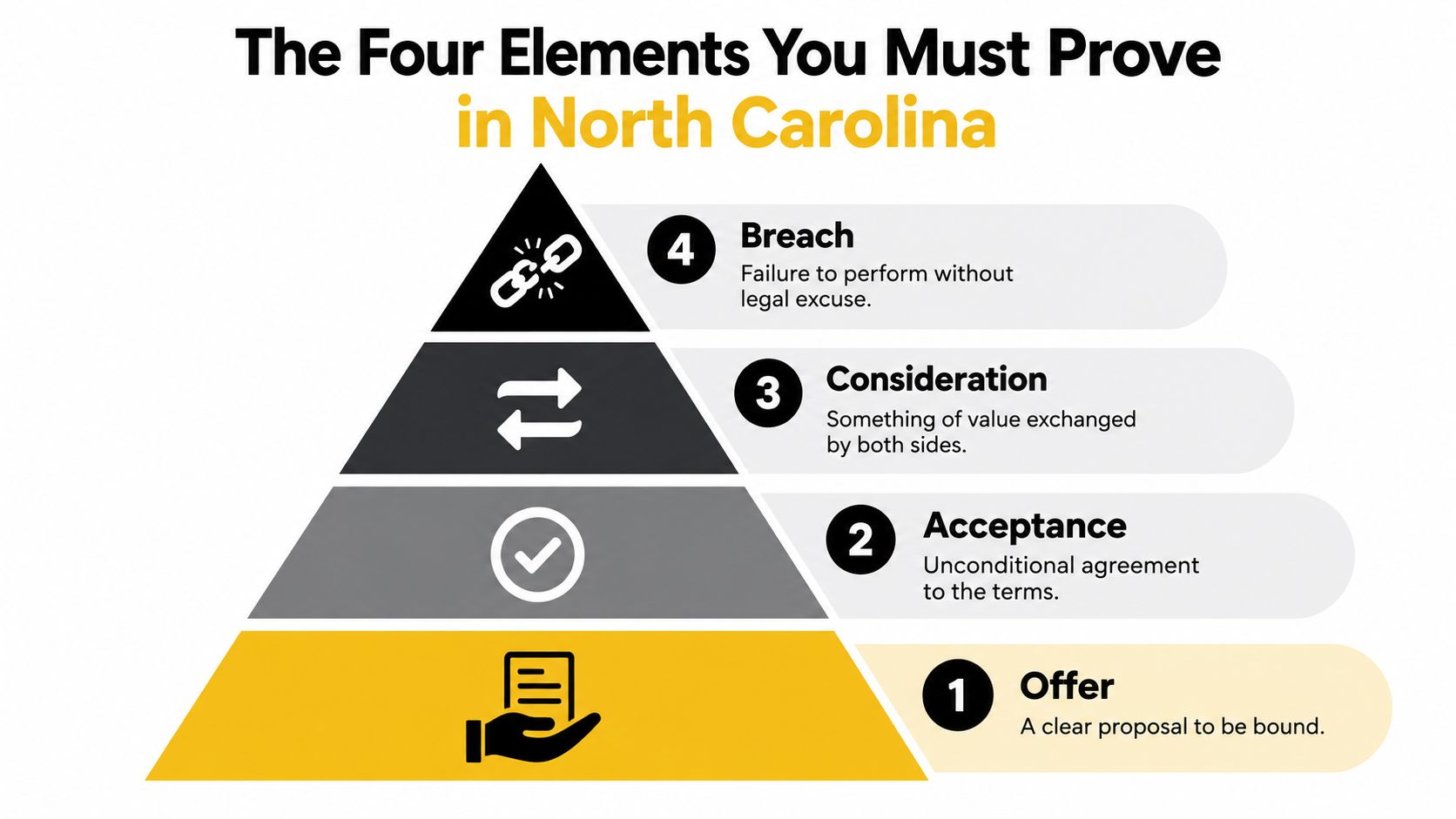
A contract claim becomes easier to evaluate when you separate formation from performance. The first question is whether the parties created an enforceable agreement. The second is whether one party failed to perform a required promise. North Carolina's formation analysis generally begins with offer, acceptance, and consideration, followed by proof of breach and resulting harm.
Offer and acceptance
An offer is a sufficiently clear proposal showing that the person making it is prepared to be bound if the other party accepts. A vague conversation such as “we should work together sometime” may not establish an offer. A written proposal identifying the work, price, and basic obligations is easier to analyze, but a written document isn't always required.
Acceptance means agreeing to the offered terms. If a customer changes important terms while claiming to accept, the exchange may be a counteroffer rather than acceptance. Conduct can also matter. A vendor who begins performance after receiving an order may provide evidence that the parties reached an agreement, although the exact terms can remain disputed.
Consideration
Consideration is something of legal value exchanged between the parties. One party may promise payment while the other promises services, goods, access, confidentiality, or another obligation. A promise made without an exchange may raise enforceability problems, particularly if one side is trying to impose a new obligation after the original deal.
For example, a business owner can't necessarily turn a casual promise of a future bonus into an enforceable contract without showing the required exchange and sufficiently definite terms. The documents, messages, and conduct should be reviewed together rather than relying on one isolated sentence.
Breach and resulting harm
After showing an agreement, the claimant must identify the specific promise that was broken and establish the failure to perform. The claimant also needs evidence of legally recoverable harm. A missed promise with no provable loss may support limited relief, while a serious failure supported by invoices, replacement costs, or business records presents a different case.
Plain-English test: Did both sides agree to definite obligations, did the claimant perform or remain ready to perform, did the other party fail to do what it promised without legal excuse, and did that failure cause a provable loss?
Oral agreements aren't automatically weaker for deadlines
North Carolina doesn't make the limitations question turn on whether the contract is written or oral. The general period is three years for both written and oral contract claims, and the clock generally begins when the breach occurs, not when the injured party discovers it, as summarized in this North Carolina statute of limitations discussion. That means changing a deal to writing later doesn't necessarily reset the filing deadline for an earlier breach.
Common Defenses and Why Enforceability Comes First
Many people begin with damages because the financial harm feels urgent. A North Carolina court may reach an earlier question instead: was the disputed promise enforceable in the first place? This matters in employment-related agreements, non-competes, non-solicitation provisions, settlement terms, and agreements that contain unclear or unlawful restrictions.
The clause may fail before damages matter
A restrictive covenant that reaches too far geographically, lasts too long, or restricts conduct beyond a legitimate business purpose may be challenged as unenforceable. Recent North Carolina coverage describes Business Court decisions rejecting breach claims based on overbroad non-compete and non-solicitation language. A party can't necessarily recover damages for violating a provision that North Carolina law won't enforce.
Other formation defenses include lack of consideration, indefiniteness, incapacity, illegality, and failure to satisfy a required writing. A court may also find that the alleged breach never occurred because the contract permitted the conduct, a condition never happened, or the claimant failed to satisfy its own obligations first.
Performance may be excused
A party may argue that performance became objectively impossible, that the other side committed a prior material breach, or that the agreement was induced by duress or misrepresentation. These defenses are fact-specific. A business that says a delivery became impossible still may need to show why performance could not reasonably occur, rather than merely claiming that it became inconvenient or more expensive.
The parties' later conduct can create another defense. North Carolina's accord-and-satisfaction statute, N.C. Gen. Stat. § 25-3-311, addresses disputed debts paid with an instrument marked as full satisfaction. If the statutory requirements are met, including good-faith tender, a disputed or unliquidated amount, payment obtained by the creditor, and a conspicuous full-satisfaction statement, cashing the check can discharge the claim.
A signed contract creates an important starting point, not an automatic answer. Read the specific term, the surrounding law, and the parties' performance before calculating damages.
The same careful reading applies outside commercial disputes. For example, someone researching North Carolina Divorce Residency Requirements is dealing with a separate family-law rule involving the six-month residency requirement for filing divorce in North Carolina, not a contract limitation period. Keeping legal categories separate prevents a plausible-sounding argument from being applied to the wrong claim.
Remedies Available for Breach of Contract in North Carolina
Winning the liability question doesn't mean every claimed loss becomes recoverable. North Carolina limits contract damages to losses that are the direct, natural, and proximate result of the breach, or losses likely to arise in the ordinary course of events and foreseeable when the parties formed the contract, as explained in the UNC School of Government materials on contract damages.
That rule is especially important for lost profits and other consequential damages. A business may feel that a failed deal cost it future opportunities, but the claim still needs evidence connecting the breach to the amount sought. Speculative losses generally don't satisfy the reasonable-certainty requirement.
| Remedy Type | When NC Courts Award It | Key Limit |
|---|---|---|
| Compensatory damages | To place the nonbreaching party in the position the contract promised | The loss must be proven and tied to the breach |
| Consequential damages | When the additional loss was foreseeable and naturally connected to the agreement | Unforeseeable or speculative losses are excluded |
| Lost profits | When records and other evidence establish the amount with reasonable certainty | A prediction without reliable support may fail |
| Specific performance | When money can't adequately provide the promised benefit, often involving unique property | Courts don't order this remedy automatically |
| Injunction | When a court order is needed to prevent or require conduct consistent with enforceable rights | The requested restriction must be legally available |
| Mitigated damages | Recovery after reasonable efforts reduce the resulting loss | A failure to mitigate can limit the award |
Mitigation changes the calculation
North Carolina imposes a duty to mitigate damages, meaning the injured party must use reasonable diligence to reduce the harm. In lease cases, appellate authority explains that failing to act reasonably can cap recovery at the difference between the contract benefit and the fair market value that could have been obtained through mitigation. When the party does mitigate, recovery is reduced by the net amount obtained from reletting during the relevant contract period, as described in this North Carolina Court of Appeals decision.
A landlord may need to make reasonable efforts to relet. A buyer may need to seek reasonable cover. A service provider may need to document replacement work or other steps that reduce the loss. Keep a damages ledger with dates, invoices, replacement offers, communications, payments, and mitigation efforts. For disputes that overlap with other civil obligations, readers may also review breach of fiduciary duty as a distinct claim that shouldn't be assumed from a contract dispute alone.
Deadlines and Where to File Your NC Contract Claim
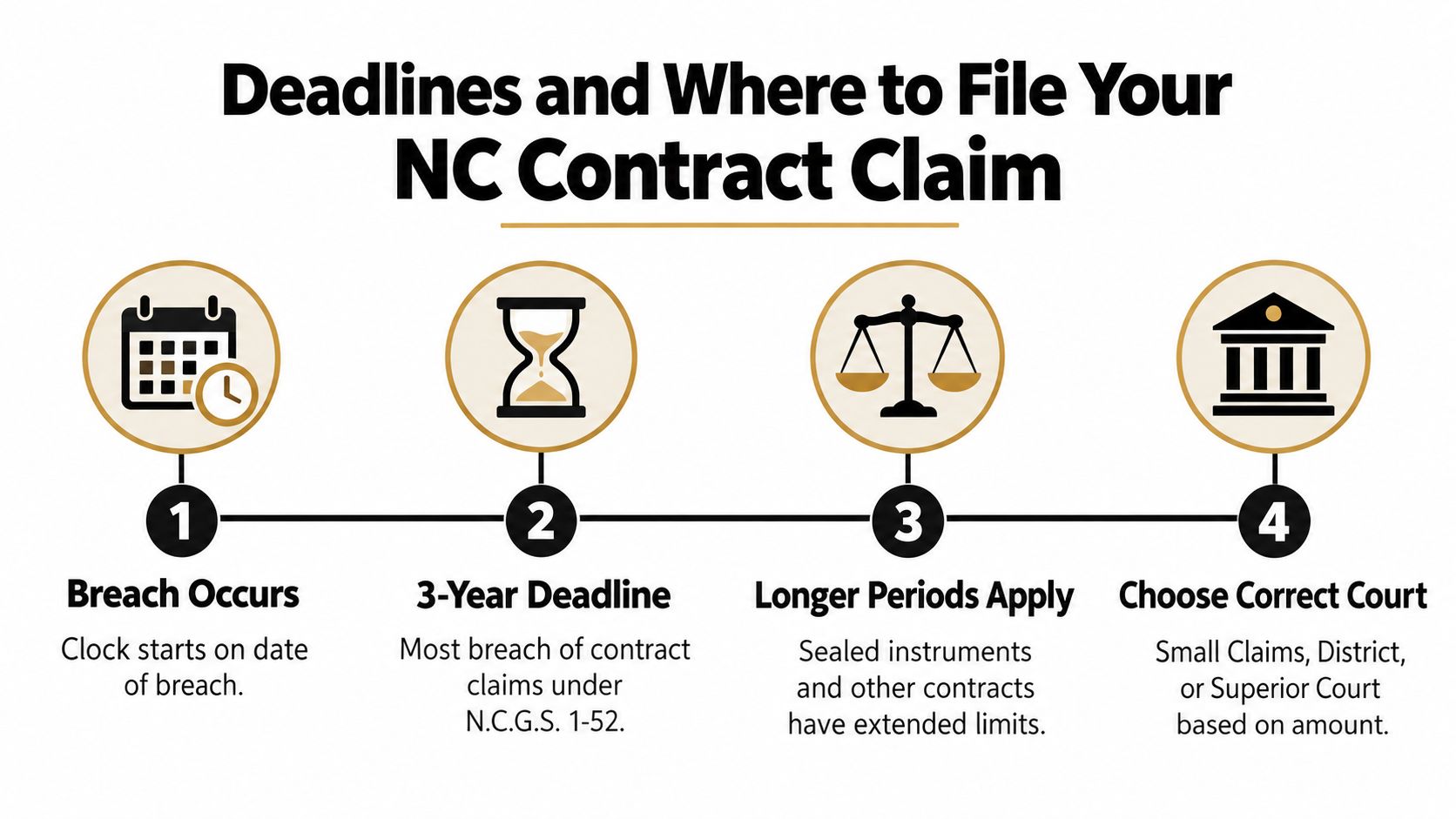
A contract claim can be strong on the facts and still be barred if filed too late. North Carolina's baseline period for a breach-of-contract claim is three years under N.C. Gen. Stat. § 1-52, which applies to an action upon a contract, obligation, or liability arising from a contract. The statute is the controlling reference for the default rule and should be reviewed with the actual agreement and breach date.
Start with the breach date
For most claims, the clock starts when the breach occurs. For sales-of-goods claims, the Uniform Commercial Code expressly provides that the claim accrues when the breach occurs regardless of the aggrieved party's lack of knowledge, under N.C. Gen. Stat. § 25-2-725. Discovering the problem later doesn't automatically move the starting date.
The contract category can change the deadline:
- General contract claims: The baseline period is three years under § 1-52.
- Sales of goods: The UCC provides a four-year period under § 25-2-725. The parties may shorten it to no less than one year, but they can't extend it by agreement.
- Certain sealed instruments: North Carolina recognizes a 10-year period under § 1-47(2), as discussed in this North Carolina Supreme Court limitations analysis.
- Construction or repair improvements to real property: Section 1-50 provides a six-year limit for actions to recover damages for certain contract breaches.
Two documents may look nearly identical but have different deadlines if one was executed under seal. Calendar the earliest plausible breach date while investigating exceptions. Waiting for the other side to negotiate can consume the filing window.
Match the court to the dispute
North Carolina civil matters may proceed in Small Claims Court, District Court, or Superior Court, depending on the amount in controversy, the nature of the claim, and local jurisdictional rules. Filing in the wrong forum can create delay or procedural complications, so review the county's requirements and the claim's value before filing. A basic overview of small claims court in North Carolina can help orient you, but a complicated contract dispute may require more extensive pleading, discovery, or injunctive relief.
Practical Next Steps From Demand Letter to Filing
Stress can make a contract dispute feel like one large problem. Treat it as a sequence of smaller tasks, and preserve the evidence before memories and records become harder to recover.
Build the file before making accusations
Collect the original agreement, amendments, exhibits, invoices, canceled payments, delivery records, project photographs, time records, and messages. Create a timeline with the date of each promise, performance, missed obligation, notice, and response. Save communications in their original form where possible, and avoid editing messages into a summary that removes context.
Then identify your own performance. If you haven't paid an invoice, delivered required materials, approved work, or provided access, the other side may argue that your conduct excused or preceded its nonperformance. A lawyer should see both favorable and unfavorable facts early.
Calculate loss and mitigation together
List each claimed loss separately. Note the amount, date, supporting document, connection to the breach, and steps taken to reduce it. If a tenant leaves, document reasonable re-letting efforts. If a supplier fails to deliver, record replacement inquiries and the difference between the promised arrangement and the reasonable substitute.
A demand letter should identify the agreement, describe the breach without exaggeration, state the requested cure or payment, provide a reasonable response deadline, and reserve available rights. Don't threaten criminal consequences for a civil dispute or make statements that could later undermine your position.
Decide whether filing is necessary
Negotiation or mediation may resolve a dispute while preserving business relationships, but settlement discussions shouldn't cause you to miss a limitations deadline. If filing becomes necessary, the complaint must identify the parties, jurisdiction, contract, performance, breach, damages, and requested relief. The defendant must then be properly served, and the case follows North Carolina's civil procedure rules.
For disputes involving contracts, property, and business conflicts, the civil law practice is one possible place to seek guidance about available litigation and resolution options. A consultation can help separate a strong claim from a difficult one before you spend more money or make avoidable admissions.
North Carolina Breach of Contract FAQs and Consultation Next Steps
Does putting an oral agreement in writing restart the deadline?
Usually, no. North Carolina's general three-year limitation period applies to oral and written contract claims, and the central timing question is typically when the breach occurred. A later writing may help prove terms, but it doesn't automatically erase an earlier breach date.
Can a sealed contract have a longer filing period?
Certain sealed instruments can receive a 10-year limitations period under North Carolina law, rather than the general period. The document's execution form must be examined carefully. A seal can affect timing, but it doesn't guarantee that every promise in the document is enforceable.
Can I sue if the clause itself may be invalid?
You may be able to file, but the claim can fail if the provision is overbroad, indefinite, unlawful, or contrary to public policy. North Carolina courts may address enforceability before reaching the alleged breach or damages. This issue frequently matters for non-competes, non-solicitation provisions, and other restrictive terms.
When should I contact a North Carolina contract lawyer?
Contact counsel promptly if the breach is recent, the agreement contains a seal, the amount is significant, the other side sent a full-satisfaction check, or you aren't sure which court or deadline applies. Bring the contract, amendments, timeline, payment records, communications, and documents supporting mitigation. No attorney can promise an outcome without reviewing the facts, but early analysis can clarify options and prevent avoidable timing or evidence problems.
The Law Office of Bryan Fagan provides North Carolina-focused guidance for civil disputes involving contracts, property, and business conflicts, including evaluating enforceability, deadlines, damages, and practical resolution strategies. Visit Law Office of Bryan Fagan to schedule a consultation and discuss what happened, what the agreement requires, and what steps may protect your interests.