A parent in Wake County may begin with a simple question: should the father's name go on the birth certificate, or should it remain blank until everyone knows the truth? Sometimes the doubt comes from a relative's comment or a child's appearance. Sometimes it arrives through a custody filing from a man who may not be the biological father. Whatever starts it, a paternity question can quickly affect support, custody, inheritance, medical history, and official records.
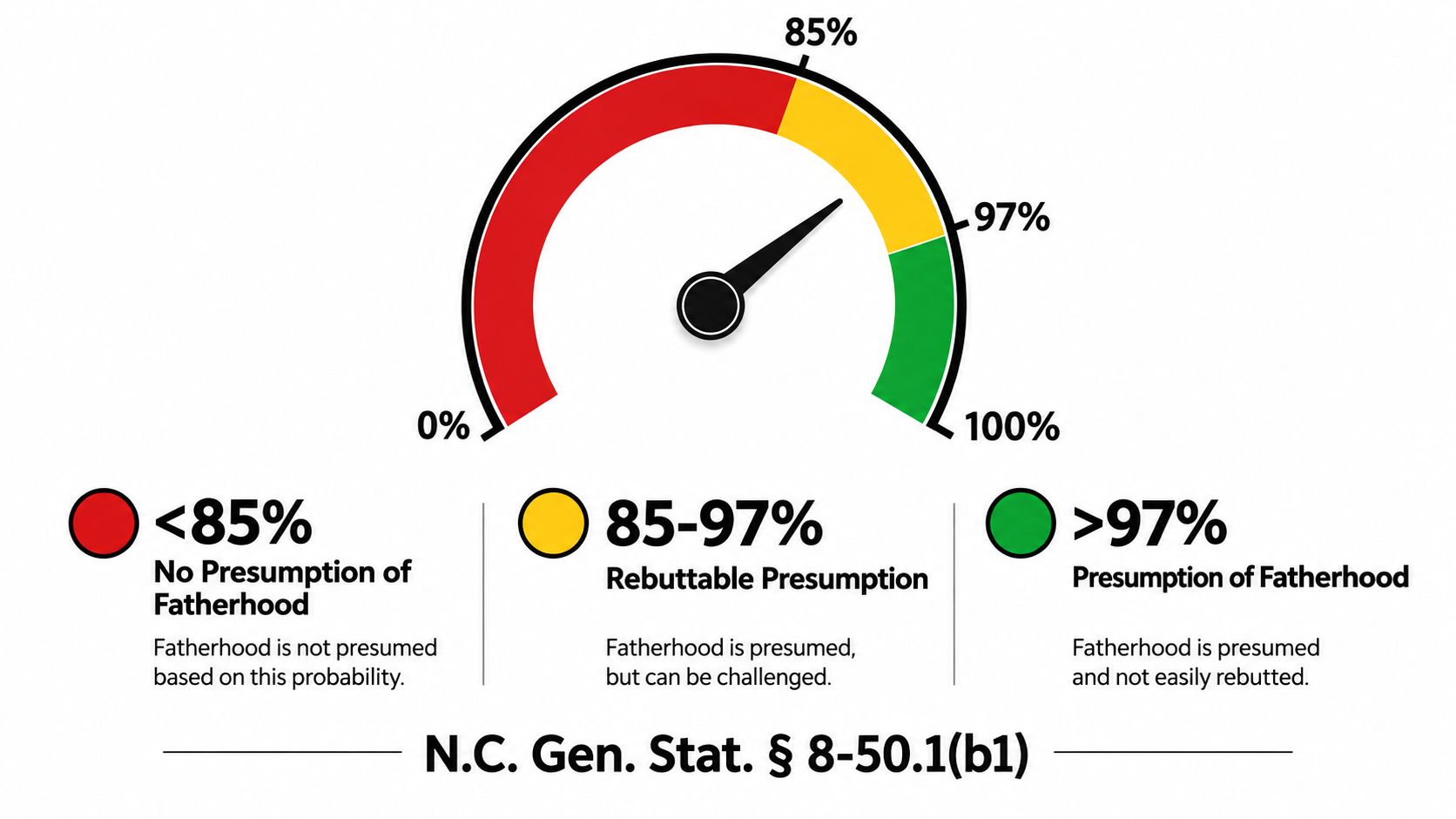
North Carolina law gives DNA results unusual legal force. Under N.C. Gen. Stat. § 8-50.1, results below 85%, between 85% and under 97%, and at 97% or higher receive different treatment in court. The test itself matters, but so does the way it was collected, documented, and presented.
When a Paternity Question Lands in Your Life
A Wake County mother sits at her kitchen table with a hospital birth worksheet in front of her. The line for the father's name is still empty. She knows one man believes he's the father, but she's no longer sure. Calling him could start a family argument. Leaving the line blank could create problems later with support, custody, or the child's records.
That uncertainty is common in North Carolina cases. A whispered concern may lead someone to order a private cheek-swab kit. A child-support agency may begin a case. A man who was never listed as the father may ask for visitation. A husband who signed documents may later question whether he is biologically related to the child. Each situation has different legal consequences, even when the underlying question sounds identical.
The first decision is not only whether to test. It's which testing path fits the legal problem. A private test may answer a personal question, but it usually doesn't establish evidence that a judge can rely on. A properly documented test can become part of a paternity action and influence the legal status of the parties.
The stakes go beyond biology
A paternity determination can affect:
- Child support, including the creation, enforcement, or review of a support obligation.
- Custody and visitation, because legal parentage may give an alleged father a basis to seek court-ordered parenting rights.
- Inheritance and benefits, particularly when a child's relationship with a father must be documented.
- Birth records, which follow a separate administrative process rather than changing automatically after a DNA report.
- Existing orders, where a person may need a court order to obtain relief even after genetic testing shows nonpaternity.
North Carolina's child-support system has historically treated paternity establishment as a central part of its IV-D caseload. A state report described an overall paternity-establishment rate exceeding 99%, with annual statewide rates of 100.12% in 2008, 99.64% in 2009, 100.27% in 2010, and 100.78% in 2011. The report also explains that the federal-style measure can exceed 100% because it uses the prior year's denominator. (North Carolina Department of Health and Human Services report)
The practical lesson is direct: paternity testing isn't an unusual side issue in North Carolina family law. It can be the event that determines which parent can seek custody, who may owe support, and whether a child has a legally recognized relationship with a parent.
At-Home Kits and Court-Admissible Tests
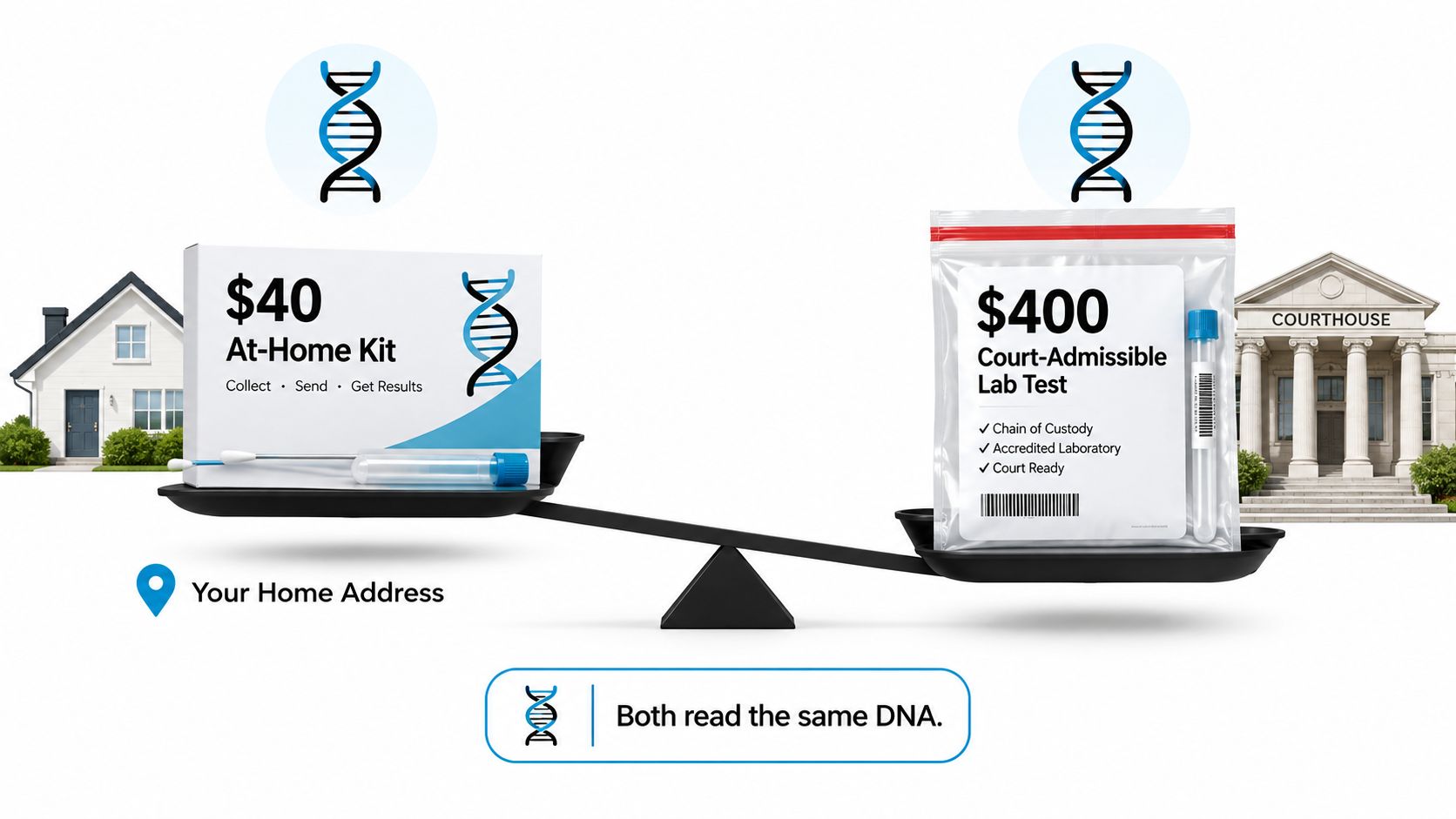
An at-home kit and a legal, chain-of-custody test may both use cheek swabs. Their legal value is not the same.
A retail kit can be useful for personal information. You collect the samples yourself, mail them to a laboratory, and receive a report intended for private use. That process doesn't reliably prove who handled the swabs, whether the correct people supplied them, or whether the samples were altered or confused.
A court-admissible test uses controlled collection and documentation. The lab or collection professional verifies identity, witnesses the swabbing, records the transfer, seals the samples, and preserves the documentation needed to authenticate the report.
Chain of custody is the courtroom dividing line
Think of the sample as a sealed evidence bag. A judge needs to know who placed the evidence inside, who transported it, and whether the seal remained intact. If a swab leaves someone's sight without documented handling, the underlying laboratory science may still be accurate, but the court may have no reliable way to connect that result to the correct person.
A properly administered test generally involves:
- Identity verification, commonly including government-issued photo identification.
- Collection by a neutral professional, such as a laboratory employee or medical professional.
- Documented handling, including signatures and transfer records.
- Secure sealing and shipment, so the laboratory can track the sample.
- A report from an appropriately accredited laboratory, often one meeting AABB standards used for relationship testing.
The court is not evaluating only the genetic calculation. It's also evaluating whether the report is authentic and whether the samples came from the people identified in the case.
Practical rule: If custody, support, inheritance, or a court filing may be involved, don't mail an informal swab before getting legal guidance.
Under N.C. Gen. Stat. § 49-14, genetic test evidence can be used in a paternity action. The important distinction is that a private kit may answer “what is likely true,” while a legally supervised test is designed to answer “what can be proven in court.”
That same decision-making approach appears in other family-law matters. For example, spouses who agree on the necessary issues may use Uncontested Divorce in North Carolina to understand how an agreed divorce can be completed efficiently. Agreement can simplify procedure, but it doesn't eliminate the need for legally valid documents.
How North Carolina Weighs a DNA Result
A DNA report can change a North Carolina paternity dispute from a question of biology into a question of legal rights, support, and exposure. The percentage is a calculated probability based on genetic markers and population allele frequencies. It is then evaluated under a statute that assigns legal significance to specific probability ranges.
Under N.C. Gen. Stat. § 8-50.1, the thresholds are:
- Below 85%: The alleged parent is presumed not to be the parent.
- 85% to under 97%: The result is admissible and weighed with other competent evidence.
- 97% or higher: The result creates a presumption of parentage.
What the zones mean in practice
A 72% inclusion is below the statutory threshold. It supports a presumption that the alleged father is not the biological parent, although clear, cogent, and convincing evidence may rebut that presumption.
An 89.4% inclusion falls into the middle range. The court may admit the result, but it does not resolve the genetic issue by itself. The judge can weigh testimony, records, the circumstances surrounding conception, and any prior acknowledgment of parentage.
A 99.97% inclusion meets the highest threshold. It creates a presumption of parentage and can substantially alter the alleged father's position in the case. The result still must come from a legally reliable collection and reporting process. Questions about sample identity, handling, procedure, fraud, or other defenses can affect how much weight the court gives it.
That is why chain of custody matters. A private swab may satisfy personal curiosity, but a documented sample connects the reported probability to the person identified in court. Without that connection, a strong number may provide less courtroom value than the parent expected.
Once admitted, the report can become legal advantage for one party and legal exposure for another. A high-probability inclusion may support a parentage order and related claims, while a result below the lower threshold may support a challenge.
Paternity and custody remain separate legal questions. For related background, review North Carolina child custody laws for unmarried parents. Establishing biological or legal parentage does not guarantee a particular custody schedule.
How the Testing Process Actually Works in NC
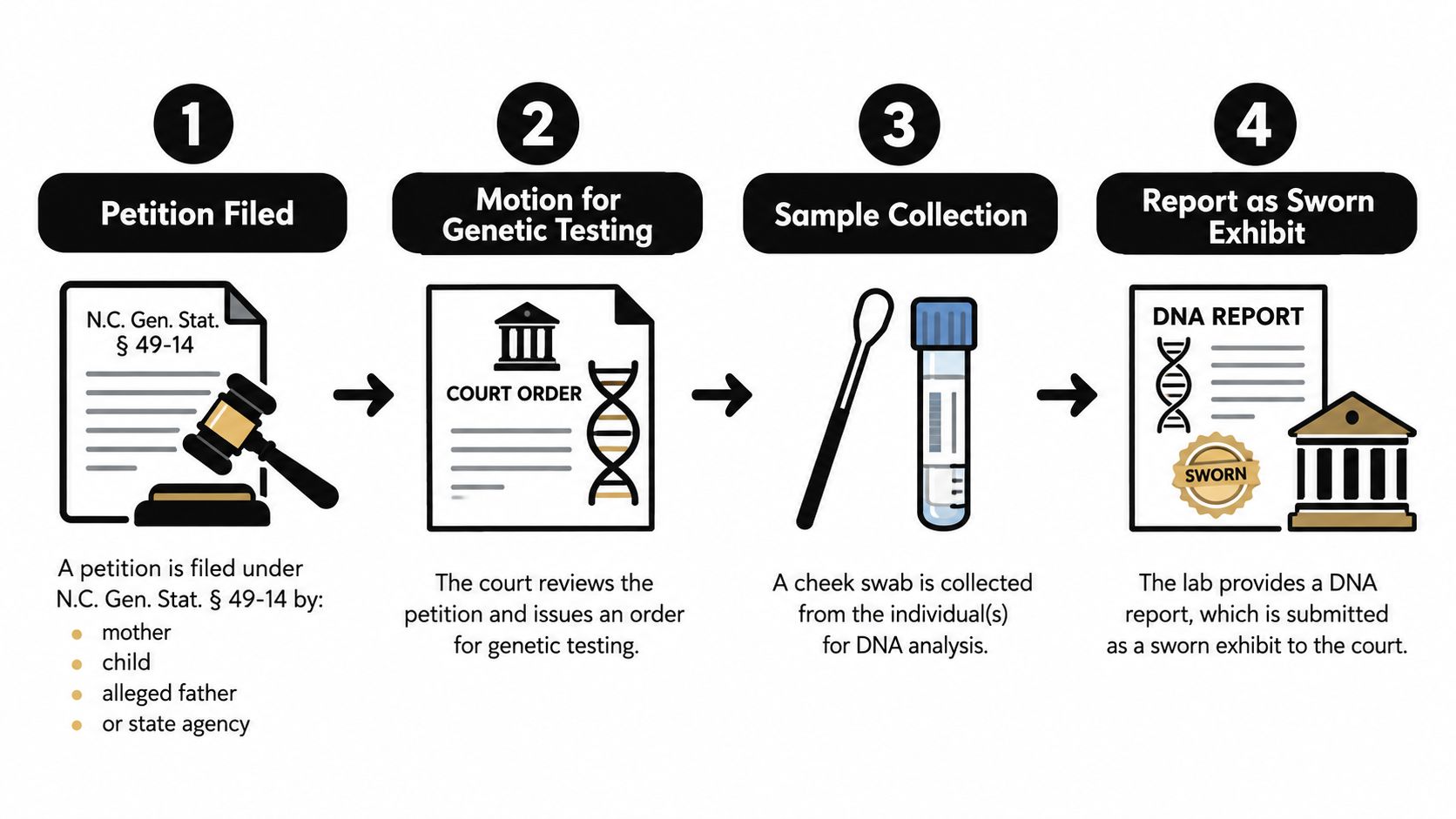
A North Carolina paternity case usually moves from a filed claim to an ordered test, then from documented collection to a report offered in court. The statutes give the court and certain agencies tools to require participation rather than leaving testing entirely to voluntary cooperation.
Starting the case
Under N.C. Gen. Stat. § 49-14, a paternity action may involve the mother, the child, the alleged father, or a county Department of Social Services office. The pleading identifies the parentage dispute and asks the court for appropriate relief.
The judge may order the mother, child, and alleged father to submit to blood or genetic-marker testing under the statutory procedure. The result is admissible when offered through a qualified medical or scientific witness. That authority matters when one person refuses to cooperate or disputes the need for testing.
Collection and court presentation
The collection appointment should be scheduled through a laboratory that understands legal relationship testing. Each participant's identity is verified, the swabs are collected under observation, and the kit is sealed for shipment. The laboratory then prepares a report that identifies the tested parties, describes the methodology, and states the calculated result.
The report's route to the court matters. Counsel may offer it as an exhibit, call or arrange for a qualified witness, and address objections concerning authentication or chain of custody. A private report that doesn't document those points may create an avoidable evidentiary fight.
The goal isn't merely to obtain a DNA answer. The goal is to obtain an answer the court can connect to the correct people and use under North Carolina law.
Refusal can also affect the case. North Carolina law provides consequences for failing to comply with an authorized testing process, and a court may consider the refusal when applying the statutory framework. In appropriate circumstances, the court can address noncompliance through contempt procedures or presumptions under the paternity statutes.
Paternity often affects issues that must be handled together. A parent who needs to understand how North Carolina courts apply the best-interests standard should also review Child Custody in North Carolina when planning the next filing.
Costs, Timelines, and What Happens Next
Families often ask for a simple price and completion date. The answer depends on whether the test is for private information or litigation, whether all participants cooperate, whether a court order is needed, and how quickly the laboratory and court can act.
The figures sometimes quoted by testing companies, such as a $40 retail kit or a $400 legal test, should be treated as examples of different service categories rather than guaranteed North Carolina pricing. The legally important issue is not the number on the invoice. It's whether the process produces evidence that fits the case.
| Factor | At-Home Kit | Court-Admissible Lab |
|---|---|---|
| Primary purpose | Private information | Evidence for a legal proceeding |
| Collection | Self-administered | Witnessed and identity-verified |
| Chain of custody | Usually absent or limited | Documented from collection through delivery |
| Court usefulness | May be challenged or rejected | Designed for authentication and admission |
| Best use | Deciding whether further action is needed | Paternity action, support, custody, or set-aside litigation |
A court may allocate testing costs under the applicable procedure, particularly when testing is ordered in a contested matter. Don't assume the other party will automatically pay, and don't assume the court will ignore the expense if someone acted unreasonably.
The legal consequences may arrive quickly
A paternity action can lead to child-support proceedings, custody requests, or agency involvement. In IV-D cases, North Carolina law provides mechanisms for temporary support while paternity is pending when the required evidentiary showing is made. If testing later establishes that paternity wasn't proven, the putative father must be reimbursed in full for temporary support paid under that order. (North Carolina child-support statutes)
Birth-certificate timing is separate. A court determination may provide a route to an amendment, but the laboratory doesn't change Vital Records directly. The documents required depend on how paternity was established and whether an acknowledgment or court order is available.
How a Test Result Changes Custody and Support
A man who was never listed as the father receives a properly administered DNA result showing 99.9% probability of parentage. That result falls within North Carolina's highest statutory zone under N.C. Gen. Stat. § 8-50.1, assuming the report is admissible in court. He may petition for legal recognition of parentage and ask the court to decide custody or visitation.
The number alone does not create equal parenting time or a fixed schedule. North Carolina custody decisions turn on the child's best interests, including facts about care, safety, stability, and each parent's relationship with the child. Establishing parentage opens the case. Evidence about parenting determines the custody outcome.
Support involves a separate analysis. After legal paternity is established, the court may determine child support under North Carolina's applicable framework, using the information required by the guidelines and considering the child's needs. Reviewing North Carolina child support laws and procedures can help a parent understand why the DNA result does not answer every financial question.
A challenge to existing parentage looks different
A person already treated as the legal father may have paid support under an existing order. A later genetic result can support a request for relief, but it does not erase that order. The person must follow the applicable statutory procedure, meet its requirements, and obtain a court ruling.
North Carolina law addresses challenges involving an affidavit of parentage and requests for relief from a support order. Under N.C. Gen. Stat. § 50-13.13, testing may be mandatory in certain challenges when good cause exists. Relief based on testing depends on whether the result establishes nonpaternity and whether the person knowingly acknowledged paternity.
That distinction prevents a private test from automatically canceling legal obligations. Chain-of-custody records and identity verification can determine whether the result carries weight in court. Existing custody, support, inheritance, and birth-record consequences may each require separate orders or filings.
Common Misconceptions Worth Clearing Up
A DNA report can answer the biological question, but it does not complete every legal or administrative step that follows.
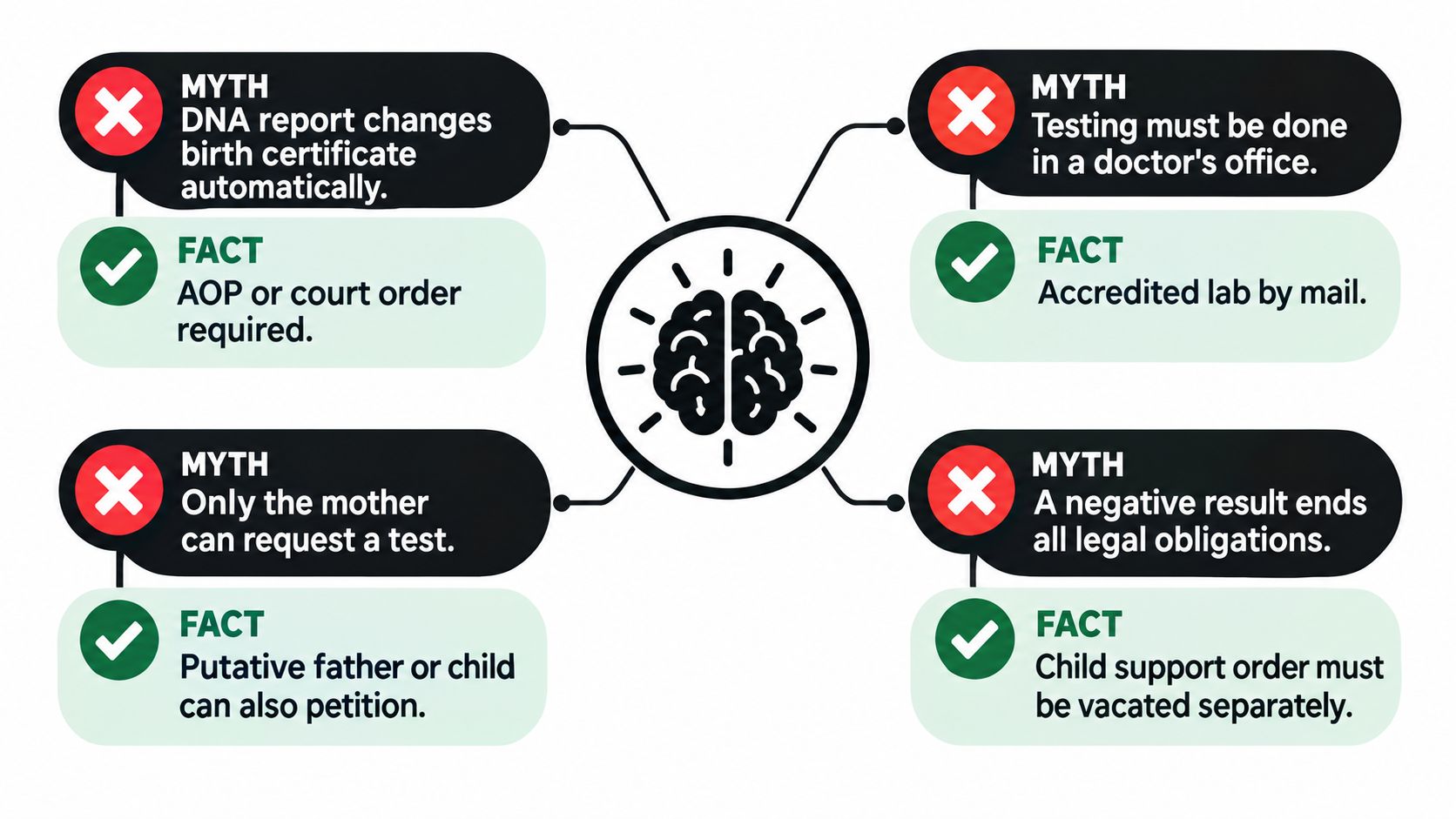
迷思:DNA 報告會自動更改出生證明。 North Carolina Vital Records 說明,申請人不能以 DNA 結果取代 Affidavit of Parentage,將父親加入出生證明。North Carolina Vital Records paternity guidance 州註冊官負責管理出生紀錄,實際程序可能需要 AOP、法院命令,或出生紀錄法規允許的其他文件。
迷思:生物學上的父親與法律上的父親完全相同。 兩者可能一致,但法律效果不同。某人可能已簽署承認文件、取得法律上的親子關係裁定,或受法院命令約束。即使 DNA 結果顯示非親生,也通常要依法院程序提出挑戰,法律後果才可能改變。
會造成可避免風險的迷思
- 「拒絕檢測,案件就會消失。」 法院可以命令進行檢測。不配合可能影響程序,也可能造成證據上的不利後果。
- 「中間範圍的結果會直接決定一切。」 在北卡羅來納州,85% 至低於 97% 的結果會被接納,並與其他證據一併衡量。(N.C. Gen. Stat. § 8-50.1)
- 「陰性報告會自動終止扶養義務。」 已存在的扶養命令通常仍需透過另行聲請及法院裁定處理,能否獲得救濟取決於法定要求。
- 「私人套件已經足夠,因為實驗室使用 DNA。」 法院仍可能審查受測者身分、樣本保管、交接紀錄及報告認證。缺少完整 chain of custody,私人測試較難成為有力的法庭證物。
出生證明是官方紀錄,不是實驗室報告。把兩者當成同一份文件,可能讓父母在親子關係、扶養或後續訴訟中承受不必要的風險。
Next Steps for North Carolina Families
Before ordering a kit, signing an Affidavit of Parentage, or responding to a paternity complaint, assemble the documents that establish the legal history. Include the birth certificate, existing custody or support orders, prior acknowledgments, agency notices, earlier test reports, and records of support payments or other relevant events. Those documents may matter as much as the DNA result.
If testing has already occurred, preserve the chain-of-custody file. Keep the original report, collection records, identity documents, laboratory correspondence, and delivery information. Do not edit the records or rely only on a screenshot from a testing portal. A private swab may answer a biological question, while documented collection and handling determine whether the result can carry weight in court.
Build the decision around the actual case
A productive consultation should address the decisions in front of you:
- Testing route: Is a private answer enough, or does the dispute require a court-admissible test?
- Filing strategy: Should a party file a paternity action, respond to an existing case, or seek relief from a prior order?
- Parentage documents: Has anyone signed an AOP, and do deadlines or legal grounds apply to rescission or challenge?
- Custody and support: Should custody, parenting time, and child support be addressed in the same proceeding?
- Venue and timing: Which North Carolina court should hear the matter, and what immediate deadlines apply?
Older or contested cases require particular care. North Carolina law provides that if a paternity action begins more than three years after birth, or after the putative father's death, contested paternity generally cannot be established without blood or genetic-marker evidence. The statute is N.C. Gen. Stat. § 8-50.1.
A parent facing an urgent parenting dispute may need temporary relief while the paternity issue continues. This guide to how to get temporary custody can help identify the type of immediate order that may be relevant, although the correct filing depends on the facts and jurisdiction.
Do not treat a paternity test as an isolated purchase. Review the full legal picture before sending a swab, signing an acknowledgment, or assuming the result settles support.
The Law Office of Bryan Fagan helps North Carolina parents evaluate testing options, paternity filings, custody, child support, and challenges to existing parentage orders. Visit Law Office of Bryan Fagan to schedule a consultation about the documents, deadlines, and testing path that fit your situation.