You may have found texts you weren't supposed to see. Maybe a hotel charge showed up on a joint card. Maybe your spouse admitted the affair, and now the shock is giving way to more immediate questions: Do I still have to wait a year to divorce? Will adultery change alimony? Does it matter for custody? Can the court do anything if marital money went to the affair?
Those questions matter in North Carolina because adultery still has legal consequences here. But the consequences aren't the same across every part of a case. That's where many people get bad advice. Some assume cheating changes everything. Others assume it changes nothing because North Carolina also allows no-fault divorce after separation. Neither view is accurate.
If you're trying to understand how does adultery affect divorce in NC, the practical answer is this: adultery can be decisive in some parts of a case and only conditionally relevant in others. It can completely change alimony. It can support a claim for court-ordered separation. It usually does not control property division unless money was spent on the affair. It only matters in custody if it affects the child's well-being.
Practical rule: In North Carolina, the legal effect of adultery depends on the issue in front of the court. You have to analyze support, separation, property, and custody separately.
That distinction is what protects people from costly mistakes. A spouse who panics may give up rights they still have. A spouse who assumes an affair is enough by itself may build a case around the wrong evidence. Clear strategy starts with the part of the case adultery affects.
Adultery as Grounds for Separation Not Absolute Divorce
One of the most common misunderstandings I hear is, “My spouse cheated, so I can file for divorce right away.” In North Carolina, that's only partly true, and the wording matters.
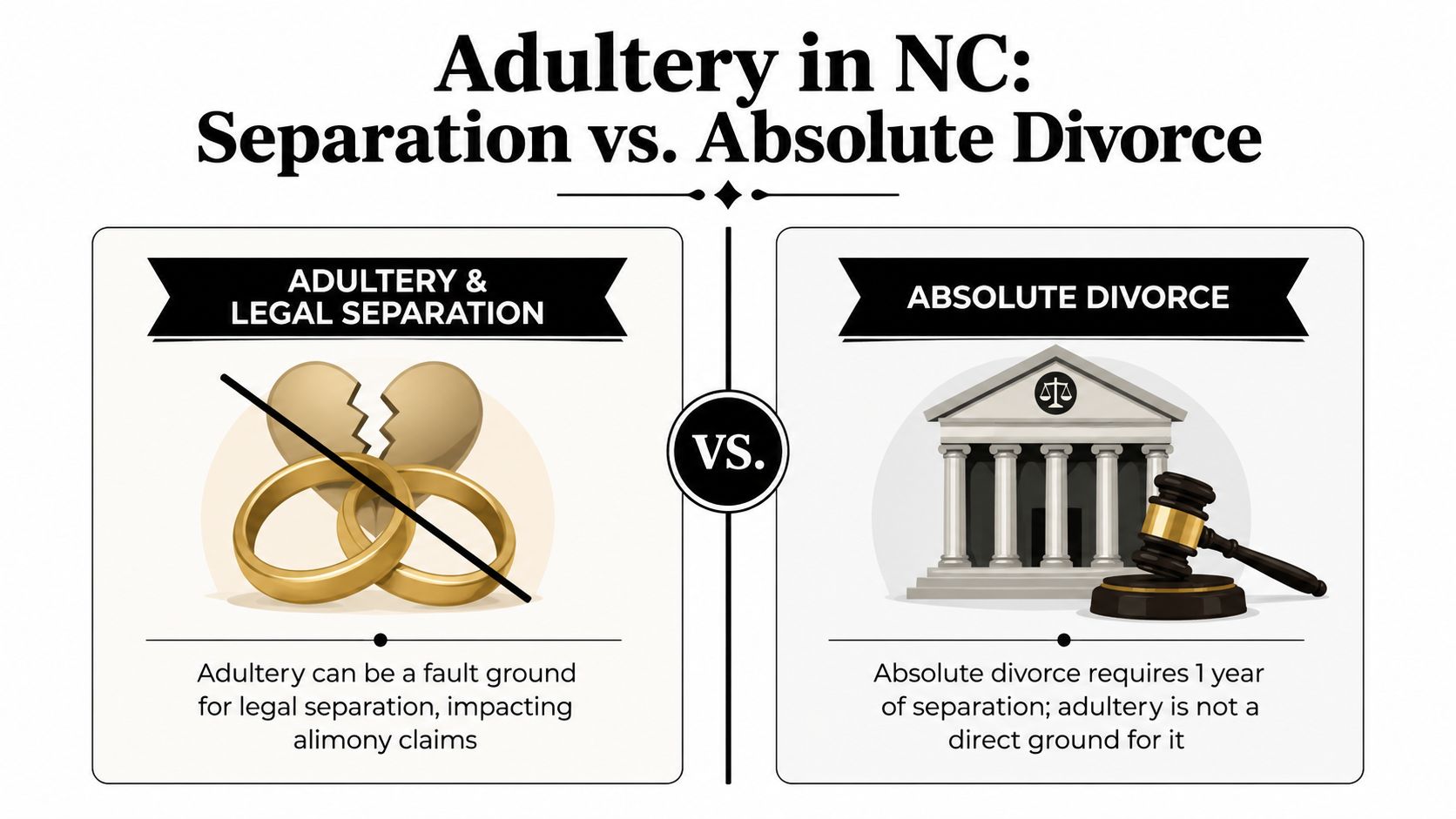
Adultery is not a ground for absolute divorce in North Carolina, which only recognizes separation for 12 consecutive months or incurable insanity as valid grounds; however, adultery is a statutory ground for divorce from bed and board under N.C. Gen. Stat. § 50-7, allowing a spouse to file for immediate court-ordered separation without waiting one year, as explained in this discussion of adultery and North Carolina divorce law.
What divorce from bed and board means
Despite the name, divorce from bed and board is not an absolute divorce. It is a fault-based form of judicial separation. It can be useful when one spouse needs the court to act before the one-year separation period for absolute divorce has run.
That matters because waiting can create real pressure. People often need decisions about:
- Who stays in the home: A court order can settle possession issues when living together is no longer workable.
- Temporary support: Financial issues often need attention long before an absolute divorce is available.
- Parenting arrangements: Children still need a routine, even when the marriage has collapsed.
A practical example helps. If a wife discovers her husband's affair in January and files in February for divorce from bed and board, she may be able to seek court intervention on support and custody without waiting until the following year to file for an absolute divorce.
What adultery does not do
Adultery does not let a judge skip the legal requirements for an absolute divorce. If your goal is to end the marriage itself, the standard no-fault path still matters. For a straightforward overview of the residency rule, filing steps, and court requirements, North Carolina residents often look to resources such as How to File for Absolute Divorce in North Carolina.
The affair may explain why the marriage ended. It does not replace the statutory requirements for absolute divorce.
That's an important trade-off. A bed and board claim can strengthen your position and get you into court sooner on immediate issues, but it doesn't eliminate the separate path required to dissolve the marriage completely.
The Unforgiving Rule of Adultery and Alimony in NC
A spouse can walk into my office with clear proof of an affair, a long marriage, and a serious income gap, then learn that one fact may decide alimony before the judge weighs much else. That is how strict North Carolina law can be on this issue.
Under N.C. Gen. Stat. § 50-16.3A, adultery, called illicit sexual behavior in the statute, has an absolute effect on alimony in some cases. If the dependent spouse committed illicit sexual behavior during the marriage and before the date of separation, the court must deny alimony. If the supporting spouse committed illicit sexual behavior and the dependent spouse did not, the court must award alimony. If both spouses engaged in it, the judge regains discretion and can decide the issue based on the full circumstances. You can read the statute directly in N.C. Gen. Stat. § 50-16.3A.
Those labels matter because clients often assume the higher earner is automatically the supporting spouse. Sometimes that is true. Sometimes it is not. The court looks at actual financial dependence and actual ability to pay.
Here is the practical rule set:
- Dependent spouse cheated before separation: alimony is barred.
- Supporting spouse cheated and dependent spouse did not: alimony is required.
- Both spouses cheated: the judge may award alimony, reduce it, or deny it.
That makes adultery different from many other divorce issues. On alimony, fault can control the outcome. On property division and custody, the effect is much more limited unless the affair affected finances or the children.
Timing also matters more than people expect. The conduct must occur before or on the date of separation to trigger the alimony rule. If someone starts a new sexual relationship after a valid separation, that usually raises a different analysis. In close cases, the fight often turns on dates, living arrangements, and whether the parties were separated or only saying the marriage was over.
A common mistake is treating every affair allegation as if it will end the support case immediately. Proof still matters. So does who did what, and when.
| Scenario | Alimony Outcome for Dependent Spouse |
|---|---|
| Dependent spouse engaged in illicit sexual behavior before or on date of separation | No alimony |
| Supporting spouse engaged in illicit sexual behavior and dependent spouse did not | Alimony must be awarded |
| Both spouses engaged in adultery | Judge may award or deny alimony |
For a fuller explanation of how spousal support works beyond adultery alone, see North Carolina alimony laws.
The often-missed point about Post-Separation Support
This is the part many spouses do not hear until they sit down with counsel. A bar to long-term alimony does not always end the temporary support discussion.
North Carolina courts can award Post-Separation Support (PSS) under a different framework. PSS is temporary support intended to address immediate need while the larger claims are pending. In practice, that means a spouse who may ultimately lose on alimony because of illicit sexual behavior can still have an argument for short-term support depending on the facts, the timing of the request, and the court's view of the immediate financial situation. The North Carolina Judicial Branch outlines temporary and permanent spousal support in its Spousal Support overview.
That distinction is easy to miss and it matters a great deal. I often have to explain that “adultery kills alimony” is only partly true. It can kill the final alimony claim. It does not always prevent a short-term PSS award that helps cover rent, utilities, or basic expenses while the case is pending.
The trade-off is straightforward. PSS can provide short-term breathing room, but it does not erase the risk that the final alimony claim will fail under the statute.
Strategy matters here. A spouse alleging adultery needs to focus on proof, dates, and whether the other party is the dependent spouse. A spouse defending against the allegation needs to examine whether the conduct meets the statutory definition, whether it happened before separation, and whether temporary support should still be requested even if final alimony is in danger.
Conditional Effects on Property and Child Custody
A lot of spouses walk into my office assuming an affair will decide everything in the divorce. In North Carolina, that assumption usually creates bad strategy. Adultery has a hard, often case-dispositive effect on alimony. Property division and custody are different. Here, the question is usually not whether the affair happened. The question is whether it affected marital finances or the child.

Property division and marital waste
North Carolina uses equitable distribution. Judges divide marital property fairly under N.C. Gen. Stat. § 50-20. Fair does not mean the court punishes a cheating spouse for moral wrongdoing.
What can matter is dissipation of marital assets, sometimes called marital waste. If one spouse spent marital money on the affair, that spending can affect the property division. The focus stays on the money, not the betrayal itself.
If property division is a major issue in your case, it helps to understand how equitable distribution in North Carolina works before you decide what financial records to subpoena or what settlement position makes sense.
A common example is straightforward. If a spouse had an affair but paid for it entirely with separate funds and there is no proof of wasted marital assets, the affair may have little or no effect on property division. If marital funds paid for hotel rooms, gifts, rent, flights, or cash transfers to the other person, the court may account for that and adjust the distribution.
That distinction matters in real cases. Angry text messages rarely change the property outcome. Credit card statements, bank withdrawals, Venmo records, and travel charges often do.
Custody and the child's best interests
Custody cases turn on the child's best interests under N.C. Gen. Stat. § 50-13.2. A parent does not lose custody because of adultery alone.
Judges look for a connection between the conduct and the child's welfare. If the affair exposed the child to conflict, instability, neglect, unsafe supervision, or inappropriate overnight situations, the issue becomes relevant quickly. If the affair stayed separate from the child and did not interfere with parenting, it often carries much less weight.
I tell clients this plainly. Family court does not exist to referee marital morality. It exists to protect children and divide property under the statute.
Evidence that usually matters
For property claims, useful evidence often includes:
- Bank and credit card statements showing spending tied to the affair
- Travel records, hotel charges, gifts, or transfers to the third party
- Dates that show the spending happened before separation and involved marital funds
For custody claims, useful evidence often includes:
- School, medical, and childcare records showing missed responsibilities
- Witness testimony about who was caring for the child
- Specific incidents where the child was exposed to inappropriate conduct or unsafe conditions
What usually falls flat is broad character evidence. A judge is far more likely to respond to a timeline, documents, and concrete examples than to repeated claims that a spouse was unfaithful.
That is the practical trade-off. If adultery is part of your case, use it where North Carolina law gives it legal weight. For property, prove the money. For custody, prove the impact on the child.
How Adultery Is Proven in a North Carolina Court
A photo or a confession that neatly proves adultery is not typically available. Court cases usually rely on a combination of facts that point to the same conclusion.

Courts look at patterns, not just one clue
In practice, adultery is often proven with circumstantial evidence. That means the court considers surrounding facts that make the affair more likely than not. One suspicious text message usually won't carry a case by itself. A cluster of evidence is far more persuasive.
Common forms of evidence may include:
- Messages and emails: communications that show romantic or sexual involvement.
- Financial records: charges tied to travel, hotels, gifts, or unexplained spending.
- Photos or social media content: especially when paired with other evidence.
- Witness testimony: sometimes from someone who observed the relationship firsthand.
- Investigation evidence: in some cases, testimony from a private investigator or another qualified witness.
When testimony becomes technical or specialized, questions about admissibility can matter. That's one reason litigants sometimes need to understand the role of expert witness testimony in North Carolina cases.
Timing matters
North Carolina adultery issues often turn on when the conduct happened. The relevant period is during the marriage and before or on the date of separation for the consequences discussed earlier. If the date of separation is disputed, that dispute can become central.
That's why I often tell clients to build a timeline early. Save records. Keep events in order. Don't rely on memory alone months later.
For a visual overview of related legal issues, this video gives additional context:
Defenses people should know about
Being accused of adultery does not end the analysis. Defenses may apply depending on the facts. Common issues raised in these cases can include:
- Condonation: the other spouse knew about the affair and forgave it, then resumed the marital relationship.
- Connivance: the accusing spouse encouraged or facilitated the misconduct.
- Recrimination: the accusing spouse also engaged in adultery.
These defenses are fact-sensitive. They don't fit every case, and they don't erase damaging evidence automatically. But they can affect how the court views an adultery claim and what legal consequence follows.
Frequently Asked Questions About NC Adultery Laws
A common consult starts the same way. One spouse has proof of an affair and wants to know whether that changes everything. In North Carolina, it changes some things a great deal, especially alimony, and other issues only if the facts connect to money, parenting, or a separate civil claim.
Can I sue the person my spouse had an affair with in North Carolina
Possibly. North Carolina still recognizes claims such as alienation of affection and criminal conversation against a third party in some cases. Those claims are separate from divorce, custody, and support. They also require proof that goes beyond showing the marriage ended after an affair.
These cases can be valuable, but they are not automatic. Timing, the strength of the marriage before the affair, available evidence, and whether the third party can satisfy a judgment all matter. Before spending money on that kind of lawsuit, I look at collectability and proof, not just anger.
Is adultery a crime in North Carolina
Yes. North Carolina still has a criminal adultery statute on the books. In practice, that is rarely the issue that drives a family law case.
Key pressure points are usually alimony, post-separation support, settlement advantage, and credibility in court. That is where clients tend to feel the consequences.
What happens if both spouses cheated
This is one of the most misunderstood parts of North Carolina law. If only the dependent spouse committed illicit sexual behavior before separation, alimony is barred. If only the supporting spouse did, alimony can be required. If both spouses engaged in that conduct, the judge has discretion instead of following an automatic rule. The North Carolina General Assembly states that framework in N.C. Gen. Stat. § 50-16.3A.
That distinction matters in settlement. A case with adultery on one side may have a hard alimony outcome. A case with misconduct on both sides often turns into a fight about proof, credibility, and what result the judge views as fair.
Does cheating automatically mean a parent loses custody
No. Custody decisions turn on the child's best interests. An affair matters in custody only when it affects the child in a real way.
For example, judges may care if the relationship exposed a child to unsafe people, constant conflict, poor supervision, overnight instability, or inappropriate situations. If the affair was morally upsetting but had no real impact on parenting, it often carries much less weight than clients expect.
Will adultery automatically stop all spousal support
No. This is the exception many people miss. Adultery can be outcome-determinative for alimony, but post-separation support is a different analysis. At the temporary stage, a court may still award or deny support after a closer look at the circumstances, even in a case where adultery creates a major alimony problem later. The North Carolina General Assembly addresses post-separation support separately in N.C. Gen. Stat. § 50-16.2A.
That difference affects early strategy. A spouse may have a weak long-term alimony claim and still pursue temporary support while the case is pending. A supporting spouse may also have reasons to contest PSS aggressively rather than assuming the alimony rule ends the discussion.
Quick answers from friends, relatives, or internet forums often miss the difference between alimony, post-separation support, custody, and property division. In North Carolina, those differences can change the value of the case and the right settlement strategy.
Protecting Your Rights When Adultery Is a Factor
Adultery cases are emotionally charged, but the legal analysis has to stay disciplined. In North Carolina, cheating can be outcome-determinative on alimony, strategically important for divorce from bed and board, and only selectively relevant to property division and custody. If you treat all four issues the same way, you can hurt your case.
What works is targeted proof. If alimony is the fight, the timing and nature of the conduct matter. If property is the fight, trace the spending. If custody is the fight, focus on the child, not your spouse's character. If you need immediate court involvement, look closely at whether a fault-based separation claim should be part of the strategy.
What doesn't work is assuming the truth will “come out” on its own. Judges decide cases based on admissible evidence, credible testimony, and legal standards that are narrower than commonly expected.
For North Carolina residents dealing with adultery in a divorce or separation case, legal advice early in the process can prevent expensive mistakes. One option is the Law Office of Bryan Fagan, a North Carolina-focused firm that handles family law matters including divorce, equitable distribution, custody, and spousal support. The right next step is a confidential case review specific to your facts, your county, and your immediate priorities.
If adultery is part of your divorce, separation, alimony, or custody case, schedule a confidential consultation with the Law Office of Bryan Fagan. You can get clear guidance on your rights under North Carolina law, what evidence may matter, and what steps make sense now to protect your finances, your home, and your relationship with your children.