If you're dealing with a divorce while one spouse is serving, you're probably balancing more than the usual legal stress. Duty schedules, relocation orders, housing allowances, retirement questions, and child custody logistics can all collide at once. In North Carolina, that pressure gets sharper because state divorce rules don't pause, despite military life being complicated.
A military divorce in North Carolina sits at the intersection of state family law and federal protections for servicemembers. That overlap creates opportunities, but it also creates traps. A filing that looks straightforward on paper can stall because of the Servicemembers Civil Relief Act. A separation period that seems complete can become disputed if deployment interrupted the required continuity. Retirement, support, and custody each come with their own military-specific issues.
The good news is that these cases are manageable when they're approached strategically. The key is understanding where North Carolina law controls, where federal law changes the analysis, and where timing matters more than people expect.
Understanding Jurisdiction and SCRA Protections
A common military divorce problem starts like this. One spouse is stationed at Fort Liberty, the other has already moved out, and deployment or training dates make everyone assume the case has to wait. Sometimes that is true. Sometimes it is a costly mistake.

Jurisdiction and SCRA protections are often the first pressure points. In North Carolina military cases, state filing rules and federal servicemember protections do not always line up neatly. If you get either one wrong, the case can stall before the court reaches property, custody, or support.
When North Carolina can hear the case
North Carolina law requires at least one spouse to have lived in the state for six months before filing for divorce, under N.C. Gen. Stat. § 50-8. In military families, the confusion usually comes from treating domicile, home of record, and duty station as if they mean the same thing. They do not.
A servicemember may keep legal ties to another state for tax or voting purposes and still meet North Carolina's filing requirement. Being stationed here can be enough for the divorce court to exercise jurisdiction, even if the servicemember expects to leave after the current assignment ends. That point surprises many families, especially when one spouse insists, in good faith, that "North Carolina is not our real home."
The trap is timing. North Carolina has a strict one-year separation requirement for absolute divorce, and military orders can blur what counts as separation if the spouses were apart because of duty rather than a decision to end the marriage. I often tell clients to separate the questions. First, can North Carolina hear the case? Second, when did the legal separation begin? Those are related issues, but they are not the same issue.
The SCRA's function
The Servicemembers Civil Relief Act gives procedural protection to active-duty servicemembers whose military duties materially affect their ability to participate in the case. It does not erase the case, and it does not give either spouse a free pass to ignore court deadlines.
North Carolina courts also require attention to military-status affidavits before entering certain orders, especially defaults. If the servicemember cannot appear or respond because of deployment, training, or other active-duty obligations, the court may be required to stay the proceeding for a period of time under federal law. That can be a fair protection. It can also frustrate a civilian spouse who expected a quick filing to produce quick results.
Both sides need to treat this seriously.
For the civilian spouse, pushing ahead without proper SCRA compliance can lead to delay, added expense, or an order that gets challenged later. For the servicemember, assuming the SCRA will "handle it" without a response is risky. Courts expect timely action when participation is possible, and a stay is not automatic in every circumstance.
Where military families get tripped up
These mistakes show up often in my office:
- Assuming North Carolina has no jurisdiction because the servicemember claims another domicile. Duty station presence may still satisfy the state filing requirement.
- Confusing physical separation with military absence. Deployment can complicate the timeline if the spouses were apart for service reasons before they were apart as a married couple.
- Treating the SCRA like a permanent delay tool. It protects fair participation. It does not stop the divorce indefinitely.
- Filing in one state while another state may control custody. Divorce jurisdiction and child custody jurisdiction do not always match.
That last point matters. A North Carolina court may have authority over the divorce itself while another state has the stronger claim over child custody under the UCCJEA. If your children have been living elsewhere with one parent, review how North Carolina handles custody when parents live in different states.
A practical way to assess the case
Before filing, I look at four questions:
| Issue | Why it matters |
|---|---|
| Has either spouse satisfied North Carolina's six-month residency requirement | Without that, the divorce claim may be dismissed or delayed |
| Is active-duty service likely to prevent a timely response or court appearance | The SCRA may justify a stay and affect the filing strategy |
| When did the marriage truly separate, as opposed to spouses living apart because of orders | North Carolina's separation requirement is strict, and bad date selection creates avoidable disputes |
| Are the children living in another state or under a temporary military care plan | Custody jurisdiction may need a different analysis from the divorce itself |
Handled early, these issues save time and reduce avoidable conflict. Handled late, they tend to multiply.
Dividing Military Retirement and Spousal Support
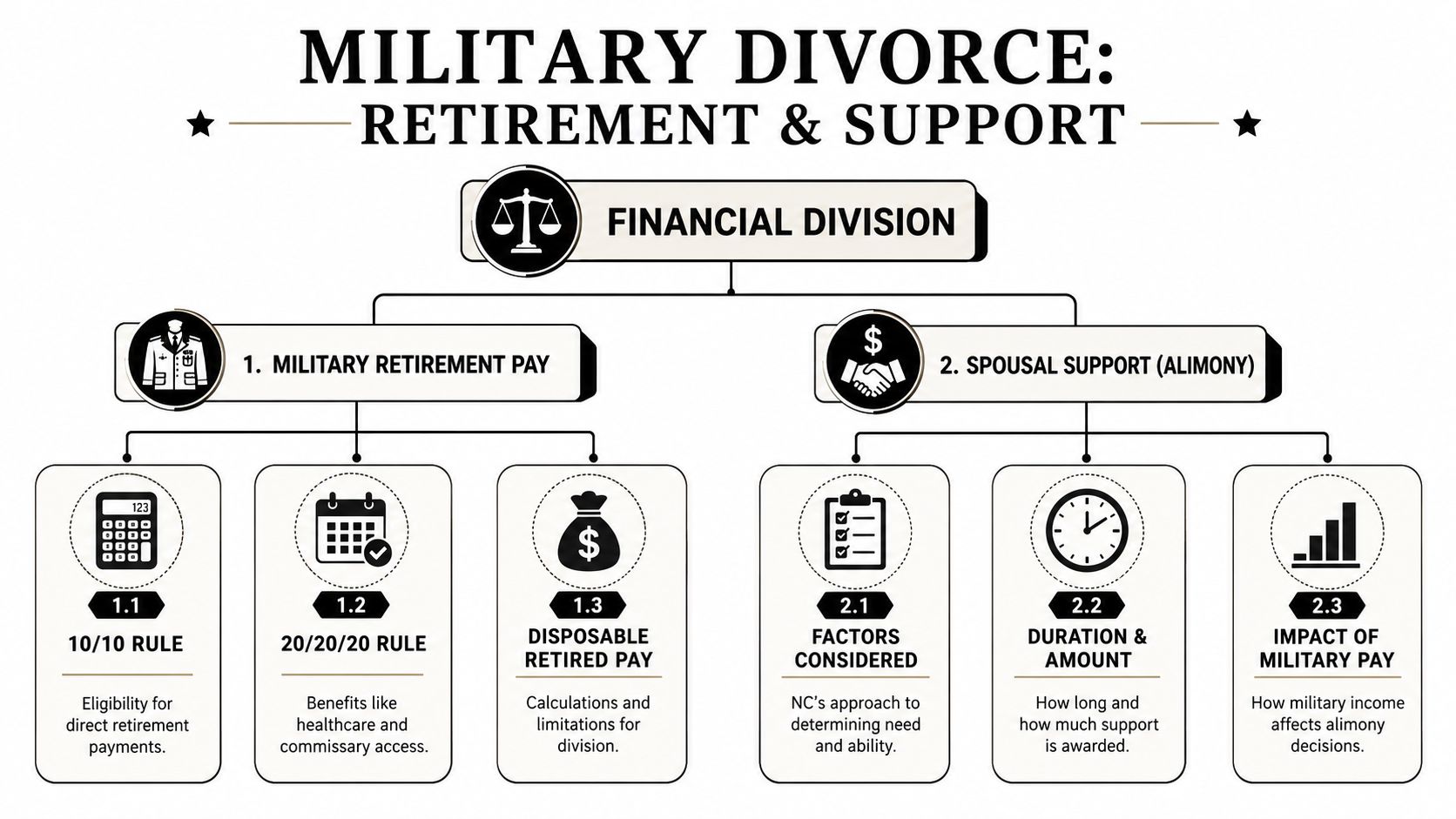
Money disputes in military divorce usually center on two things. Retirement and support. They sound similar because both involve future income, but North Carolina treats them differently.
Military retirement is property, not support
In North Carolina, military retirement benefits earned during the marriage are considered marital property and divisible, with courts often using the time rule formula to identify the marital portion: Years of marriage overlapping service ÷ Total years of service, as explained in this discussion of military divorce in North Carolina and the time rule.
That formula is simple enough to state, but the implications are often misunderstood. The key point is that the court is not dividing the entire retirement automatically. The court is identifying the part earned during the marriage.
A practical example helps. Suppose a servicemember served both before and during the marriage. North Carolina typically looks at the overlap between marriage and service to determine the marital share. That is why short marriages and long careers can still involve divisible retirement, but only to the extent service and marriage overlapped.
For readers who want a broader view of how North Carolina classifies and divides assets, Equitable Distribution of Property in North Carolina explains the state's equitable distribution system. North Carolina is not a community property state.
What support calculations include
Support creates a separate analysis. In North Carolina, courts can look at the full military income picture for support purposes, including base pay, housing and subsistence allowances, and other qualifying pay. A point many people miss is the treatment of disability benefits.
North Carolina courts apply a 60% cap on the total award of child and spousal support from a military member's pay and allowances, which is stricter than the federal 65% limit, and VA disability pay, while non-divisible as property, is counted as income for support calculations, according to this explanation of North Carolina military divorce support rules.
That leads to one of the most common client questions: "If disability pay can't be divided, why does it still matter?" Because property division and support are different legal categories. A benefit can be protected from equitable distribution as property and still affect the calculation of available income for alimony or child support.
What works and what doesn't in negotiation
In these cases, broad assumptions usually backfire. Better results tend to come from separating issues cleanly.
- Retirement analysis first: Identify what part of the pension is marital before negotiating percentages or offsets.
- Support analysis separately: Don't assume the same income rules apply to property division.
- Allowance review: BAH, BAS, and other military pay components often matter.
- Drafting precision: Settlement language needs to match the asset being divided and the support being claimed.
What doesn't work is rolling everything into a vague "fair split" conversation. That approach causes avoidable disputes because one spouse may be talking about pension rights while the other is thinking about monthly cash flow.
Client concern I hear often: "If I give up part of retirement, will that reduce support?" Sometimes people try to trade those issues informally. That can be risky because the legal standards are different and the long-term consequences are easy to underestimate.
If alimony is part of your case, this overview of North Carolina alimony laws can help frame the state-law side of the analysis.
Navigating Military Child Custody and Support
Custody cases involving military parents don't fail because a parent serves. They usually become difficult because the family needs a parenting plan that can survive real military life. Orders, training, leave blocks, relocation, and deployment schedules all affect what a stable arrangement looks like.

A realistic North Carolina parenting plan
North Carolina courts decide custody based on the child's best interests. In a military case, that usually means the court is looking for a plan that gives the child stability without ignoring service members' obligations.
A common scenario looks like this: one parent is stationed in North Carolina, the other remains nearby at first, and both expect a future relocation or deployment. A vague parenting plan may work for a few months. It usually breaks down when the first duty change hits.
A stronger plan often addresses practical issues up front:
- Deployment communication: Set expectations for video calls, phone contact, and notice.
- Leave periods: Decide how parenting time will be handled when the servicemember returns on leave.
- School and medical decisions: Clarify who handles routine decisions when one parent is away.
- Relocation procedure: Include a process for revisiting the schedule if military orders require a move.
Parents often assume the court will "figure it out later" if a deployment happens. That's not a strategy. It's better to write a plan that anticipates disruption.
Child support in a military case
Support issues can become tense when one spouse looks only at base pay and ignores the rest of military compensation. North Carolina support analysis can include the broader pay structure, and support has limits as well.
As noted earlier in this article, North Carolina courts apply a 60% cap on the total award of child and spousal support from a military member's pay and allowances, and VA disability pay counts as income for these support calculations even though it is not divisible as property. That combination can surprise both servicemembers and spouses.
The practical lesson is straightforward. Support should be calculated with complete financial information, not quick assumptions based on an LES summary someone only partly understands.
Misconceptions that hurt custody cases
Some parents walk into a military divorce in North Carolina believing one of these things:
- "Military service will count against me." Service alone does not decide custody.
- "Deployment means I lose my role as a parent." Not automatically. Courts can structure parenting plans around absences and returns.
- "If we're cooperative, we don't need detailed terms." Cooperation is helpful, but clear written terms matter more when schedules change suddenly.
- "Child support only follows base pay." It can involve a broader income analysis in military cases.
A useful starting point for the state-law framework is this guide to child custody laws in North Carolina.
The best military custody orders are flexible in operation but specific in wording. Those two qualities are not opposites. In practice, they need each other.
The Step by Step North Carolina Filing Process
A common military divorce problem starts like this: one spouse is stationed elsewhere, the other remains in North Carolina, both believe they have been "separated for a year," and they are ready to file. Then the timeline gets examined closely. A visit during leave, a housing change, or unclear intent about whether the marriage had ended can create a real dispute about whether North Carolina's filing requirements have been met.
To file for absolute divorce in North Carolina, one spouse must have lived in the state for the required period before filing, and the parties must have completed the state's one-year separation period under N.C. Gen. Stat. § 50-6 and § 50-8. The filing fee and basic court process are outlined in this summary of North Carolina military divorce filing requirements.
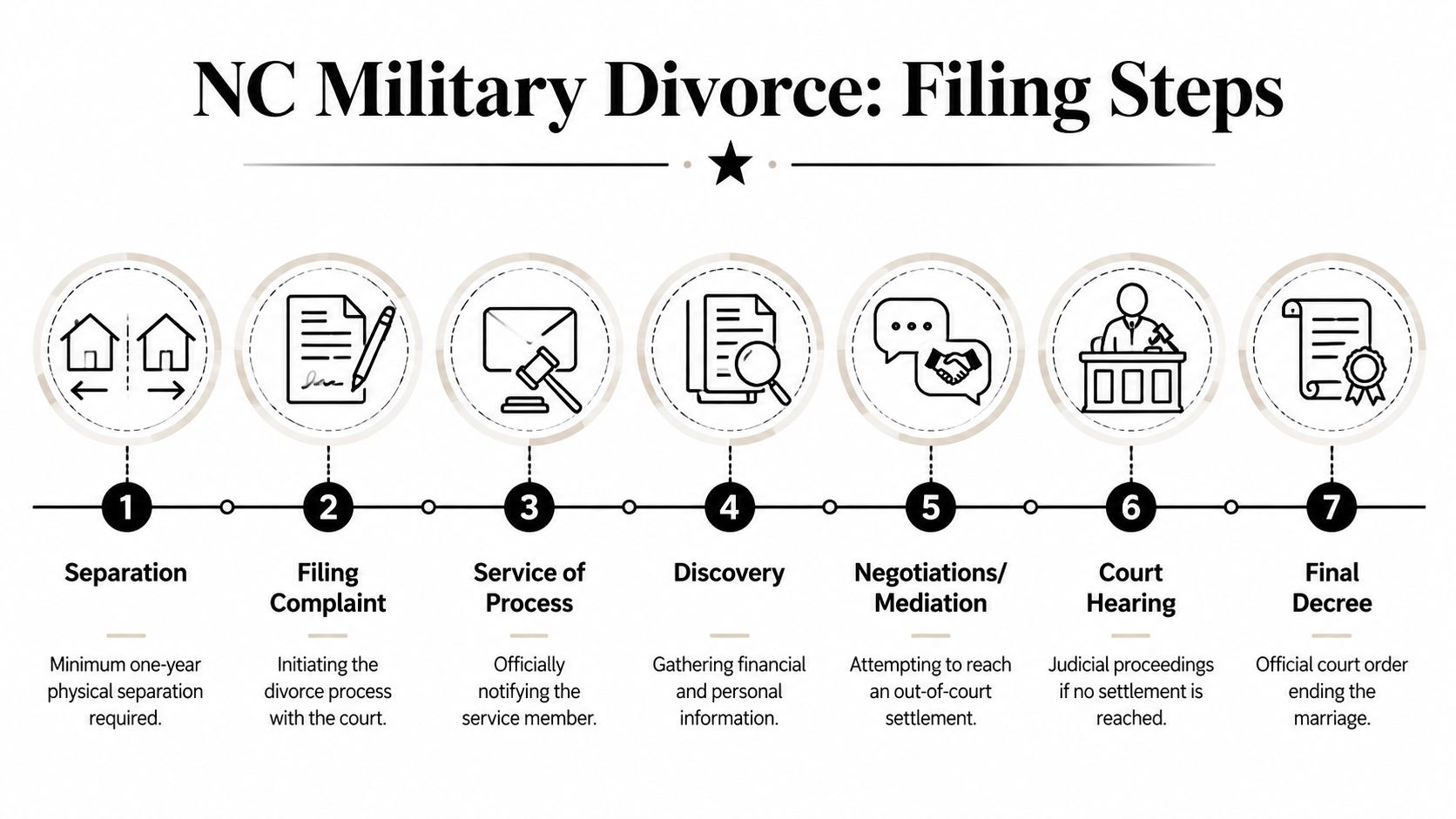
This timeline graphic gives a useful overview of the process from separation through final decree.
The steps that matter most
Pin down the legal separation date
North Carolina requires separate residences, not just separate bedrooms. The separation also has to be accompanied by intent to remain apart permanently. In military cases, that intent should be documented carefully because PCS orders, temporary duty, and deployments can blur what was voluntary separation and what was military necessity.Test whether the separation was continuous
Federal military life and North Carolina divorce law often clash on this point. A spouse may be away for service reasons, but the court still looks at the actual facts of the marriage and living arrangement. Filing before the year is complete can delay the case and create avoidable expense.Confirm North Carolina residency and venue
Before drafting anything, confirm that North Carolina is the right state and the right county for filing. Military families often have ties to several states at once, and choosing the wrong forum can create service problems, delay, or disputes over whether the court can move the case forward.Prepare the complaint and military-related filings correctly
The divorce complaint is only part of the package. If the other spouse is on active duty, the court will expect paperwork addressing military status so the case proceeds in a way that respects federal protections as well as state procedure.File with the clerk and address fees
The complaint must be filed in the proper county. Some people qualify to ask the court to waive costs, but that should be handled with the same care as the rest of the filing.Serve the other spouse the right way
Service is often where self-filed military cases start to break down. Out-of-state service, overseas service, and service on an active-duty spouse each raise different practical issues. A technically defective service attempt can stall the case even if everyone knows the divorce is coming.Assert related claims before they are lost
This step gets missed more often than it should. Equitable distribution, post-separation support, alimony, and other claims need to be reviewed before the divorce is finalized. Once absolute divorce is entered, some claims can be barred if they were not properly preserved.
The filing mistakes I see most often
The biggest mistake is treating the divorce filing as paperwork only. In a military case, timing and sequence matter.
For example, a spouse may be ready to file as soon as the calendar reaches one year from the move-out date. But if the parties resumed the marital relationship in a legally meaningful way, or if the facts around separation were never clean to begin with, the court may not see that year the same way they do. That problem is especially common when deployment schedules and leave periods interrupt an already messy separation.
This video offers a general visual explanation of the process and can help orient you before you focus on the military-specific issues:
Filing too soon is not a harmless mistake. It can cost time, money, and your negotiating position.
What works in practice
The smoother cases usually start with a written timeline. I want to know when the parties separated, where each spouse lived, what military orders were in effect, whether there were visits or reconciliations, and whether any property or support claims need to be filed before the divorce judgment is entered.
That early review often changes strategy. Sometimes the right answer is to file promptly. Sometimes the better answer is to wait, clean up the record, and avoid a preventable challenge. In military divorce cases, that judgment call can make the difference between an orderly filing and a case that starts with avoidable problems.
Answering Your Top Military Divorce Questions
Can a deployment interrupt the one-year separation period in North Carolina
Yes, it can. A critical but often overlooked issue is that a military deployment can interrupt North Carolina's mandatory one-year continuous physical separation requirement, and that interruption can potentially reset the clock for divorce eligibility, as discussed in the North Carolina Bar resource on military divorce and continuous separation issues.
This is one of the biggest traps in military divorce in North Carolina. People often assume a year has passed and file, only to learn the court views the separation period differently.
Is my spouse entitled to my VA disability benefits as property
VA disability benefits are not treated the same way as divisible marital property. But that does not mean they are irrelevant. In the right case, those benefits may still affect support analysis, which is one reason military divorces need careful financial review instead of broad assumptions.
Can I file in North Carolina if my spouse is stationed overseas
Possibly, yes. The key question is whether North Carolina has jurisdiction over the divorce. If the filing spouse meets the state's residency requirement, a case may still be filed here even when the other spouse is overseas. Service of process and SCRA issues then need to be handled carefully.
Will the court wait if I'm on active duty and can't participate
Often, yes, if military duties materially affect your ability to appear or respond. That protection comes from the SCRA. It is meant to prevent unfair proceedings while a servicemember is unable to participate meaningfully because of service obligations.
What should I gather before meeting with a lawyer
Bring what shows the timeline and the money. That usually means:
- Separation information: Dates, addresses, and any events that may have interrupted separation
- Military records: Orders, LES records, and retirement-related documents if available
- Family information: Existing custody arrangements, school information, and any deployment schedule affecting the children
- Court paperwork: Anything already filed or served
The first meeting is usually more productive when the timeline is clear. In military cases, dates often drive the legal strategy.
Schedule Your Confidential Consultation Today
A spouse gets transferred, the family keeps using the same house off and on, and everyone assumes the one-year separation clock is running. In North Carolina, that assumption can create a serious problem. If the separation was not continuous, or if living arrangements during deployment blurred whether the parties were separate, the case may not be ready for an absolute divorce when you think it is.
Military divorce often turns on the gap between what seems practical for service life and what North Carolina law requires. Federal protections may delay a case or affect how it proceeds. State law still controls issues like divorce grounds, equitable distribution, custody, and support. If those rules are not lined up correctly from the start, the result can be delay, added expense, or a settlement that misses an issue you should have addressed.
Good legal advice helps you sort out those conflicts before they become expensive mistakes. That includes checking whether North Carolina is the right place to file, whether SCRA protections may affect timing, how military pay and benefits should be treated in support or property discussions, and whether your separation timeline will hold up if challenged.
Careful planning does not guarantee an outcome. It does put you in a stronger position to make informed decisions, protect your rights, and avoid preventable errors that are common in military cases.
If you are considering a military divorce in North Carolina, a confidential consultation can help you identify the pressure points early and decide what to do next.
Schedule Your Confidential Consultation Today
A service member is set to PCS in a few weeks. The other spouse wants to file now, protect parenting time, and make sure military pay and retirement issues are handled correctly. In North Carolina, those decisions can affect jurisdiction, timing, and settlement advantage much earlier than many families expect.
Military divorce cases often get harder at the point where federal rules and North Carolina law do not line up neatly. A missed filing decision can leave the wrong court involved. An incomplete review of LES statements, retirement information, or housing allowances can distort support and property discussions. A parenting proposal that sounds workable on paper may fail once training, deployment, or relocation orders enter the picture.
The Law Office of Bryan Fagan handles North Carolina family law matters, including divorce, equitable distribution, child custody, child support, and spousal support. In a military divorce, legal advice should do more than answer general questions. It should identify the pressure points in your case, flag avoidable mistakes, and give you a practical plan for what to file, what to preserve, and what to address before the other side sets the pace.
If you are facing a military divorce in North Carolina, schedule a confidential consultation. Bring your separation timeline, any court filings or military orders, recent pay records, and your questions. A focused case review can help you understand your options, protect your position, and make decisions with a clear view of both North Carolina law and the military rules affecting your case.