When parents first call about custody, they usually ask some version of the same question: what does the judge want to see? They've heard advice from friends, read generic articles online, and already know the case feels personal. What they usually don't know is that North Carolina custody decisions are rarely won by the parent who sounds the most upset or the most confident.
They're built by the parent who can show a clear, steady, child-focused pattern.
If you're preparing for a custody case, or trying to defend your current role in your child's life, the most useful starting point is this: judges don't reward slogans. They evaluate facts. They look at how your child is doing, what each parent has been doing, and what arrangement is most likely to protect stability going forward.
Preparing for Your North Carolina Custody Case
You may be dealing with school pickups, missed exchanges, tense text messages, and the fear that one hearing could affect your child's daily life for years. That fear is real. So is the confusion. Many parents walk into this process thinking the court must prefer equal time, or mothers, or the parent with the stronger accusations.
That's usually the wrong frame.
A better frame is this: North Carolina custody cases turn on what helps the child most, and your job is to prove your version of that with specific, credible evidence. A parent who says, “I've always been the one handling school,” is making an argument. A parent who brings attendance records, teacher emails, appointment confirmations, and a workable parenting schedule is building a case.

Consider a common example. One parent insists the other is unreliable. But when the case gets close to court, the reliable parent has no calendar, no school communications, no medical records, and no organized summary of who handled what. Meanwhile, the other parent shows up with records, names of teachers, exchange notes, and a child-centered plan. The court can only rule on what it can evaluate.
Good custody strategy starts long before the hearing. It starts the moment you realize your conduct, records, and communication may become evidence.
No lawyer can promise an outcome. But a parent who understands what the court is looking for is in a far better position than a parent who treats custody like a character contest. In North Carolina, preparation matters because the court is looking for substance, not theater.
The Only Rule That Matters The Best Interests of the Child
North Carolina custody law is built around one controlling standard: the best interests of the child. According to the UNC School of Government bench book on child custody, judges are not required to begin with any presumption of 50/50 custody, sole custody, or a preference for mothers or fathers. The court weighs the facts of the child's actual life, including safety, daily care history, schooling, and stability.
That point changes how a case should be prepared.
A lot of parents come in expecting custody to work like a formula. They assume equal time is the default unless someone proves the other parent is unfit. Or they assume one parent starts with an advantage. In North Carolina, that's not the framework. The judge has broad room to evaluate the family in front of the court, not a script from someone else's case.
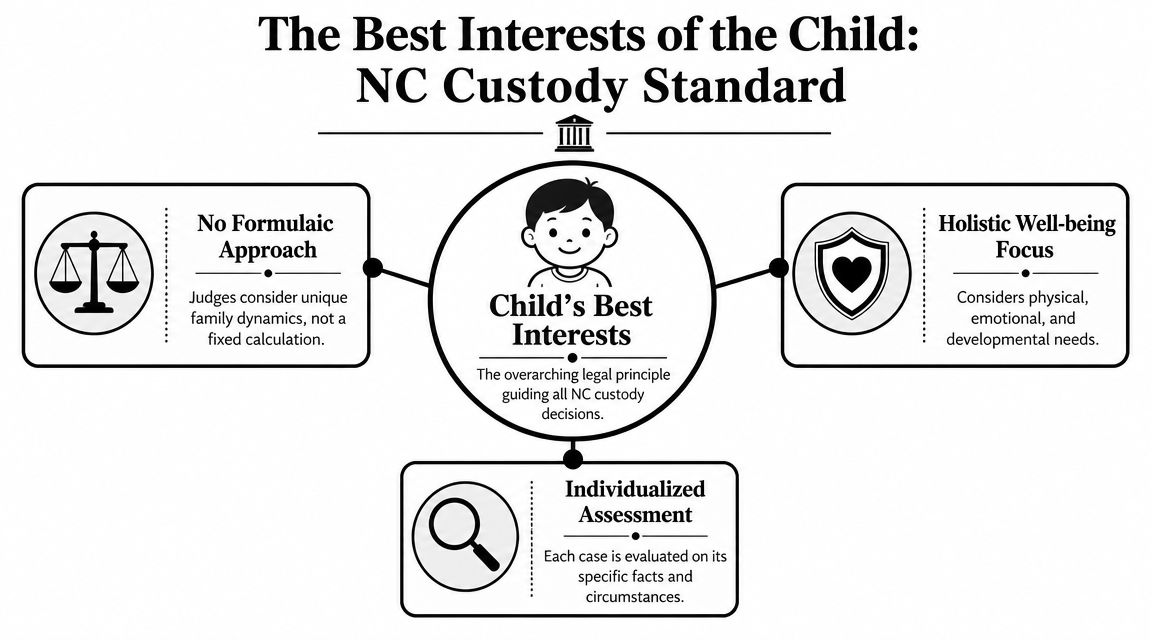
Core principle: The question is not “What seems fair to the parents?” The question is “What arrangement serves this child's best interests?”
What this means in practice
Think of the best-interests standard as a wide-angle review of your child's life. The court isn't just asking where the child sleeps. It's looking at who gets the child ready for school, who knows the doctor, who handles medication, who keeps routines steady, and who is more likely to reduce conflict instead of intensify it.
That also means broad emotional arguments often miss the mark. Saying “I love my child more than anything” may be true, but it doesn't answer the legal question. The judge needs usable facts. A good custody presentation ties each fact back to the child's welfare.
If you want a fuller explanation of how this legal standard works, this discussion of the best interest of the child in NC gives additional context.
What parents often get wrong
The most common mistake is treating custody like a referendum on the other parent's flaws. Judges do care about serious safety issues. But many cases are not about proving the other parent is a bad person. They are about showing why your proposed arrangement better supports the child's day-to-day life.
That's why the custody strategy North Carolina judges look for is usually disciplined, not dramatic. It focuses on the child's needs, not on punishing the other side. It shows patterns. It avoids overclaiming. And it recognizes that in a fact-driven system, proof beats indignation.
What North Carolina Judges Evaluate Key Custody Factors
North Carolina's custody statute, N.C. Gen. Stat. § 50-13.2, gives judges broad discretion to consider all relevant circumstances. Secondary North Carolina guidance consistently points to the same practical factors, including the child's age and health, each parent's ability to provide a safe home, the child's relationship with each parent, domestic violence history, and the child's preference if mature enough, as explained in this North Carolina child custody guide discussing § 50-13.2.
That list matters because your strategy should track the factors the court can use.
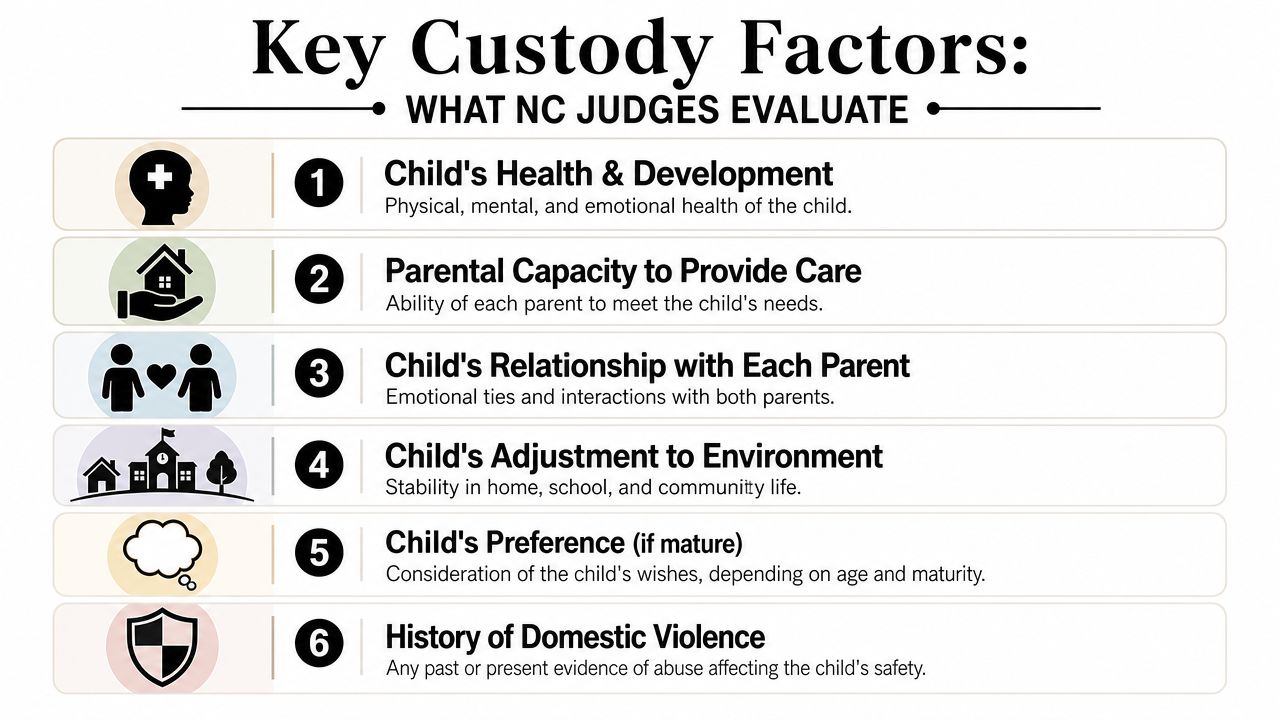
The factors in plain English
- The child's age and health means the court looks at developmental needs, medical issues, emotional functioning, and how much structure or supervision the child needs.
- Each parent's mental and physical health doesn't mean perfection. It means whether a parent can safely and consistently meet the child's needs.
- A safe home includes more than housing. The court is looking at stability, supervision, basic care, and whether the child is secure there.
- Relationships with parents and siblings matter because continuity of attachment affects children in practical ways.
- Adjustment to home, school, and community includes classroom performance, attendance, support services, friendships, sports, and routine.
- Domestic violence history matters because safety comes first.
- The child's preference, if mature enough may be considered, but it is one factor, not the whole case.
For a broader discussion of court decision-making, this page on how judges decide custody in North Carolina is useful.
A short video can also help frame how these issues show up in real disputes.
How judges connect these factors to daily life
Parents sometimes hear these factors and think they sound vague. In court, they become concrete very quickly.
A child's adjustment to school may involve attendance issues, late pickups, behavior reports, tutoring needs, or special education support. A parent's ability to provide care may involve work schedule reality, transportation consistency, medication follow-through, meal routines, and whether the parent keeps the child's life organized.
This is how to understand it:
| Factor | What a judge may be trying to understand |
|---|---|
| Stability | Which parent can keep routines steady without unnecessary disruption |
| Caregiving history | Who has actually handled the child's daily needs over time |
| Safety | Whether there are risks in either home that affect the child's welfare |
| Relationships | Whether the child has strong, healthy bonds that should be preserved |
| Maturity and judgment | Which parent makes decisions that put the child first |
Courts don't award custody based on who presents the most polished story. They evaluate which facts show a healthier, more stable path for the child.
Building Your Custody Strategy with Persuasive Evidence
A parent walks into court saying, “I've always been there for my child.” The other parent says the same thing. The judge cannot rule on sincerity alone. The judge looks for records, witnesses, and specific facts that show who handles the child's life in a steady, reliable way.
That is why custody strategy in North Carolina is really evidence strategy.
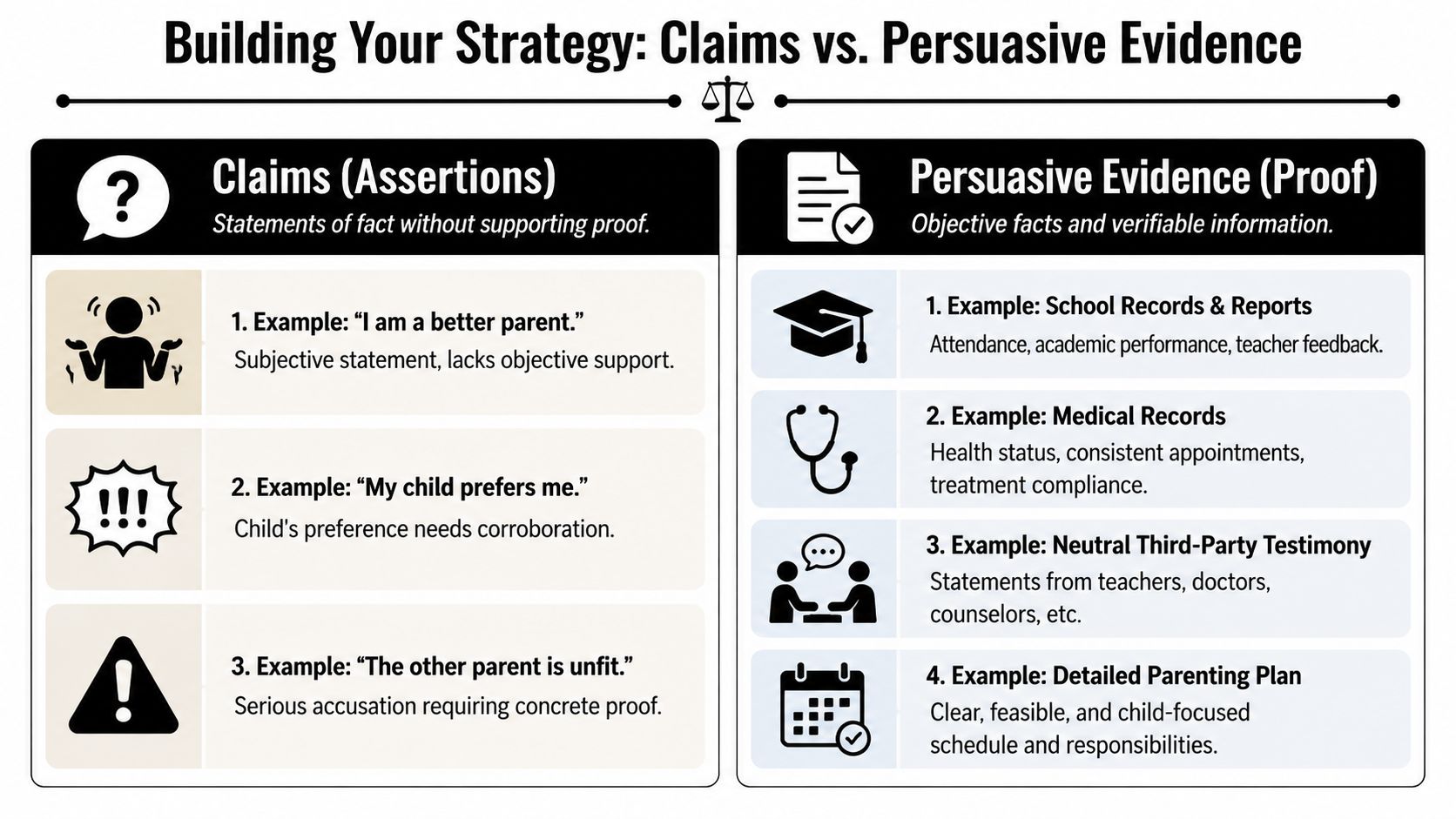
Judges are persuaded by proof tied to daily parenting
General statements rarely decide a custody case. Specific proof often does.
A parent who says, “I support my child's education,” is offering a conclusion. A parent who brings school attendance records, email chains with teachers, report cards, tutoring records, and notes from parent conferences is showing the court what that support looks like in real life. The same rule applies to medical care, therapy, extracurriculars, and day-to-day routines.
I tell clients to build evidence around the question a judge is asking: What facts show that this parent meets the child's needs, follows through, and makes sound decisions?
What usually carries weight in court
Strong custody evidence tends to fall into a few categories. The point is not to collect everything possible. The point is to gather the items that prove a pattern.
- School records that show attendance, tardies, grades, behavior issues, special education services, and which parent communicates with the school
- Medical and mental health records that show appointments, diagnoses, treatment recommendations, prescription follow-through, and who brings the child to care
- Calendars and parenting logs that show overnights, exchanges, missed visits, childcare arrangements, and who handled schedule changes
- Communications such as texts, emails, and portal messages that show cooperation, notice of problems, decision-making, or repeated failure to respond
- Neutral witness testimony from teachers, counselors, coaches, daycare staff, or medical providers with direct observations
- A detailed parenting proposal that covers school nights, holidays, transportation, exchange times, and decision-making without creating constant conflict
In some cases, a formal assessment also becomes part of the record. This overview of the custody evaluation process in NC explains how that process can affect the evidence a judge sees.
The difference between a weak point and a persuasive one
This is the gap I see in many custody cases:
| Weak approach | Persuasive approach |
|---|---|
| “I am the primary parent” | School contacts, appointment history, daycare records, and calendars showing regular caregiving over time |
| “The other parent is irresponsible” | Missed pickups, unpaid activity fees, failure to attend appointments, or messages showing repeated lack of follow-through |
| “My child does worse in that home” | Attendance records, grade changes, counseling notes if properly introduced, and testimony tied to the child's actual functioning |
| “I can provide stability” | A realistic schedule, a workable transportation plan, consistent housing, and records showing routines are already in place |
The stronger version gives the court something concrete to rely on.
Organization matters almost as much as the records themselves
Judges and attorneys deal with crowded calendars and high-conflict allegations all the time. A stack of disorganized screenshots usually does not help much. A clean timeline with labeled exhibits, short explanations, and supporting documents is far more useful.
Good evidence presentation usually has three traits:
- It is chronological. The court can follow what happened and when.
- It is tied to a custody issue. Each document connects to schooling, health, safety, scheduling, or parenting judgment.
- It is proportionate. Ten focused exhibits beat a hundred pages of repetitive accusations.
Evidence that often hurts more than it helps
Parents sometimes bring in material that feels important but carries little weight. Family members repeating what they were told. Social media posts with no clear connection to the child. Long text chains full of insults from both sides. Records with no witness available to explain them.
Exaggeration is another problem. If a parent claims the other side “never” helps, and cross-examination shows regular involvement, credibility takes a hit. Judges notice overstatement quickly.
If there is a serious issue, prove it carefully. Use dates, records, and witnesses. Tie the concern to the child's welfare, not your frustration with the other parent.
One practical option for parents who need case-specific help is to work with a North Carolina family law attorney who can sort records, prepare testimony, and decide what evidence is worth presenting. The Law Office of Bryan Fagan is one North Carolina-focused firm handling child custody matters.
Presenting Your Case How Your Actions In and Out of Court Matter
Judges don't just review documents. They also evaluate judgment. That happens in the courtroom, in your communications with the other parent, and often through the digital trail people forget they're creating.
Courtroom conduct sends a message
The parent who interrupts, rolls their eyes, or treats the hearing like a personal showdown usually does themselves no favors. A judge is watching how you handle stress, whether you listen, and whether you can stay focused on the child even when you're frustrated.
A few practical habits matter:
- Dress appropriately and appear prepared with your papers organized.
- Answer the question asked instead of giving speeches.
- Stay calm during testimony even if the other side says things you strongly dispute.
- Address the court respectfully and let your lawyer object or clarify when needed.
Your texts, emails, and posts may become exhibits
Most parents know they should be careful in court. Many are less careful in daily communication. That's a mistake.
If you send texts that insult the other parent, threaten to withhold the child, or drag the child into adult conflict, those messages can undermine your claim that you promote stability. The same goes for social media. Posts about partying, mocking the other parent, discussing the case publicly, or showing poor judgment can all become part of how the court views your credibility.
The parent who looks more likely to reduce conflict often looks more credible.
What judges often infer from behavior
Conduct outside court can signal whether a parent will support the child's relationship with the other parent when appropriate. That matters. Courts often look favorably on the parent who communicates clearly, follows schedules, avoids using the child as a messenger, and doesn't speak negatively about the other parent in front of the child.
A simple example shows the difference. Parent A sends repeated messages saying, “You're a terrible parent and the child doesn't want to see you.” Parent B responds with, “Pickup is at the usual time. Please confirm.” Even if Parent B is equally frustrated, the record tells a very different story.
If the other parent is difficult, your best move usually isn't matching the tone. It's building a better record.
Frequently Asked Questions About NC Custody Strategy
How does strategy change if I'm trying to modify an existing custody order
A modification case is different from an initial custody case. In North Carolina, the moving party must prove a substantial change of circumstances affecting the child's welfare by the greater weight of the evidence, as explained in this North Carolina custody modification training video. That makes modification strategy more demanding.
The first question is not merely what arrangement would be better now. The first question is whether the legal threshold to reopen custody has been met. If you're seeking modification, your evidence must show an important change tied to the child's welfare. If you're defending against modification, your strategy often focuses on whether the claimed changes are substantial and whether they significantly affect the child.
How much weight does a judge give my child's preference
A child's preference can matter if the child is mature enough, but it is not automatic control over the outcome. Judges don't hand the decision to the child. They consider maturity, reasoning, and whether the preference appears independent or shaped by pressure, conflict, or short-term preferences.
Parents often make a serious mistake here by coaching the child or repeatedly asking where the child wants to live. That can damage both the child and the case. A better strategy is to avoid putting the child in the middle and let the court handle the issue appropriately.
Can my social media posts really be used against me
Yes. If a post speaks to your judgment, parenting, conflict level, substance use, living situation, or credibility, it can become relevant. Even posts you think are private can circulate.
The practical rule is simple:
- Don't discuss the case online
- Don't attack the other parent
- Don't post content that contradicts the image you want to present in court
- Don't assume deleting something fixes the problem if someone already saved it
Do I need to prove the other parent is unfit to get a better custody arrangement
Usually, no. Many parents think custody is won only by proving the other parent is unfit. That isn't how most cases work. The stronger approach is often to show why your requested arrangement better supports the child's stability, routine, education, health, and relationships.
That said, if there are serious safety concerns, they need to be documented and presented carefully. The key is to stay evidence-based. Serious allegations without proof can hurt the person making them.
Develop Your Judge-Focused Custody Plan with Our Help
A parent walks into court with a stack of text messages, a lot of frustration, and a firm belief that the judge will "see what kind of person" the other parent is. Another parent walks in with a proposed schedule, school attendance records, medical appointment history, daycare payment records, and a witness who can explain the child's routine. The second parent usually presents the stronger custody case.
That is the essential task in a North Carolina custody dispute. Judges are not looking for the most upset parent. They are looking for proof. They want to see what arrangement serves the child, what facts support that request, and whether the parent asking for relief has done the work to document daily parenting.
Good preparation is specific. It often means collecting the records that show who gets the child to school, who handles counseling or medical care, what communication between the parents looks like, and whether your proposed schedule fits the child's life as it exists now. In modification cases, it also means identifying what has changed since the last order and what documents prove that change.
I tell clients to stop thinking in themes and start thinking in exhibits. "I am the more involved parent" is a theme. A calendar of overnights, school portal logs, report cards, appointment summaries, prescription records, reimbursement requests, and neutral witness testimony are exhibits. North Carolina judges decide cases based on evidence they can trust.
The parents who present best in court are usually the ones who prepare early, stay consistent, and back up their claims with records.
Custody cases also involve trade-offs. A schedule can sound fair on paper and still fail if it ignores school start times, a parent's work hours, therapy appointments, or long exchanges between homes. A legal review should focus on the facts a judge is likely to care about, the weak spots the other side will press, and the documents or testimony that can make the difference.
If you're facing a custody dispute or need to modify an existing order, schedule a consultation with the Law Office of Bryan Fagan. We help North Carolina parents sort the useful facts from the distracting ones, organize persuasive evidence, and build a custody plan that can hold up in court.