When considering how to win a divorce case in North Carolina, you're probably not thinking in legal categories. You're thinking about your house, your children, your paycheck, your retirement, and what life looks like when this is over.
That instinct is understandable. But in North Carolina, "winning" usually doesn't mean delivering a dramatic courtroom speech or proving your spouse was the bad actor. It means making smart procedural decisions early, preserving the claims that matter, and building a file that holds up when negotiation gets serious or a judge needs proof.
Understanding What Winning Means in a North Carolina Divorce
North Carolina gives people a simple path to an absolute divorce because it is a no-fault divorce state. For the divorce itself, the court generally isn't deciding who caused the marriage to fail. That changes the strategy. If you're focused only on blame, you're often focused on the wrong fight.
The danger is much more practical. Many people think they just need to wait out the separation period, file for divorce, and move on. But North Carolina treats property division, alimony, child support, custody, and divorce as distinct issues, and failing to preserve those claims before the divorce is finalized can mean losing rights you can't get back, as explained in the North Carolina State Bar overview of divorce.
The divorce decree is not the whole case
A client may say, "I just want the divorce over with." Sometimes that's emotionally understandable and legally risky.
If the marriage includes a house, retirement accounts, debt, a family business interest, support needs, or children, the absolute divorce is only one part of the picture. A quick decree can feel like relief in the moment and create expensive problems later if the financial and parenting issues weren't handled properly.
Practical rule: In many North Carolina cases, the person who "wins" is the one who plans for life after the divorce, not the one who rushes to get the marriage formally ended.
What works and what doesn't
What works:
- Thinking long term: Focus on property, support, custody, and enforceable agreements.
- Preserving claims early: Raise the issues that matter before your bargaining power wanes.
- Using documents, not accusations: Courts decide cases based on evidence.
What doesn't:
- Treating divorce like a morality contest: That rarely controls the result of the divorce itself.
- Finalizing too soon: Speed can cost you bargaining power.
- Assuming fairness will sort itself out: It won't unless the record supports your position.
A practical example helps. If one spouse files for absolute divorce before addressing property division or alimony, that spouse may feel proactive. In reality, the filing can weaken the other side's incentive to settle and may affect whether key claims remain available. That isn't a strategic win. It's a strategic mistake.
Laying the Groundwork The Mandatory One-Year Separation
North Carolina divorce law is unforgiving about timing. Before you think about hearings, negotiations, or property division, you need to satisfy the threshold rules for the divorce itself.
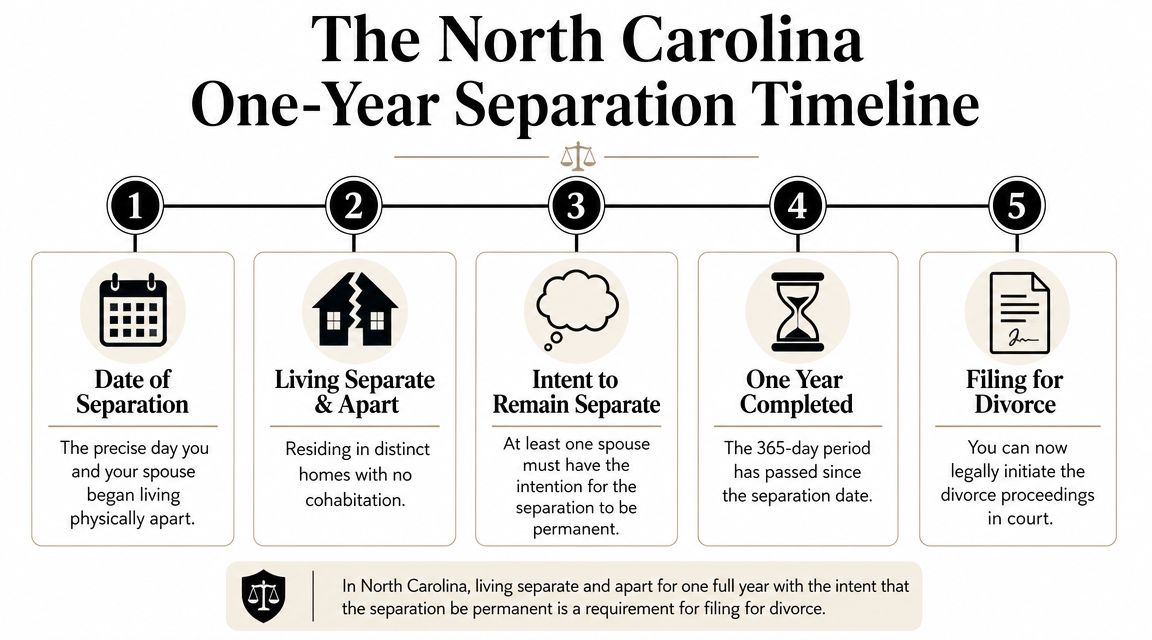
The central requirement is simple to say and easy to mishandle. Spouses must live separate and apart for 12 consecutive months, and at least one spouse must intend for the separation to be permanent. At least one spouse must also have been a North Carolina resident for six months before filing for absolute divorce, as discussed in this North Carolina separation rule guide.
What separate and apart really means
Separation is generally understood to occur when one spouse moves out. The harder cases involve money problems, children, or housing shortages that keep both spouses under one roof.
North Carolina guidance recognizes that living in different parts of the same home can sometimes qualify, but only with strong proof that the spouses are genuinely holding themselves out as separated, and cohabitation can reset the clock, as noted in this North Carolina divorce discussion of separation under one roof.
That means details matter. A court may look at whether you sleep in separate bedrooms, stop functioning as a couple socially, separate finances where possible, and act consistently with a permanent break.
Proof problems that derail cases
People often lose time because they guessed instead of documenting. The date of separation shouldn't be a rough estimate if the case may later become contested.
Use practical proof such as:
- Housing evidence: Lease changes, move-out records, or address changes
- Household records: Utility bills, mailing records, and account statements
- Third-party proof: Sworn affidavits from people who know when the separation began
- Conduct evidence: Separate bedrooms, separate routines, and no public presentation as a couple
If you reconcile, even briefly, you need to talk with counsel about whether the separation period has been interrupted. Many people underestimate how quickly that issue can complicate a filing.
A real-world example
Suppose a couple stops sharing a bedroom in January, but they continue attending events together as spouses, sharing meals, and telling family they're "working things out." One spouse later claims the separation began in January. The other disputes it. That case now has a proof problem.
By contrast, a stronger file shows a clear separation date, changed mailing information, separate sleeping arrangements, separate financial behavior where possible, and consistent communication that the relationship had ended.
If you want to know how to win a divorce case in North Carolina, start here. Get the separation date right. Protect the evidence. Don't let impatience create a procedural failure.
Building Your Case Gathering Crucial Evidence and Documents
A divorce case gets stronger when the paper trail gets stronger. Courts don't divide property, decide support, or evaluate credibility based on who sounds more upset. They rely on records.
The strongest file is built around dates and documents, not accusations. Key evidence can include lease changes, utility records, and sworn affidavits confirming the separation date, and one North Carolina process guide notes that the responding spouse generally has 30 days to answer after service, making proof of service and timing important parts of a clean case file, as described in this North Carolina divorce process guide.
Start with the documents that define your financial life
Some records are obvious. Others get overlooked until they become hard to find.
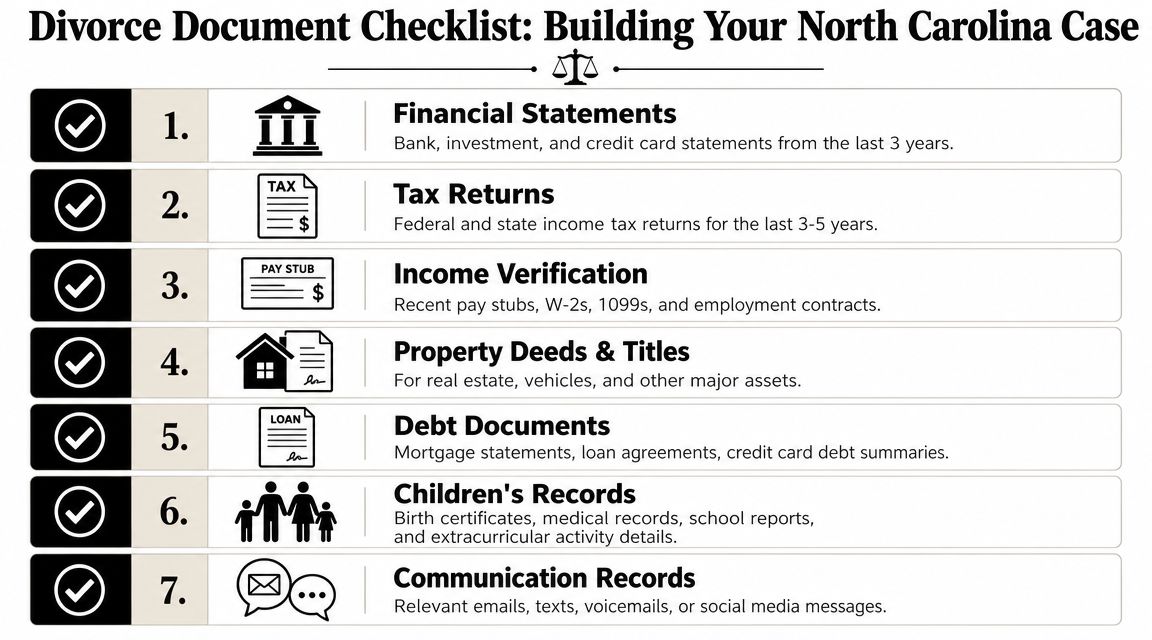
Gather these first:
- Income records: Recent pay stubs, W-2s, 1099s, bonus information, and employment contracts
- Tax returns: Federal and state returns, with schedules and attachments
- Bank records: Checking, savings, and money market statements
- Retirement and investment records: Statements for pensions, IRAs, brokerage accounts, and employer plans
- Real property documents: Deeds, mortgage statements, refinance paperwork, and home equity records
- Debt records: Credit cards, personal loans, auto loans, and lines of credit
- Insurance records: Health, life, homeowners, and auto policies
- Business records: Ownership documents, profit and loss statements, and account access records if one spouse owns a business
Why timing matters
A document isn't just a document. It helps answer a legal question.
A bank statement may show whether funds existed before marriage, during marriage, or after separation. A retirement statement may help trace what portion was accumulated during the marriage. A deed can help identify title history. A loan statement can show whether a debt was marital, separate, or incurred after separation.
Case-building habit: Save records in a way that lets your attorney compare assets and debts across time, especially around the date of marriage, the date of separation, and the period leading to filing.
Don't ignore children-related records
If custody or support is in dispute, financial documents aren't enough.
You may also need:
- School records: Attendance, grades, teacher communications, and schedules
- Medical information: Appointment records, prescriptions, and provider contact details
- Childcare records: Payment histories and provider agreements
- Communication records: Messages about exchanges, parenting decisions, and emergencies
What discovery looks like in practice
In a contested case, both sides may use formal discovery. That can include written questions, requests for documents, and other tools used to verify income, assets, debts, and parenting facts.
A common mistake is assuming discovery will "find everything later." It often reveals gaps, but it doesn't erase the damage caused when records disappear, accounts change, or digital access is cut off.
Here's the practical difference:
| Situation | Likely result |
|---|---|
| You gather records early | Negotiations start from verified facts |
| You wait until conflict escalates | Missing records create disputes and delay |
| You rely on memory | The other side may control the paper trail |
If you're organized, your lawyer can negotiate from strength. If you're not, your lawyer spends time reconstructing what should've been preserved at the start.
Winning the Battles That Matter Property Custody and Support
The legal divorce may be straightforward. The issues that shape your future usually are not.
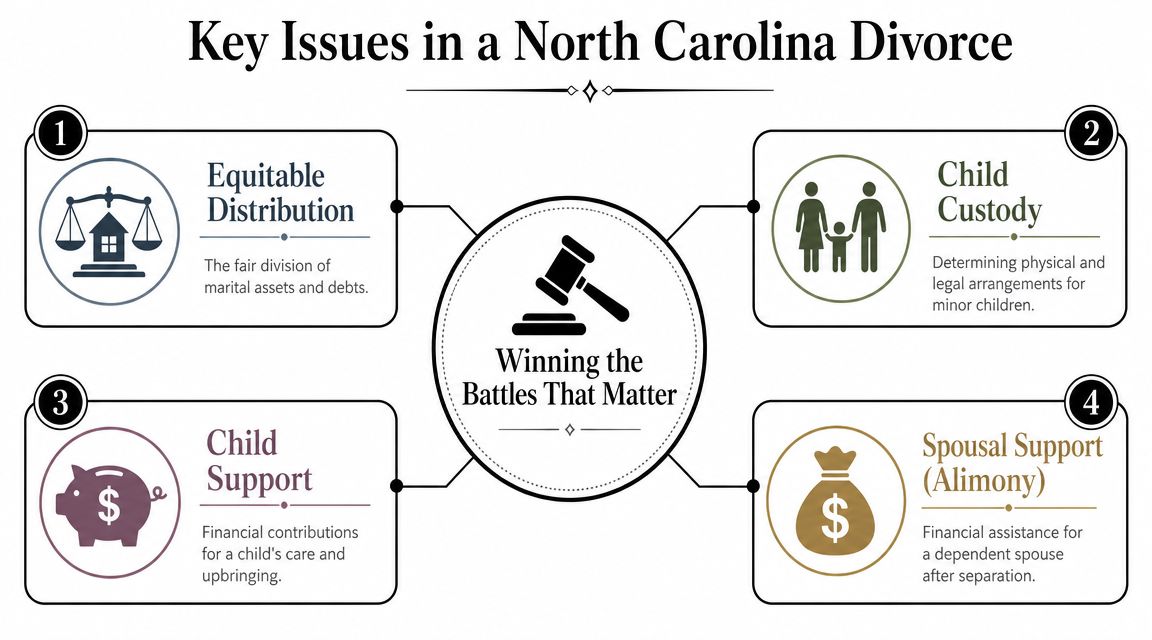
North Carolina reporting on divorce notes that the state had a divorce rate of 3.2 divorces per 1,000 residents in 2021, down from 5.1 per 1,000 in the 1990s, and that divorce cases often revolve around five issues: property, alimony, child support, custody, and the divorce itself, as summarized in this North Carolina divorce rate and case issues discussion. That's why learning how to win a divorce case in North Carolina means focusing on the parts of the case that continue affecting you after the decree is signed.
Equitable distribution
North Carolina uses equitable distribution for marital property. That means the court aims for a fair division, not a reflexive split with no analysis. If you need background on the concept itself, this overview of equitable distribution in North Carolina is a useful starting point.
The first fight is often classification. Is the asset marital, separate, or mixed? Property acquired during the marriage is generally marital property. Gifts and inheritances are treated differently. That sounds clean on paper and becomes messy quickly when accounts were commingled or one spouse handled all finances.
Practical example: a spouse had savings before marriage, then continued using the same account during the marriage for household expenses and payroll deposits. That doesn't make the issue impossible, but it does make tracing more important.
What helps:
- clear account statements
- title records
- purchase documents
- proof of premarital ownership
- evidence showing whether an asset changed character over time
Alimony and post-separation support
Support claims often drive settlement influence. People routinely underestimate them.
The court isn't only looking at who wants support and who doesn't. It looks at need, ability to pay, and the overall financial structure of the marriage and separation. In practice, support issues become far easier to evaluate when both sides have produced reliable income and expense records.
A weak strategy is refusing to disclose finances while demanding support or resisting it. Judges and opposing counsel are persuaded by records, not broad claims that someone is "doing fine" or "can't afford anything."
The strongest support arguments connect real monthly living needs to real financial documents.
This section includes a short video overview that may help if you're trying to understand the issues at a high level before your consultation.
Child custody
Custody disputes are emotionally hard because every parent feels the stakes immediately. The court's focus is the best interests of the child, not which parent is angrier, louder, or more technically correct in every argument.
Parents often help their case by doing ordinary things well and consistently:
- Show reliability: Get children to school, appointments, and activities on time
- Communicate clearly: Keep messages child-focused and calm
- Protect stability: Avoid exposing children to adult conflict
- Respect the other parent's role: Reasonable co-parenting often matters
A poor custody strategy usually looks like overreaching. A parent asks for a result that doesn't match the actual caregiving history, work schedule, or child needs. Judges notice when a position is driven by punishment rather than practicality.
Child support
North Carolina uses guideline worksheets for child support. One source identifies Worksheet A for primary custody, Worksheet B for joint custody, and Worksheet C for split custody, and explains that the calculation depends on factors such as gross monthly income, insurance, extraordinary expenses, and work-related childcare costs, as described in this North Carolina divorce preparation guide focused on support and financial claims.
That means support isn't something either side gets to estimate casually. If income is disputed, if childcare costs aren't documented, or if health insurance information is incomplete, the calculation may be challenged.
A useful way to think about the four major battles is this:
| Issue | What usually wins |
|---|---|
| Property | Classification, tracing, valuation, and records |
| Support | Credible income and expense evidence |
| Custody | Stable parenting conduct and child-focused decisions |
| Child support | Accurate worksheet inputs and documentation |
Choosing Your Path Settlement Negotiations and Courtroom Strategy
A common mistake happens late in the case. One spouse gets tired, wants the marriage over, and agrees to terms that seem good enough. Then the divorce is entered, and the harder questions remain. Who keeps the retirement account. How will debt be divided. Was alimony preserved or waived. In North Carolina, winning often means slowing down long enough to protect those long-term issues before the final divorce is done.
Settlement gives you room to shape the outcome
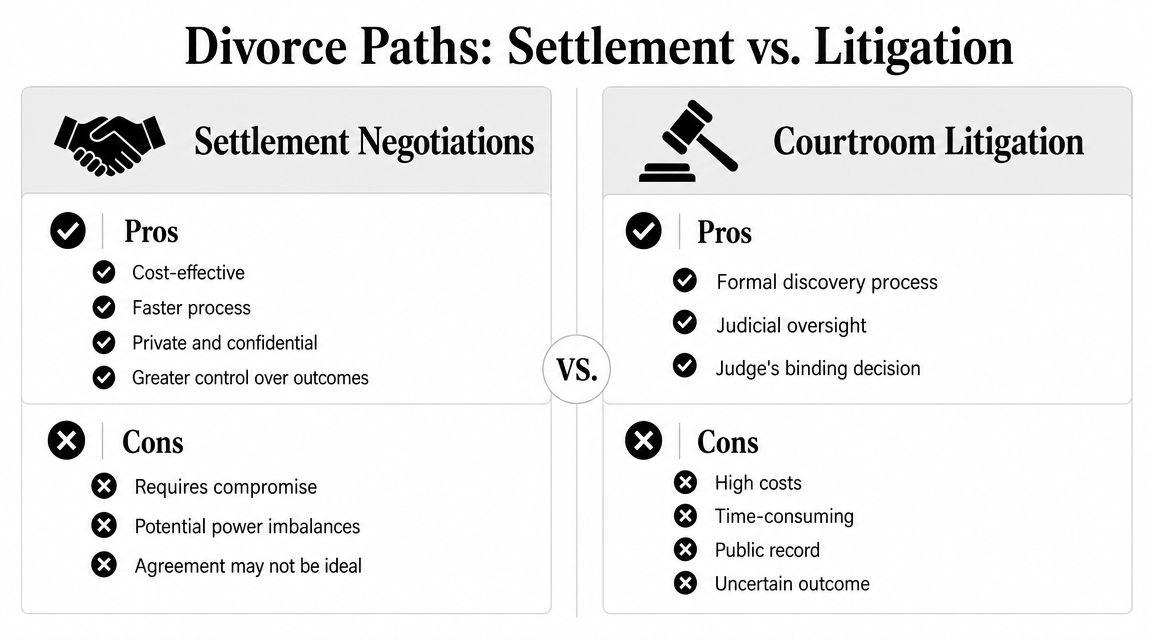
Settlement works best when both sides have enough information to make informed decisions and enough realism to value the case accurately. That may happen through attorney-to-attorney negotiation, mediation, or a settlement conference. The advantage is control. You can reach terms that fit your finances, parenting schedule, and tolerance for risk in ways a court order often cannot.
The trade-off is compromise. Good settlements usually do not give either side everything requested. The question is whether the agreement protects the points that matter years from now, not whether it feels emotionally satisfying on the day it is signed.
I often advise clients to sort issues into three groups before serious negotiations begin:
- Required terms: points tied to financial security, parenting time, safety, or preserving legal claims
- Strong preferences: terms worth pressing for, but not at the cost of blowing up a reasonable settlement
- Flexible terms: issues that can be traded to gain better results on property, support, or custody
That approach keeps negotiations focused. It also reduces the risk of making an expensive concession just to end the stress.
Litigation is sometimes the only practical option
Some cases do not settle because one spouse withholds records, hides income, ignores deadlines, or uses delay as a tactic. In those cases, court is not a failure. Court gives you subpoenas, discovery rules, hearing dates, temporary relief, and a judge who can make binding decisions.
Litigation also has costs. It usually takes longer. It increases legal fees. It places important decisions in the hands of a judge who sees only a slice of your life and has limited time to hear the evidence.
Here is the practical comparison:
| Path | Advantages | Costs and risks |
|---|---|---|
| Settlement | More control, more privacy, more flexible solutions | Requires enough information and a spouse willing to bargain seriously |
| Litigation | Enforceable deadlines, formal discovery, court orders | More expense, more delay, more uncertainty about the final result |
The right strategy depends on the other side's conduct as much as your own goals.
Use settlement pressure and trial preparation together
The strongest cases often do both. Prepare as if the matter will be tried. Negotiate as if a fair agreement is still possible.
That combination matters because serious preparation creates a stronger negotiating position. Organized financial records, a clear proposed parenting plan, accurate valuations, and a credible witness usually produce better offers. If settlement fails, that same work puts you in a stronger position at hearing.
If your case goes to court, credibility matters
Judges pay close attention to judgment, consistency, and preparation. A party who looks organized and reasonable usually has an advantage over a party who looks reactive or evasive.
Focus on basics:
- Answer the question asked
- Follow court orders exactly
- Bring records in a usable format
- Stay calm, even when the other side does not
- Avoid exaggeration
- Let your evidence do the work
Many people hurt their own case by treating the courtroom like a place to vent. It is a place to prove facts.
If you need help choosing between negotiation and trial strategy, work with a lawyer who handles North Carolina family law cases as more than a filing process. The Law Office of Bryan Fagan's North Carolina family law team is one example, and local court experience matters. The larger point is simple. Winning usually comes from protecting claims, gathering proof, and choosing the path that preserves your financial and parental future.
Frequently Asked Questions About North Carolina Divorce
Can I date during the separation period
You should be careful. Dating can complicate negotiations, inflame custody disputes, and affect how the other side approaches support issues. Even when it doesn't change the legal path to divorce itself, it can make the case harder and more expensive.
What if my spouse refuses to sign divorce papers
A spouse doesn't get to veto an absolute divorce by refusing to cooperate. The filing still has to meet North Carolina's procedural requirements, including proper filing and valid service. If service is handled correctly and the case is otherwise in order, refusal alone doesn't stop the process.
Do we have to divide everything before the divorce is final
Not necessarily by agreement, but you do need to think strategically before the divorce is entered. Property division, alimony, custody, and support are separate issues. If you finalize the divorce without preserving the claims that matter, you can lose your advantage and, in some situations, lose rights.
How are debts handled in a North Carolina divorce
Debt usually has to be identified, classified, and allocated just like assets do. The important questions are when the debt was incurred, what it was used for, and whether it should be treated as part of the marital estate or as one spouse's separate responsibility.
Will I have to go to court
Not always. Many cases resolve through negotiation or settlement. But if there are disputes about property, support, custody, or compliance, a court appearance may become necessary. The more organized and realistic both sides are, the better the chance of resolving issues without a full trial.
Protect Your Future with an Experienced North Carolina Divorce Attorney
A common mistake in North Carolina divorce cases happens at the finish line. A spouse gets focused on being divorced as fast as possible, signs off on the final step, and only later learns that property division or support claims were not preserved the right way. By then, the marriage is over, but the financial damage remains.
Winning, in practical terms, means protecting what your life will look like after the divorce is entered. That includes your income, your share of marital property, your parenting position, and your ability to avoid preventable mistakes that are expensive to fix. Good legal advice is not about stirring up conflict. It is about making sure short-term decisions do not cost you long-term rights.
If you are separated, preparing to file, or concerned that something has already been missed, speak with counsel before another deadline or filing decision narrows your options. A lawyer can review your timeline, identify claims that need to be asserted before the divorce is finalized, assess settlement risk, and prepare for court if the other side will not deal fairly. You can learn more about working with a North Carolina divorce lawyer if you want a confidential review of your situation.
The Law Office of Bryan Fagan represents clients in North Carolina divorce and family law matters with a clear focus on strategy, preparation, and protecting long-term outcomes. If you are ready to protect your finances, your parental rights, and your next chapter, schedule a confidential consultation with the Law Office of Bryan Fagan.