You look at the calendar, realize the hearing was this morning, and your stomach drops. That reaction is normal. In custody cases, parents usually know the date matters, but many don't realize how fast a missed court appearance can affect parenting time, temporary arrangements, and the judge's view of the case.
If you're searching for what happens if I miss a custody hearing in NC, the short answer is this: it's serious, but it may still be fixable. What matters most is why you missed court, what the judge did in your absence, and how quickly you act now. North Carolina courts expect people to appear when ordered. That expectation is strict across the court system. For example, in criminal court a missed date can lead to an order for arrest and bond consequences, as discussed in this North Carolina court-date overview. Family court is different, but the same basic message applies. A scheduled hearing is not casual. It is a court order in practice.
Custody hearings also tend to come early. If you're new to the process, this guide to North Carolina child custody laws gives helpful background on how these disputes move through district court.
Introduction A Guide for North Carolina Parents
Missing a custody hearing doesn't always mean you've lost your child forever. It does mean you need to stop guessing and start doing the right things immediately.
A lot of parents miss court for reasons that feel understandable in real life. They were in the emergency room. They wrote the wrong date down. They moved and didn't receive paperwork. Their car broke down on the way to court. The legal system doesn't treat all of those explanations the same way. That distinction matters.
Why the reason for missing court matters
North Carolina judges usually focus on one practical question first. Was this an honest failure that you moved quickly to correct, or did you choose not to show up?
That is the line between excusable neglect and what many judges will view as willful absence. Excusable neglect means a real mistake or problem prevented attendance, and you acted responsibly once you learned what happened. Willful absence usually means you had notice, could have acted, and did not.
Practical rule: The court is much more willing to correct a genuine breakdown than a parent who ignored the hearing and reacted only after an order was entered.
Why speed matters now
A missed hearing can affect a case at a very important stage. In North Carolina, initial custody hearings are often scheduled about 6 to 8 weeks into the case, according to North Carolina custody-hearing guidance. That means the hearing you missed may have been one of the first meaningful chances to shape temporary custody, scheduling, and the judge's early impression of both parents.
If you act quickly, you may be able to set aside what happened or limit the damage. If you wait, the other side can argue that the current arrangement should stay in place because the child needs stability and you didn't take the matter seriously.
The Immediate Aftermath of a Missed Hearing
You miss the hearing, call the clerk later, and learn the judge went forward without you. That is often the turning point. What happens next usually depends on two questions. Was your absence a genuine mistake or emergency, and did the court enter an order before you could respond?
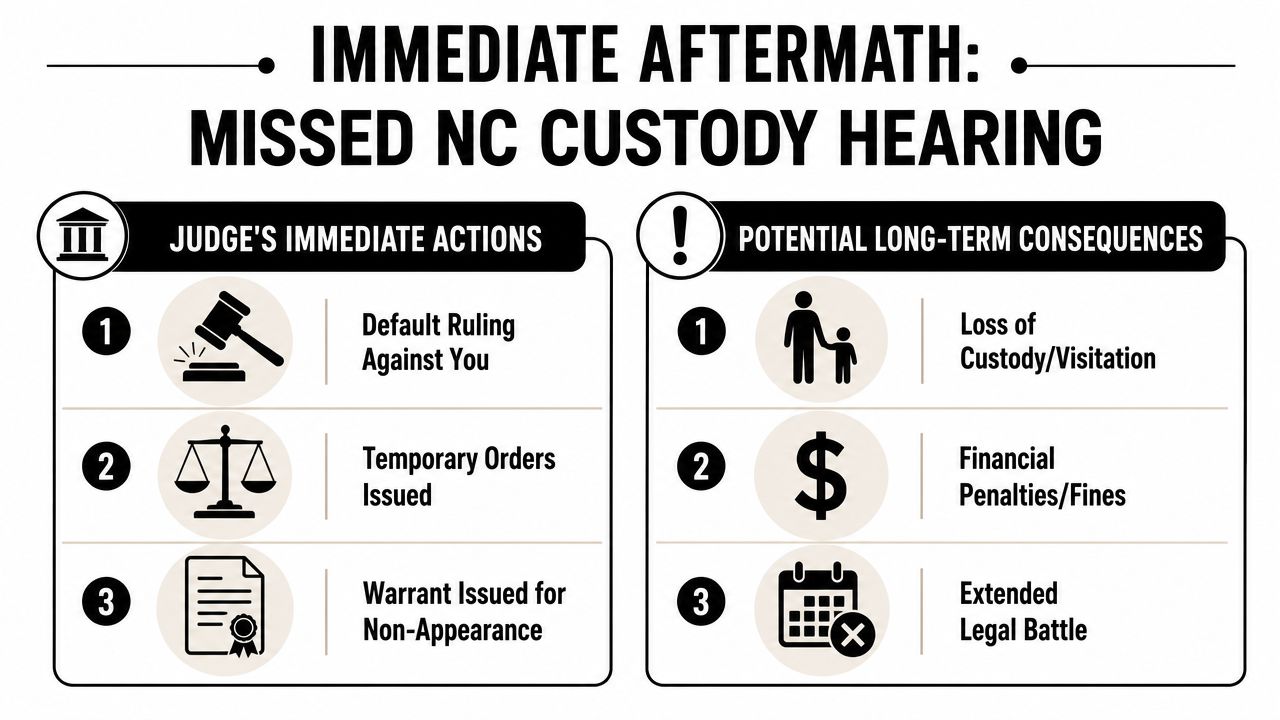
What the judge may have done
In North Carolina custody court, the case often proceeds if one parent appears and the file shows the hearing was properly set. Judges are not required to stop the hearing just because one side is absent. If the court believed you had notice and no valid reason was presented at the time, the judge may have heard the other parent's evidence and ruled on what was pending.
That can create several immediate problems:
- The court may have heard only one side of the facts. If the other parent brought messages, school records, witnesses, or a proposed schedule, that may have been the only evidence the judge considered that day.
- A temporary custody order may have been entered. Many parents treat temporary orders too casually. Even when labeled temporary, they can shape school schedules, exchanges, decision-making, and the practical status quo. If you need background on how those rulings work, this explanation of a temporary custody order in North Carolina gives useful context.
- The judge may have granted the relief requested for that hearing. In practical terms, you may have lost the chance to object, offer your own evidence, or ask for a different parenting arrangement before the order was signed.
Sometimes no order is entered that day. Sometimes a temporary order is entered, and sometimes the court decides a more specific issue that affects the rest of the case. The answer is in the file, not in assumptions.
Why the reason for your absence matters immediately
Many generic articles often stop too early. Missing court does not automatically put every parent in the same position.
A parent who missed court because of a hospitalization, a notice problem, or a documented emergency may have a very different path to relief than a parent who knew about the date and chose not to attend. Judges look hard at that distinction. In practice, it often shapes whether the court sees this as excusable neglect or as willful absence.
That difference matters because it affects what remedy may work later. If the record suggests you ignored the hearing, the court is less likely to undo what happened. If the absence resulted from a real problem and you act promptly, the court may be willing to reconsider the result through the proper procedure, including a Rule 60 motion in the right case.
Default in family court is often more practical than dramatic
Family court rarely looks like television. No one needs to say you "lost everything" for the missed hearing to hurt your case.
The resulting effect is usually narrower and more serious. The court may enter an order based on the evidence presented by the parent who appeared. That order can give the other parent more parenting time, more control over major decisions, or a better starting position for later hearings.
I often tell parents to focus on the paper order and the court record, not the label attached to it. Whether someone calls it a default, an ex parte problem, or a missed appearance issue, the practical question is the same. What did the judge sign, and what procedure is available to challenge it?
The damage is not only legal
A missed hearing can also affect how the court views your reliability.
Judges notice patterns. If the file shows no appearance, no contact with the court, and no prompt effort to correct the problem, the other side may argue that your absence reflects poor judgment or a lack of follow-through as a parent. In custody litigation, those arguments can gain traction if the missed hearing is followed by more delay.
A single missed hearing does not decide every custody case. But the first impression left behind can be hard to undo if you do not address it quickly and with proof.
Your First Steps What to Do Immediately
Panic doesn't help. A fast, organized response does.

Start with the court file
Call the Clerk of Superior Court in the county where your custody case is pending. Ask whether the hearing took place, whether an order was entered, and whether another hearing date has been set. You need facts, not assumptions.
If possible, get a copy of anything entered that day. Your next legal step depends on whether the judge continued the case, entered a temporary order, entered a final order on a pending issue, or noted a service problem.
Preserve the reason you missed court
Don't rely on memory. Gather proof while it's fresh.
Medical issue
Save discharge papers, appointment records, or any documentation showing when and why you were unavailable.Transportation emergency
Keep tow receipts, accident reports, repair invoices, rideshare records, or photos that support your timeline.Notice problem
Save envelopes, returned mail, address records, screenshots, or messages showing you did not receive notice or were served at the wrong place.Work or childcare conflict
Collect schedules, employer emails, school communications, or provider records. These won't always excuse an absence, but they may help explain it.
Don't contact the other parent as your only solution
Some parents think a text message to the other side will fix things. Usually it won't. The other parent cannot undo a court order just by agreeing that you had a good reason.
What works is a documented legal response. That usually means consulting counsel quickly, evaluating whether a motion should be filed, and preparing evidence that supports your explanation.
A short overview may help if you want to hear the issue discussed in plain terms:
Get legal advice before you file something careless
The first filing after a missed hearing matters. An angry, rushed, unsupported motion can hurt more than it helps. A lawyer can review the order, the notice history, and the local court file to decide whether you should ask for a new hearing, seek to set aside an order, raise a service defect, or take a different route.
If you're calling around, ask whether the lawyer regularly handles North Carolina district court custody matters and post-hearing motions. The issue isn't just custody law. It's procedure.
Legal Remedies to Correct a Missed Hearing
Once a hearing has been missed and an order has been entered, the question is no longer whether the judge will be annoyed. The question is what procedural tool fits the problem, and whether the absence looks excusable or deliberate.
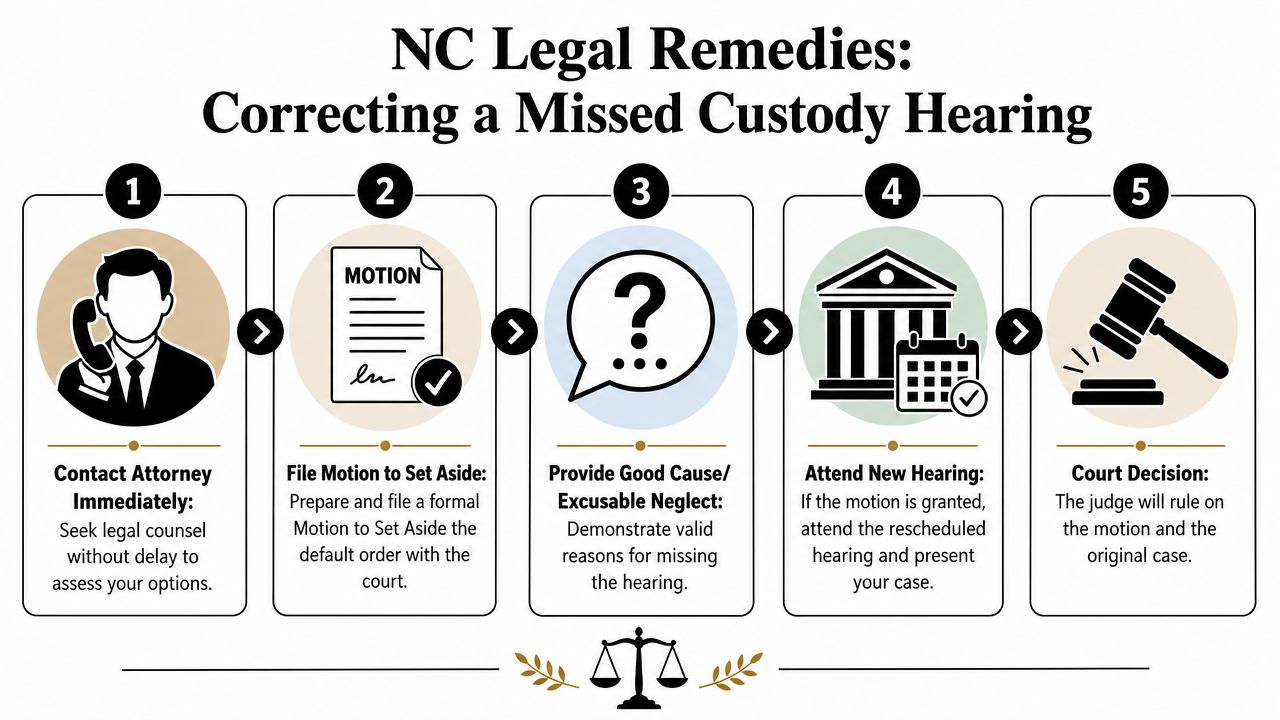
Rule 60 is often the key procedural tool
In North Carolina custody cases, the main remedy is often a motion for relief from an order under N.C. Gen. Stat. § 1A-1, Rule 60(b). Lawyers usually call it a Rule 60 motion or a motion to set aside.
That motion asks the court to reopen or undo an order for a legally recognized reason. The judge is looking for a proper ground under the rule, supported by sworn facts and documents. Regret is not a legal ground.
Timing matters. Rule 60 motions must be filed within a reasonable time, and some grounds carry an outside limit of one year. Which deadline applies depends on why you are asking for relief. A parent who acts quickly usually has a better position, both legally and practically.
Excusable neglect versus willful absence
This is the distinction that decides many of these motions.
A parent who missed court because of a genuine emergency, a notice failure, or another problem that could not reasonably be avoided stands in a very different position from a parent who chose not to appear, ignored the hearing, or treated it as optional. North Carolina judges may use different wording, but they are asking the same basic question. Was this excusable neglect, or was it willful?
| Situation | How courts often view it |
|---|---|
| Sudden hospitalization on the hearing date, supported by records | More consistent with excusable neglect |
| Serious notice problem or defective service | Strong ground for relief |
| Unexpected emergency with prompt follow-up that same day or next day | More favorable than delay |
| “I forgot” with no documentation | Usually viewed poorly |
| Choosing work, vacation, or inconvenience over court | Often treated as willful absence |
| Waiting weeks to respond after learning about the order | Makes relief harder |
In practice, the best motions address both sides of the problem. They explain why the hearing was missed, and they show responsible conduct afterward. If the court sees a real emergency plus prompt action, the request is stronger. If the court sees avoidable absence plus silence, the request is weaker.
Defective service can change the analysis
If you were never properly served, or if the notice did not meet legal requirements, the issue may go beyond excusable neglect. It may be a due process problem.
That matters because relief based on defective service is different from relief based on a good excuse. You are not asking the judge to forgive a mistake. You are arguing that the order should not have been entered against you without proper notice in the first place. For that reason, service defects are often among the strongest grounds to challenge a missed-hearing order.
A useful discussion of how notice problems affect missed custody hearings appears in this notice and missed-hearing analysis.
What a solid motion usually includes
A Rule 60 motion should read like a clear record, not a rant. It usually needs:
- A specific timeline showing when you learned about the hearing, what prevented attendance, and what you did once you found out an order had been entered
- Supporting exhibits such as hospital records, accident reports, phone records, travel disruption records, proof of address, or documents showing defective service
- A stated legal basis under Rule 60(b), or another applicable procedural ground, tied to the facts
- An affidavit or verified facts so the court has evidence, not just argument from a filing
- A real custody position on the merits showing there is an actual dispute the court should hear
One practical point matters here. A weak motion can lock in a bad record. If the filing sounds evasive, leaves out dates, or fails to attach proof, the court may conclude the absence was willful even if the actual situation was more complicated.
One option for parents who need North Carolina counsel on this kind of filing is the Law Office of Bryan Fagan, which handles family law matters including custody disputes and related court proceedings.
Factors the North Carolina Court Considers
A motion to set aside is not decided on one excuse alone. Judges usually look at the full picture.
The quality of your explanation
The court wants a reason that is concrete, believable, and supported. “I had transportation issues” is weak by itself. “My car was struck on the way to court, I called as soon as I could, and here is the report” is very different.
Judges also pay attention to whether your explanation fits the timeline. If your evidence shows you knew about the problem early enough to alert the court and you did nothing, that hurts credibility.
How fast you acted after the missed hearing
Delay is one of the biggest mistakes I see in these situations. A parent may feel embarrassed, avoid the issue for days, and hope the order isn't too bad. That almost never helps.
The court tends to look more favorably on a parent who moved quickly to get the order, gather records, and file an appropriate motion. Fast action suggests responsibility. Silence suggests disregard.
Whether reopening the matter would unfairly harm the other side or the child
North Carolina family court is centered on the child's best interests, and judges don't make procedural decisions in a vacuum. If setting aside the order would create serious disruption, the court will weigh that.
That doesn't mean relief is impossible. It means your request should address practical concerns. If the child has already started a new exchange routine or school-related plan under the order, your motion should acknowledge that reality and explain why correcting the process still matters.
A judge is more likely to listen when your motion shows respect for the child's stability, not just your frustration.
Whether you have a real case to present
Lawyers often call this a meritorious defense. In plain English, it means the judge wants to know whether reopening the case would matter.
If your motion says only, “I missed court and want another chance,” that's incomplete. If your motion says, “I missed court because I was hospitalized, and I have evidence about school involvement, caregiving history, and a workable parenting schedule the court did not hear,” that gives the judge a reason to reopen the matter.
A Rule 60 motion is not just about your absence. It is also about whether justice requires the court to hear your side.
FAQ What North Carolina Parents Often Ask
Can I be arrested for missing a custody hearing in North Carolina
Usually, a standard custody hearing does not trigger the same immediate arrest process people associate with criminal court. But that does not mean it's harmless. If the missed appearance is tied to contempt, enforcement, or another proceeding with additional court orders in play, the consequences can be more serious. The safest approach is to check the file immediately and have a lawyer review exactly what kind of hearing you missed.
What if I never received the court notice at all
That may be one of your strongest arguments. If you were never properly served or the notice was legally defective, the court may have grounds to set aside the order. The key is proof. Save address records, copies of envelopes, screenshots, and anything else that shows the notice problem wasn't just a misunderstanding.
Will I automatically lose custody forever if I miss one hearing
No. Missing one hearing does not automatically end your parental rights or permanently decide every future custody issue. But it can lead to an order that puts you in a worse position, especially if you do nothing afterward. Courts focus heavily on what you do next.
What if I missed the hearing because I wrote down the wrong date
That is harder than a true notice defect or documented emergency, but it is not always hopeless. The court will likely examine whether the mistake was reasonable, whether the notice itself was clear, and how quickly you acted once you discovered the error. A simple “I mixed up the date” with no prompt follow-up is usually much weaker than a mistake backed by records and immediate corrective action.
How much does it cost to file a motion to fix this
Costs vary by county, by the type of filing, and by whether you hire counsel. I won't guess at a number because that depends on the specific court process and the work required. The practical point is that waiting can make the situation more expensive, not less, because undoing a bad order usually takes more effort than trying to prevent one in the first place.
Protecting Your Rights in North Carolina Family Court
Missing court is a serious mistake. It is not always a fatal one.
What usually separates manageable cases from damaging ones is the parent's response. Parents who move fast, gather proof, and use the correct procedure often have better options than parents who delay, argue emotionally, or assume the court will reset the matter automatically. If your absence was caused by a real emergency, defective notice, or another problem you can document, that needs to be presented carefully and promptly.

Many parents ask whether they can fix this themselves. Sometimes they can file on their own. The key question is whether they can do it well. Post-hearing motions require more than telling your story. They require proper legal grounds, evidence, timing, and a custody position the judge can take seriously. If you're weighing that decision, this discussion of when to hire a custody lawyer in North Carolina may help.
If you missed a custody hearing in North Carolina, don't wait for the problem to grow. Get the file. Get the order. Get legal advice based on the actual record.
If you're dealing with a missed custody hearing in North Carolina, schedule a consultation with the Law Office of Bryan Fagan. A lawyer can review the court file, assess whether Rule 60 or another remedy fits your situation, and help you take the next step before the current order becomes harder to challenge.