Yes. North Carolina is a true no-fault divorce state, and the sole ground for an absolute divorce is that spouses have lived separate and apart for at least one year and one day with at least one spouse intending the separation to be permanent. But that simple answer can be misleading, because fault still matters in very real ways when money, support, and strategy are on the line.
If you're reading this, you're probably not asking a textbook question. You're trying to figure out what happens to your home, your support, your children, and your future. Many people come into this process thinking, “If North Carolina is no-fault, then what my spouse did doesn't matter.” For the divorce decree itself, that's largely true. For alimony and related financial issues, it often isn't.
Understanding North Carolina's Approach to Divorce
North Carolina treats absolute divorce and marital misconduct as two different tracks.
On the first track, the law asks a narrow question. Have you and your spouse lived separate and apart long enough to qualify for an absolute divorce under North Carolina law? If the answer is yes, the court can end the marriage without requiring either spouse to prove adultery, cruelty, abandonment, or some other wrongdoing.
On the second track, the law looks at consequences. Financial claims, especially spousal support, can turn on conduct during the marriage. That means the answer to “Is NC a no fault divorce state?” is yes, but that answer alone won't tell you what your case is worth or what risks you face.
A useful starting point is understanding the difference between ending the marriage and protecting your claims during the process. The basic framework is outlined in this overview of North Carolina divorce law.
What clients often misunderstand
People usually worry about one of three things:
- Whether they must prove bad conduct: For an absolute divorce, they don't.
- Whether the one-year separation can be waived: It can't.
- Whether affairs or other misconduct still matter: They can matter a great deal when alimony is at issue.
Practical reality: In North Carolina, getting divorced and getting divorced wisely are not always the same thing.
That distinction matters because a rushed filing can cost more than a delayed one. A person may qualify for a divorce decree and still damage their own financial position by filing before support or property claims are properly addressed.
The Foundation of NC Divorce The One-Year Separation Rule
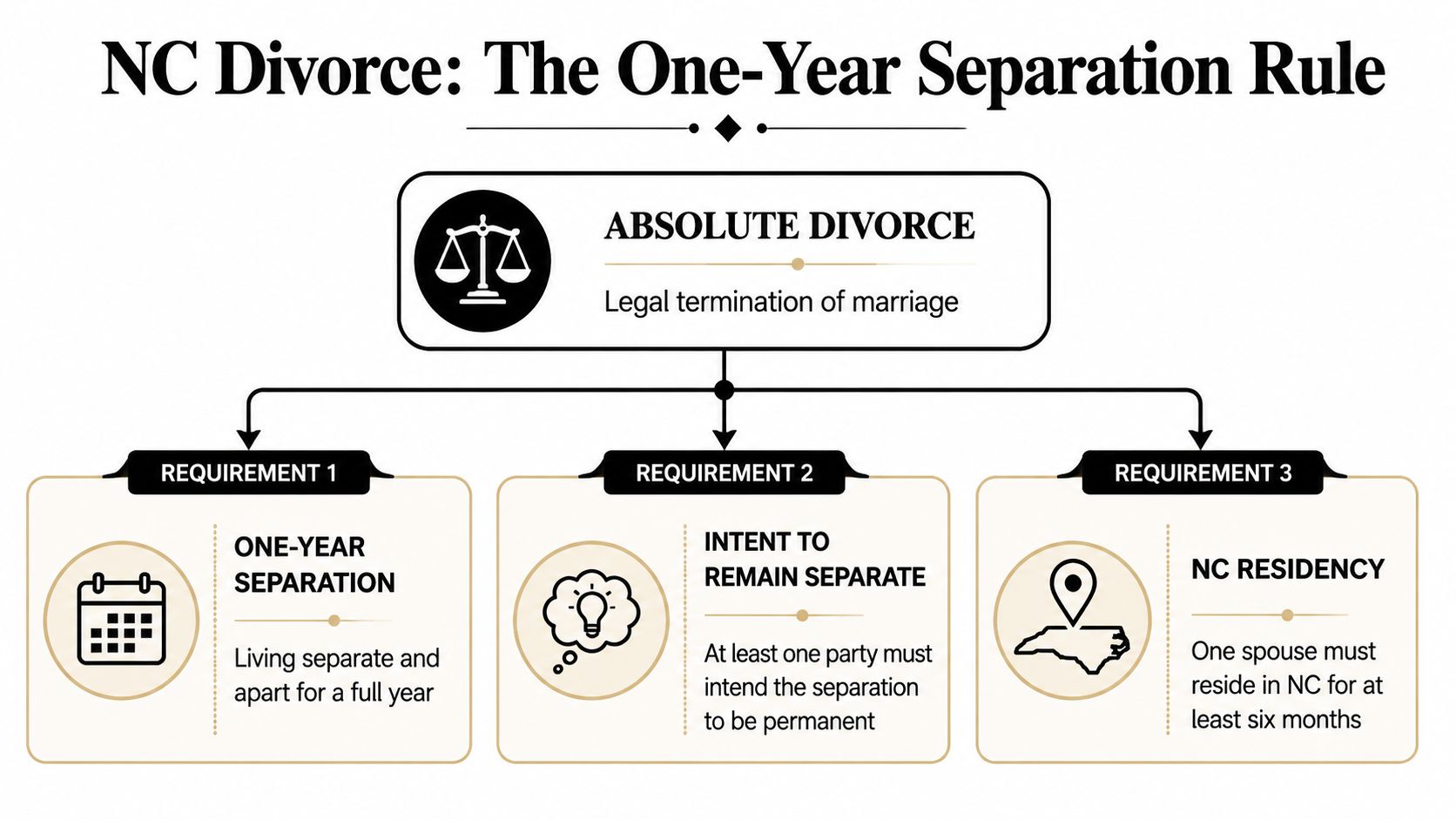
North Carolina is a “true” no-fault divorce state, meaning spouses don't need to prove wrongdoing to dissolve a marriage. The sole statutory ground under N.C. Gen. Stat. § 50-6 requires the parties to have lived separate and apart for at least one year and one day, and that requirement is mandatory and jurisdictional, as explained by Arnold & Smith's discussion of North Carolina no-fault divorce.
What separate and apart means in real life
“Separate and apart” usually means living in different residences. It's not enough to feel emotionally done with the marriage while still living under the same roof. At least one spouse must also intend the separation to be permanent.
That intent matters because North Carolina law isn't looking for a trial separation or a cooling-off period. The court is looking for a genuine marital separation that has lasted long enough to satisfy the statute.
If you want a closer look at how courts and lawyers think about timing, this guide to the one-year separation rule in NC is a helpful companion.
The filing mistake that causes avoidable problems
The timing rule is stricter than many people expect. Filing on day 365 is too early. The complaint must be filed more than one year after separation, which is why lawyers often talk about one year and one day.
Consider a common example. A couple separates on June 1 of one year. One spouse wants to file on June 1 the next year because it feels like a full year has passed. In North Carolina, that filing is premature. Waiting the extra day avoids an automatic dismissal problem that creates delay and needless expense.
File too early, and the court can't fix it by agreement. Even cooperative spouses can't waive the statutory waiting period.
Why planning during separation matters
The one-year waiting period doesn't mean you should put everything else on hold. In many cases, that period is when the important work gets done.
A separation period is often the right time to address practical issues such as:
- Property arrangements: Who stays in the home, who pays which bills, and how accounts are handled.
- Support issues: Whether one spouse needs temporary financial help before the divorce is final.
- Parenting structure: Where children live, how exchanges work, and how decisions are made.
For some families, a written Separation Agreements in North Carolina document can resolve property, support, and custody while the spouses are still legally married but living apart.
How Marital Fault Still Shapes Your Divorce Outcome
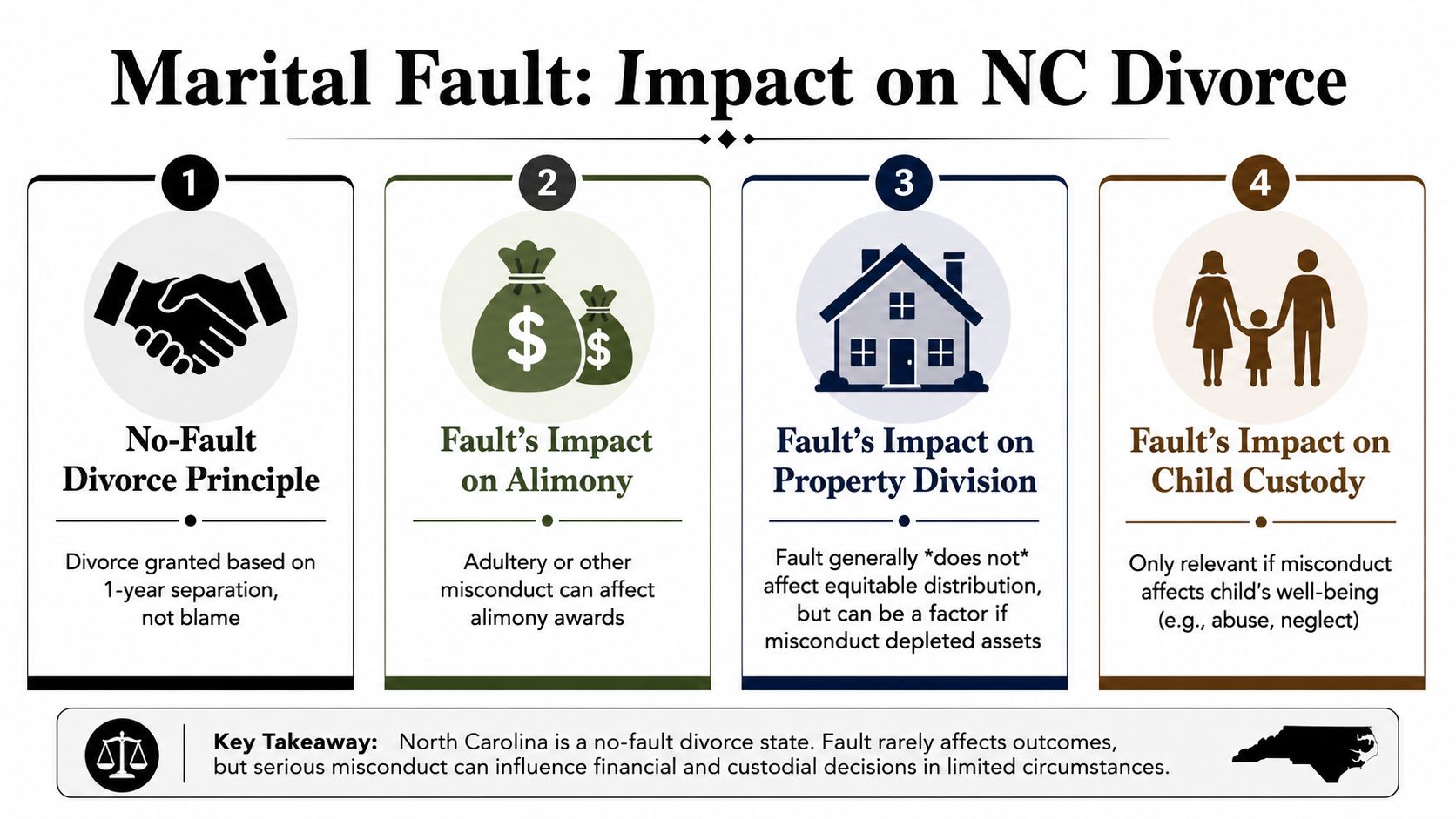
A lot of spouses walk into my office with the same assumption: if North Carolina is a no-fault divorce state, an affair or other misconduct should not matter. That is only partly true. North Carolina uses a dual-track system. One track governs whether the court will grant the divorce itself. A separate track can affect money, especially alimony and post-separation support.
While fault does not control whether the marriage can be dissolved, marital misconduct can still carry real legal consequences. Conduct such as “illicit sexual behavior” is a statutory factor under NC statute § 50-16.1A(3) in alimony cases. That distinction is described in Caulder & Valentine's explanation of no-fault divorce in North Carolina.
The dual-track system in plain English
Here is the practical breakdown:
| Issue | What the court looks at |
|---|---|
| Can the marriage be ended | Whether the legal requirements for absolute divorce have been met |
| Who may receive support | Financial need, ability to pay, and any marital misconduct recognized by statute |
That means a spouse does not need to prove adultery to get divorced. But adultery may become one of the most important facts in the case if either side is asking for alimony.
This catches people off guard.
A common example helps. One spouse spent years out of the workforce raising children and now depends on the other spouse financially. If the supporting spouse had an affair, that fact may significantly affect the alimony analysis. Change the facts, and the result can change too. If the dependent spouse engaged in illicit sexual behavior, that can damage or even bar an alimony claim depending on the circumstances.
That is why fault evidence still matters in many so-called no-fault cases. Text messages, emails, bank records, travel records, and witness statements may have little to do with getting the divorce judgment signed. They may have a great deal to do with whether support is paid, denied, or contested on better terms.
Important distinction: No-fault answers how the marriage ends. It does not answer who pays support, who receives support, or how a party's negotiating position may change in settlement discussions.
Where divorce from bed and board fits
North Carolina also recognizes divorce from bed and board under N.C. Gen. Stat. § 50-7. Despite the name, it does not end the marriage. It is a fault-based remedy that can result in a court-ordered separation.
In the right case, it can affect who remains in the home, how misconduct is framed early in the case, and how settlement discussions develop. It is not appropriate in every divorce, and it is not a substitute for absolute divorce. Still, it remains part of the larger North Carolina family law system and can matter when one spouse has been abandoned, forced out, or subjected to conduct covered by the statute.
What helps and what causes problems
Some decisions improve a client's position early. Others make the case harder than it needs to be.
- What helps: preserving evidence, keeping dates straight, and reviewing support claims before finalizing the divorce
- What causes problems: assuming an affair is legally irrelevant, deleting communications, or discussing sensitive facts in texts and social media posts
- What requires legal judgment: deciding whether to assert alimony, post-separation support, or fault-based claims early enough to protect them
If you are weighing options, the right path depends on the facts. Some cases are resolved through private agreement. Others require court action to protect support rights or respond to misconduct allegations. The Law Office of Bryan Fagan handles North Carolina family law matters including divorce, support, custody, and equitable distribution.
Navigating the NC Divorce Process Step by Step
Even when a divorce is uncontested, the procedure has to be done correctly. North Carolina courts expect specific paperwork, proper service, and careful attention to timing.
At least one spouse must meet a strict six-month residency period in North Carolina before filing for divorce under N.C. Gen. Stat. § 50-8. The statewide filing fee for the complaint is $225, plus a $30 sheriff service fee, as noted in Monroe Family Law's discussion of North Carolina divorce requirements and rates.
Here's a visual overview of the process:

The basic filing path
A typical absolute divorce case follows this sequence:
- Live separately long enough: The statutory separation period must be complete before filing.
- Prepare the complaint: The filing spouse submits a Complaint for Absolute Divorce. A verified complaint means the party signs it under oath.
- Issue and serve the summons: The other spouse must receive formal legal notice.
- Wait for the response period: The receiving spouse has an opportunity to answer.
- Request the divorce judgment: If the paperwork is in order, the court can enter a judgment of absolute divorce.
- Receive the final decree: The marriage is legally terminated.
A real-world way to think about it
Take a couple who separated, one spouse remained in North Carolina, and neither wants a courtroom fight over the divorce itself. Even in that relatively calm situation, several details still matter.
The filing spouse has to use the correct separation date. The complaint has to be verified. Service has to be completed properly. If there are unresolved claims for support or property, those issues need attention before the judge signs the final divorce judgment.
This short video gives a practical overview many people find useful before they begin:
Uncontested doesn't always mean simple
An uncontested divorce usually means the spouses aren't fighting over whether the divorce should be granted. It doesn't necessarily mean they have safely handled everything else.
Watch for these pressure points:
- Financial claims: Alimony and property claims may need to be filed before the divorce judgment is entered.
- Service problems: If the other spouse isn't served correctly, the case can stall.
- Date disputes: If the separation date is challenged, the court may need proof.
A clean filing process lowers stress. It doesn't replace legal strategy.
Faults Role in Property Division and Child Custody
People often assume fault affects every issue in divorce. It doesn't. North Carolina treats property division and child custody differently from alimony.

Property division usually turns on finances, not blame
North Carolina uses equitable distribution to divide marital property. In plain English, that means the court divides marital assets and debts in a way the law considers fair. Fair doesn't always mean emotionally satisfying, and it usually doesn't mean the judge is assigning moral blame.
A spouse's affair, standing alone, generally doesn't decide who gets what property. What can matter is conduct that affected the marital estate itself. If one spouse used marital funds in a way that depleted shared assets, that can become part of the property analysis. For a basic overview of the concept, see this explanation of what equitable distribution means in North Carolina.
Custody turns on the child's well-being
Child custody follows a different standard. Courts focus on the best interest of the child. A parent's private misconduct isn't automatically decisive.
A judge is more likely to care about conduct when it affects parenting or child safety. Examples include behavior that exposes a child to instability, neglect, or harmful conflict. By contrast, a judge usually isn't deciding custody to punish an adult for being a bad spouse.
A useful way to separate the issues
When clients feel overwhelmed, it often helps to sort the case into three questions:
- Alimony question: Did marital misconduct affect support rights or exposure?
- Property question: Did either spouse mishandle or deplete marital assets?
- Custody question: Does any conduct affect the child's best interests?
Those are related questions, but they aren't interchangeable. Treating them as if they all rise and fall together is one of the most common strategic mistakes in North Carolina divorce cases.
Common Questions About NC No-Fault Divorce
Can I date during the one-year separation
You can date during separation, but that doesn't mean it's harmless. If alimony or post-separation support may become an issue, new relationships can complicate facts, create evidence problems, and inflame settlement discussions. Before making personal decisions that could affect a support claim, get legal advice based on your specific situation.
What if my spouse disputes the separation date
That happens more often than people expect. The court will care about when the separation began and whether at least one spouse intended the separation to be permanent. If the date is likely to be contested, keep records that help establish it, such as lease documents, move-out details, address changes, and consistent communications.
What if we briefly moved back in together
That can create serious timing issues. If spouses reconcile rather than remain separated, the separation period may not be treated the way one or both parties hoped. Before filing, make sure the timeline is legally sound rather than relying on assumptions.
Do I really need a lawyer if the divorce is uncontested
Sometimes people can handle a narrow absolute divorce filing on their own. The danger is that the divorce judgment may cut off claims they assumed could be addressed later.
An absolute divorce decree permanently destroys future claims for equitable distribution or alimony if they aren't asserted in a counterclaim before the judgment is granted, as explained by Charles Ullman's discussion of no-fault divorce and related claims. That is one of the biggest reasons even “simple” cases deserve careful review.
The easiest divorce paperwork can still produce the most expensive mistake if financial claims aren't preserved.
Protect Your Future with Strategic Legal Guidance
The short answer to “Is NC a no fault divorce state?” is yes. The answer that protects people is more nuanced.
North Carolina makes the divorce decree relatively straightforward if the legal prerequisites are met. The harder part is protecting what comes next. Alimony, property division, separation strategy, and custody concerns don't disappear because the state uses a no-fault system for absolute divorce. In many cases, that's where the actual case begins.
If you're separated, preparing to separate, or worried about what your spouse's conduct means for support, don't rely on labels alone. Get advice specific to North Carolina law, your timeline, and your financial exposure. A careful review now can help you avoid waived claims, premature filings, and avoidable conflict later.
If you're a North Carolina resident facing divorce, the Law Office of Bryan Fagan can help you assess your options, identify risks, and build a strategy for divorce, support, custody, and property issues under North Carolina law. Schedule a consultation to discuss your circumstances and get clear guidance on the next step.