
The urgent question frequently sought is this: How is alimony calculated in NC? Individuals often anticipate a chart, a calculator, or a percentage. North Carolina doesn't work that way.
That uncertainty is frustrating. You're trying to budget for rent, a mortgage, groceries, children, and legal fees, and the answer seems slippery. The hard truth is that alimony in North Carolina is not a plug-in-the-numbers exercise. The useful truth is that judges still follow a real framework, and once you understand it, the process becomes much more predictable than internet calculators make it seem.
Understanding North Carolina Alimony Beyond the Myths
A spouse comes into my office after a separation and asks for the number. What will alimony be each month, and how long will it last? That question makes sense, especially if bills are due and household income has changed overnight.
North Carolina does not answer alimony with a calculator, chart, or fixed percentage. The court decides these cases one at a time under N.C.G.S. § 50-16.3A, based on the facts of the marriage and the finances of both spouses. If you are still sorting out the timing and legal meaning of separation, it helps to understand how legal separation works in North Carolina before focusing on support.
Online calculators create a false sense of certainty because they usually rely on income alone. That is not how alimony is decided here. Judges look first at whether one spouse is dependent on the other for support, whether the other spouse has the ability to contribute, and whether an award is equitable under the circumstances.
Why calculators overlook the central question
In practice, these cases often come down to a needs-based review. I explain it to clients this way: the court is trying to identify the dependent spouse's reasonable budget shortfall and compare it to the supporting spouse's available monthly surplus after reasonable expenses are paid.
That framework is much closer to how courts evaluate alimony than any internet estimate.
Income still matters, of course. But so do recurring expenses, debt service, housing costs, health limitations, child-related responsibilities, and whether the budget being presented is credible. A high salary on paper does not settle the issue if that spouse also carries legitimate expenses. A lower-earning spouse does not automatically receive support if the claimed need is inflated or unsupported.
The court may also weigh sixteen statutory factors when deciding whether alimony is appropriate and, if so, what it should look like. Those factors bring in the parts of life that a simple calculator cannot measure well, including the length of the marriage, the standard of living during the marriage, age, health, education, earning capacity, and marital misconduct where the law allows it to matter.
Internet calculators may give you a number. North Carolina courts want proof. They focus on documented need, documented ability to pay, and the facts that make your case different from anyone else's.
What clients usually need answered first
Before talking about an amount, most clients need clear answers to a few practical questions:
- Am I likely to qualify as a dependent spouse based on my income, expenses, and financial position after separation?
- Am I at risk of paying support if my spouse can show need and I have room in my budget?
- What monthly figure is realistic once the court reviews both parties' actual income and reasonable expenses?
- How long might support last in light of the marriage, work history, health, and future earning potential?
Those answers come from records, not guesswork. Bank statements, pay stubs, tax returns, account statements, and a careful monthly budget usually matter more than any online estimate. A good alimony analysis is less about finding a magic formula and more about building a believable financial picture the judge can use.
Post-Separation Support vs Alimony Explained
Many people use the word "alimony" to describe every kind of spousal support. In North Carolina, that shortcut causes confusion. There are two different concepts that often arise after separation: post-separation support and alimony.
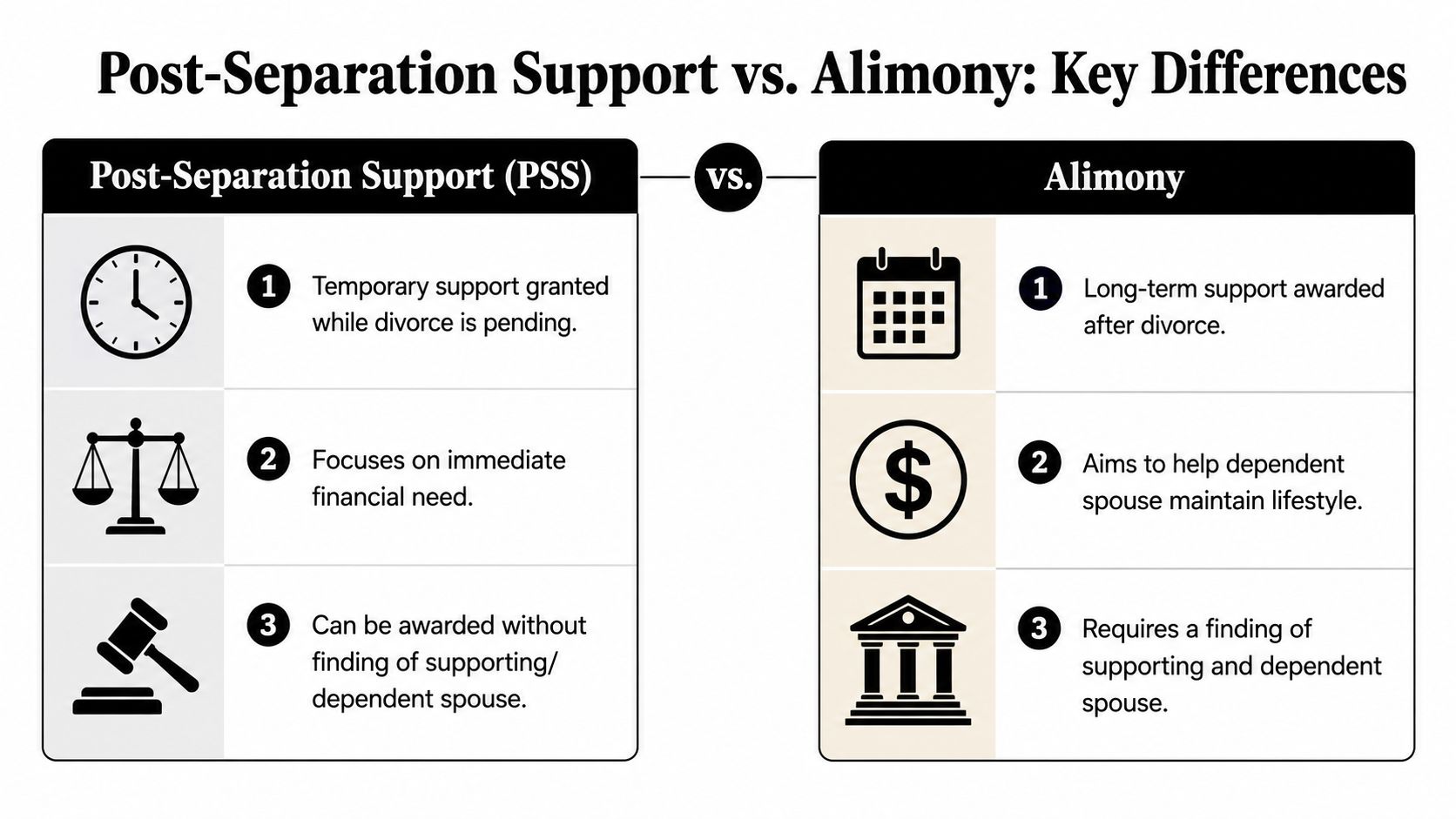
The practical difference
Post-separation support is temporary. It can help a spouse cover immediate living expenses after separation while the larger divorce case moves forward.
Alimony is the longer-term remedy. It addresses support on a more developed record and can be ordered for a set period, in a lump sum, or, in rare cases, on a more open-ended basis depending on the circumstances.
A short comparison helps:
| Issue | Post-separation support | Alimony |
|---|---|---|
| Timing | Early in the separation period | Later, after fuller litigation or agreement |
| Purpose | Short-term help with immediate need | Longer-term support decision |
| Practical role | Bridge while the case is pending | Final support structure after deeper review |
Why this distinction matters in real life
A spouse who has just moved out may need quick help with ordinary monthly bills. Another spouse may be worried about paying too much too soon based on an incomplete picture. Strategy changes depending on which issue is on the table.
If you're still sorting out the legal meaning of living apart, this overview of legal separation in North Carolina can help frame the starting point. In many cases, a negotiated arrangement also matters. A Separation Agreements in North Carolina approach can resolve property, support, and custody without asking a judge to decide every issue.
Temporary support and longer-term alimony aren't interchangeable. Treating them as the same issue can lead to the wrong evidence, the wrong expectations, and the wrong settlement posture.
How NC Judges Determine Financial Need and Ability to Pay
The closest thing to a real calculation in North Carolina is the needs and ability analysis. Many alimony cases are won or lost based on this analysis. A spouse does not receive support merely because the other spouse earns more. The court looks for two things: a genuine financial shortfall on one side and a realistic ability to contribute on the other.
A visual overview helps:
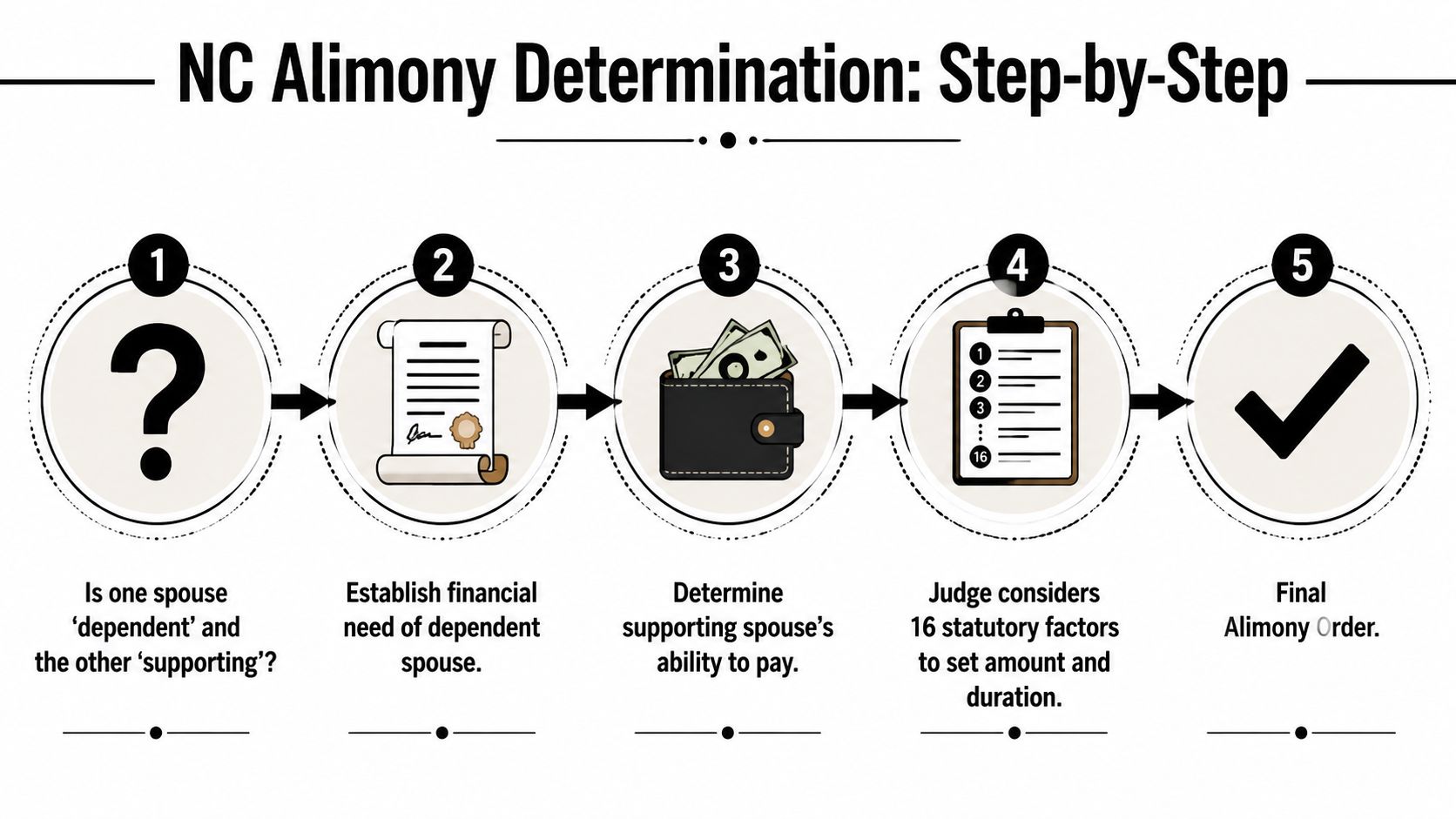
Step one looks at the dependent spouse
The court examines the dependent spouse's reasonable monthly needs and expenses, then compares those expenses to that spouse's net monthly income. If the expenses are higher than the income, the difference is the shortfall.
The true calculation: "The practical calculation method used by judges involves a 'needs and ability' analysis: the court first identifies the dependent spouse's 'unmet needs' (reasonable monthly expenses minus their net income) and then determines the supporting spouse's 'excess income' (income minus reasonable expenses). The final alimony amount is typically the portion of the supporting spouse's surplus that is applied to fill the dependent spouse's deficit." This framework is described by the North Carolina State Bar's alimony guidance.
A simple example shows how this works. Suppose a spouse has reasonable monthly living expenses for housing, food, transportation, insurance, and other ordinary needs. If that spouse's take-home income doesn't cover those needs, the court will focus on the gap, not on a generic percentage.
Step two looks at the supporting spouse
The court then reviews the other spouse's income and subtracts that spouse's own reasonable expenses. What remains is often described as surplus or excess income. If there is no meaningful surplus, the support claim becomes harder. If there is room to pay, the court considers whether some or all of that surplus should go toward the dependent spouse's shortfall.
Inflated budgets often hurt both sides. A spouse seeking support can undermine credibility by listing expenses that don't look reasonable. A spouse resisting support can make the same mistake by exaggerating personal expenses to make income disappear on paper.
For readers who prefer a visual explanation, this video gives additional context on how support issues are approached in North Carolina divorce matters:
What works and what doesn't
The strongest presentations usually share a few features:
- Accurate budgets that reflect real monthly life, not wish lists or artificially stripped-down numbers.
- Clear income proof from payroll, tax records, and other financial documents.
- Consistent testimony that matches the written records.
- Thoughtful explanation of why an expense is reasonable in light of the marital lifestyle.
What doesn't work is assuming the judge will "split the difference" because that feels fair. North Carolina courts expect proof.
North Carolina's 16 Alimony Factors Under N.C.G.S. § 50-16.3A
A lot of people come into my office looking for a number. What they face is a judge reviewing the facts of their marriage through sixteen statutory factors. That is why there is no reliable North Carolina alimony calculator. The court starts with need and ability to pay, then tests that financial picture against the details of the spouses' lives, choices, and future prospects.

Financial factors the court weighs
Several factors focus on money in the practical sense, not just on a pay stub. Judges look at income, earning capacity, unearned income, assets, debts, and each spouse's reasonable financial obligations. They also consider the standard of living established during the marriage, because a support case is tied to how this family lived.
That matters in real cases. A spouse may have a strong salary but little true room to pay after reasonable expenses. Another spouse may show a monthly deficit on paper, but lose credibility if the budget includes inflated or unsupported items. The judge is deciding what is fair based on evidence, not on a formula.
The court can also consider property division and tax consequences. Those issues are separate from alimony, but they often affect settlement value and the court's view of what is equitable overall.
Personal circumstances often drive the result
Two cases with similar incomes can end very differently because the spouses' circumstances are different.
Age, physical condition, mental condition, and emotional health can affect earning ability and the cost of daily life. Education matters too, along with the time needed for the dependent spouse to get training or return to the workforce in a realistic way. A spouse who has been out of the job market for years while raising children is in a different position than someone who can step back into comparable work next month.
Judges also look closely at contributions made during the marriage. If one spouse supported the other through school, accepted career limits to follow relocations, or carried more of the childcare and household responsibilities so the other could advance professionally, that history can matter a great deal. In alimony cases, unpaid contributions often have long-term financial consequences.
Marital misconduct can change the case
Marital misconduct is one of the statutory factors, and it deserves careful treatment. In North Carolina, illicit sexual behavior can have major consequences for alimony depending on who engaged in it and what the evidence shows. Timing matters. Proof matters. Assumptions get people into trouble.
Clients are often surprised by how fact-specific this issue becomes. Text messages, admissions, private investigator evidence, and separation dates can all affect how the court evaluates the claim. A spouse should never assume misconduct will be ignored because the marriage was already in serious trouble.
No single factor controls
Judges do not tally these factors like points on a chart. They weigh them together.
A long marriage may support a stronger claim, but it does not guarantee a large award. A dependent spouse with education and work history may still need support for a period of retraining. A supporting spouse with substantial income may still defeat an inflated request if the evidence shows the claimed need is overstated or the actual surplus is limited.
That is the answer to how alimony is calculated in NC. The court examines budget shortfall, surplus income, and the sixteen statutory factors as a whole. Good preparation means presenting each factor in a way that fits the facts, instead of hoping a calculator will do the work.
How Amount and Duration of Alimony Are Decided
Once the court has reviewed the finances and the statutory factors, the judge decides two practical questions: how much and for how long. There is no official chart for either one.
The amount often grows out of the needs-and-surplus analysis described earlier, but the final number is still discretionary. A judge may order periodic payments, such as monthly support, or a lump sum. The exact structure depends on what is equitable in that case.
The informal rule people hear about
Many North Carolina residents hear a rule of thumb that alimony lasts about half the length of the marriage. There is some practical truth to why that idea circulates, but it is not a rule a judge must follow. As explained in this discussion of alimony duration in North Carolina, payments commonly follow an informal rule of thumb of half the length of the marriage, and in a 20-year marriage a court might informally consider about 10 years of support. That remains discretionary, not binding.
What can lengthen or shorten support
A judge may order a shorter term if the dependent spouse can become self-supporting with time, training, or a return to work. A longer term may be more likely when age, health, or long absence from the workforce makes self-sufficiency difficult.
Here are the termination points people most often need to know:
- Remarriage of the receiving spouse
- Cohabitation of the receiving spouse
- Death of either party
In rare cases, support can be indefinite. More often, the fight is over whether support should be short-term rehabilitative support or a longer obligation based on the realities of the marriage and each spouse's future earning path.
Documents and Evidence You Need to Prepare
Strong alimony claims are built with paper. North Carolina courts expect financial proof, not rough estimates or general statements about who spent what during the marriage. The process requires a formal complaint and detailed financial evidence, including tax returns, pay stubs, and expense records, as discussed in this North Carolina alimony guide.

Gather the documents that prove your story
The court needs to see where money comes from and where it goes. Start collecting records early, before statements disappear or access changes.
- Tax returns help show annual income patterns, business income issues, and deductions that may matter.
- Pay stubs and other income records show current earnings more accurately than memory does.
- Bank statements can confirm spending patterns, cash flow, and ordinary monthly living costs.
- Credit card statements and loan records help document recurring debt obligations.
- Mortgage, rent, utility, insurance, and medical records support the reasonableness of your monthly budget.
Build a careful monthly budget
This part is often harder than gathering documents. A useful budget is specific and credible. It should reflect what you spend to live, not a number designed to shock the other side.
A few practical habits help:
- Use real categories such as housing, transportation, groceries, insurance, medical costs, and debt service.
- Match line items to records whenever possible.
- Avoid vague rounding that makes the budget look invented.
- Separate your expenses from your children's shared expenses where possible, because not every family expense is alimony-related.
If you're preparing for that first case meeting, this checklist on how to prepare for a divorce consultation in North Carolina can help you organize documents before you walk into a law office.
Judges don't award alimony based on guesswork. The spouse with the cleaner records usually has the stronger position, whether seeking support or defending against it.
Frequently Asked Questions About NC Alimony
Can alimony be modified or terminated in North Carolina
Yes, but the answer usually turns on timing, proof, and the wording of the existing order.
A court can modify alimony after a substantial change in circumstances, such as a serious income drop, a job loss, a disability, or a meaningful shift in either party's monthly expenses. The court will want more than a general claim that life got harder. It will look for updated financial records that show what changed and why. If you want a closer look at that process, read this guide to modification of spousal support in North Carolina.
Termination is a separate question. In many cases, alimony ends because of remarriage, cohabitation, death, or the end date written into the order or separation agreement. The specific language matters. I often tell clients to start with the document itself before making assumptions about whether payments stop automatically or require court action.
Is there an alimony calculator for North Carolina
No official calculator exists in North Carolina, and relying on one is one of the fastest ways to misunderstand an alimony case.
Judges do not plug incomes into a fixed formula and get a monthly number. They examine whether one spouse has a real budget shortfall and whether the other has surplus income after meeting reasonable expenses. Then they apply the statutory factors to those facts. Two couples with similar incomes can end up with very different results because debt, health, earning capacity, length of marriage, and marital standard of living can change the analysis.
That is why online estimates often miss the mark. They cannot measure credibility, disputed expenses, uneven income, or whether a claimed budget will hold up in court.
Does education or job training matter in an alimony case
Yes. It can affect both amount and duration.
If a spouse needs education, licensing, or job training to become more self-supporting, the court may weigh how realistic that plan is, how long it will take, and whether the family made career choices during the marriage that delayed that spouse's earning capacity. In practice, this issue often shapes whether support is structured for a shorter rehabilitative period or for a longer term.
The details matter. A vague statement that someone plans to go back to school carries less weight than a specific program, timeline, cost estimate, and work history.
What if my former spouse refuses to pay court-ordered support
A court order is enforceable. If your former spouse stops paying, the court may use contempt and other enforcement tools, depending on the facts.
The first question is usually whether the nonpayment is willful. A spouse who has the ability to pay and chooses not to is in a very different position from someone who has had a legitimate financial collapse and should have asked for modification sooner. Payment records, bank statements, and prior communications often matter here.
Quick action usually helps. Waiting too long can make the arrears problem harder and more expensive to address.
Alimony disputes are difficult because they combine money, personal history, and future uncertainty. They also resist shortcuts. A sound case evaluation depends on records, not guesses, and on how a judge is likely to view your actual need, the other party's ability to pay, and the facts that support or weaken each side.
If you live in North Carolina and need a practical answer about support, the next step is a case-specific review. The Law Office of Bryan Fagan handles North Carolina family law matters, including divorce and spousal support disputes. Schedule a consultation to discuss your finances, your goals, and what a North Carolina court is likely to focus on in your case.