Navigating a North Carolina custody case can be incredibly intimidating. The legal jargon alone is enough to make anyone's head spin. As you face this serious legal matter, it’s crucial to have clear, accurate information. The good news is that the most common outcome, joint custody, is something you can understand and prepare for.
The key is realizing that "joint custody" isn't a single concept. In North Carolina, it’s actually two separate ideas: one about decision-making authority (legal custody) and another about where your child lays their head at night (physical custody). And no, North Carolina law doesn't have a magic formula for a 50/50 split. Every single decision a judge makes comes down to one guiding principle: the "best interest of the child."
Understanding Joint Custody in North Carolina
When a relationship ends, the parenting doesn't. For families in North Carolina, the legal system provides a framework for co-parenting centered on joint custody. The goal is to keep both parents deeply involved in their children's lives, recognizing the value each parent brings.
Let's clear up a huge misconception right away. Many people hear "joint custody" and immediately picture a perfect 50/50 time split. The reality in North Carolina courtrooms is much more flexible and nuanced.
The term actually breaks down into two distinct types of parental rights:
- Joint Legal Custody: This gives both parents the power and responsibility to weigh in on the big-picture decisions for their child. You are essentially co-CEOs of your child's life. You'll need to consult and decide together on crucial topics like schooling, non-emergency medical care, and religious upbringing.
- Joint Physical Custody: This is the parenting schedule—the physical "where" and "when." It doesn't automatically mean a 50/50 split. It can be any arrangement where both parents have significant, meaningful time with the child, structured to fit the child's needs.
Legal vs. Physical Custody: What's the Real-World Difference?
It’s vital to understand that these two types of custody are separate. A judge in North Carolina can award one without the other. For example, it's very common for parents to share joint legal custody (making decisions together) while one parent has primary physical custody (the child lives with them more often), and the other parent has secondary physical custody (a regular visitation schedule).
This table helps break down the practical differences you'll encounter.
Joint Custody at a Glance
| Custody Type | What It Covers | Common NC Scenario |
|---|---|---|
| Joint Legal Custody | Big-picture decisions: education, healthcare, religion, and general welfare. | Parents must consult one another on major issues, like which school the child attends or if they need braces. A parenting agreement might specify who has the final say if they can't agree. |
| Joint Physical Custody | The day-to-day schedule of where the child lives and spends their time. | Parents might share a week-on/week-off schedule, or one parent may have the child during the school week while the other has them on weekends, holidays, and a large portion of the summer. |
Essentially, even if your child lives primarily with your ex-spouse, having joint legal custody ensures you still have a voice in how they are raised. Failing to consult the other parent on a major decision when your court order requires it can land you right back in court. For a deeper dive into the specifics, you can review our full guide on child custody laws in North Carolina.
The "Best Interest" Guiding Principle
Every single decision a North Carolina judge makes about custody is filtered through one powerful lens: the best interest of the child. This isn't just a suggestion; it's the law, written into North Carolina General Statute § 50-13.2.
This statute gives judges wide latitude to look at all the circumstances and create a custody plan that will "best promote the interest and welfare of the child."
A judge’s order will not be based on what is fair to the parents, but on what is best for the child’s development, happiness, and overall well-being. This principle supersedes any agreement or preference the parents may have. We never guarantee outcomes, but we can state that this principle is paramount.
What does this mean for you? Even if you and your co-parent agree on a perfect joint custody schedule, a judge must review and approve it. They will only sign off on it if they are convinced it truly serves your child’s needs. They'll consider everything from each parent's home stability to the child's specific developmental stage and the existing parent-child bond.

How Judges Determine the "Best Interest of the Child"
In every North Carolina custody case, one principle overrides everything else: the "best interest of the child." This isn't just a vague concept; it's a legal standard that a judge must use to decide the future of your family. It’s the lens through which every piece of evidence, every argument, and every proposed schedule is viewed.
So what does that actually look like in a courtroom? The law, specifically North Carolina General Statute § 50-13.2, gives judges the power and responsibility to create a custody arrangement that will "best promote the interest and welfare of the child." Notice the wording—it’s entirely focused on the child, not on what feels "fair" to the parents. This child-centric approach is the absolute foundation of our state's custody laws.
A common client concern is whether a judge will just "rubber-stamp" a parental agreement. While judges give great weight to a plan parents create together, they still have an independent duty to review it and ensure it truly serves the child's best interest before making it a court order.
Factors a Judge Considers
North Carolina law intentionally avoids a rigid checklist. Instead, it gives judges the flexibility to weigh any factor that's relevant to a child's well-being. From our experience in courtrooms across North Carolina, we know that while every case is unique, judges consistently zoom in on a core set of issues to piece together a picture of the child's life.
Think of it this way: a judge is trying to figure out what will provide your child with the most stability, safety, and opportunity to thrive emotionally and physically. They need to see the whole story.
Here are some of the most critical questions a judge will be asking:
- Each Parent's Living Situation: Is the home safe? Is it a stable environment where a child can feel secure?
- The Child's Age and Needs: The schedule for a 3-year-old who needs consistent routines will look very different from the schedule for a 15-year-old with a busy social and academic life.
- The Relationship Between the Child and Each Parent: Who has been the primary caregiver? What is the nature and quality of the bond each parent has with the child?
- Each Parent's Ability to Provide Care: This isn't just about money. It’s about who has the time, the emotional capacity, and the judgment to meet the child's day-to-day needs.
- Any History of Domestic Violence: This is a major red flag for the court. Under North Carolina General Statute § 50-13.2(a), a judge must consider any acts of domestic violence, which can severely limit or even prevent a joint custody arrangement.
- The Child's Adjustment to Home, School, and Community: Judges are very reluctant to disrupt a child's life unnecessarily. Keeping a child in their current school and neighborhood is often a high priority.
A Real-World Scenario
Let's walk through how these factors play out in a real case. Imagine a Raleigh couple, Sarah and Tom, are separating. They both want joint custody of their 8-year-old daughter, Emily.
Sarah has a predictable 9-to-5 job as an accountant. She’s staying in the marital home in Cary, which means Emily would remain in her school, close to her friends and everything she knows. Tom, a freelance graphic designer, has a flexible but less predictable work schedule and has moved into a new apartment in Apex, about 20 minutes away.
A judge won’t simply say, "One schedule is stable, the other is flexible." They'll dig much deeper.
The judge will weigh Sarah’s routine, which provides great consistency during the school week, against Tom’s flexibility, which might make him the perfect parent to handle a sick day or an early dismissal. They will look at the home environments—Sarah’s offers continuity, but they'll want to ensure Tom's new apartment is safe, has appropriate space for Emily, and is in a good neighborhood.
Most importantly, the judge will want to know about their history of involvement. Who has always been the parent to handle doctor’s appointments and teacher conferences? Who helps with homework every night? Testimony about past behavior is often the best predictor of future actions.
In a situation like this, a judge might determine that a 50/50 physical custody schedule isn’t in Emily’s best interest during the school year because of the potential disruption. A likely outcome could be an order granting both parents joint legal custody (to make big decisions together), but giving Sarah primary physical custody during the school week to maintain Emily's stability. Tom might receive a generous schedule with every other weekend, a mid-week dinner visit, split holidays, and half of the summer vacation.
This result isn't about choosing a "winner" or "loser." It's about crafting a practical solution that honors Emily's need for stability while ensuring she maintains a strong, loving relationship with both of her parents.
The Link Between Parenting Time and Child Support
When parents in North Carolina begin discussing joint custody, two topics dominate the conversation: the parenting schedule and child support. In our experience, you can't really talk about one without the other. Your physical custody schedule doesn't just determine when you see your children—it directly and significantly impacts how child support is calculated.
The state’s child support guidelines are built on a common-sense foundation. The parent who has the child more often is naturally shouldering more of the daily costs of raising them—think groceries, utilities, and all the little things that add up. Child support is the system's way of making sure both parents contribute to these costs fairly, based on their income and how much time the child spends in each home.
The 123-Overnight Threshold
If there's one magic number to know in North Carolina child support law, it's 123. This is the number of overnight visits a child must have with a parent each year for the arrangement to be considered "shared custody" for the specific purpose of calculating child support.
Hitting this number is a big deal because it changes the entire formula.
When a parent has the kids for fewer than 123 overnights, the court uses a calculation tool called Child Support Worksheet A. Think of this as the standard worksheet for primary custody situations. It calculates a support amount based primarily on the parents' incomes, with little adjustment for the non-primary parent's parenting time.
But once you cross that 123-overnight line, everything changes. The court can now use Child Support Worksheet B.
Key Takeaway: Worksheet B is designed for true shared parenting. It acknowledges that both parents are managing substantial direct costs because they each have significant time with the child. This worksheet applies a credit that almost always leads to a lower child support payment than Worksheet A would produce.
This is why the calendar can become a battleground in custody negotiations. A schedule with 120 overnights a year has a completely different financial outcome than one with 125 overnights. To see how these worksheets function in detail, our complete guide to child support laws in North Carolina breaks it all down.

How This Shapes Your Custody Negotiations
Because of the 123-night rule, a conversation about the parenting schedule is never just about the schedule—it’s also about money. It’s crucial to understand that adding or subtracting just a handful of overnights around this threshold can swing the monthly support payment by hundreds of dollars.
For this reason, parents and their attorneys spend a lot of time mapping out calendars. A few extra days during the summer or a mid-week overnight every other week can be the difference between using Worksheet A and Worksheet B.
Let’s look at a quick example:
- Parent A drafts a schedule where Parent B has the children every other weekend plus two weeks in the summer, for a total of 110 overnights. Child support would be run on Worksheet A, resulting in a higher payment for Parent B.
- Parent B counters by asking for an additional mid-week overnight and a longer summer visit, bringing their total to 128 overnights. Now, Worksheet B applies, which will likely reduce Parent B's monthly support obligation.
This isn't about trying to game the system. It's about ensuring the final child support order accurately reflects the reality of who is paying for the child's daily needs. A well-crafted custody schedule creates a fair arrangement that recognizes the time, effort, and financial resources both parents are investing in their child's life.
How to Build a Rock-Solid Parenting Plan
A well-thought-out parenting plan is probably the single most important document you will create for your family post-separation. In North Carolina, this isn't just a friendly suggestion—it becomes a legally binding court order. Its real purpose is to provide certainty and cut down on future conflict by forcing you to answer the hard questions now, before they blow up into major arguments.
Think of it like the detailed architectural blueprint for a house. You wouldn't just start building and hope for the best, and you shouldn't try to co-parent without a clear, written guide. This document provides the essential structure for your new family dynamic, making sure everyone knows what to expect. A vague plan is a recipe for future trips to the courthouse; a detailed one is an investment in peace.
The goal is to get past fuzzy statements like "we'll just split the holidays" and dig into the nitty-gritty details that actually prevent fights. A strong plan anticipates where you might disagree down the road and puts a solution in writing today. That foresight is what makes a joint custody arrangement in NC successful.
The Essential Components of a NC Parenting Plan
While every family's needs are unique, any comprehensive parenting plan in North Carolina must cover several core areas to be effective. If you leave these elements vague, you’re creating loopholes that often lead to conflict. A judge will expect to see these issues clearly defined and resolved.
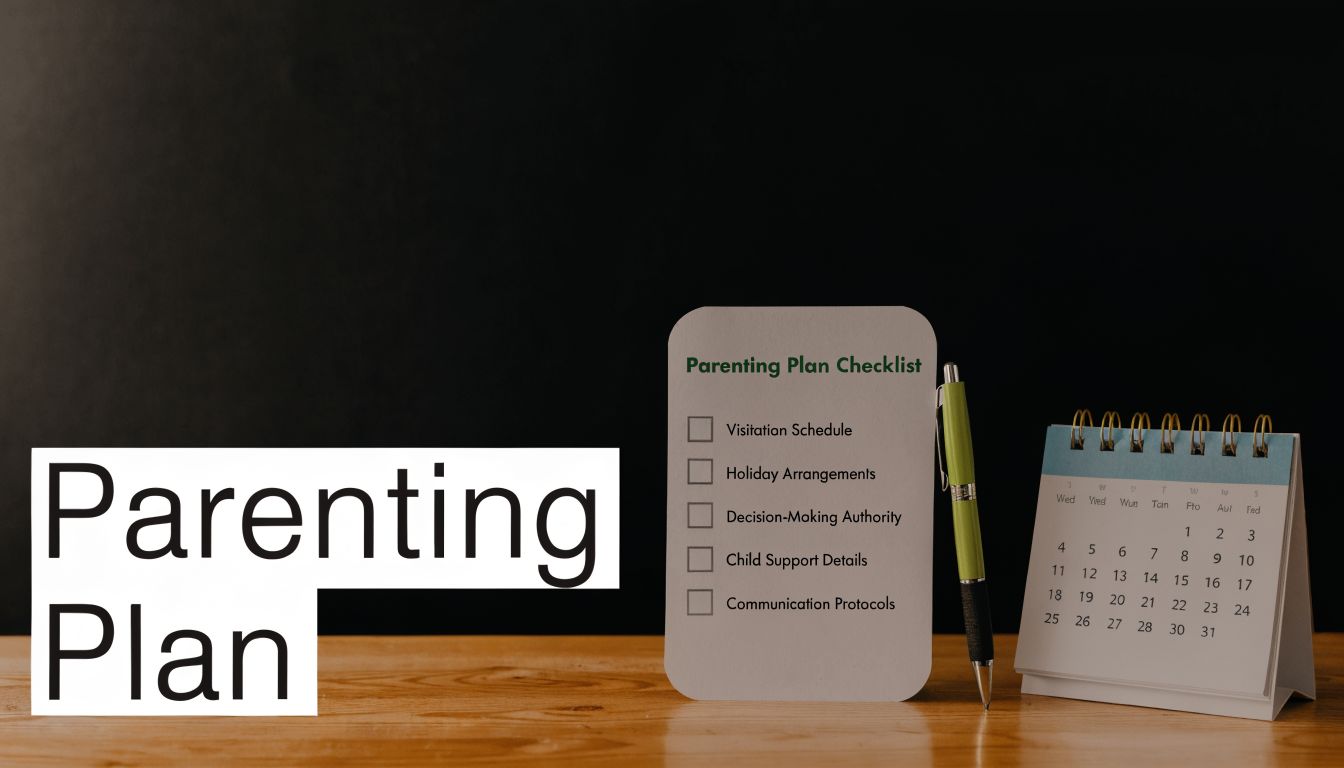
At a minimum, your plan must clearly outline:
- A Detailed Residential Schedule: This is the nuts and bolts of your calendar, showing where the child lives day-to-day. It needs to specify exact pickup and drop-off times and locations to avoid any confusion.
- A Holiday and Vacation Schedule: This section overrules the regular residential schedule. It should cover all major holidays (e.g., Thanksgiving, Christmas), school breaks (like winter and spring break), and the long stretch of summer vacation, specifying which parent has which days in odd/even years.
- Decision-Making Authority (Legal Custody): How will you handle major life decisions about education, non-emergency medical care, and religious upbringing? Will one parent have the final say, or is mutual agreement required for everything?
- Communication Protocols: This sets the ground rules. It dictates how, when, and how often you will communicate with your co-parent and, just as importantly, how you can communicate with your child when they are with the other parent.
Adding Detail to Prevent Future Conflict
The difference between a plan that just gets by and one that truly works is in the details. Taking the time to address potential friction points now will save you an incredible amount of stress and money later. You need to put on your problem-solver hat, imagine future "what if" scenarios, and create the answers for them today.
A huge mistake we see parents make is assuming they'll "just work it out later." We can tell you from experience, when emotions are running high, even the smallest disagreement can feel like a major crisis. A detailed parenting plan makes you have those tough conversations now, with the structure of the legal process to guide you.
Consider adding specific clauses to cover these common battlegrounds:
- Right of First Refusal: If a parent needs childcare for a certain amount of time (for example, more than four hours), are they required to offer that parenting time to the other parent first before calling a babysitter?
- Travel: Can a parent take the child out of state or out of the country? How much advance notice is required, and what information, like flight itineraries and contact numbers, must be shared beforehand?
- Communication with the Child: Get specific about what "reasonable" access means. You could set a specific time for a daily phone or video call (e.g., 7:00 PM nightly) to prevent constant interruptions or arguments about access.
- Emergency Contacts and Procedures: What constitutes a true "emergency" that requires immediate notification? List primary contacts and clarify the procedure for everything from a scraped knee to a trip to the hospital.
- Resolving Disagreements: Build a process for what happens when you hit a wall on a major decision. Will you agree to attend mediation before either of you can file a motion with the court? This single clause can be a powerful tool for staying out of the courtroom.
A Father's Guide to Navigating North Carolina Custody
Let’s be honest. Many fathers heading into a custody case in North Carolina feel like they're starting at a disadvantage. It's a common feeling, and it speaks to a long-held societal bias that can, unfortunately, still surface.
On paper, the law is completely fair. North Carolina statutes are gender-neutral, meaning a judge must base their decision solely on the child's best interest, not the gender of the parent. But what the law says and what happens in practice can feel like two different things. This is where your strategy begins.
Facing the Reality of Custody Trends
While the legal standard is equal, historical patterns and old-school biases can sometimes linger. It’s not something to be defeated by, but it is something you must be prepared for.
A 2018 CustodyXChange study painted a revealing picture. It showed that while fathers across the nation averaged about 35% of custody time, fathers here in North Carolina were awarded only 27.9%. You can read the full analysis of the custody data to get a deeper sense of these state-specific trends.
Don't let that number discourage you. Instead, see it for what it is: a call to be more prepared, more organized, and more intentional. A judge won't know how involved you are unless you show them.
The single most powerful tool a father has is evidence. You can’t just tell a judge you are an involved parent; you have to prove it with a mountain of specific, concrete examples that paint an undeniable picture of your role in your child's life.
Practical Strategies for Fathers Seeking Joint Custody
To build a compelling case for a true joint custody NC arrangement, you need to shift the entire conversation. This isn't about what you want—it's about what your child needs and how you are uniquely positioned to provide it. This is done by proving your involvement and presenting a bulletproof, child-focused plan.
1. Become a Master Documenter
Your memory isn't good enough. You need a written record. Start a log, a journal, or even a private calendar today. This documentation is the foundation of your case.
Every single parental action is a data point. Your log should track:
- The Daily Grind: Every school drop-off and pickup. Every meal you prepare. Every scraped knee you've bandaged, bath you've given, and bedtime story you've read.
- The Big Stuff: Keep a folder—digital or physical—for every doctor's visit you attended, every prescription you picked up, and every parent-teacher conference you joined. Log your emails and texts with teachers and coaches.
- The Fun Stuff: Your involvement in extracurriculars is huge. Are you the one driving to soccer practice? Helping them with their lines for the school play? Cheering them on from the sidelines? Write. It. Down.
2. Present a Plan, Not Just a Plea
Walking into court or mediation and simply asking for "joint custody" is a mistake. You need to hand the judge a solution on a silver platter. Present a detailed, written parenting plan that shows you've thought through every possible detail.
Your proposal isn’t just a request; it's a demonstration of your competence and commitment.
Show them how your work schedule is already structured to accommodate parenting time. Provide photos of the bedroom you've set up for your child in your home. Propose a specific schedule that prioritizes the child’s routine and minimizes disruption to their school and social life.
When you do this, you transform your image. You are no longer just another parent asking for more time. You are a prepared, thoughtful, and engaged parent who has presented a workable, child-centered solution to the court. That is a position that commands respect.
Changing or Enforcing Your NC Custody Order
One thing we know for sure is that life changes. The joint custody arrangement that was perfect when your child was a toddler might feel completely unworkable now that they're a teenager with a packed schedule.
North Carolina family law understands this. That's why there are clear legal paths for parents to either change (modify) or enforce an existing custody order. But it's not as simple as just asking. A judge put that order in place for a reason—to provide stability—so you have to meet a specific legal standard to get it changed.
How to Modify Your NC Custody Order
If you want to formally change your custody order, you'll need to prove to the court that there has been a "substantial change in circumstances" that directly impacts your child's well-being. This is the single most important test for any custody modification in North Carolina.
Think of it as a two-part requirement. First, you must show that a major life change has happened since the judge signed the last order. Second, you have to connect that change to your child and explain why, because of it, the current order is no longer in their best interest.
So, what does a "substantial change" actually look like? It's not a set list, but here are some common situations that judges often consider:
- A parent is relocating. A move across town might not be enough, but a move to another county or state that makes the current schedule impossible certainly is.
- A major shift in a work schedule. If one parent takes a new job that requires constant travel or overnight shifts, the old schedule may no longer be practical.
- Serious safety concerns arise. This could involve new evidence of a parent's substance abuse, neglect, or exposing the child to a dangerous person or environment.
- The child's own needs have changed. An older child might have sports, after-school clubs, or a strong desire to spend more time with friends, which can make a rigid schedule feel restrictive.
Taking a proactive approach is key. You have to show you are an integral part of your child's life, and that's just as true when modifying an order as it is when first establishing one.
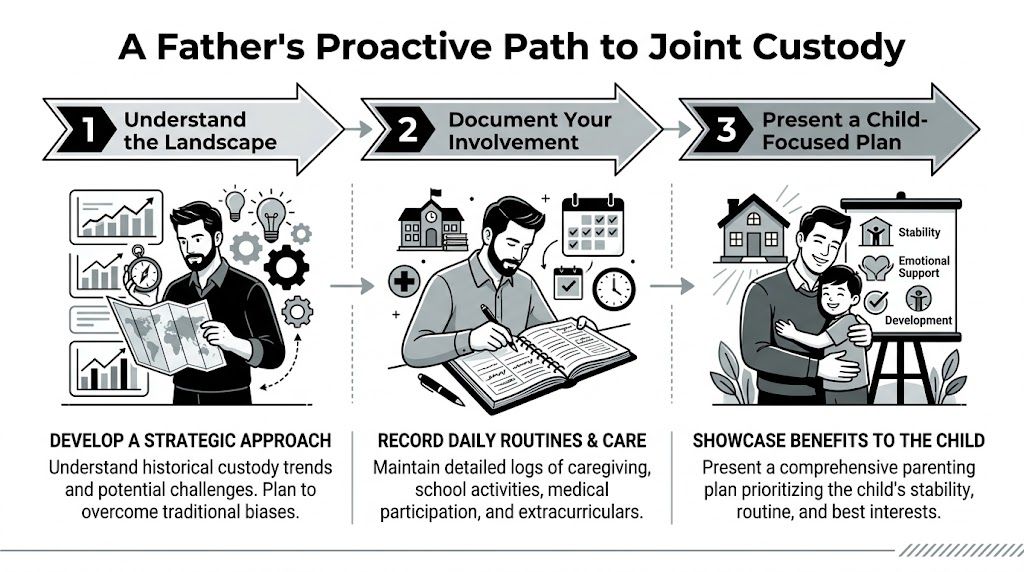
As the graphic shows, being organized, prepared, and always focusing on your child's needs are the principles that apply to any custody action—and they are vital when you're asking a judge to make a change.
How to Enforce Your Custody Order
What if the problem isn't that the order is outdated, but that the other parent just isn't following it? It's an incredibly frustrating situation when your co-parent consistently misses exchange times, denies your court-ordered parenting time, or ignores the rules about making decisions together.
You do not have to put up with it. A custody order isn't a friendly suggestion; it's a direct command from a judge. When one parent ignores it, you can take action by filing a Motion for Contempt. This is a formal request asking the judge to step in and hold the other parent accountable for willfully violating the order.
To prove contempt, you must clearly show the judge three things: there is a valid court order, the other parent knows what the order says, and they willfully chose to disobey it anyway. This is why keeping a detailed log of every violation—dates, times, and what happened—is absolutely essential.
If a judge finds the other parent in contempt, they have a lot of power to set things right. They can order make-up parenting time, force the parent to pay your attorney's fees, issue fines, or even impose jail time for repeated or severe violations. While your case is ongoing, you might also want to look into how to get temporary custody to provide stability for your child in the meantime.
Frequently Asked Questions about Joint Custody in NC
When you're facing a custody case, questions can pile up fast. Here are some straightforward answers to the questions that come up most often for parents in North Carolina.
Is 50/50 Custody the Standard in North Carolina?
No, there is no automatic rule in North Carolina that defaults to a 50/50 custody split. This is one of the most common misconceptions. While many judges prefer to see both parents actively involved, their one and only legal obligation is to make a decision based on the "best interest of the child." An equal 50/50 schedule is definitely an option, and is increasingly common, but it's not a given. The court will look at the reality of your family's life—work schedules, the distance between your homes, the child's age, and other practical factors—to create a schedule that truly works for the child.
Can a Child Decide Which Parent to Live with in NC?
No, in North Carolina, a child cannot make the final decision on where they live. That power rests solely with the judge. However, a judge can listen to what a child has to say. If the child is considered to be of "sufficient age and maturity" to express a preference, the judge may consider it. There's no magic number for that age—it's up to the judge's discretion. The opinion of a thoughtful 14-year-old will likely carry more weight than that of a 7-year-old, but in the end, it's just one factor among many in the "best interest" analysis.
Do I Still Pay Child Support with Joint Custody?
Yes, in almost every case, a child support obligation will still be part of the picture, even with joint physical custody. Sharing parenting time doesn't automatically erase the financial responsibility. Child support is calculated based on both parents' incomes and the number of overnights the child spends with each parent. In North Carolina, when each parent has the child for at least 123 overnights a year, the court uses a specific formula called Worksheet B. This often leads to a lower child support payment than a primary custody arrangement, but it rarely eliminates it completely, especially if there's a significant income gap between the parents.
Get Experienced North Carolina Custody Guidance
The road to a fair and stable joint custody agreement is complex, and it pays to have a deep understanding of North Carolina's laws. You shouldn't have to figure this out on your own. The attorneys at the Law Office of Bryan Fagan are dedicated to protecting your parental rights and fighting for a resolution that puts your child first. We help families across North Carolina get the experienced guidance they need to build a secure future for their children.
If you are a North Carolina resident facing a custody battle, we are here to help. Schedule a consultation with us today to talk about your case and find out how we can help you navigate this challenging time.